Wooden Shaft Umbrellas: OEM Guide for Retail Brands
Retail buyers often underestimate how many small choices determine whether a wooden shaft umbrella feels premium or becomes a return problem: rib count, shaft straightness, fabric tension, handle coating, logo placement, and carton strength all show up in the first shipment. On our Songxia factory floor, wooden shaft umbrellas OEM projects succeed when specifications are locked before sampling, with clear tolerances for materials, branding, packaging, MOQ, and final QC checks.
What Defines a Wooden Shaft Umbrella
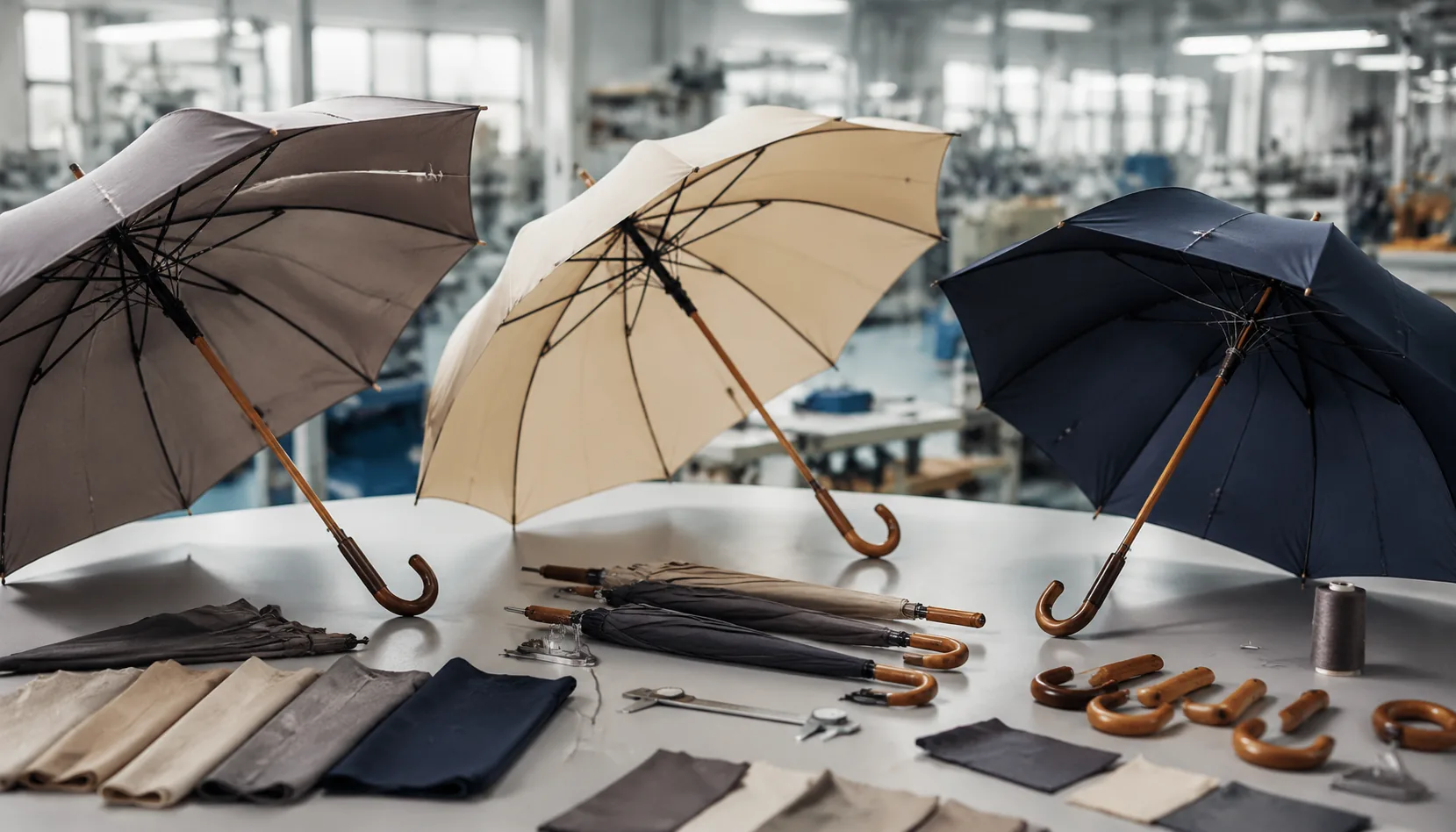
A wooden shaft umbrella is a classic stick umbrella built around one continuous straight center pole, usually 23" or 27" for city and retail use, with 30" reserved for golf-style coverage. Unlike compact folding umbrellas, the shaft does not telescope, so the umbrella feels more rigid in the hand and opens with a cleaner line. In wooden shaft umbrellas OEM projects, the shaft is typically beech, maple, ash, or rubberwood, selected by grain consistency, straightness, and moisture control. A poor shaft will warp after container shipping or crack near the runner stop; a good one is kiln-dried, sanded, stained, and sealed before assembly. This is why classic stick umbrellas still have a place in retail assortments: the customer can immediately feel the structure, weight balance, and finish quality before opening the canopy.
The handle defines much of the product character. Crook handles are the traditional choice for wood handle umbrellas because they hang naturally on a forearm, chair back, or retail display rail. Common options include a one-piece bentwood crook, a laminated wood crook, or a straight shaft with a separately attached hook handle. The runner is normally metal or reinforced plastic with a metal cap, depending on price point, while the ferrule at the top can be nickel-plated steel, brass-look alloy, or color-matched plastic. Rib construction is usually 8K steel for a traditional slim profile, though fiberglass ribs are used when a brand wants better wind recovery. Tips may be metal, plastic, or wood-tone, and they should align cleanly with the canopy seams; mismatched tips are one of the first things retail buyers notice during inspection.
This style suits luxury retail umbrellas and premium gifting because it has visible surface area, a strong silhouette, and fewer moving parts to explain to end users. A 190T or 210T pongee canopy gives a tighter, more refined hand feel than basic polyester, while Teflon water-repellent treatment or UPF 50+ coating can be specified without changing the traditional look. For branding, screen printing works well on solid panels, heat transfer handles detailed logos, and woven labels or engraved handle plaques make the umbrella feel less promotional. As a straight umbrella manufacturer, we usually recommend manual open for heritage ranges and auto-open only when the retail brief demands convenience. For wooden shaft umbrellas OEM orders, the key control points are shaft straightness, handle bonding strength, runner smoothness, ferrule crimping, and canopy tension under AQL 2.5 inspection.
Canopy Size, Rib Count, and Frame Strength
For wooden shaft umbrellas OEM programs, the most common retail sizes are 23-inch and 25-inch straight models. A 23-inch canopy usually finishes around 102–105 cm arc width, making it suitable for daily city use, department-store private label, and promotional gifting where carton weight matters. A 25-inch model gives roughly 110–113 cm arc width and looks more premium on the floor, especially for classic stick umbrellas with crook wood handles. The larger size also needs tighter fabric control: 190T pongee is acceptable for mid-range goods, but 210T pongee cuts cleaner, carries solid-color dyeing better, and reduces puckering around the crown when tension is high.
Rib count changes both appearance and factory cost more than many buyers expect. An 8K frame is the standard for wood handle umbrellas because it opens round enough, keeps the profile clean, and controls weight. A 16K layout gives a fuller, more architectural canopy with smaller fabric panels, which is attractive for luxury retail umbrellas, but it adds rib material, more sewing operations, and longer assembly time. On the production line, 16K also means twice the rib-tip alignment points, so poor panel cutting shows immediately as uneven scallops. For retail brands, I usually recommend 8K for volume SKUs and 16K only when the product brief clearly needs a heritage or premium look.
Steel ribs remain the lowest-cost choice and give a crisp opening feel, but they bend permanently if a customer forces the umbrella in gusty weather. Fiberglass ribs cost more but recover better after inversion, so they are the safer choice for 25-inch canopies or regions with frequent wind. A practical specification for a straight umbrella manufacturer is a wooden shaft, metal runner, 8K fiberglass ribs, and nickel-plated or black electroplated stretchers; this balances strength and retail price without making the umbrella feel nose-heavy. Our standard practice at ZheBrella is to check open diameter, rib symmetry, runner lock force, and tip tension under AQL 2.5 before packing, because frame imbalance is much easier to prevent than repair after FOB shipment.
Fabric and Weather Performance Choices
For wooden shaft umbrellas OEM projects, the canopy fabric choice matters more than the wood finish because premium retail buyers notice hand feel, drape, and drying speed before they notice the shaft. 190T pongee is the common baseline for wood handle umbrellas: it is lighter, softer in the hand, and packs neatly on classic stick umbrellas with 21-inch or 23-inch frames. 210T pongee has a tighter weave, better opacity, and a slightly richer surface, which is why luxury retail umbrellas usually spec it when they want the canopy to look fuller under retail lighting. Polyester can be cheaper and easier to source at scale, but it usually feels stiffer, prints differently, and shows water marks more clearly unless the finish is controlled well. For a straight umbrella manufacturer supplying premium accounts, I would treat 190T as acceptable for mid-tier programs and 210T as the safer standard for retail lines that need a more polished first impression.
Water-repellent performance is not just about spraying on a coating and calling it done. On the factory floor, the real difference is whether the fabric has a durable DWR finish, how evenly it is applied, and whether the sewing holes are held tight enough to prevent seepage at the seams. A good 190T or 210T pongee canopy should bead water quickly after 20 to 30 minutes of rain exposure, then shake dry without leaving a heavy residue. For polyester alternatives, the coating often sits more on the surface and can feel plasticky if the hand-feel target is too low. Optional UPF 50+ backing is worth adding when the product is sold into golf, resort, or commuter programs, but it needs a UV-blocking underlayer or silver-black coating, not just a marketing claim. ZheBrella usually treats that spec as a separate material stack, not a simple print add-on, because the performance has to survive real sun, not just lab labeling.
Colorfastness is where premium lines get rejected if the buyer is not strict enough. For luxury retail umbrellas, I would require at least Grade 4 for dry rubbing and Grade 3 to 4 for wet rubbing, with wash or light fastness checked separately when the canopy uses saturated reds, navy, or black-on-color combinations. Pongee generally holds pigment better than low-grade polyester, especially after repeated folding on classic stick umbrellas with wood handle umbrellas hardware, but the dye recipe and heat-setting process still matter. For wooden shaft umbrellas OEM programs, we also check that the canopy does not bleed onto the wood ferrule or handle wrap during humid storage, because that ruins presentation at the retail shelf. If the buyer wants a premium look, specify 210T pongee, DWR finish, optional UPF 50+ backing, and documented colorfastness targets in the PO; otherwise the product may pass appearance inspection once and fail after one season in the field.
Wood Finish, Handle Branding, and Accessories
Wood finish is where buyers can either make wooden shaft umbrellas OEM look like a real retail product or like a cheap giveaway with a brown handle. For beech, maple, and ash shafts, we usually quote four finish routes: clear varnished, matte lacquer, stained wood, and natural oil-look finish. Gloss varnish gives the highest perceived value and better scuff resistance during carton handling, but it also exposes dust and uneven sanding if the shaft is rushed. Matte lacquer is popular for luxury retail umbrellas because it photographs better and feels less plasticky in hand. Stained finishes let a brand hit walnut, cherry, or ebony tones without paying for those woods, but color control needs a signed master sample because wood grain absorbs stain differently batch to batch. Natural finish works best on wood handle umbrellas with tight grain and minimal knots; otherwise the buyer should accept visible character marks instead of treating them as defects under AQL 2.5.
Handle branding should be chosen by retail channel, not by decoration trend. Laser engraving is the most durable option on curved crook handles and straight handles; it will not peel like pad print, but the mark is subtle unless the wood is stained darker first. Metal badges raise the unit cost, especially when using zinc alloy or brass with plating, yet they suit classic stick umbrellas sold as gift items because the badge remains visible when the canopy is closed. For softer branding, a woven label sewn into the canopy seam or sleeve gives a cleaner look than oversized logos on the shaft. Our standard practice at ZheBrella is to position engraving on the outer curve of the hook handle, verify readability after varnish, and include it in the pre-production sample approval before mass production starts.
Accessories are not afterthoughts on wooden shaft umbrellas OEM; they decide whether the item works for department stores, corporate gifting, or hospitality retail. A matching sleeve can be made from 190T or 210T pongee, with the same fabric lot as the canopy to avoid shade mismatch. Hangtags should specify canopy material, rib count such as 8K or 16K, frame material, UV coating if UPF 50+ is claimed, and care instructions, because customs and retail compliance teams check these details. Gift boxes need drop-test thinking: a slim kraft box is fine for FOB wholesale cartons, while DDP e-commerce shipments usually need a thicker mailer or inner protection around the wood tip and handle. A straight umbrella manufacturer should confirm box length early, especially for 23 inch, 27 inch, and 30 inch classic stick umbrellas, because oversized packaging can increase freight cost more than the handle upgrade itself.
QC, MOQ, Lead Time, and Shipping Considerations
For wooden shaft umbrellas OEM work, the first QC point is not the canopy or the print; it is the wood itself. Retail buyers should approve the wood grain range before bulk production, because beech, maple, ash, and bamboo all show different color bands after staining. A golden-brown curved crook handle can look premium in the sample room but become uneven in mass production if the supplier does not sort by grain and shade. For wood handle umbrellas, we check moisture content before assembly, normally keeping it around 8% to 12% depending on the season, because wet shafts shrink after export and overly dry shafts crack during drilling or riveting. The common failure points are handle splitting at the ferrule, shaft cracking near the runner slot, and lacquer peeling after humidity changes. A good straight umbrella manufacturer should do incoming wood inspection, stain adhesion checks, and torque checks on the handle joint before any canopy is mounted.
Functional inspection should be stricter on classic stick umbrellas than on cheap folding models, because the product is visibly simple and any defect is obvious on the retail shelf. Our standard practice at ZheBrella is to run open-close testing on production samples, usually 300 to 500 cycles for standard retail orders, with extra attention to runner smoothness, spring lock position, rib alignment, and tip seating. Steel ribs are still common for traditional 23-inch and 27-inch wooden shaft models, while fiberglass ribs improve wind recovery but increase cost and change the weight balance. Canopy QC should include fabric count confirmation such as 190T or 210T pongee, coating checks for Teflon water repellency or UPF 50+ when specified, seam strength, panel symmetry, and print registration. Final inspection is normally based on AQL 2.5 for major defects and tighter internal limits for visible wood defects, because scratches, dents, and stain mismatch directly affect luxury retail umbrellas.
MOQ and lead time depend heavily on how custom the wooden parts are. If the buyer accepts existing shaft diameter, crook shape, and stain color, MOQ can often start around 500 to 1,000 pieces per color. A custom carved handle, laser logo, special lacquer, metal badge, or proprietary shaft profile usually pushes MOQ to 1,500 to 3,000 pieces because handle tooling, sanding fixtures, and finishing trials are separate from canopy production. Normal lead time is about 35 to 45 days after sample approval for standard wooden shaft umbrellas OEM orders, while new handle development can add 10 to 20 days before bulk production begins. Carton packing should use individual sleeves, tip protection, moisture-control bags when needed, and 5-ply export cartons to prevent shaft dents during ocean freight. FOB Ningbo or Shanghai is common for experienced importers, while DDP is useful for promotional-product distributors who need landed cost control, especially for mixed cartons or Amazon-style routing.
Frequently Asked Questions
Are wooden shaft umbrellas heavier than metal shaft umbrellas?
They are often slightly heavier than aluminum-shaft models but can feel balanced because the weight is distributed through the straight shaft and crook handle. Final weight depends on canopy size, rib material, and handle design.
Can wooden umbrellas use an auto-open mechanism?
Yes, but many premium wooden shaft umbrellas use manual-open mechanisms for a classic feel and simpler construction. If auto-open is required, buyers should confirm spring strength, runner design, and cycle-test results.
What rib count is most practical for a retail wooden shaft umbrella line?
For most retail programs, 16 ribs balance the classic look, wind stability, and unit cost. An 8-rib frame is lighter and more price-competitive, while 24 ribs are usually reserved for premium collections with a higher target retail price.
Which branding method works best on wooden shaft umbrellas with dark canopy fabrics?
On navy, black, or deep green pongee, white or metallic silk screen printing is usually the most cost-effective and readable option. If the artwork has gradients or multiple colors, heat transfer printing is better, but it raises unit cost and should be checked for panel alignment before mass production.
How should a buyer specify packaging for luxury retail umbrellas to reduce transit damage?
A common export setup is 1 umbrella in a polybag or sleeve, then 12 to 24 pieces per master carton with dividers if handles are lacquered. For gift-ready retail, buyers often request an individual paper wrap or custom box, which usually increases packing time by 3 to 7 days and should be confirmed before sampling.
Looking to Launch Your Custom Umbrella Line?
ZheBrella is a Zhejiang-based OEM/ODM umbrella manufacturer with 17 years of export experience. Free design, low MOQ from 100 pieces, windproof construction, full-color print.
Get Free Quote Now »People Also Search For
Related Articles
Wooden Shaft Umbrellas: Product Specs for Retail Brands
Compare wooden shaft umbrella specs, frame pairings, canopy fabrics, finishes, QC checks, and order terms for premium re...
Read More »
Wooden Shaft Umbrellas: Buyer Guide for Premium Retail
Compare wood shaft, crook handle, pongee canopy, and frame specs for premium umbrellas, with MOQ, QC checks, and FOB/DDP...
Read More »
Wooden Stick Umbrellas for Premium Retail and Hotel Programs
Choose wooden stick umbrellas for hotels and retail with the right shaft, handle, rib material, canopy fabric, logo meth...
Read More »