Wooden Stick Umbrellas: Buyer Guide for Retail Brands
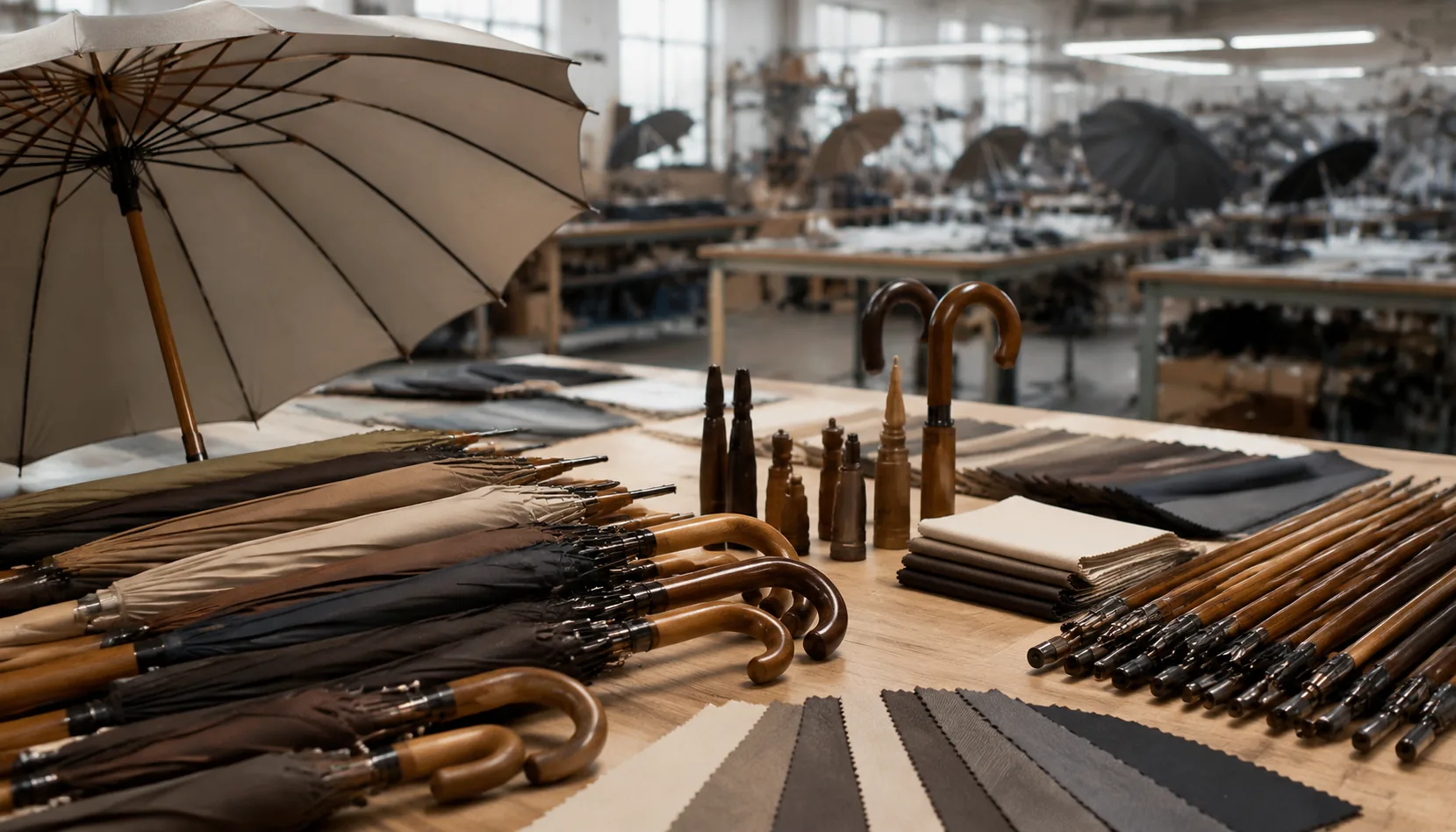
For retail brands, wooden stick umbrellas look simple on a shelf, but small choices in shaft straightness, rib material, fabric shrinkage, and handle finishing decide whether the order feels premium or becomes a returns problem. On our factory floor in Songxia, we check these parts before bulk production because wood movement, plating consistency, and canopy tension can change from sample to shipment. Buyers should compare specs and QC points before locking a private-label order.
Where Wooden Stick Umbrellas Fit in a Product Line
Wooden stick umbrellas fit the premium tier of a product line: higher perceived value, stronger shelf presence, and better brand visibility, but higher freight cost than compact folders. For premium retail, a wooden shaft umbrella with polished maple or beech, a metal runner, and a 190T or 210T pongee canopy presents better than a basic folding model. For hotel guest programs, durability matters more than ornament: coastal resorts and windy-city properties should specify fiberglass ribs instead of plain steel ribs to reduce bent-frame returns from repeated borrowing, lobby storage, and wet returns. Corporate gifting usually needs a clean 1-color screen print on two panels, a branded sleeve, and predictable delivery more than complex hardware. Fashion collections can use special canopy colors, contrast binding, curved wood handles, and custom tips, but the OEM umbrella factory should approve fabric lab dips and wood stain standards before bulk production because dye lots and natural wood tone can shift.
The main retail choices are 23 inch and 25 inch rib lengths. A 23 inch, 8K wooden stick umbrella typically opens to about 102 to 105 cm, fits department-store fixtures and hotel stands more easily, and keeps carton length under better control. A 25 inch frame gives better shoulder coverage for men’s outerwear or two-person hotel use, but it increases carton length, shipping volume, warehouse slotting, and display planning. For any custom stick umbrella, confirm manual open or auto-open before sampling because the spring, runner, and shaft drilling differ. A straight J handle is the retail default because it hangs cleanly and feels familiar, but the curve radius affects both appearance and packing efficiency: too tight looks low-end, while too wide wastes carton space.
Full-length packaging is often the hidden cost in retail umbrella sourcing. These umbrellas cannot compress into small gift boxes, so most ship in long inner cartons with tip protectors, polybags, and either full-length paper sleeves or clear PVC display sleeves. A 23 inch model may pack efficiently in cartons around 88 to 92 cm long; a 25 inch version often needs 95 to 100 cm depending on handle length and ferrule design. Those dimensions affect FOB price, DDP landed cost, pallet use, and store backroom handling. Before bulk cutting, check straight shaft alignment, rib symmetry, handle glue strength, canopy tension, print registration, stain consistency, and sharp points under AQL 2.5. ZheBrella’s practical control point is approving the pre-production sample with final carton dimensions, because a good-looking umbrella still fails the buy if it cannot meet display, freight, or warehouse requirements.
Frame Choices: Wood Shaft, Fiberglass Ribs, or Steel Ribs
For retail wooden stick umbrellas, the shaft choice should start with the customer’s hand feel, not just the product photo. A real wood shaft, usually beech, maple, or ash, gives better warmth in the hand and a more credible premium look for department stores, gift shops, hotel programs, and heritage-style private labels. The tradeoff is control: natural wood must be dried properly, straightened, sanded, stained, and sealed, or it can warp after sea freight or show color variation under bright retail lighting. I would use real wood when the umbrella is positioned above the basic price tier, especially on 23 inch or 27 inch stick models with a curved wooden handle and 190T or 210T pongee canopy. For aggressive price points, a metal shaft with wood-look coating is more stable and easier to keep consistent across 3,000 to 10,000 pieces, but it will not fool a buyer who handles samples side by side.
Fiberglass ribs are the better choice when the umbrella must survive real street use, because they flex instead of taking a permanent bend like low-grade steel. On a classic 8K wooden shaft umbrella, fiberglass ribs with steel or iron stretchers give a good balance: enough flexibility for gusts, but still the traditional stick profile retailers expect. For a stronger windproof story, a double-canopy vented construction with fiberglass ribs can pass practical 50+ mph wind-tunnel checks if the runner, notch, tips, and sewing tension are all specified correctly. Steel ribs still have a place in retail umbrella sourcing, especially for opening-price programs, supermarket promotions, and seasonal displays where cost control is more important than long service life. A steel-rib 8K build can be acceptable, but I would avoid very thin ribs on 27 inch or 30 inch models because canopy load increases quickly in rain and wind.
Most classic stick umbrellas are 8K because eight ribs keep the canopy shape clean, the sewing layout simple, and the landed cost predictable. A 10K or 16K build can look more refined, but it adds rib joints, sewing operations, inspection points, and weight; for many retail brands, the upgrade is not recovered at shelf. If you are developing a custom stick umbrella, specify the frame as a complete system: real wood or coated metal shaft, rib material and diameter, stretcher material, runner type, tip material, and opening mechanism. Manual open is still the safest choice for traditional wooden shaft umbrella programs, while auto-open can work if the spring force is matched to the shaft and handle construction. Our standard practice at ZheBrella is to confirm frame samples before canopy printing, then run AQL 2.5 checks on opening smoothness, rib alignment, shaft straightness, and handle bonding before FOB or DDP shipment.
Canopy Fabric and Finish Options
For retail wooden stick umbrellas, 190T pongee is the cost-controlled baseline; 210T pongee is the premium step when the buyer wants a cleaner drape on an 8K or 10K frame. Both are polyester yarn fabrics, but 210T’s tighter weave gives a smoother hand, denser dye surface, and more even panel tension after sewing. A 190T pongee canopy with a durable water-repellent finish should bead rain in normal city use, but low-grade DWR often wets out first at fold lines, rib-tip contact points, and stitched seams. For a wooden shaft umbrella positioned above entry level, specify stable 190T pongee at minimum, then upgrade to 210T before approving complex decoration. Require rubbing and light colorfastness checks before bulk cutting, especially for bright red and deep purple; black, navy, forest green, and burgundy are lower-risk only when the dye lot is controlled.
Plain polyester can fit low-cost promotional programs, but retail umbrella sourcing needs tighter fabric approval because shine, wrinkling, and seam puckering show quickly on a long wooden frame. Compared with pongee, basic polyester often looks glossier, wrinkles more around panel seams, and exposes needle tension problems after sewing. Screen-printed logos may pass a flat-swatch review, so buyers should check ink adhesion after wet-rub and repeated folding tests. Pongee handles screen print and heat-transfer logos more predictably, which suits a custom stick umbrella with a one-panel mark, border print, or subtle all-over pattern. Avoid heavy plastisol-style prints because they stiffen the canopy and reduce the soft fall expected from a wood handle and shaft. For photographic artwork, use sublimation on white or light 190T/210T polyester pongee and confirm artwork placement against panel cutting before bulk production.
Coated sun-rain fabric is worth specifying only when the retail claim justifies the higher cost and firmer hand feel. Silver, black, or color-matched UV coatings can bring the canopy to UPF 50+, which is most useful for golf, resort, school, and outdoor event umbrellas in 23 inch, 27 inch, and 30 inch sizes where shade coverage affects value. For fashion retail, UPF 50+ may matter less than a slim silhouette, lighter swing, and softer canopy movement. ZheBrella confirms coating side, adhesion, odor, and fold-mark resistance before bulk fabric approval because weak UV coatings can block, smell, or stick together during humid sea freight. A serious OEM umbrella factory should verify spray rating, hydrostatic pressure where required, and colorfastness before assembly, while fabric rework is still possible.
Branding, Handle Finish, and Retail Presentation
Start branding with canopy geometry, then size the logo. A 23" or 27" wooden stick umbrellas program usually has eight printable panels, but live print area depends on rib length, seam allowance, closure strap position, and whether the canopy is 190T or 210T pongee. Use screen printing for one- to three-color retail logos where Pantone control matters; choose heat transfer for gradients or small sponsor marks, accepting the added film feel on lighter fabrics. Sublimation only makes sense on white or very light polyester and should be tested before bulk cutting. Lock the branding layout early: one panel, alternating panels, or all panels changes print fixtures, inspection time, and unit cost. Add woven labels at the closure strap or lower seam for brand marks, care symbols, and country-of-origin information without crowding the canopy artwork.
Treat the wood handle and shaft as controlled appearance parts, not decorative afterthoughts. A wooden shaft umbrella may use maple, beech, ash, or rubberwood depending on target price and finish, and each species absorbs stain differently. Dark walnut stain masks variation; clear lacquer exposes grain, knots, and finger-joint differences. For engraved wood handles, approve laser depth, burn color, logo position, and legibility on production handles from the correct batch. Metal badges can work, but coastal retail programs should consider adhesive failure and corrosion risk. Pre-production samples must define acceptable grain range, stain tolerance, gloss level, engraving placement, strap alignment, and handle color band. Keep the signed PP sample at the assembly line so QC can reject parts that drift before final AQL 2.5 inspection.
Build retail presentation into the quote, not after production starts. Hang tags should show barcode, model name, canopy size, rib count such as 8K or 16K, fabric spec, tested UV claim if using UPF 50+, and wood-handle care warnings. Sleeves should fit the full stick profile without crushed tips or stretched stitching near the ferrule. Gift boxes for 27" models need reinforced end panels because the handle adds weight and impact risk in transit. For retail umbrella sourcing, confirm whether the OEM umbrella factory is quoting plain polybag, printed sleeve, color box, gift box, master carton, or a DDP-ready pack-out; each option affects FOB cost, carton cube, barcode scanability, and freight. Final inspection should check print registration, woven label placement, tag accuracy, sleeve stitching, box scuffing, and handle finish as one retail-ready unit.
Order Specs, QC, and Shipping Considerations
Lock the frame spec before approving artwork for wooden stick umbrellas. Your PO should state rib length in inches, arc in centimeters, rib count, and full frame construction, because a 23-inch straight umbrella can open to different diameters if crown height or fabric tension changes. For most retail programs, 8K is the practical baseline: it lowers unit cost versus 16K, keeps spare parts consistent across lots, and simplifies repairs. Do not stop at “straight umbrella.” List each component: fiberglass ribs, steel stretchers, ferrule finish, vented or non-vented canopy, and target wind performance if relevant. A frame built with fiberglass ribs, a steel stretcher, and a black electroplated ferrule usually gives a better cost-to-durability balance than full steel, especially on vented styles designed for 40-50 mph survival. For any wooden shaft umbrella, also specify wood species when appearance matters and call out finished shaft diameter, typically 14 mm or 16 mm, since that affects weight, hand feel, and carton density.
Canopy and finish details need the same discipline. Specify 190T or 210T pongee for standard fashion programs, or POE, PVC, or EVA for clear canopies, then add color standard, coating, and print method. A custom stick umbrella with Pantone-matched 190T pongee will not print the same way as a full-bleed 210T canopy using heat transfer or sublimation, so panel layout and logo position across 8 panels should be approved before cutting. Handle finish should be written as matte lacquer, gloss varnish, rubberized paint, or stained natural wood, with photo approval for grain if the item targets mid-tier retail. Add measurable tolerances for total length, open diameter, shaft straightness, and net weight per piece, because polished wood can warp if post-finish moisture control slips. Typical pre-production samples take 5-7 days; counter-samples or print strike-offs usually add 3-5 days.
Put QC and shipping terms on the PO, not in follow-up emails. For retail umbrella sourcing, require final random inspection to AQL 2.5 and define the pass-fail checks: open-and-close action, runner lock security, top-notch alignment, stitch consistency, water spray performance, and handle adhesion after carton-drop simulation. MOQ at an OEM umbrella factory is commonly 1,200-3,000 pieces per colorway with standard materials; below that level, expect shared fabric lots or fewer handle finish options. Bulk lead time is typically 35-50 days after deposit and sample approval, with longer timing if you add custom ferrules, engraved nameplates, or FSC-documented wood parts. FOB Ningbo is usually the cleanest term for experienced importers, while DDP gives smaller brands clearer landed-cost control. Ask for carton dimensions, pieces per carton, and container loading data early, because straight wooden stick umbrellas consume cube quickly and can change freight cost per unit more than buyers expect.
Frequently Asked Questions
Are wooden stick umbrellas heavier than metal-shaft umbrellas?
Usually yes, especially with real wood shafts and J handles. Buyers should request finished unit weight and carton weight before approving retail or airline-sensitive orders.
Can wooden stick umbrellas be made windproof?
They can be improved with fiberglass ribs and reinforced runners, but they are not usually as compact-windproof as double-canopy golf umbrellas. Specify the target wind test or open-close cycle test in the QC plan.
What MOQ should retail brands expect for custom wooden stick umbrellas?
For OEM wooden stick umbrellas, a typical MOQ is 500-1,000 pieces per design, depending on canopy fabric, logo method, and handle finish. Custom dyed fabric, special wood stains, or retail packaging may require a higher MOQ.
Which rib materials are most common for wooden shaft umbrellas?
Retail wooden stick umbrellas usually use fiberglass ribs for better wind resistance or metal ribs for lower cost. Fiberglass ribs are preferred for mid-range and premium retail lines because they reduce breakage during repeated opening and closing.
What QC points matter most before approving bulk production?
Buyers should check shaft straightness, wood finish consistency, rib tension, canopy stitching, fabric water repellency, logo position, and opening/closing smoothness. A pre-production sample and inline inspection are recommended before mass production begins.
Looking to Launch Your Custom Umbrella Line?
ZheBrella is a Zhejiang-based OEM/ODM umbrella manufacturer with 17 years of export experience. Free design, low MOQ from 100 pieces, windproof construction, full-color print.
Get Free Quote Now »People Also Search For
Related Articles
Wooden Shaft Umbrellas for Retail: OEM Buyer Guide
Source wooden shaft umbrellas with clear specs for canopy fabric, ribs, handle finish, auto-open parts, MOQ, and retail-...
Read More »
Wooden Stick Umbrellas: OEM Buyer Guide for Premium Orders
Compare wooden shaft, steel, and fiberglass stick umbrella specs, from 8K ribs and 190T pongee to MOQ, AQL 2.5 checks, a...
Read More »
Wooden Stick Umbrellas: Buyer Guide for Premium Lines
Source premium wooden stick umbrellas with proper shaft, ribs, pongee fabric, handles, packaging, AQL 2.5 checks, MOQ, a...
Read More »