Airport Gift Shop Umbrellas: Compact Specs That Sell
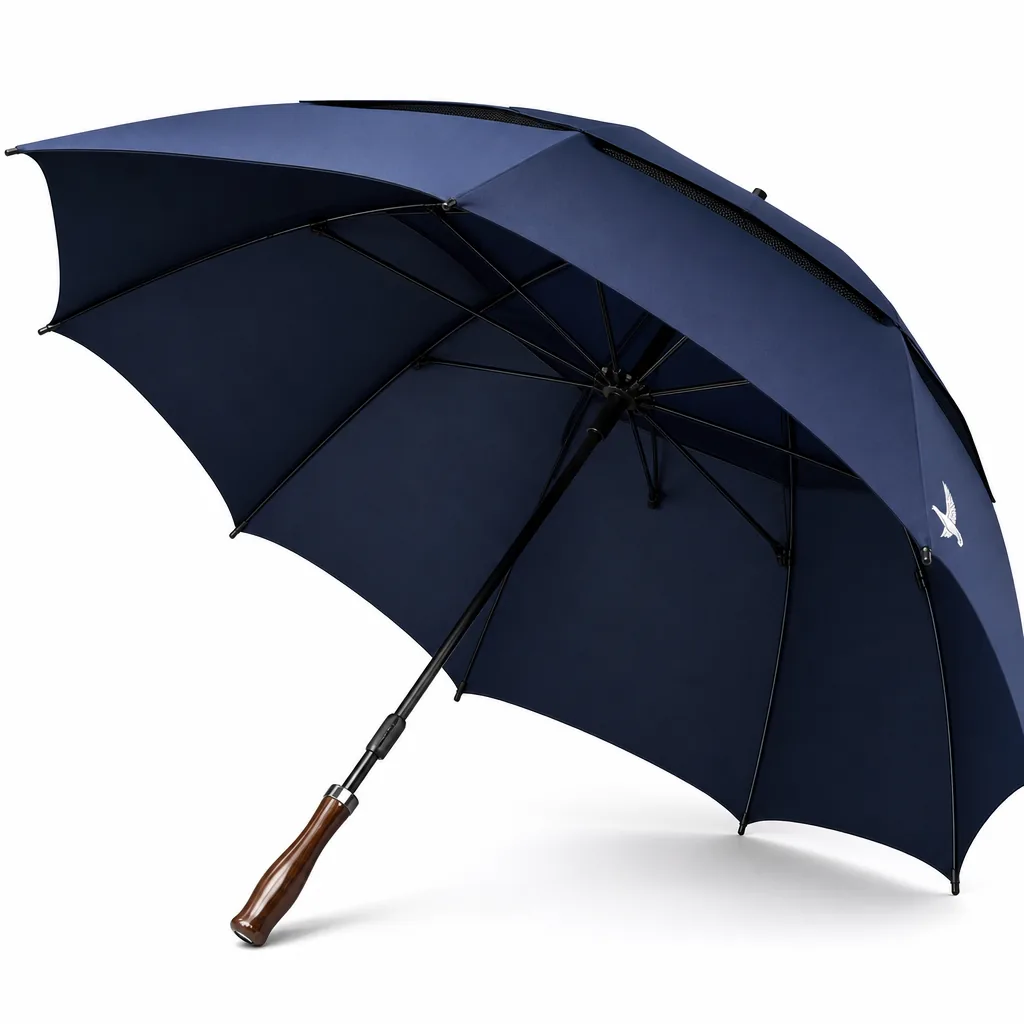
Airport buyers need compact umbrellas that look giftable, scan cleanly at checkout, and survive being opened in a jet bridge wind gust. On our Songxia production floor, airport gift shop umbrellas usually win or lose on small spec choices: rib material, shaft play, fabric drying time, sleeve fit, barcode placement, and carton cube. Getting those details right early keeps landed cost predictable whether you buy FOB Ningbo/Shanghai or need DDP delivery.
Design for Travelers, Not General Retail
Airport gift shop umbrellas have to solve a luggage problem first and a rain problem second. A 21" 8K three-fold frame is usually the sweet spot: about 10.5–11.5" folded length, 11–13 oz finished weight with fiberglass ribs, and enough open arc for one adult moving between taxi stand, terminal curb, and hotel entrance. I would avoid heavy 23" steel-frame models for this channel unless the buyer specifically wants a premium boxed item; they feel sturdy in hand, but they punish travelers who are already managing a carry-on and laptop bag. For compact retail umbrellas, the better spec is a black aluminum shaft, fiberglass/steel mixed ribs, and an auto-open-close mechanism tested for at least 500 cycles before shipment.
Fabric choice matters because airport buyers hate returns caused by wet sleeves leaking inside bags. 190T pongee with a Teflon water-repellent finish dries faster than cheap polyester, folds cleaner, and handles screen printing or heat-transfer logos without the sticky hand-feel that low-grade coatings create. For branded travel umbrellas, we normally keep the canopy around 38–41" open diameter, add a 6–7" elastic wrist strap, and use a sleeve with a slightly wider mouth so customers can pack the umbrella quickly after one shake. A tighter sleeve looks neat in the sample room but becomes a complaint at the gate when the canopy is still damp.
Point-of-sale handling should be part of the umbrella import specs, not an afterthought. A sleeve width under 2.25", hang tag with barcode, and carton layout of 12 inner / 48 outer usually works well for airport gift shop bins and spinner racks without crushing the canopy tips. If you are sourcing through a travel umbrella supplier, ask for drop-test packaging, AQL 2.5 inspection on mechanism function, and a folded-length tolerance of ±0.25" because small deviations affect shelf fit. Our standard practice at ZheBrella is to confirm the actual sleeve-packed size from production samples, not just the frame catalog, before quoting FOB Ningbo or DDP delivery.
Pick Compact Frames That Survive Repeat Use
For airport gift shop umbrellas, the first decision is the frame, not the print. A 3-fold steel frame gives the lowest unit cost and a stiff open feel, but once you start closing and reopening it hundreds of times, the weak point is usually the rivets and runner wear, not the canopy. Aluminum shafts cut weight and help compact retail umbrellas stay under carry-on-friendly bulk, but aluminum alone does not fix wind failure. Fiberglass ribs are the real upgrade because they flex instead of creasing; that matters in terminals where customers stuff umbrellas into bags, drop them on tile, and reuse them on the next trip. As a travel umbrella supplier, we normally separate “light to carry” from “durable enough to resell,” because those are not the same spec.
For standard branded travel umbrellas, 8K ribs are the sweet spot. An 8K build keeps the folded profile compact, works well with 21-inch and 23-inch canopies, and gives enough spring resistance for normal city rain without pushing the price into premium territory. If the SKU is meant for souvenir counters or high-volume airport assortments, 8K also keeps packaging simple and helps protect margin after decoration, hangtagging, and cartonization. Once the buyer wants a stronger feel, move up to reinforced 10K or 16K constructions. Those higher rib counts usually pair better with fiberglass tips, thicker stretchers, and a more stable shaft joint, especially on umbrellas that are expected to survive repeated opening in gusty curbside or platform conditions.
The practical rule is to match the frame to the selling point, not the marketing copy. If the umbrella is a low-cost impulse item, a 3-fold steel frame with 8K ribs is usually enough, but the moment the program is positioned as premium airport merch, 10K or 16K becomes a better umbrella import specs choice because it reduces bounce, tip inversion, and return risk. For custom programs, I would rather spend a little more on ribs and shaft geometry than on oversized packaging that looks good but adds no durability. ZheBrella’s standard practice is to lock the frame spec first, then build the print and case around it, because changing rib count later almost always breaks both pricing and lead time.
Specify Fabric, Coatings, and Colorways
Fabric choice is where airport gift shop umbrellas either feel like a useful travel purchase or a disposable counter item. For mainstream compact retail umbrellas, I would specify 190T pongee because it packs tightly, dries faster than cheap polyester taffeta, and gives a cleaner hand-feel under fluorescent retail lighting. For premium assortments, step up to 210T pongee; the denser weave holds dye better, resists pinholes during sewing, and looks less wrinkled after repeated open-close handling by shoppers. I would avoid very shiny low-denier polyester for airport racks because it telegraphs low value, especially next to luggage, headphones, and branded neck pillows. If you are comparing offers from a travel umbrella supplier, ask for actual fabric weight, yarn count, and colorfastness data, not just “pongee” written on a quote sheet.
A durable water repellent finish should be standard on airport gift shop umbrellas, not an upsell. Basic DWR helps rain bead and roll off, which matters when travelers shake the umbrella before entering a terminal, taxi, hotel lobby, or rental car. For higher-priced branded travel umbrellas, add a Teflon-type water-repellent treatment or equivalent fluorine-free DWR if your retailer has chemical compliance restrictions. UPF 50+ is worth specifying for warm-weather airports, cruise terminals, resort cities, and outdoor event destinations, but it needs to be tested on the finished dark fabric, not assumed from the coating supplier’s brochure. Our standard practice at ZheBrella is to confirm coating performance after canopy cutting and sewing because needle holes, heat-transfer logos, and seam tension can affect final water resistance more than buyers expect.
Colorways should be practical, not just pretty. Black, charcoal, navy, deep forest, burgundy, and dark gray hide scuffs from carry-on bags, airport floors, and wet sidewalks better than white, beige, or bright yellow. A compact travel umbrella in a dark neutral also works for business travelers, tourists, airline crew, and hotel guests, which keeps sell-through more stable than seasonal fashion colors. If the program includes branded travel umbrellas, use one or two accent panels, a sleeve print, or a small heat-transfer logo instead of a full loud canopy unless the shop targets events or destination souvenirs. Good umbrella import specs should define Pantone references, acceptable shade tolerance, print method, coating type, and whether the sleeve fabric matches the canopy, because mismatched sleeves are one of the fastest ways to make a retail display look cheap.
Plan Retail Packaging and Logistics
Packaging decides whether airport gift shop umbrellas look like a $9.99 emergency item or a $24.99 travel accessory. For compact retail umbrellas, I prefer a tight 21" or 23" 3-fold unit with a woven sleeve, not a loose polybag, because travelers handle the product before buying and messy sleeves kill perceived value. Hangtags should state the real umbrella import specs: canopy diameter, folded length, weight, rib count such as 8K fiberglass or steel, fabric like 190T pongee, coating such as Teflon water repellency or UPF 50+, and mechanism type. Barcode stickers need GS1-compliant EAN/UPC placement on the tag back or sleeve label, not stuck across the logo. For branded travel umbrellas, put the retail story on the hangtag and keep the canopy clean; airport buyers dislike overprinted products that only fit one season or promotion.
Counter display cartons matter because many airport shops have shallow fixtures and no stockroom patience. A good display carton for airport gift shop umbrellas holds 12 or 24 pieces, opens cleanly at the perforation, and shows the sleeve color, logo, and barcode without staff unpacking every unit. For a 21" compact, we commonly plan an inner carton around 12 pcs and a master carton of 48 or 60 pcs, keeping gross weight near 13–17 kg so one person can move it safely. If the umbrella has an auto-open-close shaft, EVA handle, or heavier 210T pongee canopy, carton count may need to drop because crushed handles and bent tips create avoidable AQL 2.5 failures. Our standard practice at ZheBrella is to confirm carton drop-test strength after final sleeve and hangtag approval, because a pretty display box that collapses in export transit is not retail-ready.
FOB and DDP serve different buyers, and choosing wrong creates hidden cost. FOB Ningbo or Shanghai works best when the importer already controls freight, customs brokerage, and warehouse receiving; the factory quotes product, export carton packing, and local port charges, while the buyer manages vessel or air freight. That gives better control on larger seasonal buys, usually 1,000–5,000 pcs per SKU, especially when combining umbrellas with luggage tags, rain ponchos, or other travel goods. DDP is cleaner for replenishment programs because the travel umbrella supplier handles freight, duty, customs clearance, and final delivery to the buyer’s warehouse or 3PL. The unit price looks higher, but procurement teams can compare landed cost immediately. For airport gift shop umbrellas, I recommend FOB for initial bulk rollouts and DDP for smaller reorders of 300–1,000 pcs when speed, predictable landed cost, and shelf continuity matter more than squeezing every freight dollar.
Set Sampling, MOQ, and Inspection Rules
Approval samples should be locked before any bulk fabric is cut, especially for airport gift shop umbrellas where a small defect becomes a return at the register, not just a complaint email. I recommend one pre-production sample for each major construction: 21" or 23" compact 3-fold, manual or auto-open-close, steel shaft with fiberglass ribs, and the exact canopy material, usually 190T or 210T pongee with Teflon water-repellent finish. If the order includes branded travel umbrellas, approve the logo on the real substrate, not on a lab swatch; heat-transfer film, screen ink, and sublimation all sit differently on dark navy, black, and high-visibility yellow. Scan labels, hang tags, UPC/EAN placement, polybag warnings, and retail carton artwork should be checked at the same time because airport buyers care about shelf readiness as much as rain performance.
MOQ should be quoted by color and logo position, not only by total order quantity. For compact retail umbrellas, a realistic starting point is often 1,000 to 2,000 pieces per color for stock pongee colors and 3,000 pieces or more for custom-dyed canopy fabric, with logo MOQ depending on whether the print is one-color screen, heat transfer, woven label, or full-panel digital print. A travel umbrella supplier should also separate MOQ for handle color, sleeve print, and carton marks; changing a rubberized handle from black to PMS red can create a separate component run. For normal umbrella import specs, I would plan 7 to 10 days for sampling, then 30 to 45 days for bulk production after sample approval, deposit, barcode files, and packaging dielines are confirmed. Rush orders are possible, but they usually force choices: stock frame, stock fabric, standard sleeve, and limited logo positions.
Inspection needs to be written into the purchase order, not discussed after cartons are packed. Our standard practice at ZheBrella is AQL 2.5 for major defects and tighter internal sorting for functional failures: auto-open-close misfire, runner jamming, bent ribs, weak tips, loose ferrules, crooked stitching, skipped seams, canopy stains, coating streaks, pinholes, and wrong scan labels. For airport gift shop umbrellas, inspectors should open and close a meaningful sample size repeatedly, not just look at the canopy on a table; a compact frame that survives five cycles in inspection is not the same as one that passes a 50-cycle internal mechanism check. Carton checks should include master carton quantity, inner pack count, UPC readability, country-of-origin marking, warning label language, and mixed-color ratio. A failed barcode can block receiving just as badly as a broken rib.
Frequently Asked Questions
What folded length works best for airport gift shop umbrellas?
A folded length around 9 to 11 inches works well for most travel buyers because it fits bags without feeling too small or fragile. Ultra-mini 5-fold models are easier to carry but can feel less sturdy.
Should airport retail umbrellas be manual or auto-open?
Auto-open compact umbrellas feel more premium and are easier for travelers carrying luggage. Manual models reduce cost and weight, making them better for entry-price impulse purchases.
What compact umbrella size works best for airport gift shop shelves?
Most airport retailers choose 3-fold umbrellas around 21 to 23 inches with a closed length of about 9 to 11 inches. This size fits carry-on bags, counter displays, and standard retail peg or shelf packaging.
Can compact umbrellas be supplied with retail barcodes and hang tags?
Yes. For B2B orders, umbrellas can be packed with UPC/EAN barcode stickers, hang tags, care labels, and carton marks. Buyers should provide barcode files and packaging artwork before pre-production sampling.
What MOQ and lead time should importers expect for branded travel umbrellas?
A typical MOQ is 500 to 1,000 pieces per style for logo printing, depending on fabric, frame, and packaging. Standard production usually takes 25 to 40 days after sample approval and deposit, with extra time for custom retail packaging.
Looking to Launch Your Custom Umbrella Line?
ZheBrella is a Zhejiang-based OEM/ODM umbrella manufacturer with 17 years of export experience. Free design, low MOQ from 100 pieces, windproof construction, full-color print.
Get Free Quote Now »People Also Search For
Related Articles
How to Specify a Travel Umbrella for Retail and Gift Programs
Compare compact travel umbrella specs, fabrics, and mechanisms so you can choose a retail-ready model with the right MOQ...
Read More »
Mini Pocket Umbrellas: Sourcing Guide for Promo and Retail Kits
Compare mini pocket umbrella builds, 5-fold frames, pongee fabrics, auto-open limits, MOQ, QC, and packaging for retail ...
Read More »
Foldable Sun Umbrellas for Retail and Travel Buyers
Plan foldable sun umbrella orders with UPF 50+ fabric, compact frames, coating choices, wind specs, MOQ, and QC points f...
Read More »