Branded Umbrellas for Construction, Utility, and Field Teams
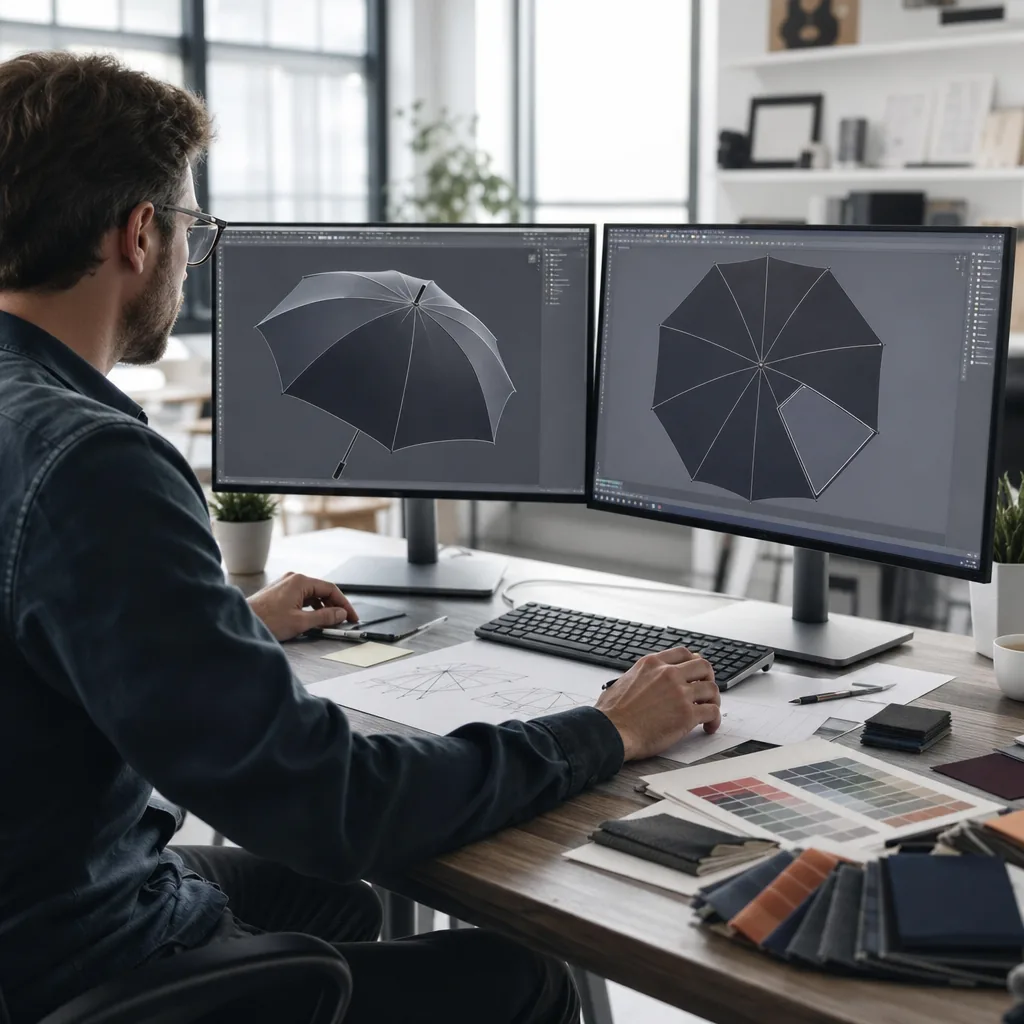
Construction, utility, and field crews need branded gear that holds up to abrasion, wind, rain, and daily pack-out without creating another procurement headache. At the factory level, we see the difference between a promo umbrella and one built for real job sites, so the best worksite umbrellas start with reinforced ribs, dependable opening hardware, hi-vis color control, and branding that stays legible after hard use.
Why Field Teams Need a Different Umbrella Spec
Inspectors, utility crews, survey teams, and roadside workers use an umbrella differently than a shopper or commuter does. They are stepping in and out of trucks, carrying clipboards, radios, meters, cones, or sample kits, so the umbrella has to work with one hand and stay usable when the other hand is occupied. That is why worksite umbrellas should prioritize a tacky, non-slip grip, a fast auto-open or auto-open-close mechanism, and a frame that can be deployed without looking at it. Decorative vent shapes, fashion handles, and thin promotional canopies do not help when a crew member is standing in rain beside a live trench or waiting at a lane closure. For utility team umbrellas, the real spec question is not appearance; it is whether the tool can be opened quickly, held securely with gloves on, and kept steady while the user is moving.
Canopy size matters because field work is rarely stationary. A 21-inch compact umbrella may be fine for commuting, but roadside workers and survey teams often need 23-inch, 27-inch, or even 30-inch coverage so rain does not blow onto paperwork, tablets, or radio gear. That is where windproof golf umbrellas and double-canopy vented builds make sense, especially when the site is exposed and gusty. The frame should favor fiberglass ribs over brittle steel in the upper structure, because flex is better than snap when wind loads spike around open roads, elevated utility corridors, or construction staging areas. For bulk safety umbrellas, we usually specify materials and panel counts based on the job, not the logo, because a branded product that fails in wind is just dead inventory.
The best worksite umbrellas are simple, rugged, and easy to train across a crew. A textured EVA or rubberized handle helps when hands are wet or dusty, and a balanced shaft length keeps the umbrella from feeling awkward while climbing in and out of vehicles. ZheBrella’s standard approach for field orders is to match the canopy fabric, rib count, and opening mechanism to the actual use case, then proof it in a wind test rather than guessing from a catalog photo. If the buyer needs consistent deployment across inspectors, contractors, and maintenance teams, the spec should also support repeat purchasing: same size, same handle feel, same color coding, and enough canopy coverage to protect uniforms, devices, and documents. That is what makes worksite umbrellas a tool, not a giveaway.
Choosing Between Steel and Fiberglass Ribs
For worksite umbrellas, steel ribs still make sense when the priority is low up-front cost and the canopy will live in a controlled yard, not on a windy road crew or utility substation. Steel has better dent resistance than cheap thin fiberglass in some impact scenarios, but once you start talking about salt spray, rain, fertilizer dust, or daily truck-bed abuse, corrosion becomes the real failure mode. Fiberglass ribs weigh less, do not rust, and usually recover better after a gust because they flex instead of staying bent. That matters on utility team umbrellas carried in and out of vehicles all day. In practice, a steel frame is cheaper to buy, but a broken runner, rusted spoke, or seized ferrule can erase that savings fast because repair is usually not worth the labor on bulk safety umbrellas.
An 8K frame is enough for short-term promotions, light site coverage, and crews that need basic rain protection without carrying the umbrella all shift. Once the site is exposed, on open concrete, along highways, near scaffolding, or on coastal jobs, 16K wind resistance is worth the extra cost because the load is spread across more ribs and the canopy holds its shape better in gusts. That is especially true for windproof golf umbrellas used by supervisors and inspectors who cannot afford a failure during a storm. Fiberglass ribs are the better choice at 16K because they handle repeated flex cycles with less permanent deformation than steel. If the umbrella is being issued in volume, the replacement cost is not just the part price; it is the labor, downtime, and the fact that one failed frame can make the whole batch look unreliable.
Double-canopy designs matter on exposed sites because they let air pass through instead of loading the top like a sail. That reduces inversion risk when a sudden gust comes across an elevated platform, bridge deck, or open yard, which is where ordinary single-canopy worksite umbrellas usually fail first. A vented double canopy also lowers stress on the ribs and stretch points, so even a mid-range fiberglass frame lasts longer under repeated wind events. For crews who need the umbrella deployed daily, I would specify double-canopy venting before I would pay for a heavier steel frame, because the wind relief is usually a better engineering answer than simply adding weight. If the goal is durable field use, not showpiece branding, the combination that holds up is fiberglass ribs, 16K on exposed routes, and a vented canopy cut in 190T or 210T pongee with reinforced tips and a proper runner lock.
Canopy Material, Safety Features, and Visibility
For worksite umbrellas, 190T pongee is the baseline I would spec for most utility team umbrellas: it is light, packs cleanly, and sheds water fast enough for crews moving between truck, pole, and trench. 210T pongee costs more, but the tighter weave holds coating better, dries a bit faster after repeated wetting, and usually feels less floppy in wind. On the floor, the difference shows up after a dirty shift: 210T keeps its finish longer, while 190T is easier to source in larger bulk safety umbrellas runs when price matters more than a premium hand feel. Either way, insist on a proper water-repellent finish and stitched seam quality, because cheap canopy cloth that soaks through defeats the point of field use.
For visibility, the canopy should do more than carry a logo. Hi-vis yellow, orange, or lime panels are standard for roadside and utility work, and reflective trim around the hem or panel edges gives a real nighttime signal without turning the umbrella into a costume piece. UPF 50+ coating matters when crews are standing exposed for hours, especially on 21-inch and 23-inch compact frames or larger windproof golf umbrellas used over tool belts and PPE. If the application is safety-sensitive, I prefer fiberglass ribs over steel because they flex instead of buckling, and they keep the frame lighter for extended carry. ZheBrella’s standard practice is to match the canopy color to the site requirement first, then build the print around that, not the other way around.
Compliance details are usually where low-end suppliers cut corners. Rounded tips and safer ferrule options reduce snagging on ladders, vehicles, and overhead routing, and they are worth specifying up front for construction and utility jobs. A blunt plastic tip or capped ferrule is better than a sharp metal point when the umbrella is going to live in a crew cab and get tossed around all day. For wind exposure, a vented double-canopy design is still the most practical choice for worksite umbrellas because it relieves pressure instead of trying to fight it; paired with fiberglass ribs, it will hold up better in gusts than a standard single canopy. For bulk safety umbrellas, I would also lock in AQL 2.5 inspection, confirm open-close mechanism type, and test water shedding after a full soak so the supplier cannot hide behind a dry-lab sample.
Procurement Specs That Reduce Reorder Problems
The fastest way to create reorder problems is to leave handle, shaft, and branding details vague. For worksite umbrellas, specify the grip material first: straight EVA, molded rubber, or a wooden hook handle all behave differently in wet gloves and in storage racks. Then lock the shaft finish, because glossy chrome, matte black powder coat, and plated steel each show wear differently and affect corrosion resistance. Closure strap width and fastener type matter more than buyers expect; a 10-15 mm hook-and-loop strap is usually safer than a narrow snap tab on bulk safety umbrellas. Branding placement should be fixed in the PO as panel count, panel location, print method, and maximum artwork size so the factory does not shift the logo near a seam or vent edge.
MOQ should be tied to construction, not just color. Utility team umbrellas with stock shafts and standard straight handles can usually start at a lower MOQ, while custom molded handles, wood hooks, or special matte shaft finishes push the order higher because of tooling and plating setup. A practical sample process is first-fit sample, pre-production sample, then sealed golden sample with signed measurements and color references. That sequence prevents arguments later about rib tension, logo position, and canopy panel alignment. For windproof golf umbrellas and other large formats, the sample must be opened and closed repeatedly, not just inspected visually, because handle wobble and button misfire show up only under cycle testing.
QC needs to catch the failures that actually cause returns: handle pull strength, shaft straightness, seam leakage, and open/close function. Require a torque or pull test on the handle joint, especially on auto-open and auto-open-close models, because cheap bonding fails after repeated wet-dry cycles. For the canopy, inspect stitching density, seam sealing, and pinhole leakage under spray, then check every vent and tip cap for loose assembly. Our standard practice is AQL 2.5 for general inspection, with extra checks on fiberglass ribs, spring tension, and canopy edge reinforcement for worksite umbrellas used in rough handling. Buyers should also confirm packaging counts, barcode labels, and spare parts policy before release, because a missing ferrule or broken strap can stall a large reorder.
Shipping, Pricing, and Delivery for Multi-Site Teams
FOB works when the buyer has a central procurement team and local freight control: the factory price covers the umbrellas, cartons, and export loading, and each regional branch budgets its own ocean freight, import duty, inland trucking, and clearance. DDP is cleaner for contractor networks and branch managers who need one landed number per case, because the quote already includes customs handling and last-mile delivery to the warehouse or jobsite. For worksite umbrellas, that difference matters more than people admit, because a 500-piece order split across five branches can look cheap on paper under FOB and then get expensive after destination charges are added. ZheBrella’s standard practice is to separate product cost, packing cost, and destination cost so procurement can compare utility team umbrellas and bulk safety umbrellas on a true landed basis.
Lead times depend on what is being customized. Stock frames with a one-color canopy usually move in 15 to 20 days, while custom color runs, printed panels, and special handle or tie-band changes normally take 25 to 35 days after artwork approval and deposit. If the spec uses fiberglass ribs, double-canopy venting, or a heavier windproof golf umbrellas build, add time for extra frame checks and pre-production sampling. For contractor networks, I recommend branch-level carton packing instead of mixed pallets: each master carton should carry the branch code, SKU, color, and quantity so receiving does not have to break down a mixed shipment at the dock. That is the difference between a clean rollout and a warehouse mess.
Safety stock is the part most buyers underfund, especially for utility team umbrellas that get pulled from stock during storm season, outage response, or large field events. A practical buffer is 10 to 15 percent above forecast for branches in coastal or high-wind regions, with the reserve held centrally so one branch does not run dry while another sits overstocked. On a 1,000-unit program, that can be the difference between absorbing a weather spike and paying air freight for an emergency refill. Good branch planning also means matching carton counts to distribution logic: 24 or 36 units per master carton for easy pallet math, labeled by branch and route. For worksite umbrellas, that is how you keep replenishment predictable instead of chasing demand after the first storm hits.
Frequently Asked Questions
Should worksite umbrellas use fiberglass or steel ribs?
Fiberglass is usually better when crews need lighter weight and better wind flex. Steel can work for lower-cost programs, but it is heavier and can be less forgiving in gusty conditions.
What minimum spec should a utility buyer ask for?
Ask for a windproof frame, 190T or 210T pongee, and an auto-open mechanism if one-handed use matters. For exposed sites, specify a double-canopy structure and confirm the supplier can pass AQL 2.5 checks.
What minimum order quantity is typical for branded worksite umbrellas?
For OEM runs, many factories start around 300 to 500 pieces per design, color, or print layout. If you need multiple logo placements or special packaging, the MOQ can move higher.
How long does it usually take to produce bulk umbrellas for field teams?
Sample development usually takes 5 to 7 days once artwork is approved. Bulk production commonly takes 25 to 35 days after sample approval, depending on rib material, canopy print complexity, and order size.
What specs matter most for construction and utility use?
Buyers usually ask for fiberglass ribs, vented canopies, and a 60 to 68 inch arc for coverage. For procurement, it also helps to confirm handle type, canopy fabric weight, logo print method, and carton packing size before placing the order.
Looking to Launch Your Custom Umbrella Line?
ZheBrella is a Zhejiang-based OEM/ODM umbrella manufacturer with 17 years of export experience. Free design, low MOQ from 100 pieces, windproof construction, full-color print.
Get Free Quote Now »People Also Search For
Related Articles
Custom Umbrellas for Insurance Adjusters and Claim Teams
Source durable umbrellas for adjusters and field claim teams with fast-open specs, weather-ready fabrics, QC standards, ...
Read More »
Umbrellas for Insurance Adjusters and Claims Field Teams
Plan branded umbrellas for claims teams with specs for field durability, visibility, storage, MOQ, lead time, and import...
Read More »Branded Umbrellas for Telecom Field Teams and Retail Stores
Source umbrellas for telecom stores, installers, and field teams with practical specs, durable frames, QC targets, and d...
Read More »