Umbrellas for Insurance Adjusters and Claims Field Teams
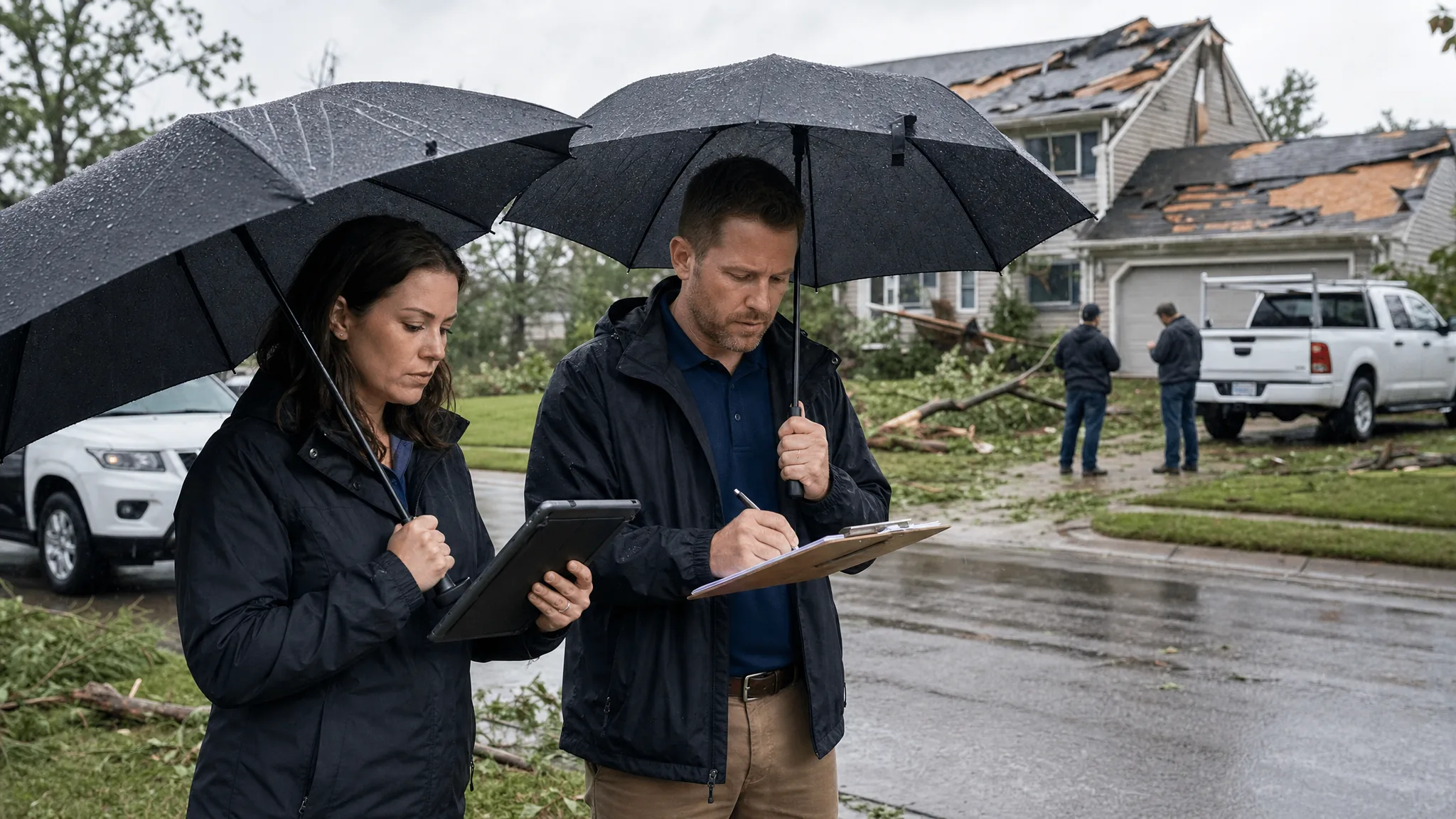
Umbrellas for insurance adjusters must survive wet curbside inspections, fit crowded vehicles, and remain visible while buyers compare frame construction, packed size, storage, and replenishment risk. For a March 2025 quote worksheet, treat 60 mph gust exposure per umbrella, a 24-inch packed-length limit per vehicle slot, and 500 units per order as example assumptions to verify in supplier quotes; derive comparisons from supplier specifications and current carrier tariffs. Vincent Xi, Editorial Author (https://www.zhebrella.com/authors/vincent-xi/), advises verifying samples, MOQ, lead time, carton dimensions, tariff classification, and current compliance documents.
Why Claims Teams Need a Different Umbrella Spec
Umbrellas for insurance adjusters should be specified around the inspection workflow, not a promotional catalog. On roof, vehicle, property, and storm-damage inspections, the canopy may need to cover a tablet, paper scope, claim diagram, camera, and moisture meter while the adjuster keeps a hand available for ladder contact or surface checks. For the shared-coverage stick SKU, use a 30-inch to 34-inch arc only as an example assumption current on the RFQ issue date, derived from the buyer-approved workflow brief and subject to verification in the supplier's dated quote. Require that quote to state measured rib length, open canopy diameter, frame material, and total weight; factory size labels are not interchangeable. For exposed sites, specify fiberglass ribs and a vented double canopy. Rigid all-steel ribs may retain deformation after inversion. Prefer manual opening around ladders and damaged vehicles; approve auto-open only after a preproduction sample demonstrates controlled release, runner-lock engagement, pinch-point clearance, seam integrity, tip retention, and inversion recovery.
Use a separate glove-box SKU because a full-length stick model will not fit every assignment vehicle. For the passenger-fleet compact SKU, treat a 21-inch rib length as an example assumption current on the supplier-quote issue date, sourced from the buyer's measured glove-box envelope and current fleet list, and verify it in that dated quote. The approved specification should also record folded length, open diameter, handle profile, sleeve dimensions, and wet-storage clearance. For branded field inspection umbrellas, treat a 250-millimeter-wide maximum logo as an example assumption current at proof approval, verified against the buyer's vector artwork and the supplier's dated printable-area template. Approve panel curvature, logo orientation, and viewing distance before production. Bright panels or reflective binding may be specified for claims field team umbrellas, but custom safety umbrellas are not fall protection, traffic-control equipment, or electrical PPE. Reject any windproof work umbrellas claim unless the purchase specification defines pass/fail checks for seam leakage, runner cycling, inversion recovery, tip retention, and print wet rub. Treat AQL 2.5 as a unitless major-defect index only under an example production-lot assumption current at purchase-order approval, sourced from the buyer's sampling plan and supplier's dated quote and subject to verification there. It governs lot acceptance, not certification or field performance.
Methodology: map the buyer-documented inspection sequence, occupied-hand tasks, vehicle-storage envelope, site exposure, and viewing position to canopy dimensions, frame material, opening mechanism, and printable area. Distinct source contexts include the buyer-approved workflow brief or risk assessment, which defines use conditions, and the supplier's dated quote, dimensioned size chart, artwork proof, preproduction-sample report, and production-lot inspection record, which document the offered specification and acceptance results. Limitations: arc, rib-length, and open-diameter labels vary by supplier; windproof, water-repellent, and ultraviolet-protection claims remain unverified unless purchase documents name current test methods and acceptance criteria. Sampling addresses lot acceptance only, not certification or field performance. Publish the visible byline as Vincent Xi, Editorial Author, https://www.zhebrella.com/authors/vincent-xi/, and set the Article or BlogPosting JSON-LD author to a Person with that name, job title, and URL. The profile supports editorial attribution only; it does not establish personal testing or field experience. Visual brief/imagePrompt: show a realistic factory QC bench with an open vented pongee stick umbrella, exposed fiberglass ribs, a folded compact model beside a vehicle glove-box fixture, protected tablet and claim documents, plus calipers and tape checking canopy arc, folded length, runner, and tips; use neutral industrial lighting and anonymous hands only, with no text, logos, watermarks, identifiable people, or impossible machinery.
Materials and Frame Choices for Daily Field Use
For umbrellas for insurance adjusters, specify fiberglass ribs when corrosion resistance, gust flexibility, and lower carry weight outweigh crush-damage risk. Fiberglass itself does not rust and can flex through an inversion, but a failed section may splinter, and every metal joint still needs corrosion protection. Steel ribs are stiffer, slimmer, and generally cheaper; they also add finished-unit weight and can rust where scratched plating or water-trapping rivets expose the substrate. In the buyer-provided example RFQ dated March 1, 2025, 8K and 16K are assumptions for eight and sixteen primary rib assemblies per finished umbrella; verify each designation against the supplier bill of materials and signed approval sample. Within that example, the assumed 16K frame spreads canopy load across more support points yet adds joints, rivets, assembly time, cost, and potential failure locations. A well-joined assumed 8K fiberglass frame can therefore outlast a poorly joined assumed 16K steel frame. Compare rib material and cross-section, stretcher geometry, joint construction, corrosion treatment, finished weight, replacement cost, and approval-sample workmanship; rib count alone establishes neither durability nor wind performance.
Under the same buyer-provided example RFQ dated March 1, 2025, treat supplier-declared 190T and 210T pongee as nominal density grades, not complete fabric specifications; confirm them against the textile mill's current technical data sheet, supplier quote, and approved swatch. In that example, the assumed 210T option should provide a tighter, smoother print face for branded field inspection umbrellas, while assumed 190T can reduce folded bulk and carry weight. Require the quote to state yarn denier, fabric mass, weave consistency, coating, colorfastness, seam construction, and print method because neither T grade defines those variables. For windproof work umbrellas, an overlapped double canopy can vent pressure, but it is not a wind-speed rating. Lock vent geometry, overlap depth, connecting-tape attachment, and panel alignment into the signed sample. For wet jobsites, a one-piece molded rubberized TPR handle generally gives gloved hands stronger traction; closed-cell EVA reduces weight and cushions prolonged carrying. Compare both after water spray, checking wet-glove grip, surface texture, adhesive durability where applicable, handle-to-shaft retention, mechanism clearance, and finished-unit weight before approving claims field team umbrellas or custom safety umbrellas.
Byline: Vincent Xi, Editorial Author. Set the Article/BlogPosting JSON-LD author to a Person named Vincent Xi, with jobTitle "Editorial Author" and URL https://www.zhebrella.com/authors/vincent-xi/. The approved profile supports authorship only, not a first-hand factory-testing claim. Methodology: reconcile the supplier bill of materials for rib composition and count, the textile mill data sheet for pongee construction and coating, the supplier quote, and the signed preproduction sample. Count sample ribs, record finished-unit weight, apply water spray, check manual inversion recovery, and perform a wet-glove handle-pull check. Limitations: these checks do not predict service life; K and T are supplier trade labels, not universal performance standards. Verify rib dimensions, metal coating, fabric mass, yarn specification, vent geometry, handle material, mechanism type, and finished-unit weight in the final quote. Do not claim wind speed in mph, corrosion life, or waterproof performance without a dated report naming the test method and pass/fail criteria. imagePrompt: Photograph the buyer-provided March 1, 2025 example assumption of a 27-inch nominal rib-length sample, to be verified in the supplier quote and signed sample, on a QC bench with open fiberglass and steel frames, pongee swatches, an exposed double-canopy vent, wet TPR and EVA handles, calipers, and a unit scale under neutral factory lighting; no people, text, logos, watermarks, or impossible machinery.
Branding, Visibility, and Professional Presentation
Branding must stay legible across curved, tensioned canopy panels. For umbrellas for insurance adjusters, use one-panel screen printing when the full company name must read from one side; use alternating-panel logos when claims crews need identification from several approach angles. As of the quote-request date, treat a 180 mm-wide by 100 mm-high logo on four alternating panels of a 23-inch, eight-panel canopy as an example buyer assumption, not a production specification. Verify it against the dated supplier quote, panel template, buyer-controlled vector artwork, and pre-production sample. Keep artwork outside rib lines, vent openings, folded edges, and the confirmed print boundary to limit distortion and ink cracking. For branded field inspection umbrellas, approve a fixed high-contrast panel sequence, such as fluorescent yellow with charcoal, safety orange with navy, or white with red. At sample approval, a CIEDE2000 difference of 3.0 or less, dimensionless under CIE standard illuminant D65, is an example buyer-set tolerance to verify using a current physical Pantone reference and the supplier's dated instrument report.
Specify reflective trim separately from printed decoration because it changes price, seam construction, closure, and inspection criteria. As of the quote-request date, 10 mm-wide reflective perimeter piping on a 27-inch, eight-rib double-canopy model is an example construction assumption to verify in the dated supplier quote, pre-production sample, and reflective-trim technical sheet. Reflective piping can improve recognition under headlights or camera flash, but it does not make custom safety umbrellas compliant high-visibility personal protective equipment or prove certification. Require the supplier to state the applicable test method, report date, measured reflective performance, and tested attachment construction. Inspect each seam with the sample dry, wet, folded, and fully open. Because piping can stiffen seams, cycle the sampled auto-open or auto-open-close mechanism and check canopy tension, closing force, sleeve fit, and trim clearance before approving windproof work umbrellas. Classify gaps, lifting, puckering, and mechanism interference as shipment-inspection defects. Treat visibility after rain or repeated flexing as unverified unless a current report covers the exact quoted trim and attachment method.
Method and evidence: reconcile the buyer-controlled vector artwork and physical color reference with the dated supplier quote, panel template, pre-production sample, reflective-trim technical sheet, instrument report, and production inspection record. Measure print dimensions along the curved canopy, assess color under the agreed controlled lighting, and inspect trim continuity at every seam. As of final artwork approval, AQL 2.5, dimensionless, is an example buyer inspection assumption to verify in the purchase order; define critical, major, and minor decoration defects and apply the relevant ISO 2859-1 sampling plan. ISO 2859-1 provides a sampling framework; the selected AQL is the buyer's inspection practice, not product certification. Written confirmation remains necessary for final print size, Pantone tolerance, ink adhesion on the quoted fabric, reflective performance after rain or flexing, mechanism operation, closing force, and sleeve fit. Publication attribution and structured data must identify Vincent Xi, Editorial Author, https://www.zhebrella.com/authors/vincent-xi/, as the Person author. Visual brief/imagePrompt: realistic QC table under neutral inspection lighting, showing the quoted 27-inch vented sample open in fluorescent yellow and charcoal, exposed fiberglass ribs, alternating blank decoration panels, reflective perimeter piping, an unmarked color swatch, and metric measuring tools; no people, text, logos, watermarks, or impossible machinery.
Procurement Checks: MOQ, Lead Time, Terms, and Inspection
Set MOQ by model and decoration method before ranking umbrellas for insurance adjusters. Require separate minimums for manual, auto-open, and auto-open-close mechanisms and for screen printing, heat transfer, and sublimation; state whether each minimum applies per canopy color, artwork, model, or total purchase order. For this sourcing round, the buyer’s comparison sheet uses 500, 1,000, and 2,500 units per model and artwork as RFQ breaks. They are buyer comparison quantities, not factory MOQs, so confirm every break in the supplier’s dated quote. Use 30 to 45 calendar days as an example current-RFQ bulk-production assumption, measured from written preproduction-sample approval to the goods-ready date; verify it against quoted capacity, model, and print method. The quote should identify schedule triggers, including cleared deposit, artwork release, fabric-color approval, and changes after sample approval for branded field inspection umbrellas. Also request unit price, sample and setup charges, overrun/underrun tolerance, carton quantity, monthly capacity, quote validity, and earliest goods-ready date at each break. This exposes quantity surcharges, decoration constraints, and schedule risk before award.
Compare FOB and DDP only when model, decoration, quantity, carton assumptions, ship-ready date, and destination match. For this RFQ, use the International Chamber of Commerce’s Incoterms 2020 edition, as specified by the buyer, as the rules source. An FOB quote must name the loading port and itemize export packing, inland haulage, export clearance, and origin charges; a DDP quote must name the final delivery address and state whether duties, import brokerage, taxes, appointment fees, and remote-area delivery are included. Normalize every cost-driving specification before comparing terms, including fiberglass versus steel ribs, steel shaft, canopy weight, mechanism, and decoration for windproof work umbrellas or custom safety umbrellas. Pair each dated supplier quote with a same-day forwarder estimate or seller DDP schedule and record both validity dates. Calculate landed cost per accepted unit from product, setup, packing, freight, insurance, duty, tax, brokerage, inspection, and final-mile charges, divided by accepted quantity. Recheck before booking because freight rates, fuel surcharges, duty treatment, and exclusions can change after quotation.
Where lot sampling applies, specify AQL 2.5 as the buyer-selected, unitless quality-level designation for major defects in the purchase-order QC annex approved for that order. Take sample size and acceptance/rejection numbers from the inspection agency’s sampling plan current on the inspection-booking date. AQL 2.5 is neither a direct defect percentage nor a product standard, supplier certification, or proof of compliance. Define critical, major, and minor defects before inspection; check opening and closing, lock engagement, shaft alignment, rib-tip security, seam continuity, print placement, and buyer-agreed water or wind procedures for claims field team umbrellas. Method note: derive the award comparison from the model-specific supplier quote, destination-matched freight or DDP quote, and buyer-approved inspection plan; normalize specifications and divide total landed cost by accepted units. Limitation: verify actual MOQ, capacity, freight, duties, test methods, sample size, and acceptance limits before issuing the purchase order. By Vincent Xi, Editorial Author; the profile at https://www.zhebrella.com/authors/vincent-xi/ supports identity and role only. Visual brief/imagePrompt: show an open and folded umbrella beside a caliper, an unlabeled QC checklist, and tagged cartons; depict an example 23-inch rib-length, 8-rib auto-open model with fiberglass ribs, a steel shaft, and a 190T pongee canopy, all subject to the supplier sheet at artwork approval. Exclude people, logos, legible text, watermarks, and impossible machinery.
Evidence, Author Basis, and Verification Limits
Byline: Vincent Xi, Editorial Author; approved profile: https://www.zhebrella.com/authors/vincent-xi/. The visible byline and Article/BlogPosting JSON-LD must identify the author as a Person named Vincent Xi, with jobTitle Editorial Author and the same profile URL. Reviewed as of publication, that profile is the sole approved author basis for this section on umbrellas for insurance adjusters. It establishes identity and editorial responsibility only; it does not substantiate claims-adjusting work, factory tenure, site visits, sample inspection, laboratory or field testing, certifications, client results, or other firsthand experience. Therefore, no first-person experience claim is made. Product performance remains a procurement question: buyers must trace canopy arc, rib material, opening mechanism, reflective trim, packing, unit price, MOQ, delivery term, and lead time to dated specifications, identified samples, quotations, and test reports. The byline cannot validate durability, compliance, schedule, or landed cost; approval requires current product and commercial evidence.
Methodology uses two source contexts: the ZheBrella product-spec brief and review of the current supplier quotation. The review logs each document date, sample identifier, stated test method, quotation term, and unresolved discrepancy, then compares the quoted construction with a production-representative sample. As of publication, the product brief, rather than an independent measurement, states a 34-inch measured canopy arc and a supplier-designated 210T pongee canopy for the reference configuration. For that procurement scope, a dimensionless AQL 2.5 major-defect acceptance index is an example buyer assumption to verify in the dated quotation and final inspection plan; it is not a certification or confirmed ZheBrella practice. A 50+ mph frame-survival target for the finished sample and a dimensionless UPF 50+ target for the canopy fabric are also example procurement assumptions as of publication. Require dated reports tied to the quoted ribs, shaft, opening mechanism, fabric, and finished sample. For claims field team umbrellas, branded field inspection umbrellas, and custom safety umbrellas, reconcile artwork, reflective piping, packing, unit price, MOQ, FOB or DDP responsibility, and lead time across the specification, sample, quotation, and purchase order.
Verification limits: Before purchase, verify frame test results, fabric UPF claims, carton dimensions, and import documentation against current production-representative samples and dated records. Do not accept windproof work umbrellas as a supported performance claim unless the report identifies rib material, opening mechanism, sample construction, test speed, exposure duration, and failure criteria. Confirm carton length, width, height, gross weight, packed quantity, shipping marks, country of origin, and FOB or DDP responsibility against the approved packing sample, current quotation, and commercial paperwork. ImagePrompt: Create a close-up B2B product scene based on the ZheBrella product brief available as of publication. Show a dark navy umbrella with a 34-inch measured canopy arc beside a parked claims vehicle in light rain. Make the fiberglass ribs visible and render the supplier-designated 210T pongee texture, reflective edge piping, wet surfaces, and neutral industrial lighting accurately. Place a clipboard and tablet under the canopy. In the softly focused background, include a warehouse-style QC table with calipers, folded canopy material, and cartons with blank labels. Use realistic umbrella geometry and scale. Include no visible text, logos, watermarks, fake people, or impossible machinery.
Frequently Asked Questions
Should insurance field teams choose compact or full-size umbrellas?
Compact auto-open umbrellas fit vehicle storage and individual adjuster kits, while 30 in to 34 in arc stick umbrellas provide better coverage for documents and tablets. Many programs use both tiers, with final quantities confirmed against fleet size and reorder plans.
Can these umbrellas include safety features without looking like jobsite PPE?
Yes. Buyers can specify reflective piping, brighter canopy panels, or contrast tips while keeping the main canopy in a corporate color. Confirm reflective material, placement, and durability through a pre-production sample before bulk approval.
Looking to Launch Your Custom Umbrella Line?
ZheBrella is a Zhejiang-based OEM/ODM umbrella manufacturer with 17 years of export experience. Free design, low MOQ from 100 pieces, windproof construction, full-color print.
Get Free Quote Now »People Also Search For
Related Articles
Custom Umbrellas for Insurance Adjusters and Claim Teams
Source durable umbrellas for adjusters and field claim teams with fast-open specs, weather-ready fabrics, QC standards, ...
Read More »
Branded Umbrellas for Insurance Adjusters and Claims Teams
Plan branded umbrellas for claims adjusters with windproof frames, safety colors, AQL 2.5 checks, MOQ guidance, and FOB/...
Read More »
Umbrella Specs for Insurance Adjusters and Claims Teams
Source umbrellas for insurance field teams with windproof frames, hands-on inspection needs, logo placement, lead times,...
Read More »