Umbrella Specs for Insurance Adjusters and Claims Teams
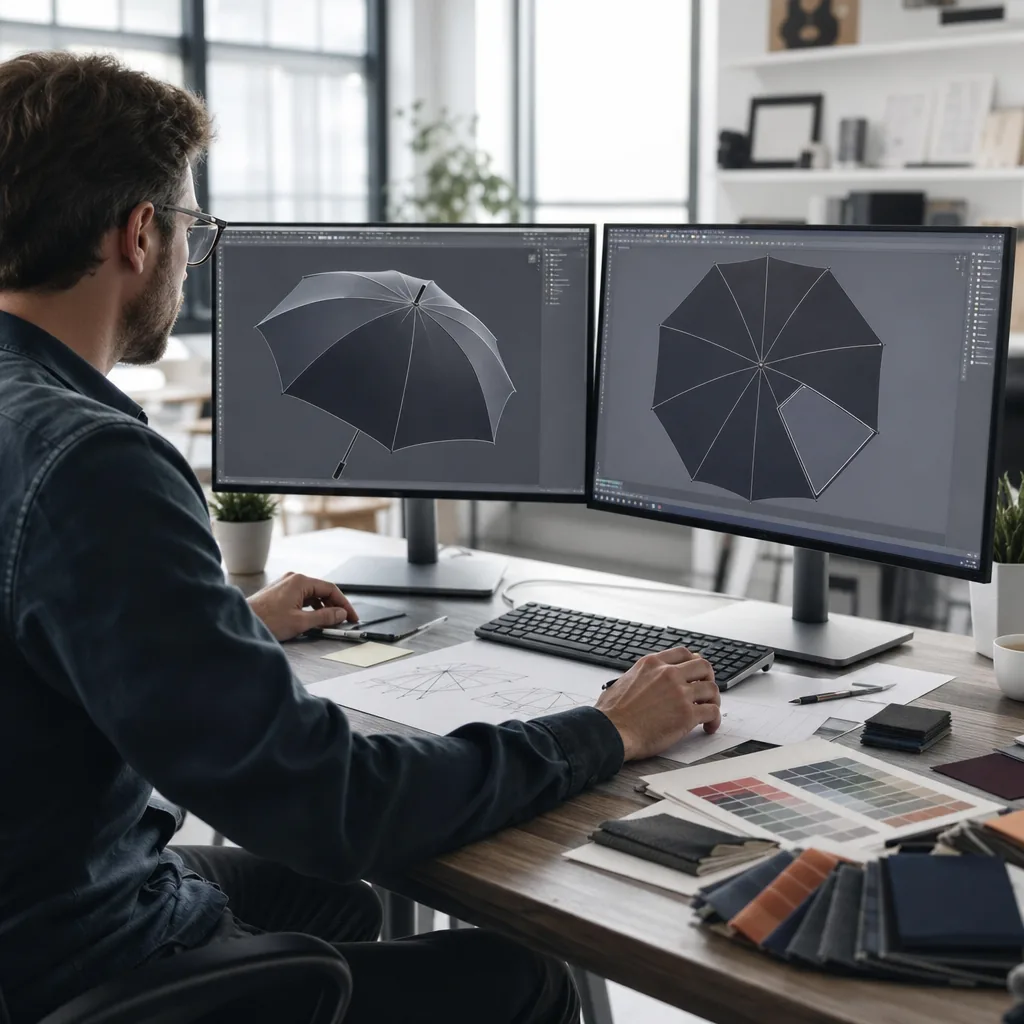
For claims teams working curbside, roadside, and on damaged properties, the wrong umbrella fails fast: it flips in crosswinds, blocks one-handed note-taking, or arrives with inconsistent logo placement across branches. At our Songxia factory, we see these issues at the frame, canopy, and inspection-table level, which is why spec decisions for insurance adjuster umbrellas need to account for wind resistance, carry weight, print registration, lead times, and AQL checks before mass production.
Why Claims Teams Need a Different Umbrella Spec
Claims work destroys lightweight promo umbrellas. An adjuster may open and close an umbrella 20 to 30 times in one shift across auto lots, muddy driveways, damaged retail sites, and policyholder visits, so insurance adjuster umbrellas need a field-tool spec, not a giveaway spec. Start with a 23-inch or 27-inch canopy, 8K fiberglass ribs, and a black electroplated steel shaft. Choose manual open or auto-open based on how often the umbrella is used between vehicle stops; auto-open-close looks efficient, but the extra spring assembly adds stress and more failure points in daily claims use. For roof inspections from the ground, auto claims, and property walkthroughs in gusty rain, a vented double-canopy frame rated to 50+ mph materially lowers inversion risk. Pair it with 190T or 210T pongee and a Teflon coating so water sheds fast instead of soaking the canopy and dripping into the vehicle between stops.
Catastrophe response creates a different failure pattern than routine field visits. Storm response umbrellas get stored wet in trucks, dragged across asphalt, and handed to temporary staff, so rib material matters more than most buyers assume. Fiberglass ribs flex and recover; cheap all-steel ribs are more likely to deform after one hard gust. For branded claims team umbrellas used in hail, hurricane, or wind-loss zones, woven 190T or 210T pongee is usually the safer canopy choice than clear POE or PVC, which can crease, stiffen in cold weather, and wear faster under repeated deployment. A UPF 50+ undercoating also helps teams working long hours outdoors between rain bands, especially in southern and southwestern markets. On branding, keep function first: two-panel or four-panel screen printing on dark pongee usually gives the cleanest result, while full-panel flood coverage adds cost and can change canopy hand feel if the ink layer is heavy.
For bulk umbrellas for insurers, the real buying questions are consistency, lead time, and failure risk. A practical MOQ is often 300 to 500 pieces per colorway, with production lead times of about 25 to 35 days after artwork approval, plus FOB or DDP shipping depending on the program. Quality control should be written into the PO, not assumed: AQL 2.5 final inspection, with extra checks for runner action, top-notch security, rib alignment, and print registration. That matters on catastrophe deployments and everyday policyholder visits alike. A sticky runner, skewed logo, or early frame failure slows the team down and weakens brand presentation at the exact moment the policyholder is judging professionalism. Well-specified field inspection umbrellas reduce replacement cost, deploy faster in bad weather, and present a cleaner, more credible brand in the field.
Frame and Canopy Choices for Storm Conditions
For storm deployments, frame durability matters more than extra logo area. Insurance adjuster umbrellas get knocked against vehicle doors, dragged across parking lots, and inverted in roofline gusts, so fiberglass ribs should be the default spec. Fiberglass flexes and recovers; low-cost steel ribs often kink at the joint after one hard inversion and then track poorly on every open-close cycle. For the shaft, use full fiberglass when wind resistance is the priority, or a fiberglass-steel hybrid when procurement needs a lower unit cost without dropping to an all-steel frame. For field inspection umbrellas, an 8K frame is still the most practical build in 23 inch and 27 inch sizes because it balances coverage, weight, and part replacement. If adjusters need more shoulder coverage while carrying tablets or claim files, step up to a 16K frame in a 27 inch or 30 inch canopy. The 16-rib structure creates a rounder edge and better rain wrap, but it adds weight and slows dry-down. For exposed lots and roadside claims work, a double-canopy vented design is usually worth the extra cost: it releases uplift instead of forcing inversion, and a properly assembled fiberglass frame can realistically test into the 50+ mph range.
Canopy fabric changes both field performance and branding quality. 190T pongee is the standard commercial choice for storm response umbrellas because it sheds water well, keeps panel sewing stable, and prints consistently by screen print or heat transfer on solid-color panels. It also packs smaller, which matters when adjusters store gear in a vehicle door pocket or inspection bag. 210T pongee feels denser in hand, drapes better, and gives branded claims team umbrellas a richer surface, but it adds some weight and typically dries a bit slower in humid conditions. When artwork includes fine lines, dark fills, or larger logo panels, 210T usually prints cleaner because the fabric face shows less seam grin-through. Operating style also affects service life: manual-open frames hold up better when sand, grit, or drywall dust gets into the runner because they have fewer moving parts. Auto-open is still a sensible upgrade for teams cycling in and out of vehicles all day, while auto-open-close adds handle bulk and more maintenance risk. A practical spec for bulk umbrellas for insurers is fiberglass ribs, a vented double canopy, 190T or 210T pongee, and AQL 2.5 inspection focused on rib tension, top-notch alignment, and water-spray performance before packing.
Mechanisms and Handles for Field Work
For field claims work, the mechanism is a working spec with direct impact on speed and equipment protection. Most insurance adjuster umbrellas should use an auto-open runner because adjusters often step out of a vehicle carrying a tablet, folder, phone, or camera and need one-handed deployment before they reach the inspection point. A 21" or 23" folding frame opens and locks in one motion, which shortens exposure time for paper files and electronics. Manual-open folding or stick models are mechanically simpler and usually lower in unit cost, but in practice they often need two hands once the frame is wet, dusty, or catching light wind. Auto-open-close only makes sense as a premium compact option for executives or senior field staff. The second spring set adds cost, extra weight, and another wear point over repeated cycles. For most branded claims team umbrellas, the best-value specification is a mid-size auto-open folding model with fiberglass ribs instead of an all-steel frame, because fiberglass flexes better in gusts, reduces hand shock, and holds up better in daily vehicle storage and repeated field use.
Handle and storage details should match how adjusters actually carry and stow gear. EVA foam grips are the safest choice for long site walks because they keep traction when wet and feel less cold than molded ABS in winter rain. Rubberized PP handles are also practical on folding units, especially when paired with a stitched wrist strap so the user can free one hand for photos without dropping the umbrella in mud or debris. Avoid polished wood-look handles on storm response umbrellas; they get slick with gloves and rain, and cosmetic damage shows fast. Size is usually decided by vehicle storage. A 21" or 23" tri-fold umbrella in 8K or 10K construction with a 190T pongee canopy fits more easily in a door pocket, seat-back organizer, or claims kit, which is why many bulk umbrellas for insurers start there. The tradeoff is coverage: compact units protect one user and a tablet, while a 27" or 30" golf umbrella gives more shoulder and equipment coverage for two-person inspections, large-loss sites, or longer outdoor assessments where canopy area matters more than storage efficiency.
Branding Without Compromising Professional Use
For insurance adjuster umbrellas, keep branding restrained and put field performance first. On a 23-inch or 27-inch canopy, a main insurer logo at about 140 to 180 mm wide is usually enough; print it on two alternating panels instead of all 8K panels so the umbrella identifies the team without reading like trade-show merchandise at a loss site. Dark navy, charcoal, black, and muted red are the safest canopy colors because they hide mud, roof grit, and roadside grime better than white or high-chroma promotional shades. Pair those colors with 190T or 210T pongee and a Teflon finish so water beads off and the canopy keeps a cleaner appearance over repeated deployments. For branded claims team umbrellas, the lowest-risk layout is a one-color screen print on solid fabric, or one printed panel plus a small woven strap label. If roadside visibility matters, add reflective piping at the canopy edge or a 5 to 8 mm reflective trim on the sleeve; it improves visibility without pushing the product into giveaway territory.
Panel layout also affects dead-stock risk and replacement flexibility. A standard 8K frame gives enough print area for a carrier logo on one panel and a catastrophe-response identifier on the opposite panel, while leaving six clean panels so the umbrella still reads as equipment. For third-party adjuster networks, use the master brand on one panel and a neutral descriptor such as CAT Response or Field Services on another; avoid personal names or phone numbers because they go obsolete fast and strand inventory. For storm response umbrellas used in roadside or open-site work, a 27-inch or 30-inch vented double-canopy model with fiberglass ribs is a better platform than a 21-inch folding promo frame: the larger arc carries logos more cleanly and holds up more reliably in gusts above 50 mph than low-cost steel-rib alternatives. Match the print method to the artwork and order size: screen print for one- or two-color insurer logos on dark pongee, heat transfer for multi-color catastrophe marks, and full-panel sublimation only when the buyer accepts higher MOQs, typically 500 to 1,000 pieces. For bulk umbrellas for insurers, a practical field inspection umbrellas spec is 23-inch auto-open or 27-inch manual vented, black EVA handle, 190T pongee, reflective edge detail, and AQL 2.5 inspection before FOB or DDP shipment.
Procurement Controls for Multi-Region Field Teams
For multi-region field teams, the real control point is supply resilience, not the lowest unit price. Insurance adjuster umbrellas should be planned against two demand layers: an annual base forecast and a branch-level surge buffer, because Gulf Coast, Southeast, and hail-belt deployments spike on different schedules. A practical MOQ is often 500 units per color and logo layout on a standard 23-inch auto-open frame with 8K fiberglass ribs and 190T pongee; it typically moves to 1,000-3,000 units when you add custom handles, vented double-canopy construction, or 10K or 16K frames. Set reorders against 45-60 days of peak-season demand by branch, not average monthly usage. That protects continuity when printed canopy panels, matching shades, or frame components tighten ahead of storm season. For buyers managing branded claims team umbrellas across multiple regions, that reorder discipline lowers the risk of forced substitutions into lower-wind frames, mismatched logo versions, or late deliveries during active claim surges.
Carton control determines whether bulk umbrellas for insurers stay traceable after arrival. Label every outer carton with branch code, PO number, canopy color, logo version, size, quantity, and destination state in plain text plus a scannable barcode, especially when one PO is split across 10-40 offices. Pre-packed branch assortments in 24-piece or 36-piece cartons usually create fewer cross-dock errors than mixed loose counts. FOB Ningbo suits buyers who control forwarding and U.S. inland distribution; DDP is usually cleaner when regional offices need direct delivery before hurricane or wildfire season. Repeat orders on common 21-inch or 23-inch frames often ship in 25-35 days, while new print setups, molded handle tooling, or 27-inch and 30-inch field inspection umbrellas more often require 35-50 days.
Release inspection should be tied to field failure risk and documented at AQL 2.5 before goods leave the factory. Check open-close cycle performance at the runner, spring, and lock on manual, auto-open, and auto-open-close models; verify rib symmetry so canopy tension stays even across all 8K or 10K panels; confirm print registration so logos and reflective text stay centered on-panel; and test water repellency so 190T or 210T pongee still beads after printing and top coating. On storm response umbrellas with vented canopies, add top-notch pull tests and visual checks for upper-to-lower canopy alignment, since poor vent sewing tends to show up first in 40-50+ mph gusts. Before release, sample cartons by shipment mark, confirm counts against branch labels, and verify the specified finish, whether standard water-repellent, Teflon-treated, or UV-coated up to UPF 50+ for sun-exposed deployments.
Frequently Asked Questions
Are golf umbrellas too large for insurance adjusters?
A 30 inch golf umbrella offers strong coverage for property inspections, but it can be awkward inside vehicles and crowded job sites. Many insurers use a two-SKU approach: compact auto-open umbrellas for daily claims and larger 16K windproof umbrellas for storm teams.
What fabric is suitable for branded claims-team umbrellas?
190T pongee is adequate for many field programs and keeps cost controlled. 210T pongee gives a denser hand feel, better print presentation, and a more premium impression during customer-facing visits.
What umbrella construction holds up best for adjusters working after storms?
A 27 to 30 inch canopy with a fiberglass shaft or ribs is usually the most practical setup for field teams. Buyers commonly spec wind resistance around 30 to 40 mph, auto-open function, and a darker canopy that hides dirt during multi-day deployment.
How should insurers handle logo placement when umbrellas may be used in claim photos or on job sites?
Most B2B orders use a 1-panel or 2-panel print so the logo stays visible without overwhelming field photos. A typical clean logo area is about 18 to 22 cm wide per panel, and many teams avoid full-canopy printing to keep replacement batches consistent across seasons.
What QC terms should procurement include on a bulk umbrella PO for claims teams?
Specify AQL 2.5/4.0, logo color tolerance against approved artwork, carton drop resistance, and opening/closing function checks before shipment. For branded field-use orders, buyers often request a pre-production sample in 5 to 7 days and bulk lead times of about 25 to 35 days after approval.
Looking to Launch Your Custom Umbrella Line?
ZheBrella is a Zhejiang-based OEM/ODM umbrella manufacturer with 17 years of export experience. Free design, low MOQ from 100 pieces, windproof construction, full-color print.
Get Free Quote Now »People Also Search For
Related Articles
Branded Umbrellas for Insurance Adjusters and Claim Teams
Specify durable branded umbrellas for claim teams working in rain, hail, and heat, with ribs, canopy fabrics, QA, MOQ, a...
Read More »
Branded Umbrellas for Insurance Claims Field Teams
Specify umbrellas for insurance adjusters with durable frames, fast deployment, professional branding, QC standards, and...
Read More »
Custom Umbrellas for Insurance Claims and Field Adjusters
Source umbrellas for claims adjusters and CAT teams with durable specs, fast deployment, QC standards, and logistics pla...
Read More »