Debossed vs Printed Logos on Umbrella Components
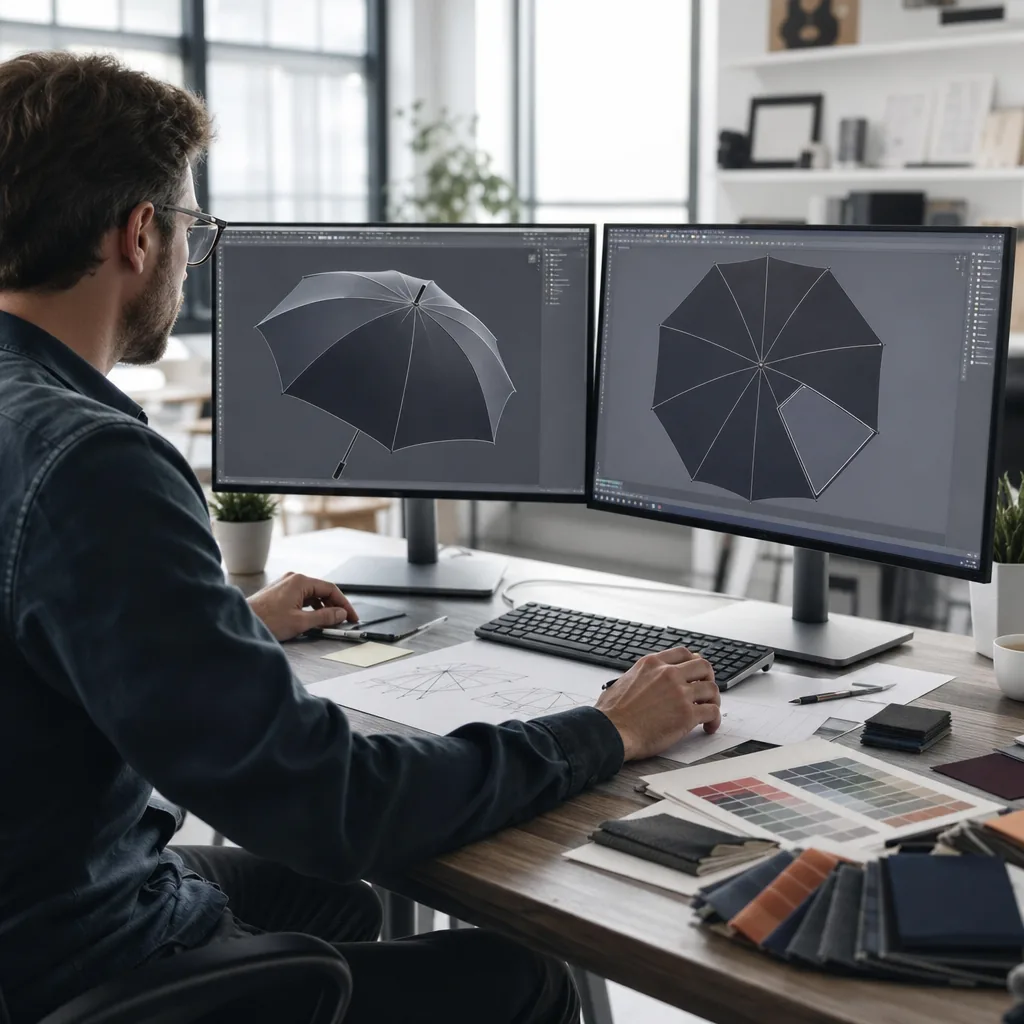
When a buyer approves umbrella branding, the logo method has to survive handling, weather, packing friction, and the real limits of each component. On our factory floor in Songxia, the choice between printing, molding, and a debossed umbrella logo usually comes down to surface material, order quantity, tooling cost, and how much detail the artwork needs to hold after production. Getting this right early prevents weak samples, delayed approvals, and logos that look good only in a mockup.
Debossed, printed, and molded branding on each component
Use a debossed umbrella logo where the hand repeatedly touches the product: EVA foam handles, PU leather grip wraps, rubberized straight handles, and heavy PVC sleeve patches. It is a tactile branding choice, not a long-distance visibility tool. On J-handles and straight golf handles, specify a 0.3-0.6 mm deboss depth; use a heated die for PU and a cold or lightly heated tool for EVA to avoid melted edges. Debossing is a poor fit for 190T/210T pongee canopy panels because the fabric lacks the body to hold a sharp depression. It also carries risk on plated metal ferrules, where stamping can crack the finish. For executive gifts, tone-on-tone debossing on black, navy, or dark gray grips usually looks more permanent than a small pad print and resists wear after repeated opening, closing, and handling.
Choose canopy print methods by artwork, fabric, and order size. Screen printing is the standard choice for promotional umbrella decoration on 21", 23", and 27" umbrellas with 1-3 solid Pantone colors; it is visible from roughly 10-20 meters and holds up through normal folding when the ink is fully cured. Heat transfer suits gradients, small text, and short runs, but thick film can crack near rib tips and other high-fold points. Sublimation works on white or light polyester panels and fits full-panel retail graphics better than simple corporate marks. POE, PVC, and EVA transparent canopies need compatible inks and longer drying time because solvent bite, blocking, and stacking marks show quickly. For outdoor events, one large canopy panel print carries more value than tiny ferrule branding because buyers can actually see it from a normal viewing angle.
Handles, straps, ferrules, and sleeves fail in different ways, so the decoration method should match the wear pattern. Handle branding faces sweat, sunscreen, and abrasion; molded-in logos, debossing, and laser marking outperform ordinary pad printing on high-use models. Pad print is acceptable on ABS handles for budget 8K manual umbrellas, but approve it only after tape and alcohol rub checks. Strap logos stay visible whenever the umbrella is closed; woven labels or screen print on a 15-20 mm strap usually outlast heat transfer when users wrap a wet canopy tightly. Ferrule branding works best as a premium detail: laser engraving on aluminum or molded marking on plastic looks clean, but the area is small and gets scraped in bags. Sleeves provide the largest secondary branding area, especially on golf umbrellas; screen print or stitched patches survive repeated storage and shipping compression better than thin transfer film. Confirm final choices in pre-production with AQL 2.5 visual limits and a handling test, not only a flat artwork proof.
Material limits by surface and attachment point
Material sets the decoration limit before artwork does. EVA foam handles accept molded debossing or a light heat press, but the surface rebounds after packing compression and sea-freight heat, so a debossed umbrella logo needs more depth than the same artwork on PVC or ABS. Smooth plastic handles are usually better for handle branding by pad print or heat-transfer label, but adhesion falls quickly on glossy PP unless the part is corona treated or primer coated first. Wood handles give the cleanest result for laser engraving and hot stamping, though grain density affects line sharpness; bamboo and stained beech show more variation than tighter-grain woods. Metal shafts, ferrules, and tips can be laser marked, etched, or enamel filled, but curved metal needs a rotary fixture. Without one, even a 40 mm logo can stretch or fade at the edges. Surface shape matters as much as material. Flat inserts, end caps, and nameplates hold registration better and produce fewer rejects than printing around a round J-handle or tapered ferrule. Ferrule branding can look premium on 27 inch to 30 inch straight umbrellas and golf styles, but ferrules are small, tapered, and handled during assembly, so scratch resistance usually matters more than color density. For promotional umbrella decoration on POE, PVC, and EVA transparent canopies, adhesion is the main risk because plasticizers migrate; flexible UV ink or low-temperature transfer films hold better than standard screen ink. On 190T or 210T pongee, the main canopy print methods are screen printing, heat transfer, and sublimation, with the best results on cut panels before final sewing, not across seams, rib pockets, or binding tape.
Branding near moving parts should be treated as a durability issue, not only a print issue. Steel ribs and stretchers have harder edges and less flex, so logos placed near the runner, notch, or spring see more abrasion during repeated opening and closing. Fiberglass frames are more forgiving because they flex under load, but they still create rubbing points at rib tips, tie points, and along the canopy where fabric shifts under tension. For auto-open and auto-open-close umbrellas, keep printed or coated branding about 15 to 20 mm away from the runner path, button slot, and top spring area; even a good coating can fail after roughly 300 open-close cycles if it sits in a wear zone. The safest approval method is a working pre-production sample, not a loose branded component. A logo that looks clean on a separate handle, ferrule, or button can fail once the umbrella is assembled and cycled. This is where buyers should weigh decoration choice against reject risk and AQL 2.5 inspection standards. A molded or laser-applied debossed umbrella logo on a fixed handle surface is typically lower risk than printing on a moving plastic button or on hardware touched during assembly. When lead time and claim risk matter, choose the flattest available surface, confirm adhesion on the actual substrate, and test logo placement on the finished frame before bulk production.
Durability, wash resistance, and order quantity tradeoffs
For hard parts, a debossed umbrella logo is the longest-wearing option on PP, ABS, and wood because the mark is pressed below the wear surface instead of sitting on top as an ink film. That advantage shows up fastest on handle branding and ferrule branding, where zipper teeth, wet sleeves, tabletop drag, car floor mats, and umbrella stands create constant abrasion. Pad print still has a place: it holds finer detail on a handle button, tip cup, or small ferrule face, and it usually carries a lower MOQ than a new deboss tool. The tradeoff is service life. Under rain, repeated wet-dry cycles, and contact with sunscreen or hand sanitizer, pad-printed edges usually wear first because the ink layer fails before the substrate. Ferrules are the harshest location since they take direct impact every time the umbrella is set down. If the logo must remain readable through a full commuting season, put debossing on the handle or other high-contact hard parts, and reserve ink-based decoration for lower-contact areas where visual detail matters more than maximum durability.
On the canopy, durability depends more on canopy print methods and fabric than on the artwork itself. Screen print on 190T or 210T pongee is the standard production choice for 1-3 spot colors and generally handles rain, folding, and normal storage well when curing is controlled; fold-line cracking is more often a curing problem than a water problem. Heat transfer suits gradients, photo artwork, and low-volume promotional umbrella decoration, but the transfer layer is usually the first failure point after repeated wet-dry cycles and tight sleeve storage. Compared with heat transfer, screen print is usually the safer choice for long-term wash and abrasion resistance on everyday umbrellas. Cost and timing often decide the method early: a new deboss tool for a handle insert commonly adds 7-12 days before a pre-production sample, and its MOQ is usually higher than pad print, while pad print can often begin at a few hundred units. Screen print is typically most economical at about 500-1,000 pieces per design. Ask for AQL 2.5 inspection when the order exceeds 3,000 pieces, combines canopy and component logos, or ships FOB to a third-party forwarder, since mixed decoration methods raise the risk of shallow deboss depth, off-center pad print, transfer misalignment, and color mismatch.
Artwork setup for small branding zones
Lock artwork rules before sampling because small branding zones expose weak files faster than canopy panels. For a debossed umbrella logo on a PU leather handle patch, silicone grip, woven strap, or plastic ferrule, require vector AI, EPS, or PDF files with outlined fonts, Pantone references, and written limits for line weight, text size, and detail loss. Set 0.25 mm as the minimum positive line for metal dies, 0.3 mm for heat transfer on straps, and avoid reversed lines under 0.4 mm; ink spread, die pressure, and material grain can close those gaps. Treat text under 5 pt as high risk on straps and ferrules, and text under 7 pt as poor value on textured handles. A 23 inch canopy panel can hold fine artwork, but a 10 mm strap label or 12 mm ferrule cap needs a simplified vector mark built at actual scale, not a reduced canopy logo.
Match the file to the production process, not the sales mockup. Canopy print methods support more detail than handle branding or ferrule branding, but 190T and 210T pongee still move during printing, curing, and panel sewing. Screen printing works best for solid spot colors, usually 1 to 4 Pantone colors, with trap allowance for curing and fabric stretch. Heat transfer can reproduce smaller shapes and gradients, but the film may feel heavier on the canopy and can crack if coating, film, and curing temperature do not match. Sublimation suits full-panel polyester artwork and retail patterns, not small strap logos or ferrule branding. For promotional umbrella decoration on curved, narrow, or elastic parts, simple vector marks outperform gradients, hairline icons, and tiny legal copy because they survive tooling, pressure, and AQL 2.5 inspection with fewer revisions.
Write component tolerances into the tech pack before approving a debossed umbrella logo. Specify target depth, acceptable edge softness, center position, and color-fill registration if the recessed mark is painted. On rubberized handles, 0.2 to 0.4 mm deboss depth is usually enough; deeper tooling can deform thin strokes or leave shiny pressure marks around the logo. Ferrules carry extra geometry risk because a flat mark wrapped around a small cone compresses visually at the edges, so the proof should show the part at 1:1 scale. Approve a physical component proof before bulk production, then inspect against AQL 2.5. Use position tolerance of +/- 1.5 mm on straps and +/- 1.0 mm on rigid handle badges unless the factory confirms tighter control. Clean files reduce die changes, approval delays, and shipment disputes after FOB Ningbo or Shanghai space is booked.
Buying specs for repeat programs
For repeat programs, treat promotional umbrella decoration as a controlled buying spec, not an artwork note. List the approved method by component: canopy print methods such as 1-color screen print on 190T pongee, heat transfer on coated 210T, or sublimation on white polyester; handle branding by deboss, pad print, laser, or metal badge; ferrule branding by laser mark or molded color insert. For a debossed umbrella logo, specify die size, logo depth, handle material, surface finish, and whether the mark is blind deboss or color fill. Define placement from fixed product points instead of photos: canopy logo 120 mm above the rib tip, centered on one panel, 180 mm wide; handle logo 35 mm wide, facing the runner when closed. Add Pantone coated or uncoated references and tolerance rules for dark fabrics, since white ink on navy pongee will not read the same as white ink on clear POE.
Include packaging in the decoration spec because it affects unit cost, labor time, carton cube, and inspection. State whether each umbrella ships in a plain OPP sleeve, printed sleeve, belly band, gift box, or retail carton with barcode, and approve carton marks before mass production. For a 23 inch auto-open repeat order, plan 25 to 35 days after deposit and artwork approval; deboss tooling, custom ferrules, color-filled handles, or retail packaging can add 7 to 12 days. Keep the signed golden sample, final artwork, Pantone callout, carton mark layout, and AQL 2.5 inspection checklist under one order code so QC checks production against the same file set. Lock commercial terms in the PO: FOB Ningbo or Shanghai transfers freight control after port handover, while DDP Los Angeles, Hamburg, or Sydney must state duty, destination handling, and last-mile delivery responsibility.
When changing factory or umbrella model, revalidate every surface that controls decoration risk. A logo approved on a straight plastic handle may not fit a curved EVA foam grip, and a debossed umbrella logo that is sharp on ABS can lose edge definition on a rubberized coating. Canopy behavior changes by substrate: 190T pongee, 210T pongee with Teflon coating, PVC, EVA, and POE need different ink systems and curing temperatures. Panel size and tension also change the result; a 21 inch folding auto-open-close umbrella has less printable area than a 30 inch golf umbrella, and 8K steel ribs can tension panels differently from 10K or 16K fiberglass ribs. Before transfer approval, require a pre-production sample using the actual frame, canopy color, handle, ferrule, sleeve, and carton. Reconfirm MOQ, die ownership, setup charges, spare parts, barcode position, inner carton count, gross weight, lead time, and whether the quoted FOB or DDP price still applies.
Frequently Asked Questions
Which umbrella parts are best for debossed branding instead of print?
Debossing works best on thicker, stable surfaces such as EVA or molded plastic handles and some straps. It is usually less effective on thin or flexible parts that do not hold a clean impression.
When should a buyer choose print instead of debossing?
Choose print when the logo needs color, small text, or faster production at a lower tooling cost. Print is also the better option when the branded area is small and the mark must stay readable from a distance.
Which umbrella components are best suited for debossed logos?
Debossing works best on soft-touch, rubberized, EVA, PU, or leather-look handles where the material can hold an impression. It is usually not suitable for fabric canopies or very hard plastic parts unless a molded logo is built into the tooling.
Does ferrule branding require a higher MOQ than canopy printing?
Often yes. Canopy screen printing can usually start around 500-1,000 pieces, while custom ferrule branding may require 1,000-3,000 pieces depending on whether the logo is printed, laser marked, engraved, or made with custom metal tooling.
What artwork files are needed for debossed or molded umbrella logos?
Factories typically need vector artwork in AI, EPS, or PDF format with outlined fonts and clear logo dimensions. For debossed or molded logos, avoid very thin lines under about 0.3 mm because they may not reproduce cleanly in production.
Looking to Launch Your Custom Umbrella Line?
ZheBrella is a Zhejiang-based OEM/ODM umbrella manufacturer with 17 years of export experience. Free design, low MOQ from 100 pieces, windproof construction, full-color print.
Get Free Quote Now »People Also Search For
Related Articles
Choosing Print Areas Beyond the Canopy for Branded Umbrellas
Extend umbrella branding beyond the canopy with practical guidance on straps, sleeves, ferrules, and tips that improve v...
Read More »
Embroidery or Print on Umbrellas: Brand Visibility Tradeoffs
Compare embroidery and print for umbrellas, including durability, setup costs, visibility, and MOQ so buyers choose the ...
Read More »Debossed, Engraved, or Printed Logos on Umbrella Handles
Compare debossing, engraving, and pad printing on umbrella handles by material, MOQ, cost, and durability for stronger b...
Read More »