Gradient Logo Printing on Umbrellas for Retail Brand Lines
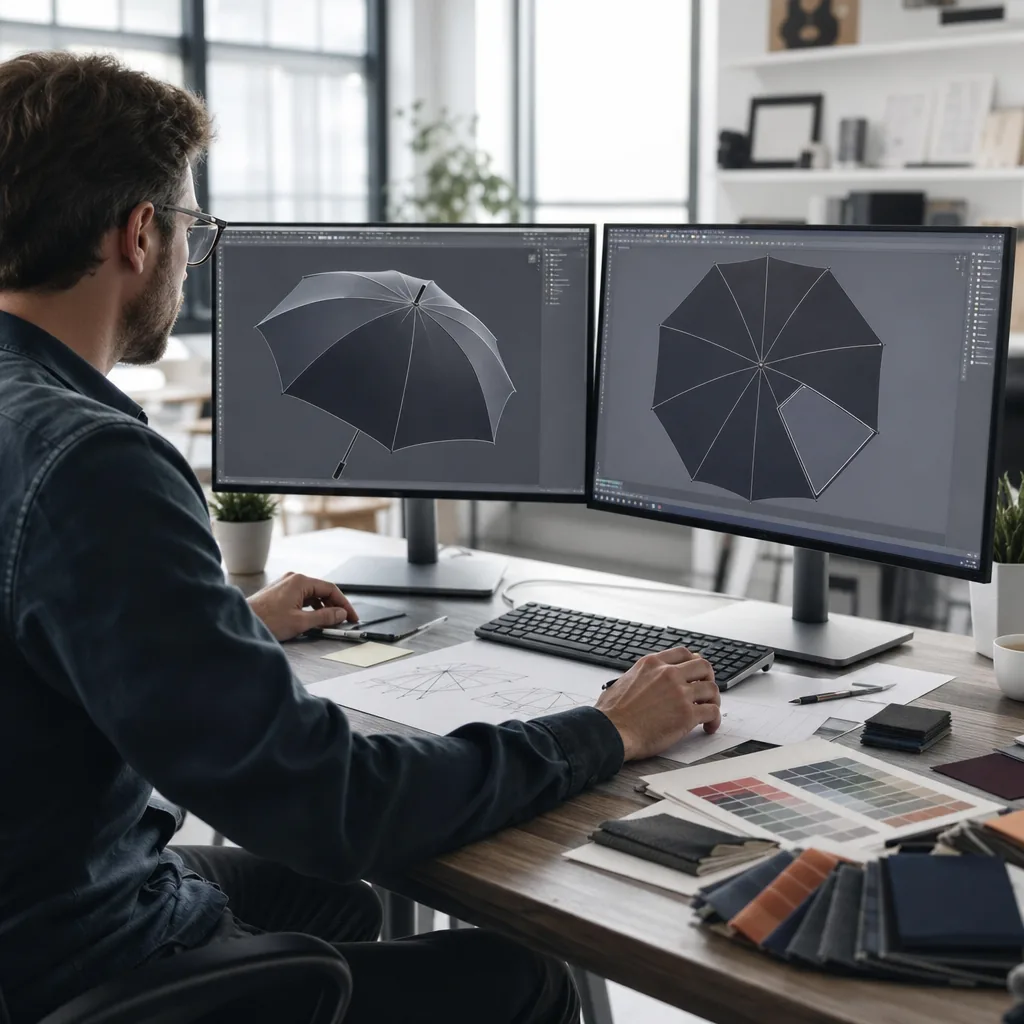
Retail buyers often approve a gradient logo on screen, then discover the real challenge is holding that fade across curved panels, coated fabrics, and repeat bulk runs. On our Songxia factory floor, gradient umbrella printing starts with matching the print method to the canopy fabric, checking color drift after heat or drying, and locking a sample before cutting thousands of panels. The earlier these tolerances are defined, the fewer surprises show up in shipment inspection.
Where Gradient Branding Fits in a Retail Umbrella Range
Gradient branding works best when the umbrella is treated as a retail SKU, not a giveaway item. Fashion capsules, seasonal color stories, licensed illustrations, museum-shop artwork, and limited drops all benefit because the customer is buying visual identity first and rain protection second. For these programs, gradient umbrella printing lets a brand carry ombré backgrounds, sunset palettes, metallic-look fades, or soft shadowed logos across multiple panels without the hard edges of screen printing. I normally push buyers toward digital umbrella printing or sublimation on 190T or 210T pongee when the artwork has more than 4 spot colors, because CMYK panel matching is cleaner than trying to split gradients into screens. For umbrella artwork approval, request one strike-off on production fabric, not just a PDF mockup, because rib seams, panel curvature, and canopy tension can shift a fade by 3–5 mm at the stitched edge.
Model choice depends on where the brand wants the gradient to be seen. An 8K compact, usually 21" or 23", is the best fit for handbag retail, travel sets, beauty-brand gifts-with-purchase, and seasonal drops where carton volume and unit cost matter; use fiberglass ribs if the retail price supports it, or steel ribs for tighter promotional margins. A 16K golf umbrella, usually 27" or 30", gives the most impressive canvas for gradient logo umbrellas because the extra ribs reduce panel width, making all-over artwork smoother and more premium when opened. Straight umbrellas sit between those two: a 23" or 25" auto-open straight model works well for department-store private label, hospitality retail, and licensed character lines where handle shape, shaft finish, and hangtag presentation matter as much as the canopy print.
For branded retail umbrellas, I would not use gradient artwork on the cheapest frame unless the buyer accepts a clearly promotional look. A double-canopy vented 16K golf model with fiberglass ribs can survive 50+ mph wind-tunnel testing and gives enough structure to keep printed gradients from looking wrinkled under tension. Compact models need tighter inspection because folded fabric can expose slight panel-to-panel color variation; our standard practice at ZheBrella is to check gradient alignment during in-line sewing and final AQL 2.5 inspection, not only after packing. For retail launches, plan MOQ around print method: digital print can support lower mixed-artwork runs, while sublimation and custom-dyed pongee are better once the order reaches larger seasonal volumes. Normal production timing is about 25–35 days after artwork approval, with FOB Ningbo or Shanghai fastest and DDP adding roughly 10–18 days depending on destination customs.
Choosing Digital Print, Transfer, or Screen Print
Digital print is the safest choice when the logo has a true fade, shadow, glow, or multi-color transition across the panel. With digital umbrella printing, we print the CMYK image directly onto cut pongee panels before sewing, so the gradient is not broken by rib positions or panel seams. On 190T and 210T polyester pongee, a well-profiled machine can hold smooth tonal steps much better than screen print, especially in blue-to-purple, orange-to-red, or black-to-transparent fades. For branded retail umbrellas, I usually recommend digital for full-panel graphics, photographic backgrounds, and gradient logo umbrellas where the buyer expects the sample to match a Pantone-heavy brand guide closely. The tradeoff is unit cost: there is less plate setup, but slower print speed and more ink cost, so it often makes sense from 100 to 1,000 pieces, depending on size, panel count, and whether the order is 21 inch folding, 23 inch stick, or 30 inch golf umbrella.
Heat transfer works when the gradient logo is small, isolated, and does not need to wrap across seams. The factory prints the artwork on transfer film, then presses it onto finished or semi-finished canopy panels using heat, pressure, and dwell time; common temperatures sit around 150 to 170°C, depending on film and fabric coating. This method is useful for a chest-style retail mark, a sponsor logo on one panel, or a short-run promotional job where MOQ is tight and the buyer wants clean edges without opening a full digital print schedule. But I do not like heat transfer for large gradients on umbrellas that will be folded hard every day, because thick transfer layers can feel plasticky and may crack sooner than ink bonded into the fabric. On Teflon-coated pongee, adhesion must be tested before mass production; otherwise a logo can pass the first visual check and fail after wet rub or repeated opening and closing.
Screen print is still the workhorse for flat spot colors, not smooth fades. If the logo is one to four solid Pantone colors, screen printing gives strong opacity, predictable cost, and fast output once the screens are made. Setup cost is higher because each color needs a screen and registration work, so MOQ pressure is real: below 300 pieces, the plate charges can make the unit price look ugly; above 1,000 pieces, it becomes very efficient. For gradient umbrella printing, screen print can fake a fade with halftone dots, but on umbrella fabric those dots often look coarse, especially on curved panels viewed in daylight. Umbrella artwork approval also differs by process. For digital and transfer, we normally ask for vector logos plus a high-resolution gradient file, then provide a digital mockup and pre-production sample. For screen print, we approve Pantone numbers, film separations, and a strike-off before bulk sewing; our standard practice at ZheBrella is to lock artwork only after the buyer signs the panel proof.
Fabric, Panel Count, and Color Smoothness
Fabric choice decides whether a gradient looks premium or muddy before the printer even starts. On 190T pongee, the weave is tight enough for retail umbrellas but still has a slightly open hand, so disperse and pigment inks sink in a little and soften hard banding. That helps pastel fades, smoke effects, and watercolor-style logos, but very fine color transitions can lose edge definition after drying. 210T pongee carries a denser yarn count and smoother face, so gradient umbrella printing usually holds cleaner transitions and deeper blacks, especially on navy, charcoal, or full-panel artwork. The tradeoff is that bad artwork preparation becomes more visible: a low-resolution gradient that looked acceptable on 190T may show stepping on 210T. For branded retail umbrellas, I prefer 210T pongee when the logo fade is part of the design language, not just a decorative background.
Coated fabrics change the ink behavior more than many buyers expect. A Teflon water-repellent finish can reduce surface wetting, so the ink system and drying curve need to be matched; otherwise, a smooth gradient turns speckled at the light end. UPF 50+ coated pongee, usually with a silver, black, or color UV layer on the underside, gives better sun protection but can make the canopy slightly stiffer and less forgiving during heat-transfer positioning. For digital umbrella printing, we normally ask for a physical strike-off on the exact fabric, not a generic swatch, because 190T pongee, 210T pongee, and UV-coated cloth can shift the same Pantone target differently after curing. This is where umbrella artwork approval should include both open-canopy photos and close-up panel shots under daylight, not only a flat PDF proof.
Panel count is the second big limiter for gradient logo umbrellas because every seam cuts through the artwork. An 8K umbrella has eight larger panels, so each printed section gives the eye more uninterrupted color travel; it is usually the safer choice for large radial fades, oversized retail logos, or a gradient running from crown to edge. A 16K umbrella looks more architectural and high-end, but the extra seams create sixteen visual breaks, and even a 2 mm sewing tolerance can misalign a continuous fade. On double-canopy vented windproof models, the problem doubles because the top vent and lower canopy may not sit in the same visual plane after assembly. Our standard practice at ZheBrella is to split artwork by sewn panel shape, add bleed beyond the seam allowance, and review the assembled sample before bulk production, because a perfect print panel can still look wrong after stitching.
Sampling, Tolerance, and Bulk Quality Control
Pre-production sample approval is where gradient umbrella printing either gets controlled or becomes a dispute later. For branded retail umbrellas, I do not release bulk fabric until the buyer signs off a physical strike-off or full umbrella sample, not just a PDF mockup. The file should be supplied in AI/PDF with embedded Pantone or Lab targets, but gradients are judged on fabric under D65 light, because 190T pongee, 210T pongee, POE, and PVC all hold ink differently. Our standard practice at ZheBrella is to compare the sample against the approved artwork at 50 cm viewing distance and also check close-up at seam zones, tips, and crown area. For umbrella artwork approval, the buyer should confirm logo size, gradient direction, panel sequence, handle label, sleeve print, and carton mark in one signed sample sheet. If the umbrella has 8 panels, every panel needs a numbered layout so the sewing line does not rotate the artwork by mistake during assembly.
Acceptable color variation must be defined before bulk cutting, especially for gradient logo umbrellas where one side of the logo may fade from 100% ink to 10% tint. For digital umbrella printing, I usually recommend a tolerance of Delta E 3.0 to 5.0 depending on fabric and coating; tighter than Delta E 3 on water-repellent pongee is possible but raises reject rates and cost. Panel alignment is checked after sewing, not only after printing, because a 2 mm print shift can become a 5 mm visual mismatch once the canopy is tensioned on a 23 inch or 27 inch frame. Critical points are the seam crossing, center cap area, and the outer arc near the tips. On double-canopy vented windproof models, the top and lower canopy must be inspected separately because the vent overlap can hide banding during flat-table review but expose it when opened.
Bulk inspection should be written at AQL 2.5 for major defects, with critical defects set to zero tolerance if the brand mark is unreadable, reversed, or heavily contaminated. For gradient umbrella printing, inspectors need a defect board that includes banding, ghosting, ink mist, seam mismatch, registration drift, pinholes, dirty transfer edges, and visible panel-to-panel density changes. Print rub resistance should be tested with dry and wet cloth rubbing, plus tape pull where heat-transfer film is used; weak adhesion often appears first near folded ribs because the canopy is creased repeatedly during packing. I also check opening and closing 20 cycles on sampled units, because print cracking can show after the fabric moves over steel or fiberglass ribs. Final QC should include canopy diameter, rib count confirmation such as 8K or 10K, UPF 50+ or Teflon coating verification if claimed, sleeve matching, barcode scan, and carton drop condition before FOB or DDP shipment release.
Cost, Lead Time, and Shipping Planning
Cost planning for gradient umbrella printing starts with MOQ, because the printing method and fabric choice set the real floor. For digital umbrella printing on 190T or 210T pongee, we usually quote practical MOQs around 500–1,000 pcs per design, while simpler gradient logo umbrellas using heat transfer panels can sometimes start at 300–500 pcs if the frame is a stock 21", 23", or 27" model. A retail-grade 23" auto-open umbrella with fiberglass ribs, 8K frame, pongee canopy, custom gradient logo, sleeve, hangtag, and barcode carton will usually price very differently from a basic steel-rib promotional unit, so buyers should not compare only canopy diameter. Pre-production samples normally take 7–12 days after umbrella artwork approval, longer if the gradient needs color correction across seams. Bulk production is typically 25–35 days after sample sign-off and deposit, but 16K frames, double-canopy vented windproof construction, UPF 50+ coating, or custom handles can push that to 40–50 days.
Peak season is where many retail launches get squeezed. From March to June, frame workshops in Songxia are full, dyeing mills are busy, and printing lines queue fast; I tell brand buyers to add at least 10–15 days of buffer if delivery is tied to spring rainwear, back-to-school, or holiday retail sets. Custom color fabric dyeing is another trap: matching a Pantone ground color on pongee is not the same as printing a logo on white fabric, and lab dips plus bulk dyeing can add 10–20 days before cutting even starts. For branded retail umbrellas, gradient placement must be checked on a full sewn canopy, not only on flat artwork, because rib seams interrupt the fade and can make a smooth logo look stepped. Our standard practice at ZheBrella is to approve one printed canopy panel set before full assembly when gradient risk is high.
FOB Ningbo or Shanghai makes sense when the buyer or distributor already controls ocean freight, consolidates with other goods, or has a customs broker handling HS code, duty, and domestic trucking. DDP is better for smaller retail programs, Amazon-style replenishment, event planners, or brands without import staff, because the factory-side forwarder can bundle export customs, ocean or air freight, destination duty, and final delivery into one landed cost. For umbrellas, carton planning matters because long shafts and retail packaging waste space quickly: a 23" straight umbrella may ship 24–36 pcs per master carton, while compact 21" folding styles may pack 50–60 pcs depending on sleeve and gift box. Retail carton requirements should be confirmed before mass production, including FNSKU or EAN labels, inner carton counts, drop-test strength, desiccant, warning labels for POE/PVC/EVA styles, and AQL 2.5 inspection access before sealing.
Frequently Asked Questions
Can a gradient be printed across multiple umbrella panels?
Yes, but seams and rib positions will break the image slightly. A 16K umbrella has narrower panels, so the artwork must be separated more carefully than on an 8K canopy.
Is digital printing always better for gradient umbrella artwork?
Digital printing is usually the best option for smooth color transitions and photo-style effects. For a small gradient logo, heat transfer may be more cost-effective if the design area is limited.
Which printing method is best for gradient logos on retail umbrellas?
Digital printing is usually best for gradients, shadows, photographic artwork, and multi-color retail graphics because it avoids screen setup limits. Screen printing is better for simple solid-color logos and lower unit cost at high volumes.
What artwork files are needed before umbrella sampling?
Factories typically need vector AI, EPS, or PDF files for logos, plus Pantone references and a canopy panel layout showing print size and placement. For digital prints, a 300 dpi raster file at actual print size may also be required.
How long does approval and bulk production take for gradient logo umbrellas?
A printed sample usually takes 7–12 days after artwork confirmation, with bulk production around 30–45 days after sample approval and deposit. Complex digital prints or custom-dyed fabric can add 1–2 weeks.
Looking to Launch Your Custom Umbrella Line?
ZheBrella is a Zhejiang-based OEM/ODM umbrella manufacturer with 17 years of export experience. Free design, low MOQ from 100 pieces, windproof construction, full-color print.
Get Free Quote Now »People Also Search For
Related Articles
Gradient Color Umbrella Canopies for Retail Brand Lines
Build gradient umbrella designs with realistic color control, panel matching, fabric choices, and approval steps for ret...
Read More »
Gradient Umbrella Printing for Retail and Event Campaigns
Plan gradient and photo umbrella prints with realistic color control, fabric selection, panel alignment, sampling steps,...
Read More »
Gradient and Photographic Umbrella Prints for Brand Campaigns
Plan photo, gradient, and all-over digital umbrella prints with file specs, 190T/210T fabric choices, panel seams, lead ...
Read More »