Incoming Material Inspection Standards for Umbrella OEMs
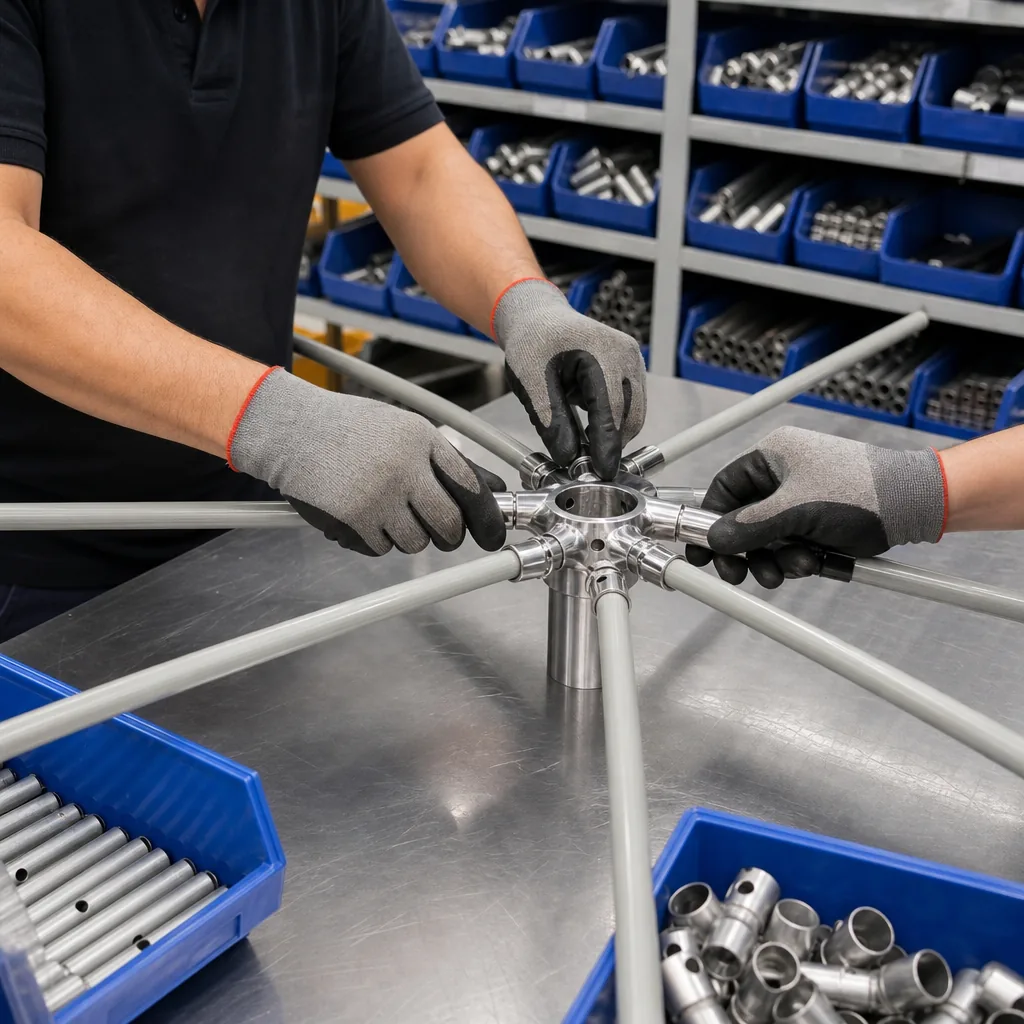
An umbrella that fails mid-season doesn't start as a factory mistake—it begins with fabric that's off-spec or a rib that's a millimeter too thin. For OEM buyers, skipping rigorous umbrella incoming material inspection means absorbing the cost of field returns and shipment rejections that could have been caught at the dock. We see this weekly on our floor in Songxia, where a few minutes of incoming checks saves weeks of rework later.
Define What Must Be Checked Before Production
Umbrella incoming material inspection begins with frames, ribs, shafts, and springs. For a 16K fiberglass rib, check flex modulus and surface finish—micro-cracks or uneven resin cause failure above 50 mph winds. Steel shafts must stay straight within 0.5 mm deviation and pass a salt-spray test confirming chrome or electrophoretic coating survives 12 months without rust. Springs need compression set and cycle-life testing; one losing tension after 500 cycles turns an auto-open mechanism into a warranty claim. Rejecting nonconforming lots before assembly avoids tearing down finished goods, which triples per-unit labor costs. At ZheBrella, this gate cuts downstream rework by 60%.
Pongee fabric inspection is the second critical gate: verify weight, weave integrity, and coating performance. A 190T versus 210T pongee differs by 15–20 g/m², directly affecting drape and tear strength. Scan for slubs and missing picks, then run a hydrostatic head test—minimum 600 mm water column for standard umbrellas, 1000 mm for golf models. Thin or uneven PU backing delaminates within 50 open-close cycles; UV-stabilized coatings require spectrophotometer verification to back a UPF 50+ claim. Color fastness to light and crocking is tested because dye bleeding onto clothing triggers a recall. Rejecting subpar fabric at receiving prevents cutting-department waste of 2–3 hours on material that should never reach the knife.
Handles, tips, and packaging are small components with outsized failure costs. Wooden handles require 8–12% moisture content to avert cracking in dry climates; glue joints undergo pull-force testing. Plastic handles are inspected for sink marks and sharp parting-line flash that injures users. Tips must withstand a 15 kg pull-off force—a detached tip creates both a safety hazard and a useless product. Packaging materials face incoming checks: corrugated box burst strength, polybag thickness of at least 0.04 mm to prevent transit tears, and barcode scannability. Catching weak cartons before filling costs roughly $200; discovering collapsed boxes at the port means repacking 500 units under demurrage charges. At ZheBrella, a 2–3% incoming rejection rate keeps final AQL 2.5 audits below 1.5% defects.
Inspect Frame Materials and Mechanical Parts
Umbrella incoming material inspection should start with the frame, because rib and shaft defects become expensive after the canopy is sewn. For fiberglass rib inspection, verify diameter, wall thickness, length, and rib count against the approved drawing, then flex a sample set to confirm the fibers do not split, whiten, or delaminate. For steel ribs, inspect plating condition by visual check and, where required, cross-hatch tape pull; reject pinholes, flaking chrome, dull spots, or thin zinc coverage that can rust in transit or storage. Compare random rib weights within the bundle against the signed sample, because a noticeably light batch usually points to thinner wall stock or lower-grade steel. Confirm hole placement, end forming, and rib finish before the lot reaches assembly, since these details drive umbrella raw material quality and reduce rework.
Shaft inspection matters just as much, especially on auto-open frames. Measure outer diameter, inner diameter, and wall consistency on the middle and lower tubes with a micrometer, then confirm the tube slides smoothly under spring load without binding or excess play. Inspect spring force as a mechanical spec, not a visual judgment: record free length, compress the spring on a fixture, and compare recovery after cycling; reject parts that lose tension or return unevenly. Check the auto-open button, slider, and lock point for fit and alignment, because poor tolerances show up first as hesitation, sticking, or incomplete opening. These checks belong in umbrella incoming material inspection because a loose shaft or weak spring turns into assembly delay, higher scrap, and field failure risk.
For 8K and 16K frame sets, lay the full assembly on the approved mold or gauge and verify that the rib geometry matches the intended canopy size. A 23-inch frame should open to the same span as the approved sample, with no twisted arms, uneven spoke spacing, or offset ferrules. The same applies to 21-inch, 27-inch, and 30-inch builds: the rib set must match the mold, or the canopy will pucker, sag, or carry uneven tension at the corners. Check plating on springs, rivets, and sliding hardware for uniform coverage and no early corrosion. This keeps OEM quality standards tied to the actual frame hardware, not just the sewing sample, and gives you a practical control point before production consumes fabric and labor.
Verify Fabric Lots Against Approved Specs
For umbrella incoming material inspection, fabric is where most avoidable claims begin. Compare every roll of pongee 190T or 210T against the approved swatch under the same light, then record color, hand feel, width, and visible defects before the cloth reaches cutting. Check width at both ends and the center, not one spot, because a few millimeters of shrink or over-width can change panel yield and throw off sewing alignment. Hold or reject any lot with shade drift, yarn slubs, broken picks, coating streaks, oil marks, pinholes, or edge waviness. Tie each roll to the PO, lot code, and approved sample so umbrella raw material quality stays traceable back to the supplier if a deviation shows up later.
When the order calls for sun protection, pongee fabric inspection needs lab or supplier verification, not just visual approval. Ask for documentation on coating type, water repellency, and any UPF 50+ claim, and make sure the report states the test method, sample lot number, and production date. If the supplier changed the finish, coating weight, or heat-setting process, update the approved spec before release. A coating can look uniform and still fail after finishing if the add-on is unstable or the repellency treatment was applied unevenly. For OEM quality standards, the record should name the exact base cloth, color code, coating side, and performance target so rejection is based on the spec, not a dispute at sewing.
Keep the same discipline used for fiberglass rib inspection: no paperwork, no approval. Verify that the cloth marked 190T or 210T matches the contract sample before cutting starts, and hold any roll with shade drift, width variance, or weak repellency for recheck instead of sending it to sewing, where scrap cost appears later. In private-label programs, this umbrella incoming material inspection step should apply to every PO, not just first articles, because fabric substitution and finish changes are common when supply is tight. Lock the lot to the spec early, or the factory absorbs rework, delay, and chargebacks after the panels are already cut.
Use Sampling Rules and Acceptance Criteria
Lot-based umbrella incoming material inspection follows ANSI/ASQ Z1.4 (MIL-STD-1916 equivalent). Each shipment of fiberglass ribs, steel shafts, or pongee fabric rolls is sampled at Level II for structural components and Level S-3 for fabric rolls. Critical defects—broken rib joints or fabric tears—require zero tolerance; major nonconformances (coating thickness, rib length tolerance) are capped at ≤1.0%. Failed lots trigger 100% sorting or return to supplier. This locks in umbrella raw material quality before assembly, enabling downstream final inspection to reliably hit AQL 2.5 on 10,000-unit FOB orders.
Normal vs. tightened inspection adjusts sample size based on history. Two consecutive lot failures double the sample and lower acceptance numbers; 10 consecutive passes allow reduced inspection (40% smaller sample). For fiberglass rib inspection, we measure straightness (max 2 mm bow over 27 inches) and flexural strength via 3-point bend test. Pongee fabric checks include roll width (±1 cm), gram weight (190T: 55–60 gsm), and colorfastness (ISO 105-B02, xenon-arc). All data enters a digital SPC log to flag trends before defects occur.
Criteria tie directly to OEM quality standards. UPF 50+ canopies are tested via spectrophotometer (ASTM D6603); any lot below UPF 55 is rejected to account for variance. Auto-open-close mechanisms undergo a 500-cycle durability test on 50 units per lot—>2 failures rejects the lot. This preemptive rigor means final AQL 2.5 inspection on a 10,000-unit FOB Shanghai order rarely exceeds 0.5% defect rate. Umbrella incoming material inspection is the first gate preventing downstream rework, delays, and chargebacks.
Connect Incoming QC to Cost and Delivery Reliability
Incoming inspection directly controls on-time delivery and unit cost. For a 10K fiberglass rib frame, we sample to AQL 2.5 and test flexural strength plus diameter tolerance to ±0.1 mm on a 3.8 mm rod. A batch that drifts oversize jams manual-assembly rivet jigs, causing 3–4 day line stoppages. On a 30-day FOB order for 5,000 units, that forces air-freighting replacement ribs at $2.80/kg or missing vessel cut-off — both erase margin on a $3.25 EXW umbrella. Catching defects before the cutting table prevents emergency sourcing and keeps production schedules intact.
If a buyer orders at the factory MOQ of 500 pieces per color and we reject 15% of a 210T pongee lot for inconsistent warp tension, we cannot simply order 75 more meters — the mill minimum is 1,000 meters per dye lot. That forces cannibalizing fabric from the next run (delaying that PO) or negotiating a partial re-dye adding 12–14 days and a $0.18/unit surcharge. Buyers on DDP terms absorb demurrage and detention costs while waiting for replacement materials — costs eventually priced into the next quotation. Smart buyers build a 3–5% material buffer into their MOQ to insulate against umbrella incoming material inspection fallout, reducing risk of line shutdowns and shipment delays.
The costliest failure is a latent defect that passes incoming inspection and surfaces during final AQL. We once received auto-open mechanisms whose spring steel met Rockwell hardness cert but had micro-inclusions from poor melt practice. Springs passed our bench test but fractured after 200 cycles during finished-goods audit — we stripped and reworked 2,400 units, sourcing replacements from a Yongkang supplier at a 22% premium with a 9-day lead time. Under an FOB Ningbo schedule, that pushed the container from a Tuesday sailing to Saturday, triggering $340 in port storage. Since then, we added a 500-cycle fatigue sample to incoming spring inspection. Rigorous umbrella raw material quality control at the receiving dock costs far less than the one batch you let through.
Frequently Asked Questions
Should buyers ask for incoming inspection records from the umbrella factory?
Yes. Records for fabric lots, frame components, and mechanism checks help confirm that the factory is controlling defects before assembly, especially on repeat OEM programs.
How often do fabric lot differences affect production quality?
Frequently enough to matter. Even when both lots are labeled 190T or 210T pongee, differences in shade, coating uniformity, or weave defects can create visible inconsistencies in bulk production.
Which umbrella materials should be checked before mass production starts?
For OEM umbrella orders, incoming checks should cover fabric rolls, fiberglass or metal ribs, shafts, stretchers, handles, tips, caps, springs, runners, and automatic open-close mechanisms. A practical buyer-supplier QC plan should also verify color, coating, GSM, frame size, rivet strength, and mechanism function before cutting fabric.
How much incoming material should be sampled for an umbrella order?
Example assumption to verify in the supplier quote: inspect 10% of fabric rolls per color and lot, pull 1 meter per selected roll for shade and coating checks, and test at least 32 frame sets per SKU before production release. Larger retail orders may require AQL-based sampling agreed in the purchase order.
Can poor incoming inspection delay umbrella shipment dates?
Yes. If fabric shade, rib flexibility, shaft diameter, or runner fit problems are found after cutting or assembly, rework can add several working days and may require replacement materials. As a quote assumption to verify, many OEM schedules reserve 1-2 working days after material arrival for incoming QC before bulk production starts.
Looking to Launch Your Custom Umbrella Line?
ZheBrella is a Zhejiang-based OEM/ODM umbrella manufacturer with 17 years of export experience. Free design, low MOQ from 100 pieces, windproof construction, full-color print.
Get Free Quote Now »People Also Search For
Related Articles
Umbrella Factory Incoming QC for Fabric, Frames, and Parts
Build an incoming QC plan for pongee fabric, ribs, shafts, handles, and cartons before mass production to reduce defects...
Read More »
Incoming Material Inspection for Bulk Umbrella Orders
Learn which fabric, frame, coating, and packaging checks to run before umbrella production to reduce defects, delays, an...
Read More »
Umbrella Frame Assembly QC: From Ribs to Final Opening
Learn how factory line QC controls rib riveting, runner fit, frame tension, and opening cycles before AQL 2.5 final insp...
Read More »