Inside-Panel and Under-Canopy Branding for Umbrella Campaigns
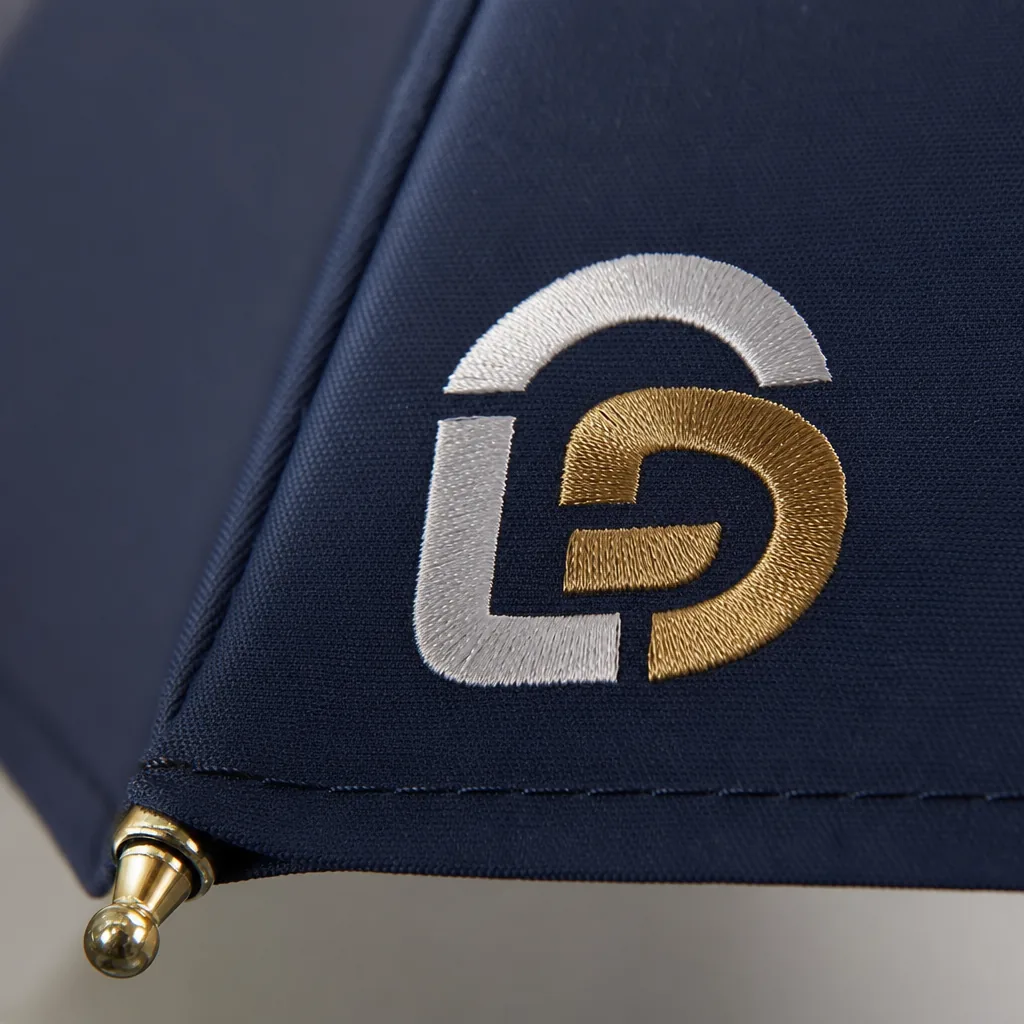
For OEM umbrella buyers, the challenge is not whether a logo can be printed, but whether it will still read cleanly when the canopy opens, flexes, and dries after repeated use. Inside canopy branding can create a strong reveal effect, yet the usable print area is limited by panel seams, venting, fabric stretch, coating behavior, and the way color shifts under backlight. On the factory floor, those details determine placement, proof approval, lead time, and whether the finished umbrellas match the campaign brief.
What inside-canopy branding looks like in production
Inside canopy branding places the graphic on the inner face of the canopy instead of the rain-facing exterior, so the logo appears only when the umbrella is opened and viewed from below. In production, the print can sit on a single inner panel, repeat on alternating 8K or 10K gores, run as a full inner ring, or lock up near the center hub where the ribs meet. That layout has to follow the frame geometry, not the flat pattern on screen. A 21-inch compact has less usable print width and a shorter viewing distance; 23-inch, 27-inch, and 30-inch frames give more room for a clean arc, a repeated slogan, or a centered mark with better legibility in photos.
The visible effect changes with the viewing angle. From the side, under canopy umbrella print is mostly hidden; once opened overhead, the art reads as a reveal; in event photography taken from below, alternating panels create a repeating pulse while a full inner-circle layout gives the strongest camera hit. That is why umbrella campaign branding often uses this placement for trade shows, stadium queues, shuttle loading zones, and other moments where the umbrella is held open in public but seen from underneath. A promotional umbrella factory has to size the artwork to the true printable area, accounting for seam allowances, rib pockets, and the ferrule zone, because tension after sewing can pull a centered flat mockup off-axis.
Method choice follows fabric and detail level. On 190T or 210T pongee, sublimation handles full-color graphics, gradients, and photographic artwork with good coverage across inner panels. Screen print is lower cost and faster for 1-color or 2-color logos, especially on simpler runs with tighter lead times. POE and PVC canopies can also carry hidden logo umbrella print, but ink adhesion and finish compatibility become the main control points. For production planning, the practical questions are simple: how much uninterrupted panel space the frame gives you, whether the logo needs to read from beneath or only in close-up, and whether the job needs a low-cost spot print or a higher-coverage process built for broader color.
Best campaign uses for hidden or surprise branding
Inside canopy branding is most effective when the camera sees the person before it sees the umbrella. That is why it outperforms exterior-only print at street launches, marathon villages, golf hospitality, stadium queues, and field activations built around front-facing photos. When the user tilts the canopy back, the artwork frames the face instead of disappearing into the top shell, so the brand stays legible in spectator shots, social clips, and press photography. For these programs, buyers typically specify 23-inch or 27-inch auto-open frames with fiberglass ribs rather than steel, because ambassadors carry them for hours and need better flex in gusts. If the event exposure is outdoor and windy, a vented double-canopy frame is the safer choice; when canopy pattern and frame geometry are matched correctly, it can handle about 40 to 50 mph wind loads. That matters because a readable image on a stable frame does more for umbrella campaign branding than a larger logo on a canopy that creases, inverts, or photographs as a dark interior.
The stronger commercial advantage is the controlled reveal. A clean outer shell can stay neutral, hotel-safe, or retail-friendly, while the message appears only when the umbrella opens. That makes hidden logo umbrella print a better fit for product launches, VIP gifting, film premieres, fashion collaborations, limited-edition drops, and seasonal stories where timing matters. Production has to be tighter than a basic exterior print: registration errors are obvious across 8K or 10K panels, so artwork setup and panel alignment need closer control at the promotional umbrella factory. Material choice also shows up on camera. Buyers usually get sharper under canopy umbrella print on 190T or 210T pongee than on low-grade polyester, especially under mixed indoor lighting. For premium hospitality and retail programs, 210T pongee with UPF 50+ or a Teflon coating holds color better and cleans more easily than POE or PVC, which tend to scratch and show fold marks. Lead time is also different: at MOQ 500 to 1,000 pieces, inside-print programs commonly run 25 to 40 days, depending on artwork complexity and whether shipment moves FOB Ningbo or DDP.
Fabric, rib count, and frame choices that affect print quality
For inside canopy branding, the fabric spec sets the ceiling for edge sharpness, seam registration, and how much panel texture shows through the art. 210T pongee is the better choice for thin lines, small type, and solid fills because the tighter weave gives a flatter print face and usually shows less grain than 190T. 190T pongee is still usable for simpler umbrella campaign branding, but the coarser weave and greater stretch under screen or heat-transfer pressure can soften borders, especially where artwork crosses gores or lands close to the seam allowance. That matters most on dark canopy colors and coated finishes, where ink laydown can shift and a file that looks clean on 210T may print less crisply on 190T. In practice, 190T is the budget-friendly spec, while 210T lowers the risk of reprint and approval delays when inside canopy branding has to hold fine detail.
Frame choice affects how flat the print field stays after opening, closing, and wind loading. Fiberglass ribs flex and recover better than steel, so the canopy usually keeps a more stable dome with less permanent crease memory at the seams, which helps the hidden logo umbrella print stay aligned over time. Steel ribs can still work for lower-cost programs, but they are less forgiving when panel flatness and image clarity matter after repeated use. Rib count changes the usable area too: an 8K frame gives eight wider panels, which leaves more uninterrupted space for a bold mark, while a 16K frame divides the canopy into narrower panels and reduces the size of each print field. For a promotional umbrella factory, that means the artwork file, seam map, and open size should be locked together before sampling, because a 23-inch 8K umbrella and a 27-inch 16K umbrella will not take the same layout or line weight.
Windproof double-canopy models need a separate print plan because the vented upper layer changes both visibility and placement. The vent reduces the continuous inside surface available for under canopy umbrella print, and the overlap at the vent edge can hide copy that would be fine on a single-canopy frame. Put critical text and logos away from the apex, vent perimeter, and rib intersections, then verify the open size, rib count, and print orientation on the sample, not just the mockup. This is where umbrella campaign branding turns from artwork to production control: the same logo can look strong on a standard 210T 8K frame and lose readability on a windproof double-canopy build if the visible field shrinks. For buyers, the decision is a balance of cost, durability, and risk. A clearer spec up front reduces art revisions, print spoilage, and disputes over whether the final canopy matches the approved proof.
Artwork constraints buyers need to plan around
The first constraint in inside canopy branding is that the artwork is never seen on a flat sheet. It is mirrored by panel, then pulled into shape when a 21", 23", 27", or 30" canopy is sewn and tensioned over the frame. That means mirror orientation has to be confirmed before sampling: should the copy read toward the shaft, toward the edge, or as a reversed image for transfer printing. If text crosses a seam, even a 3-5 mm sewing shift can throw off alignment from below. For that reason, under canopy umbrella print works best with one-panel logos, radial layouts, repeated motifs, or short words that stay inside a single print field. Buyers should also keep the color count controlled and avoid fine type unless the promotional umbrella factory can prove registration on the exact frame and fabric being used.
Seam breaks and rib curvature define the real print window. An 8K frame gives eight wider panels; 10K and 16K frames add more seams and narrower fields, which reduces room for QR codes, small text, and tight linework. Near each rib, the fabric curves inward, so circles can read slightly oval and straight lines can wave once the umbrella opens. On 190T or 210T pongee interiors, a hidden logo umbrella print usually performs best with simpler shapes and line weights above 1.2 mm for screen printing; sublimation can carry more detail, but it does not remove the distortion from the frame. If the goal is visibility from the inside, a centered mark in the lower third of the panel is safer than a full-bleed graphic from ferrule to edge.
Safe zones matter because the top tip and ferrule area distort most. Keep key text and logos at least 15-20 mm from seam lines, 25-35 mm from the top tip area, and clear of the ferrule zone where fabric bunches around the cap. Compact auto-open-close umbrellas usually distort the upper inside area more than straight-stick frames, so the same artwork can look different on a 23" folding model and a 30" stick umbrella. Inside branding should be approved with a flat panel proof first, then an opened sewn sample before mass production. That pre-production proof step is where the buyer confirms panel count, print method, exact placement, and final mirror direction. It is the practical way to keep umbrella campaign branding readable, limit remake risk, and avoid surprises on the finished run.
Sampling, pricing, and shipment terms for branded programs
Inside canopy branding takes longer to sample than standard outer-panel printing because the artwork must align to ribs, seams, and canopy stretch when the umbrella opens. For a simple one-color hidden logo umbrella print on 190T pongee, prototype lead time is usually 7–12 days; full-panel layouts, multi-color repeats, or tighter registration on 8K or 10K frames commonly need 12–18 days. If the design uses UV coating, a vented crown, or a double-layer canopy, ask for an open-frame photo or video, not just a flat swatch, and confirm the logo still reads correctly on 21", 23", or 27" sizes after tensioning and refolding. A promotional umbrella factory should also identify the print method—screen print, heat transfer, or sublimation—because that choice affects edge sharpness, wash resistance, and whether the mark stays legible on an under canopy umbrella print after repeated opening cycles.
MOQ and unit price usually rise with inside canopy branding because the factory must spend more time on panel registration, curing, and seam-side inspection than with standard outside canopy printing. A common MOQ is 100–300 pieces for repeat artwork and 500+ for custom sizes, mixed colors, or a 30" canopy; sample charges may be credited against the bulk order if the order proceeds. Buyers should compare quotes at the same production spec: canopy fabric, 190T or 210T pongee, rib count, handle style, and whether the logo is printed on one panel or all panels. Manual-open, auto-open, and auto-open-close models usually cost more because they require more handling and create more reject risk at seam intersections. For price control, request two quotes side by side—standard canopy printing and umbrella campaign branding with the same fabric and frame—so you can see the real premium before approving artwork.
For shipment terms, confirm the named FOB port or the DDP destination address, plus who pays for inland trucking, export declaration, customs clearance, duty, VAT, and last-mile delivery. If wooden packing is used, confirm whether fumigation is included and who provides the certificate. Put every approval gate in writing: artwork sign-off, pre-production sample approval, and bulk start date; once panels are cut and sewn, revisions usually mean new material and added lead time. Inspection should be defined before production begins. AQL 2.5 is a common target for appearance, function, and packaging, but inside canopy branding also needs checks for panel registration, color drift, ink transfer, and cracking or peeling after wet/dry cycling. That extra scrutiny matters because hidden logo umbrella print defects often appear only after assembly, so the sampling standard has to match the final umbrella, not just the art file.
Frequently Asked Questions
Can inside-canopy printing be used on windproof double-canopy umbrellas?
Yes, but placement needs to respect the vent construction and the way the two layers move. The design should avoid stress points and allow the print to remain readable when the canopy flexes.
Is under-canopy branding visible from outside the umbrella?
Usually not in the same way as outer-canopy printing. It is meant for the user and for photos taken from below, so it works best as a campaign or experiential branding choice rather than a street-visibility method.
How much artwork can fit on the inside canopy of a promotional umbrella?
Most inside-panel layouts use one panel or multiple adjacent panels, depending on the panel count and rib spacing. In practice, buyers usually keep critical text and logos within a safe print area of about 20 to 30 cm wide per panel to avoid distortion near seams.
What proofing is typically provided before production for under-canopy umbrella printing?
A factory usually provides a digital mockup showing panel placement, logo scale, and print orientation before sampling or mass production. For branded campaigns, buyers should expect one round of proof revisions and a physical pre-production sample when the artwork is complex or color-critical.
Does inside canopy branding require a higher MOQ or longer lead time than standard umbrella printing?
Yes, it often does, because the print setup is more detailed and may require extra alignment checks. Compared with a standard exterior logo print, lead time is commonly extended by 5 to 10 days, and MOQ may be higher if the design uses full-panel or multi-panel artwork.
Looking to Launch Your Custom Umbrella Line?
ZheBrella is a Zhejiang-based OEM/ODM umbrella manufacturer with 17 years of export experience. Free design, low MOQ from 100 pieces, windproof construction, full-color print.
Get Free Quote Now »People Also Search For
Related Articles
Inside-Panel Umbrella Printing for Subtle Brand Messaging
Learn when inside-panel umbrella printing works, how it looks in use, and what artwork and construction limits buyers sh...
Read More »
Under-Canopy Printing for Reverse-Fold Brand Messaging
Place brand messages inside reverse-fold umbrellas to create a visible surprise effect, while protecting logo placement ...
Read More »
Inside-Canopy Umbrella Printing for Hidden Brand Moments
Design inside-canopy umbrella prints that surprise users while controlling fabric opacity, frame specs, sampling, MOQ, a...
Read More »