Metallic and Special-Effect Logos on Branded Umbrellas
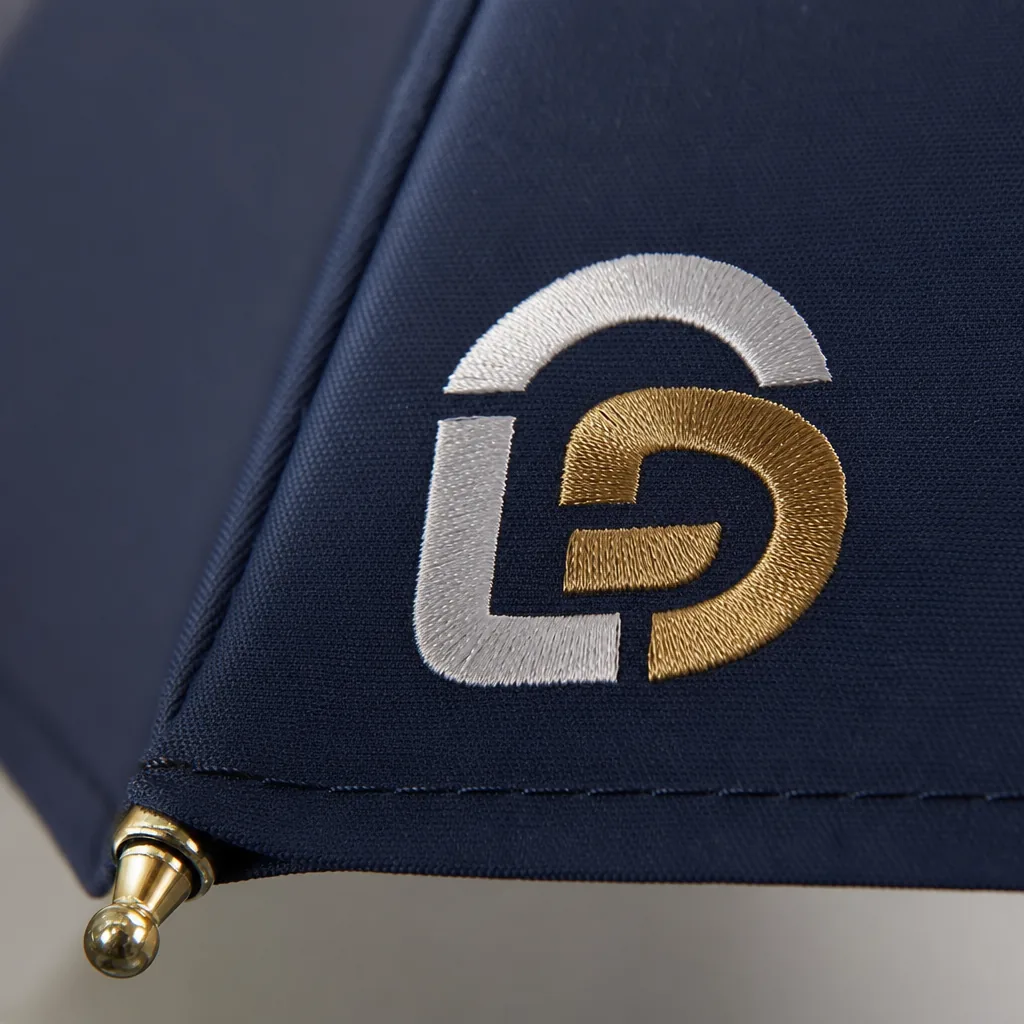
A shiny logo can make a branded umbrella look premium, but the wrong metallic process can crack on a rib seam, dull after rain testing, or fail color consistency across panels. On our Songxia production floor, metallic umbrella logo printing is evaluated against fabric coating, curing temperature, folding abrasion, and the buyer’s target MOQ before we approve bulk production. The real choice is not just visual effect; it is how that effect survives handling, packing, and repeated opening in the field.
When Special-Effect Branding Makes Sense
Special-effect branding makes sense when the umbrella is expected to feel like merchandise, not a giveaway. For premium retail lines, VIP gifts, hotel loaner programs, golf events, auto launches, and conference merchandise, the logo has to survive close inspection on the counter or in the guest’s hand. A standard one-color screen print on 190T pongee is clean and economical, but it reads flat. Metallic, pearl, glossy, matte, and reflective effects add surface contrast, so the same 23-inch auto-open umbrella can look more expensive without changing the frame. On black, navy, forest green, or wine-red canopies, metallic umbrella logo printing gives a controlled highlight that buyers notice immediately, especially under lobby lighting or retail display lamps.
The right effect depends on the brand and the umbrella construction. A foil transfer umbrella logo works well for fashion, beauty, spirits, and finance brands where a gold, silver, or rose-gold mark reinforces a premium position. Pearl ink is softer and better for wedding venues, resorts, and hospitality programs. Glossy logos on matte pongee create a tone-on-tone look that feels subtle, while matte logos on glossy POE or PVC panels reduce glare and look more architectural. Reflective printing is more functional: I prefer it for commuter umbrellas, outdoor events, and 27-inch golf umbrellas where visibility matters. On premium promotional umbrellas, these finishes often do more for perceived value than upgrading from 8K to 10K ribs, although both choices can work together.
Special-effect logo printing is not the best choice for every order. It adds process control: foil temperature, dwell time, adhesive compatibility, and canopy tension all affect the final result. On stretchier fabrics or heavily coated UPF 50+ canopies, the logo must be tested before mass production because metallic films can crack if placed across high-stress fold lines. Our standard practice at ZheBrella is to print strike-off samples, run adhesion and fold tests, then confirm appearance under daylight and warm indoor light before approving bulk production. For simple festival giveaways with a tight MOQ budget, standard screen ink is usually smarter. For branded umbrellas used in hotels, executive gifting, retail shelves, or paid event merchandise, the extra cost of metallic umbrella logo printing is usually justified because the finish changes how the buyer judges the entire product.
Metallic Ink, Foil Transfer, and Reflective Print Options
Metallic ink is the most factory-stable option for metallic umbrella logo printing when the buyer wants a gold, silver, bronze, or gunmetal effect without making the print feel like a sticker. We usually screen print it onto 190T or 210T pongee using a metallic-pigment ink system, then run curing tests because under-cured metallic ink will rub off faster than standard spot color. The hand feel is slightly heavier than normal plastisol or rubberized ink, but it still flexes well on 8K and 10K canopy panels when the umbrella is opened and closed repeatedly. Durability is good for promotional and retail use, especially if the print avoids rib seams and heavy fold lines. Cost is moderate: higher than a standard one-color screen print because the ink is more expensive and mesh control is stricter, but much lower than foil or reflective transfers.
A foil transfer umbrella logo gives the brightest mirror effect, but it is also the least forgiving on branded umbrellas because foil likes flat pressure, even heat, and consistent fabric tension. On a cutting table sample, foil can look perfect; on a finished 23-inch or 27-inch umbrella canopy, the curved panel, seam allowance, and rib tension can create small breaks, dull spots, or uneven edges. The hand feel is smoother and more film-like than metallic ink, and large solid foil areas may crease along the canopy folds after repeated packing. For premium promotional umbrellas, I prefer foil for small logos, monograms, border details, or event marks rather than a wide 250 mm chest-style imprint. Cost is high because of film, transfer paper, slower positioning, and higher reject risk during AQL 2.5 inspection.
Reflective print is a different tool: it is not a luxury metallic finish, but a visibility function that flashes under headlights or camera flash. It is usually applied as a heat-transfer film or reflective ink, and it has a thicker hand feel than metallic ink, especially on coated pongee or polyester with water-repellent treatment. Reflective transfers can perform differently on curved canopy panels than on flat textile samples because heat press pressure drops near seams and over panel crown areas, so edge lifting must be checked after open-close cycling and wet rub testing. For special-effect logo printing, reflective works best on commuter, golf, and outdoor branded umbrellas with fiberglass ribs and vented double canopies. It costs more than metallic screen ink, sometimes close to foil, but the buyer is paying for function, not just shine.
Matching Effects to Fabric and Umbrella Type
The fabric decides the safe temperature, pressure, and adhesive system for metallic umbrella logo printing before the logo artwork does. On 190T pongee, the weave is slightly more open, so foil and metallic heat-transfer films need controlled dwell time to avoid edge bleed or a “sunken” look after cooling. 210T pongee gives a smoother face and normally holds sharper metallic edges, especially for small text under 3 mm, but it still needs a low-migration adhesive if the canopy is dark navy, black, or red. RPET polyester behaves close to regular polyester in printing, but recycled yarn lots can vary in surface finish, so we test peel strength after 24 hours rather than approving from the first hot peel. For premium promotional umbrellas, I prefer sampling both a foil transfer umbrella logo and a metallic screen ink when the order is over 1,000 pieces, because the better choice often depends on wash-rub resistance and folding marks, not showroom shine.
Coated UPF 50+ canopies need more caution because the coating that blocks UV can also reduce adhesion or discolor under heat. Silver-back and black-out coatings are common on 23-inch and 27-inch golf-style branded umbrellas, and they can blister if the press temperature is set like a normal T-shirt transfer. For these, special-effect logo printing should stay on the outer fabric face, with lower temperature, longer pressure control, and a release film that does not drag the coating during peel. EVA, POE, and PVC clear umbrellas are a different case; metallic foils can look attractive, but plasticizer migration can weaken the bond, so solvent-based or UV-curable inks may be safer than hot foil. Our standard practice at ZheBrella is to run a small panel test through folding, water spray, and tape pull before confirming bulk production, especially when Teflon water-repellent treatment is specified.
Umbrella construction does not change the ink chemistry, but it changes where the logo can be placed and how the canopy must be handled on the print table. Manual, auto-open, and auto-open-close mechanisms all use the same canopy panels, yet stronger springs and thicker shafts can make finished-umbrella printing less stable, so most metallic logos are printed before final assembly. Fiberglass ribs flex more during canopy tensioning, while steel ribs hold a flatter line but can mark the fabric if stacked carelessly after printing; neither rib type changes the print method, but both affect curing racks, packing sequence, and inspection. Double-canopy vented windproof umbrellas add another constraint: the top and lower canopy layers shift under wind, so logos should avoid vent overlap zones and rib seams. On 8K, 10K, or 16K frames, we normally keep metallic marks centered within one panel, leaving 15–20 mm from stitch lines to prevent cracking during opening tests and AQL 2.5 inspection.
Artwork Rules for Clean Special-Effect Logos
For metallic umbrella logo printing, the artwork has to be built for the process, not just for the screen. Small strokes disappear fast once you add foil, metallic ink, or a textured transfer layer, so I tell clients to keep the thinnest line at least 0.35 to 0.5 mm for clean reading on 190T or 210T pongee. Lettering below about 4.5 to 5 pt usually turns into noise on premium promotional umbrellas, especially if the logo sits on a dark canopy or a glossy PVC panel. Leave generous internal spacing in letters, icons, and borders; if the gaps are too tight, the effect bridges and the logo loses its edges. For special-effect logo printing, bold geometry always prints better than hairline detail.
Placement matters as much as file quality. Keep the logo away from seams, panel joins, vent edges, and the high-fold zones where the umbrella closes against the ribs. On a 23" or 27" canopy, I want the artwork centered on a flat panel area with at least 15 to 20 mm of clearance from any stitch line, because seam tension distorts foil transfer umbrella logo edges during heat pressing and repeated opening. If the umbrella has a double-canopy vented windproof top, avoid putting fine detail across the vent cut or near the crown where the fabric curves hardest. A logo that looks perfect on a proof can still crack, wrinkle, or stretch once it meets the frame movement, so the art should be laid out for the real canopy shape, not a flat circle.
Do not use tiny gradients, micro-shadows, or photo-style fades in metallic umbrella logo printing. Foil and metallic finishes hold solid shapes well, but they do not resolve soft tonal steps cleanly, so gradient transitions should be simplified into hard color breaks or removed entirely. The same rule applies to very small text inside a special-effect logo: if the characters are too fine, they fill in after transfer and look dirty instead of premium. At ZheBrella, our prepress check flags artwork that relies on 1 mm type, thin outlines, or dense texture inside metallic umbrella logo printing because those details usually fail on press and in use. For branded umbrellas, the best result comes from one strong logo mark, clear spacing, and a print size large enough to survive stitching, folding, and daily handling without losing the metallic effect.
Sampling and Quality Control Before Shipment
Strike-off approval is the step that prevents expensive arguments later, especially with metallic umbrella logo printing. Before bulk cutting, we print the actual logo on the confirmed canopy fabric—usually 190T or 210T pongee, but sometimes POE, PVC, or EVA for fashion and transparent models—using the real mesh, foil, ink, curing temperature, and pressure settings planned for production. A foil transfer umbrella logo can look sharp on a flat test swatch but crack once sewn into an 8K or 10K folding umbrella panel, so the strike-off should be reviewed on the same panel curve and color as the order. Buyers should approve metallic tone, edge sharpness, registration tolerance, logo position from rib seam, and whether the effect is mirror, brushed, pearl, glitter, or matte-metallic. Our standard practice at ZheBrella is to keep one signed sample in the QC room and one with the printing line leader, so bulk operators are not guessing from a PDF.
For special-effect logo printing, visual approval is not enough. We run dry rub and wet rub tests with white cotton cloth, then fold testing to simulate the canopy being wrapped tightly around the shaft after repeated use. On compact 21" and 23" auto-open-close umbrellas, the print area suffers more abrasion than on a 27" golf umbrella because the folds are tighter and the runner compresses the fabric harder. Adhesion checks include cross-hatch tape pull, fingernail scratch at the logo edge, and low-temperature flexing when the order is going to cold-weather markets. Metallic inks and foils also need checking after water-repellent treatment; Teflon-coated pongee and UV UPF 50+ coated fabric can reject ink if the pretreatment is wrong. A premium promotional umbrellas order should not pass only because the first 20 pieces look good under factory lighting. We inspect under daylight-balanced lamps and compare against the approved strike-off, not against memory.
Bulk shipment inspection should be booked under AQL 2.5 for major defects, with critical defects rejected at zero tolerance. For branded umbrellas, major defects include logo peeling, foil missing, severe color deviation, crooked print placement over 5 mm, broken ribs, weak tips, jammed manual or auto-open mechanisms, and sewing holes that leak. Minor defects may include small thread ends, slight handle scuffing, or a barely visible print speck outside the logo area, but the buyer and factory should define these before production starts. MOQ depends on structure and process: simple screen metallic umbrella logo printing may start around 300–500 pieces per design, while custom foil film, matched PMS metallic ink, or double-canopy vented windproof frames usually push MOQ to 1,000 pieces or more. Sampling normally takes 5–10 days after artwork confirmation, and bulk production runs 20–35 days depending on frame stock. Confirm FOB Ningbo/Shanghai or DDP destination terms before booking materials, because carton marking, duty handling, and delivery lead time affect the production schedule.
Frequently Asked Questions
Do metallic umbrella logos cost more than standard screen printing?
Yes, metallic ink and foil transfer usually add setup cost and may require longer sampling. The exact cost depends on logo size, number of panels, fabric, and order quantity.
Can metallic logos be printed on dark umbrella canopies?
They can, and dark canopies often create strong contrast. A sample is still necessary because metallic brightness depends on ink opacity, fabric texture, and the coating beneath the print.
Which umbrella fabrics hold metallic and foil effects best in bulk production?
190T pongee and high-density polyester usually give the cleanest metallic ink laydown and the most stable foil adhesion. Lower-cost nylon can work, but buyers should expect more variation in gloss and edge sharpness across large runs.
What inspection points should buyers include for special-effect umbrella logos before shipment?
Ask for checks on color consistency, edge definition, logo position by panel, adhesion after tape test, and cracking after 20-30 open-close cycles. For reflective effects, add a photo or video check under flash or direct light because standard room lighting can hide weak reflectivity.
Do metallic inks and foil transfers change MOQ or lead time compared with standard umbrella printing?
In most OEM orders, metallic inks can often follow the normal MOQ, while foil transfer usually needs a slightly higher setup efficiency, commonly 500-1,000 pieces per colorway. Lead time is typically 3-5 days longer than standard screen printing because of plate preparation, heat-transfer trials, and adhesion approval.
Looking to Launch Your Custom Umbrella Line?
ZheBrella is a Zhejiang-based OEM/ODM umbrella manufacturer with 17 years of export experience. Free design, low MOQ from 100 pieces, windproof construction, full-color print.
Get Free Quote Now »People Also Search For
Related Articles
Metallic and Special-Effect Logos on Premium Umbrellas
Compare metallic ink, foil transfer, and reflective effects for premium umbrella logos, with fabric limits, durability t...
Read More »Metallic and Foil Logo Effects for Branded Umbrellas
Compare metallic inks, foil transfer, and pearlescent effects for umbrella logos, with fabric limits, MOQ, lead time, an...
Read More »
Metallic Logo Effects on Umbrellas: Ink, Foil, and Limits
Compare metallic ink, foil transfer, and shimmer effects for umbrellas, with durability, fabric, MOQ, and approval check...
Read More »