Metallic and Special-Effect Logos on Premium Umbrellas
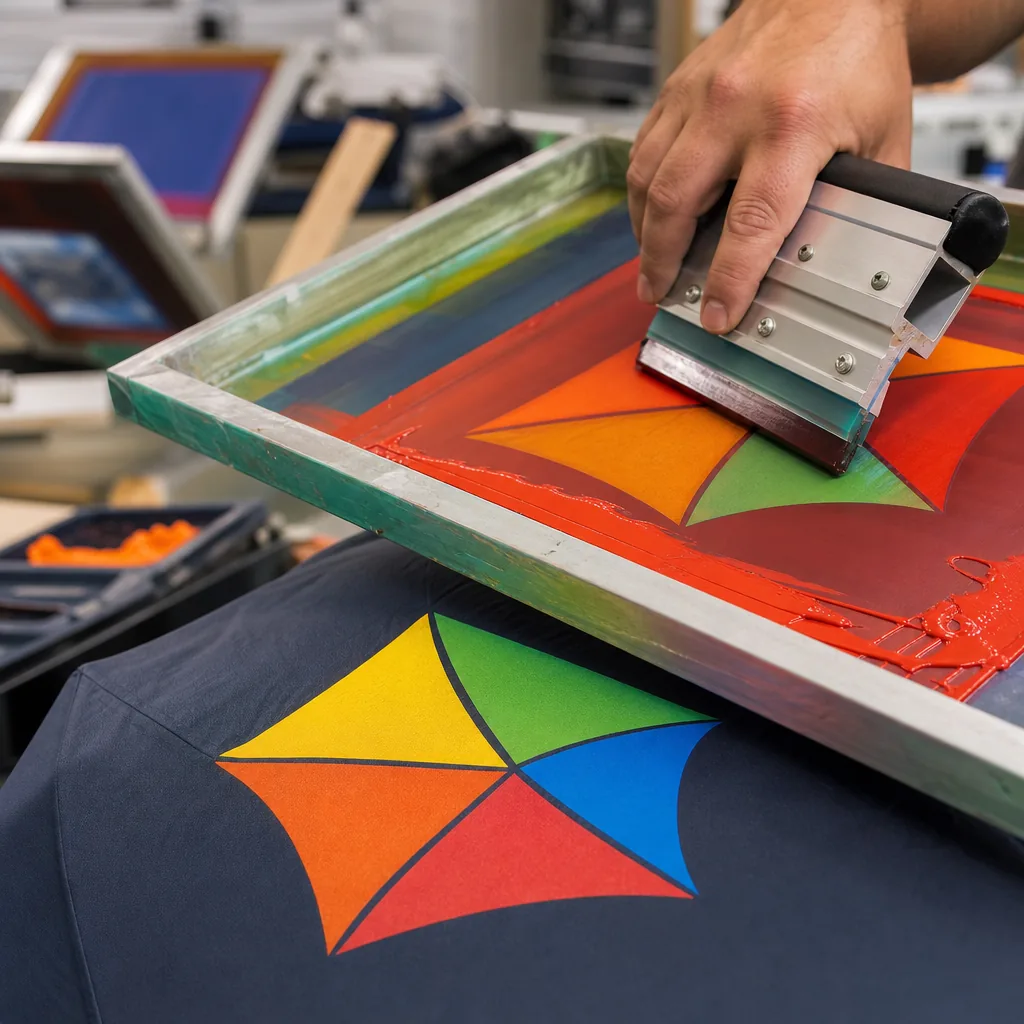
Premium umbrella buyers often ask for a logo that looks like metal, but the right process depends on fabric coating, panel tension, order quantity, and how the umbrella will be used after delivery. On our Songxia production floor, metallic umbrella logo printing, foil transfer, and reflective effects are tested differently because a finish that looks sharp on a sample can crack, dull, or lose adhesion after folding, rain exposure, and heat aging.
When Special-Effect Logos Make Sense
Special-effect logos make sense when the umbrella is part of a premium handover, not just weather protection. I see the best results on luxury retail packaging, VIP hotel gifts, private banking programs, automotive launches, and evening events where the umbrella is photographed under lobby lights or street lighting. Metallic umbrella logo printing gives a controlled flash that a normal white or black screen print cannot deliver, especially on dark 190T or 210T pongee canopies in navy, charcoal, burgundy, or black. Foil logo umbrellas also work well for executive gifts because the effect feels intentional when paired with a 23-inch or 27-inch frame, fiberglass ribs, a matte rubber handle, and a clean sleeve. For financial services and law firms, I usually recommend champagne gold, gunmetal, or brushed silver rather than bright mirror gold; it looks more expensive and avoids the souvenir-shop look.
These effects should be treated as accents because metallic, foil, pearlescent, and reflective inks behave differently from standard plastisol or water-based screen inks. Large coverage areas are harder to keep flat on umbrella panels because the fabric is cut on a curve, sewn into gores, and flexed every time the frame opens. A small chest-style logo near one panel edge, a narrow border mark, or a 60–120 mm emblem prints more consistently than a full-panel metallic block. On double-canopy vented windproof umbrellas, especially 8K or 10K fiberglass frames rated around 50+ mph in our wind-tunnel checks, the canopy moves under load; thick special-effect layers can crack earlier if the artwork is too large or placed across high-tension seams. Our standard practice at ZheBrella is to run a pre-production strike-off and cross-hatch adhesion test before approving bulk production.
Reflective umbrella logos are most useful when visibility is part of the brief, such as evening conferences, valet programs, security teams, outdoor launches, or automotive dealer events. The reflective effect should highlight the brand mark, trim line, or a small safety graphic, not cover the whole canopy like workwear tape. Pearlescent inks are better for fashion and beauty brands because they shift softly under light without the hard glare of foil. For premium branded umbrellas, the safest layout is one special-effect logo on one or two panels, with the rest of the design kept quiet through fabric color, handle finish, and sleeve detailing. Buyers should also budget a little more time: standard screen printing may fit a 25–35 day lead time, while metallic umbrella logo printing or other special effect printing usually needs extra sampling days to confirm curing temperature, wash resistance, folding marks, and AQL 2.5 appearance limits.
Comparing Metallic Ink, Foil, and Reflective Transfer
Metallic umbrella logo printing with screen ink is the most straightforward option when the artwork is simple: one-color wordmarks, basic icons, or a clean monogram. The shine comes from metallic flakes in the ink film, so the effect is softer and less mirror-like than foil. On 190T or 210T pongee, the hand feel is usually still acceptable after proper curing, but the print layer is thicker and less breathable than plain pigment ink. It flexes reasonably well on panels and sleeves, yet if the logo has tiny text, tight linework, or fine gradients, the detail starts to close up fast. For premium branded umbrellas, I usually treat metallic ink as a visual accent, not a replacement for high-resolution decoration.
Foil logo umbrellas give a sharper premium effect because the metallic layer is transferred as a separate film, not mixed into the ink. That is why the edges look cleaner and the shine is more uniform across the logo area. On a smooth canopy such as pongee or POE, foil reads as more expensive than standard special effect printing, especially for short slogans, crests, and large flat shapes. The tradeoff is flexibility: foil tolerates normal opening and closing, but if you place it across deep seams, high-stress folds, or rib contact points, it can scuff or lift earlier than screen ink. It also feels less like fabric and more like a bonded layer, which some buyers want and others reject.
Reflective umbrella logos are a different category entirely. They are built for visibility first, so the finish looks muted in daylight and flashes back hard under headlights or camera light. That makes them useful for commuter programs, safety campaigns, and outdoor event umbrellas where the logo has to do double duty as a visibility marker. Compared with metallic umbrella logo printing, reflective transfer is usually tougher on abrasion but less forgiving in repeated washing, especially if the transfer is exposed to harsh detergents or aggressive scrubbing. It also behaves differently on curved panels: the transfer can look excellent on a broad front panel, but on tight seams or seam-stitched areas it may wrinkle sooner. In practice, metallic, foil, and reflective all work, but they solve different problems: shine, premium sharpness, and visibility are not the same thing.
Fabric, Color, and Coating Limitations
Fabric choice decides whether a metallic mark looks like jewelry or like dull gray paint. On 190T pongee, the weave is slightly more open and the surface has more tooth, so heat-transfer foil and metallic screen ink usually bite better after proper curing. 210T pongee is smoother and denser, which gives a cleaner edge on small type but can reduce mechanical grip if the waterproof finish is heavy. For metallic umbrella logo printing, I prefer testing both fabrics before approving artwork with thin strokes under 0.4 mm, because metallic pigments and foil films do not flow into weave valleys the way standard plastisol or water-based ink can. Satin pongee reflects more light than matte pongee, but that also means uneven heat pressure, seam ridges, or panel stretch will show faster. Nylon can accept some special effect printing, but it is less dimensionally stable under heat, so registration on multi-panel logos is harder.
Black canopy fabric gives the strongest contrast for foil logo umbrellas, especially silver, chrome, gunmetal, rose gold, and holographic films, but it also exposes every adhesion failure. On white, navy, or gray, a slightly weak metallic layer may still look acceptable at arm’s length; on black, pinholes and broken foil edges are obvious. UV coatings, especially UPF 50+ treatments with a silver or black PU backing, are the biggest trouble spot because the print may be sitting on a coating rather than on fabric fiber. Teflon-style water-repellent finishes also reduce surface energy, so ink can pass a simple thumb rub and still fail after 24 hours of wet folding. Our standard practice at ZheBrella is to run tape pull, wet rub, dry rub, and folded-storage checks before mass production, not just a flat-panel sample under showroom lighting.
Straight umbrellas and folding umbrellas must be tested separately because the canopy does not behave the same after assembly. A 23" straight umbrella with 8K fiberglass ribs keeps panels under relatively even tension, so reflective umbrella logos stay flatter and catch light more consistently. A 21" or 23" 3-fold umbrella has deeper creasing near the ribs and shorter panel arcs, which can crack thick metallic ink or wrinkle foil after repeated auto-open-close cycling. Double-canopy vented windproof models add another variable: the top layer moves during gusts, so a large metallic print near the vent seam may flex more than expected even if the umbrella survives a 50+ mph wind-tunnel test. For premium branded umbrellas, I recommend placing special effects away from heavy fold lines, avoiding oversized solid metallic blocks on compact models, and approving production only after opening, closing, drying, and packing the actual umbrella construction.
Artwork Rules for Clean Premium Results
Clean metallic umbrella logo printing starts with artwork that survives real fabric movement, not just a PDF proof. For foil, metallic ink, reflective transfer, or raised special effect printing, I ask buyers to keep positive lines at 0.35 mm or heavier, reversed-out lines at 0.5 mm or heavier, and small text no lower than 8 pt after scaling to final print size. Tiny gradients, hairline serifs, glow effects, and 1-color shadows usually break down on 190T or 210T pongee because the weave, coating, and panel tension scatter the edge. If the logo must look premium, convert gradients into solid tone steps or simplify them into flat vector shapes. Vector files are not optional: AI, EPS, or PDF with outlined fonts and Pantone or foil references give the print room something measurable. Raster logos pulled from websites are where most dirty edges, clogged counters, and uneven metallic density begin.
Logo size should be chosen by panel shape, not by ambition. On a 21 inch compact umbrella, a single-panel logo commonly works best at 90–120 mm wide; on a 23 inch stick umbrella, 120–160 mm is safe; on a 27 or 30 inch golf umbrella, 180–240 mm can look balanced if the artwork has enough breathing room. For premium branded umbrellas, keep at least 25–35 mm clearance from seams, hems, and rib stitch lines, and do not let registered elements cross from one canopy panel to another unless the buyer accepts visible tolerance. Foil logo umbrellas are especially unforgiving because metallic film highlights every distortion near the seam. Our standard practice at ZheBrella is to mark a print-safe zone on the panel template before mass production, then test one strike-off under the actual canopy color, coating, and curing temperature.
Rib structure can ruin a beautiful layout if it is ignored during artwork setup. An 8K umbrella gives wider print fields but also larger fabric movement between ribs; 10K and 16K frames divide the canopy into narrower panels, so wide horizontal logos may feel cramped or bend visually after assembly. Fiberglass ribs flex more under wind load, which is excellent for durability on double-canopy windproof models, but that flex can make large reflective umbrella logos appear wavy when the umbrella is opened. Steel ribs hold a flatter line in calm conditions, yet their rib tips and stretchers can create harder pressure points during packing and transport. For metallic and reflective effects, avoid placing critical strokes directly over rib contact zones, runner pressure areas, or folds created by auto-open and auto-open-close frames. A clean premium result comes from designing around the umbrella’s mechanics before the first screen, foil die, or heat-transfer film is made.
Testing, MOQ, and Bulk Quality Control
Special-effect logos need harsher testing than ordinary screen print because the failure mode is different: the logo may look perfect after curing, then crack on the first tight fold or lose shine after carton vibration. For metallic umbrella logo printing, I ask the line to run dry rub and wet rub checks on the approved canopy fabric, usually 190T or 210T pongee with the same water-repellent or Teflon finish planned for bulk. We test adhesion with cross-hatch tape pull, then fold the panel along the logo area to see whether foil edges lift or reflective ink fractures. For foil logo umbrellas, temperature and dwell time are critical; too little heat gives poor bonding, too much heat can mark dark navy, black, or burgundy panels. Reflective umbrella logos also need a light-return check under angled illumination, because a logo that passes visual inspection under factory lighting may look dull outdoors at night.
Umbrella function testing cannot be separated from logo testing. A premium branded umbrella may pass print adhesion but still fail if the logo placement sits across a high-stress fold line on a 23-inch auto-open frame or a 27-inch golf umbrella with 8K fiberglass ribs. During sample approval, we open and close the umbrella repeatedly, normally 30 to 50 cycles for pre-production confirmation and higher cycle checks for retail programs. The canopy is inspected after cycling for logo cracking, panel distortion, needle-hole stress, and transfer marks from neighboring panels. Our standard practice at ZheBrella is to approve a signed pre-production sample before cutting bulk fabric, especially for metallic, reflective, puff, silicone, or high-density ink effects. Once bulk starts, AQL 2.5 inspection covers major defects such as peeling logos, misregistration over tolerance, wrong logo position, frame malfunction, broken ribs, crooked sewing, and visible stains; minor defects include slight shade variation or small packing wrinkles within agreed limits.
MOQ is usually higher than standard one-color screen print because special effect printing wastes more setup material and requires slower handling. A normal screen print order may start around 500 pieces per design, depending on umbrella type, but metallic umbrella logo printing, foil transfer, or reflective effects often make more sense from 1,000 pieces and up, especially when the buyer needs consistent color across multiple panels. Extra sample rounds are common because metallic gold, matte silver, holographic foil, and reflective gray all behave differently on coated pongee, POE, PVC, or EVA canopies. Lead time also stretches: a standard logo umbrella might ship in 25 to 35 days after deposit and artwork approval, while special-effect materials can add 5 to 12 days for film ordering, ink matching, curing tests, and bulk inspection. For FOB Ningbo or Shanghai orders, build this into the purchase schedule early; for DDP shipments, allow additional time for carton labeling, customs documents, and final packing checks.
Frequently Asked Questions
Do metallic umbrella logos last as long as standard screen printing?
They can perform well when the correct ink or transfer is matched to the fabric and coating. Buyers should approve a production sample and request rub, fold, and adhesion checks before bulk production.
Can metallic or foil logos be used on UPF 50+ umbrellas?
Yes, but the logo process must be tested against the UV coating or black-out layer. Some coatings reduce adhesion, so sampling is essential before confirming the bulk order.
Which umbrella fabrics handle foil transfer best for a clean premium finish?
Foil transfer usually performs best on smooth, tightly woven pongee and satin-like polyester because the surface helps the foil layer bond evenly. It is less reliable on heavily textured fabrics, solution-dyed materials, or coatings with low surface energy unless pre-tested.
What durability tests should a buyer request before approving a metallic or reflective logo run?
Ask for tape adhesion testing, rub testing, and at least a basic open-close cycle test on printed panels. For bulk orders, many buyers also request water exposure and 24-48 hour curing verification so the logo finish is checked after realistic handling conditions.
How should MOQ and sampling differ between metallic ink, foil, and reflective logo effects?
Metallic ink sampling is usually the fastest and often works at lower MOQs because it uses standard screen printing setup. Foil and reflective effects commonly require custom dies, transfer films, or separate setup steps, so MOQs are often higher and pre-production sampling may add 5-10 days to approval lead time.
Looking to Launch Your Custom Umbrella Line?
ZheBrella is a Zhejiang-based OEM/ODM umbrella manufacturer with 17 years of export experience. Free design, low MOQ from 100 pieces, windproof construction, full-color print.
Get Free Quote Now »People Also Search For
Related Articles
Metallic and Special-Effect Logos on Branded Umbrellas
Compare metallic inks, foil transfer, and reflective effects for umbrella logos, with fabric, durability, MOQ, and inspe...
Read More »Metallic Logo Printing on Umbrellas for Premium Brands
Compare metallic ink, foil-look transfers, and thread-tone choices for premium umbrellas, with fabric, MOQ, and QC point...
Read More »Metallic and Foil Logo Effects for Branded Umbrellas
Compare metallic inks, foil transfer, and pearlescent effects for umbrella logos, with fabric limits, MOQ, lead time, an...
Read More »