Print Durability Testing for Branded Umbrella Logos
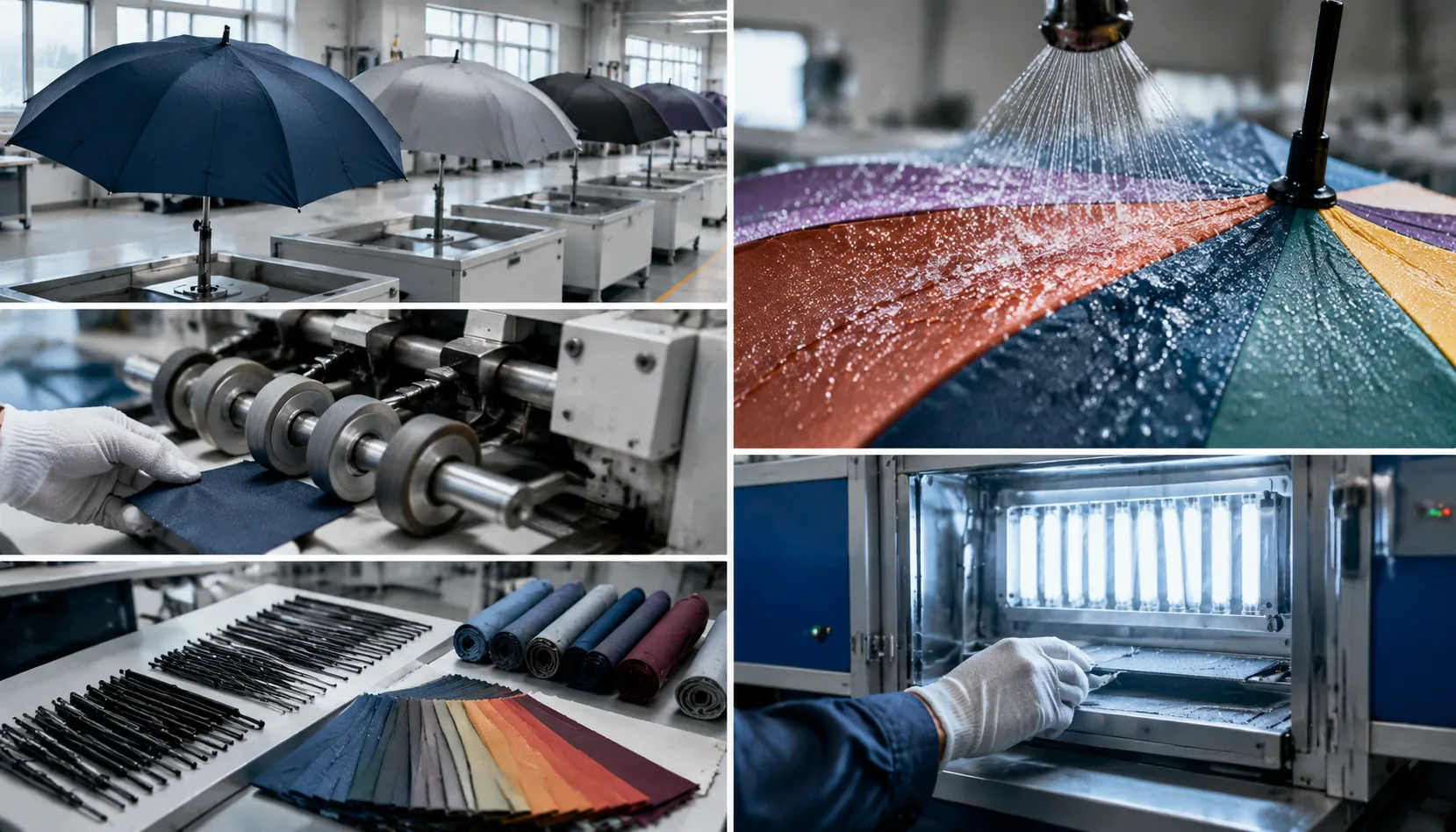
A logo that looks sharp on the approval sample can still fail after folding, packing pressure, rain, or a few rubs against wet fabric, and that failure becomes your brand problem—not the printer’s. On our Songxia factory floor, umbrella logo durability testing starts before bulk printing: ink adhesion, rub resistance, folding stress, water exposure, and AQL checks all need clear pass/fail limits tied to the actual canopy fabric and print method.
Why Logo Durability Fails in Bulk Orders
Most logo failures in bulk orders start before printing, not after shipping. The biggest culprit is poor ink adhesion on the wrong canopy surface: 190T pongee with heavy water-repellent treatment, silver UV coating, black glue coating, or Teflon finish will reject standard plastisol or low-grade screen ink if the surface tension is not checked. On POE, PVC, and EVA clear umbrellas, the problem changes again because solvent migration and plasticizer bleed can soften the print after packing. A proper print adhesion test should include cross-hatch tape pull, wet rub, dry rub, and at least 24 hours of curing before judgment. I have seen samples pass visually at 2 hours, then fail after folding because the ink film never bonded to the coated yarn. For serious umbrella logo durability testing, the print process must be matched to material: screen printing for solid logos on pongee, heat transfer for detailed multicolor artwork, sublimation only on compatible light polyester, and UV or specialty inks for clear plastic canopies.
Cracking at fold lines is the failure buyers notice first because it appears exactly where the umbrella is handled and folded every day. A 21" compact umbrella may fold into 6 or 8 tight panels, so a large chest-style logo across multiple folds will be stressed far more than a small one-panel mark. On 23" and 27" straight umbrellas, the print often survives better, but distortion can show near the rib channels if the artwork crosses stitched seams or sits too close to the tips. Fiberglass ribs flex differently from steel ribs, and on 8K versus 16K frames the canopy tension changes enough to stretch a round logo into an oval if the print position is not adjusted on the cutting pattern. During branded umbrella QC, we reject logo placement that ignores fold memory, seam allowance, and rib spacing, even if the artwork looks good on a flat digital mockup.
Sleeve rubbing is another underestimated problem, especially for promotional orders packed fast after production. If printed panels are inserted into tight matching sleeves before the ink or transfer film fully stabilizes, the logo can scuff during carton vibration, container heat, or repeated repacking at the event site. Rushed sampling makes this worse because one perfect hand-printed approval sample does not prove the bulk line can hold registration, curing temperature, pressure, and drying time across 3,000 or 10,000 pieces. Promotional umbrella inspection should include sleeve insertion/removal cycles, folded-panel rub checks, and random carton checks after 12 to 24 hours of compression. Under AQL umbrella inspection, we normally treat visible logo peeling, heavy cracking, wrong color, and misregistration as major defects under AQL 2.5, while slight print position drift may be minor depending on the approved tolerance. Good umbrella logo durability testing is not a paperwork step; it is the only way to catch coating, ink, and handling mistakes before the full shipment is branded wrong.
Core Tests for Umbrella Logo Prints
The first gate in umbrella logo durability testing is adhesion, because a logo that lifts at the edge will fail long before the frame or canopy does. For screen print and heat-transfer logos on 190T or 210T pongee, we use a cross-hatch or straight tape pull depending on artwork size: 3M 600 or equivalent tape is pressed firmly over the printed area, held for 60 seconds, then pulled back at about 180 degrees. A pass means no visible flaking, no corner lift, and no ink transfer onto the tape beyond tiny dust-like particles. On coated fabrics, especially Teflon-treated water-repellent pongee or UV UPF 50+ canopies, adhesion must be checked after curing and again after 24 hours; prints that look fine warm off the dryer can peel once the coating relaxes. For branded umbrella QC, I reject weak edge adhesion even if the center looks clean, because folding pressure always attacks the logo perimeter first.
Rub testing tells you whether the print survives real handling, not just a clean showroom photo. We run dry rub with white cotton cloth for 20 to 50 strokes under consistent hand pressure, then wet rub with damp cloth for another 10 to 20 strokes, checking color transfer, cracking, gloss change, and surface tackiness. Metallic ink, thick plastisol, and low-temperature heat-transfer films need extra attention because they can pass a tape pull but scuff badly against ribs, runner parts, or neighboring canopy panels. Water exposure is separate: the printed area should be sprayed or wetted for 10 to 15 minutes, dried naturally, then inspected for whitening, bubbling, bleeding, or adhesive shadow marks. In promotional umbrella inspection, we also compare dark logos on light fabric and white logos on navy or black pongee, because contrast makes tiny migration or staining obvious. Our standard practice at ZheBrella is to record these checks inside the same AQL umbrella inspection file instead of treating print as a cosmetic afterthought.
Folding cycle checks are where many logo failures appear, especially on 21 inch folding umbrellas and auto-open-close models where the canopy packs tightly around steel or fiberglass ribs. We open, close, shake, strap, and sleeve the umbrella for at least 20 cycles on pre-production samples, then inspect the print across fold lines, panel seams, and rib contact points. For auto-open frames, the logo must be checked after repeated spring deployment because the sudden canopy snap can stress heat-transfer film and sublimation edges differently than manual opening. Double-canopy vented windproof umbrellas need a second inspection path: the upper and lower fabric layers move at different speeds, so the logo can rub internally even when the outside surface looks untouched. Check the vent overlap, stitch line near the logo, and any contact between printed lower panels and the floating top canopy. Proper umbrella logo durability testing should combine print adhesion test results with mechanical cycling, because a logo is only acceptable if it survives the way the finished umbrella actually moves.
Material and Frame Factors That Affect Results
Darker canopy colors hide dirt but make inspection harder. White ink on navy, black, forest green, or burgundy pongee needs enough opacity, and thick ink layers are more likely to crack when the panel flexes over steel ribs or near a 16K seam junction. During promotional umbrella inspection, we check the same logo under daylight, a light box, and after water spray, because micro-cracks show up differently when the fabric is wet. Our standard practice at ZheBrella is to include printed-panel flexing in AQL umbrella inspection when the order uses large logos over 120 mm wide, metallic ink, reflective transfers, or UPF 50+ coated fabric. For AQL 2.5 final inspection, cosmetic defects like pinholes, edge lifting, ghosting, and color bleed are counted separately from functional failures such as peeling after tape pull or cracking after repeated open-close cycles.
Setting AQL Criteria for Branded Orders
AQL criteria for branded orders should be written around what the customer will actually reject at receiving, not around vague factory language like “printing not good.” For umbrella logo durability testing, I classify major visual defects as anything visible at arm’s length on the open canopy: pinholes through the ink film, misregistration over 1.5 mm on multi-color logos, ink bleed outside the approved artwork boundary, scratches longer than 5 mm, missing strokes in letters, and logo position deviation beyond the buyer’s tolerance. For most promotional umbrella inspection work, we set logo placement tolerance at ±10 mm from the approved layout on 21" and 23" umbrellas, and ±15 mm on 27" or 30" golf umbrellas unless the panel design requires tighter alignment. On curved seams or double-canopy vented windproof models, inspectors must measure from fixed references such as rib line, panel center, or canopy edge, not by eye.
For branded umbrella QC, AQL 2.5 is the normal limit for major print defects, while critical defects should be zero tolerance. A major defect includes a logo that is wrong color versus Pantone approval, upside down, placed on the wrong panel, cracked after normal opening, or failing a basic print adhesion test such as 3M tape pull after 30 seconds of firm pressure. Minor defects can be handled at AQL 4.0 if the buyer accepts it, for example a tiny ink dot under 1 mm outside the logo area or a light edge feather only visible within 30 cm. Our standard practice at ZheBrella is to separate print inspection from final umbrella function inspection: first check canopy panels flat after printing, then check again after sewing and frame assembly because scratches often appear during rib tipping, runner operation, and carton packing.
Pass-fail photo standards are more useful than long defect descriptions because factory inspectors, merchandisers, and the buyer’s third-party QC team need the same reference. The control file should include approved logo artwork, Pantone or CMYK values, print method notes for screen print, heat transfer, or sublimation, and clear “accept” and “reject” photos for pinholes, bleed, misregistration, low opacity, scuffing, and off-center placement. During AQL umbrella inspection, the inspector should open each sampled umbrella fully, check the logo under 600–800 lux lighting, view it from 50–60 cm, and record defects by panel number. For umbrella logo durability testing, add at least one adhesion check per printed color and one rub check on dark 190T or 210T pongee, POE, PVC, or EVA canopies, since coating and fabric finish change ink bite more than buyers expect.
Approval Workflow Before Mass Production
The approval workflow should lock the logo before any cutter touches bulk fabric. We start with an artwork proof showing Pantone codes, logo size, print position from canopy seam, panel orientation, and whether the job uses screen print, heat transfer, or sublimation. Allow 1–2 working days for a clean proof if the buyer supplies vector AI/PDF files; add 2–4 days if the logo arrives as a low-resolution PNG and needs rebuilding. The next step is the strike-off, usually a printed fabric panel in 190T or 210T pongee, POE, PVC, or EVA, depending on the umbrella. This is where umbrella logo durability testing begins: cross-hatch tape pull, wet rub, dry rub, and a simple fold-abrasion check over a rib line. For dark canopies with white ink, I also check opacity after drying because a logo that looks sharp on a flat table can look weak once stretched over an 8K or 10K frame.
After the strike-off passes, approve a full pre-production sample using the correct frame, handle, canopy coating, carton marks, and packing method. For manual or auto-open 23" umbrellas, that sample normally takes 5–7 days; auto-open-close folding umbrellas, double-canopy vented golf umbrellas, and UPF 50+ coated models often need 7–10 days because tension and seam position affect logo distortion. MOQ matters here. A 500-piece promotional order may run directly after one approved sample, but a 3,000–10,000 piece retail program should include a 30–80 piece bulk pilot check before full sewing. In branded umbrella QC, that pilot is where we confirm print adhesion test results after production drying time, not just from the sample room. Our standard practice at ZheBrella is to compare pilot canopies against the signed strike-off under daylight and lightbox conditions before releasing the full batch.
Final timing should be planned backward from the event date or retail launch, not from the factory’s fastest promise. For a typical MOQ of 500–1,000 pieces, keep 3–5 days for proof and strike-off approval, 7–10 days for pre-production sample approval, 15–25 days for bulk production, and 2–3 days for promotional umbrella inspection under AQL 2.5 before shipment. Larger orders, custom handles, 16K frames, fiberglass ribs, or multi-position printing can push production to 30–45 days. FOB Ningbo or Shanghai scheduling needs vessel cut-off buffers, usually 4–7 days after final inspection; DDP air for urgent events can move in 5–9 days but costs much more and still needs clean cartons and customs-ready paperwork. AQL umbrella inspection should include logo placement tolerance, color consistency, adhesion, opening function, rib alignment, and packing accuracy, because a durable print is only useful if the goods arrive on time and match the approved sample.
Frequently Asked Questions
How many folding cycles should a logo sample pass before approval?
For promotional and retail umbrellas, buyers commonly request repeated open-close and hand-fold checks before approving bulk production. The exact cycle count should match the product tier, mechanism, and expected use case.
Does AQL 2.5 cover logo print defects?
Yes, if print defects are defined in the inspection checklist as major or minor issues. The buyer should specify limits for misalignment, color variation, scratches, cracking, and ink transfer.
What logo durability tests should be included before approving bulk umbrella production?
A practical approval plan should include tape adhesion, dry and wet rub, repeated folding, water spray or soak exposure, and visual color/position checks against the approved sample. For branded orders, test both the printed panel and any seams or fold lines near the logo.
How many printed umbrellas should be checked during AQL inspection?
Most importers use AQL Level II with separate limits for critical, major, and minor defects. For logo defects, common checks include print peeling, misregistration, color mismatch, smudging, and incorrect logo placement across the selected inspection sample size.
Can logo durability testing be done on pre-production samples instead of finished goods?
Yes, pre-production samples are the best stage for adhesion, rub, folding, and water exposure tests because issues can still be corrected before mass production. Finished goods should still be inspected to confirm the approved print method, ink, color, and placement were maintained.
Looking to Launch Your Custom Umbrella Line?
ZheBrella is a Zhejiang-based OEM/ODM umbrella manufacturer with 17 years of export experience. Free design, low MOQ from 100 pieces, windproof construction, full-color print.
Get Free Quote Now »People Also Search For
Related Articles
Print Durability Testing for Branded Umbrella Programs
Compare rub, adhesion, rain, UV, and folding tests for umbrella prints, with practical specs for 190T/210T pongee and AQ...
Read More »
Logo Durability Testing for Branded Umbrella Programs
Plan branded umbrella orders with logo durability checks, AQL 2.5 inspection points, fabric tests, and approval steps be...
Read More »
Logo Durability Testing for Branded Umbrella Orders
Build a logo durability test plan for branded umbrella orders, covering adhesion, rub, water, folding, AQL 2.5 checks, a...
Read More »