Private Label Umbrella Programs for Retail and Gift Buyers
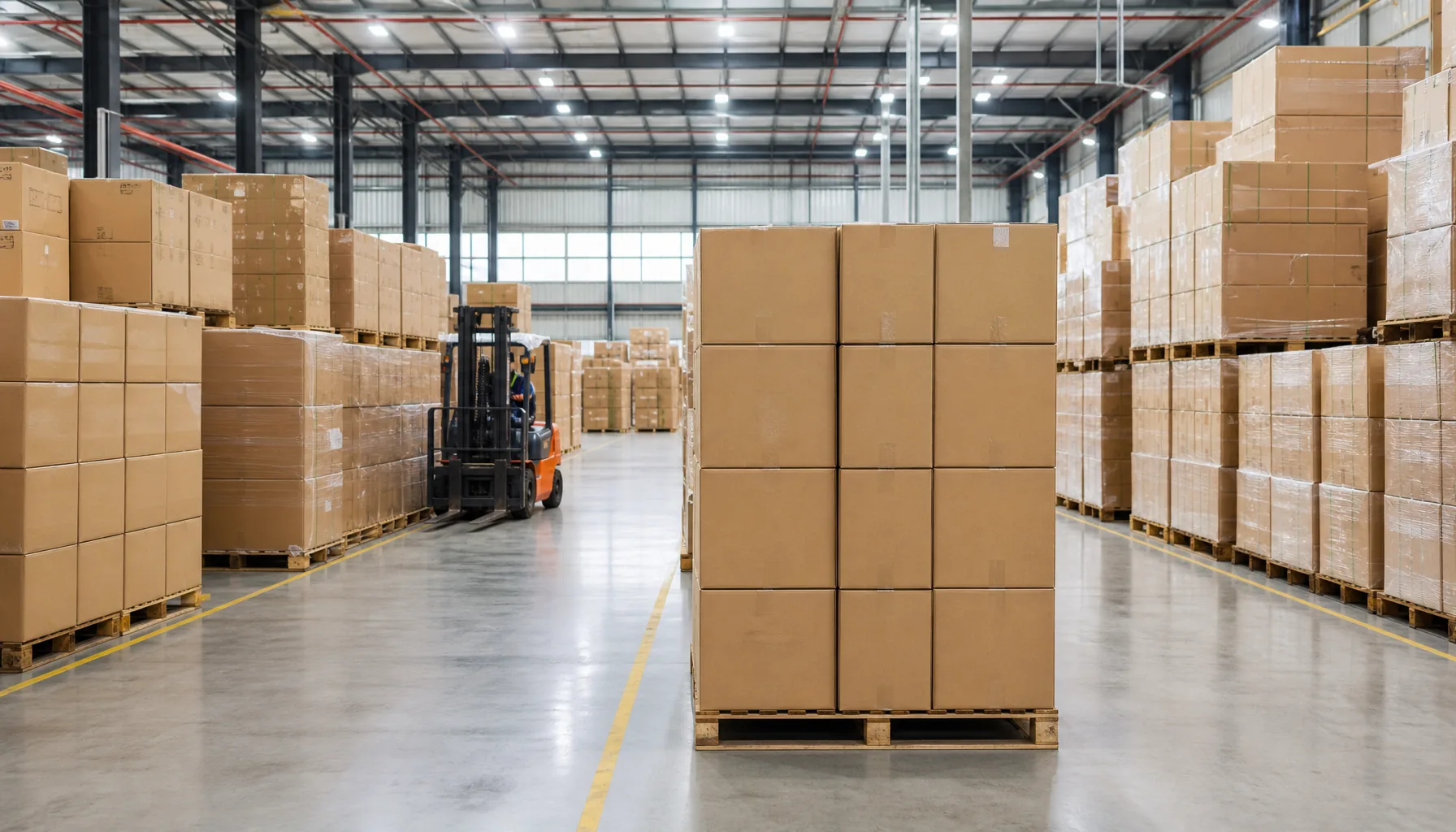
For retail and gift buyers, private label umbrellas look simple until SKU tiers, carton marks, barcode rules, and delivery windows start affecting margin and launch timing. On our factory floor in Shangyu, we plan programs by frame type, fabric grade, handle tooling, packaging method, and realistic MOQ, then lock inspection points before bulk cutting starts. A solid program also defines AQL 2.5 expectations and whether FOB or DDP from China makes the landed cost work.
Build the Umbrella Line Around Price Tiers
A profitable private label umbrellas program should start with price tiers, not artwork. For retail shelves, I like a simple good-better-best structure: entry compact umbrellas at 21" or 23" for checkout and impulse bins, mid-tier 23" auto-open stick umbrellas for daily commuters, and premium 27" to 30" golf umbrellas or UPF 50+ sun umbrellas for higher-margin seasonal displays. The entry tier usually uses a steel shaft, steel ribs, 170T or 190T polyester, a plastic handle, and manual or basic auto-open construction. That keeps the umbrella MOQ realistic and gives buyers a sharp opening retail price, but it also means the product should not be sold as windproof.
The better tier is where retail umbrella sourcing gets more technical. A 23" umbrella with 190T or 210T pongee, black electroplated steel shaft, fiberglass end ribs, and a stronger runner gives a noticeable hand-feel upgrade without pushing cost too far. For gift buyers, custom hangtag umbrellas in this tier often carry the story: water-repellent coating, reinforced tips, matching sleeve, and brand-color handle. In an umbrella OEM program, this is also where I recommend locking the rib count early: 8K is standard and cost-efficient, while 10K looks fuller on the shelf but adds sewing labor and inspection points.
Best-tier SKUs need a real performance difference, not just a nicer logo. Premium private label umbrellas should use fiberglass ribs, a fiberglass or aluminum shaft where weight matters, 210T pongee, Teflon water-repellent treatment, or double-canopy vented construction that can pass a 50+ mph wind-tunnel claim when engineered correctly. UPF 50+ sun umbrellas need silver or black UV coating, tighter seam control, and colorfastness checks because coating scratches and pinholes show quickly under light. Our standard practice at ZheBrella is to separate these premium SKUs from mass compact production during AQL 2.5 inspection, because one weak rib joint or loose vent seam can damage the credibility of the whole line.
Choose Core Specs Before Designing the Brand Look
Start with canopy size and rib architecture before you talk color, logos, or packaging. For private label umbrellas, a 21" or 23" stick umbrella reads like a lower-risk retail item, while 27" and 30" golf formats carry a higher perceived value but also higher freight and carton cost. Rib count matters just as much: an 8K frame is the common entry point for mass retail, but 16K usually feels tighter, stronger, and more premium in the hand because the canopy tension is better distributed. That extra structure is not cosmetic; it changes opening smoothness, wind response, and how often returns happen after a bad storm. In an umbrella OEM program, these choices decide whether the product lands in a discount program or a specialty shelf, so retail umbrella sourcing should lock the frame spec before ordering artwork or custom hangtag umbrellas. Fabric and mechanism drive the rest of the commercial equation. 190T pongee is standard for value programs, but 210T has a denser hand, better print sharpness, and less “see-through” feel under light, which buyers often read as quality even when they cannot name the fabric. Manual open models are cheaper and usually safer for low-end promotions, while auto-open or auto-open-close adds convenience and raises both unit cost and warranty exposure because the spring system has more parts to fail. Handle material matters too: EVA and soft-touch rubber improve grip and retail appeal, while wood and ABS signal different price tiers. If the umbrella MOQ is tight, don’t over-spec everything at once; every upgrade in canopy, frame, or handle pushes the price and can turn private label umbrellas from a competitive SKU into an unprofitable one.
Packaging, Barcodes, and Retail-Ready Details
Retail-ready packaging is not something to bolt on after the umbrella is approved; it is part of the product specification. For private label umbrellas, the buyer should lock the woven label, sewn care label, hangtag, sleeve printing, UPC or EAN barcode, and carton marks at the same time as the pre-production sample. A 23" auto-open stick umbrella with 190T pongee may look correct on the table, but if the hangtag hole position blocks the handle, the barcode scans poorly through a glossy sticker, or the sleeve is too tight after Teflon coating, the warehouse will reject it before the consumer ever sees it. Our standard practice at ZheBrella is to review packaging artwork together with the umbrella sample, including Pantone colors, logo placement, warning text, fiber content, country of origin, and retail price sticker area.
Custom hangtag umbrellas need practical barcode planning, not just nice graphics. UPC-A is common for U.S. retail, while EAN-13 is usually requested for Europe and many global gift programs. The barcode should be printed at proper size with quiet zones, usually on matte white stock or a dedicated white label, because metallic ink, dark backgrounds, and curved sleeve surfaces cause scanner failures. For an umbrella OEM program, we normally ask whether the retailer needs GS1 numbers supplied by the buyer, item-level SKU stickers, size/color callouts, or mixed-carton labels. If the product has multiple variants, such as 21" folding auto-open-close, 23" straight, and 30" golf umbrellas, each color and canopy print may need its own barcode and carton identification. This is especially important when the umbrella MOQ is split across several designs.
Inner packing should match the sales channel. Department stores may require one umbrella in a printed sleeve, 12 pieces in an inner box, and 48 pieces in a 5-ply export master carton with PO number, SKU, quantity, gross weight, net weight, carton size, and destination marks. Club stores or event buyers may prefer PDQ displays with dividers so 8K or 16K umbrellas stand upright without crushing the ribs during transport. For retail umbrella sourcing, carton strength matters as much as artwork: a 27" fiberglass golf umbrella is heavy, and weak cartons collapse in DDP delivery or during Amazon-style handling. Packaging should pass the same discipline as the umbrella itself: pre-production approval, barcode scan test, drop-test review when needed, and final AQL 2.5 inspection against the approved sample.
MOQ, Sampling, and Production Planning
MOQ has to be quoted by construction, not just by logo size. For private label umbrellas, a basic 21" 3-fold auto-open with black 190T pongee can often start around 500–1,000 pcs per SKU if the frame, handle, and fabric are stock. A 23" straight umbrella with 8K steel shaft and fiberglass ribs usually sits in the same range, while a 27" or 30" golf umbrella, especially double-canopy vented windproof, commonly needs 1,000 pcs because the fabric consumption and carton volume are higher. Color is the second MOQ driver: stock black, navy, red, and royal blue are easy, but custom-dyed 190T/210T pongee normally requires 2,000–3,000 pcs per color to justify dyeing and shade control. If the buyer wants a molded EVA handle, special plastic color, plated shaft, or custom rib finish, the tooling and material MOQ can push the umbrella MOQ to 3,000–5,000 pcs.
Print complexity changes both MOQ and planning risk. A one-position screen print on one or two panels is straightforward for retail umbrella sourcing, but full-panel printing, edge-to-edge artwork, reflective ink, or heat-transfer logos need better artwork control and more setup time. Sublimation is suitable for photographic graphics but usually works best on white polyester panels; if the brand insists on dark canopy fabric with multicolor graphics, heat transfer may be more realistic. For custom hangtag umbrellas, buyers should not forget paper stock, barcode placement, warning text, country of origin, and inner carton labels, because retail compliance problems often come from packaging details rather than the umbrella itself. Our standard practice at ZheBrella is to confirm AI/PDF artwork, Pantone references, handle and tip selections, rib count such as 8K or 10K, canopy fabric, coating requirements like Teflon or UPF 50+, and packing method before any sample is cut.
A clean umbrella OEM program follows a fixed sequence: design confirmation, material booking, sample making, sample approval, bulk production, in-line checking, final AQL inspection, and shipment. A standard logo sample normally takes 5–7 days if all materials are stock; a custom-dyed canopy, molded handle, or new retail packaging can take 12–20 days before the buyer even sees the first sample. After approval, bulk production for private label umbrellas is typically 25–35 days for folding models and 30–45 days for golf or vented umbrellas, depending on season and order size. Final inspection should use AQL 2.5 for major defects, with checks on opening force, auto-open or auto-open-close function, panel stitching, rib alignment, print adhesion, water repellency, and carton drop condition. FOB Ningbo or Shanghai is the normal export basis, while DDP needs earlier planning for carton dimensions, HS codes, and destination labeling.
Quality Control and Import Terms for Retail Buyers
For private label umbrellas, I do not treat inspection as a final-day formality; the critical defects are usually created much earlier at cutting, sewing, printing, or packing. Our standard retail inspection uses AQL 2.5 for major defects, with checks on canopy stains, oil marks from rib assembly, uneven panel tension, skipped stitches, loose seams, and seam strength at the crown and tips. Logo alignment is measured against the approved artwork, not judged by eye from three meters away. For screen print, heat-transfer, or sublimation logos, we check position, color drift, cracking after opening and closing, and rubbing resistance on 190T or 210T pongee. Runner function is tested repeatedly because a sticky runner becomes a customer complaint after two rainy days. Rib tips must be secure, especially on 8K and 10K frames where one loose tip can puncture the canopy during carton vibration.
Retail buyers also need packaging inspection written into the umbrella OEM program, not left to the carton room supervisor. Custom hangtag umbrellas should be checked for correct hangtag version, warning label, care label, color sticker, retail sleeve, polybag suffocation mark, inner carton count, and master carton shipping mark. Barcode readability should be scanned, not visually approved; UPC, EAN, and FNSKU labels fail most often when matte sleeves, curved handles, or low-contrast printing are used. Packaging accuracy matters as much as frame quality when goods go to chain stores, promotional distributors, or Amazon FBA, because a perfect umbrella in the wrong carton still creates chargebacks. For retail umbrella sourcing, I recommend a pre-shipment inspection after 80% packing is complete, plus an inline inspection once printed panels and first assembled frames are available.
Import terms should match the buyer’s internal capability. FOB Ningbo or Shanghai works well for experienced importers who already control freight forwarders, marine insurance, customs brokerage, duty classification, and final delivery. FOB gives cleaner factory pricing and better visibility into production cost, which is useful when comparing umbrella MOQ tiers such as 500, 1,000, or 3,000 pieces per design. DDP is better for gift buyers, event planners, and smaller retailers who want landed-cost simplicity: one price covering product, inland trucking, export clearance, ocean or air freight, import duty, customs clearance, and delivery to warehouse. The tradeoff is less control over freight timing and fewer levers when ports are congested. For private label umbrellas with strict launch dates, I normally advise FOB for repeat retail programs and DDP only when the buyer values predictability over freight control.
Frequently Asked Questions
What is the best starting assortment for a private label umbrella line?
Many retail buyers start with three SKUs: a compact auto-open umbrella, a straight umbrella, and a larger golf or windproof model. This covers daily carry, home or office use, and premium gifting.
Can one factory produce multiple umbrella styles under the same private label?
Yes, a vertically integrated OEM/ODM factory can coordinate frames, canopy printing, packaging, and inspection across several styles. This helps keep color standards, labels, and carton markings consistent.
How should a buyer structure SKUs for a new retail umbrella program?
A practical launch structure is 3-5 core styles, each with 2-4 colorways or prints, so you can test 12-20 SKUs without overloading inventory. Many buyers start with one entry auto-open style, one compact folding style, and one premium giftable style, then expand based on sell-through.
What barcode and packaging details should be confirmed before production starts?
Confirm whether each unit needs a UPC/EAN sticker, printed color box, swing tag, inner carton label, and master carton shipping marks before sampling approval. If the retailer uses warehouse scanning, carton barcode placement, carton pack quantity, and label format should be locked before mass production to avoid relabeling delays.
What MOQ and lead time should buyers expect for mixed private label umbrella orders?
For standard private label programs, factories often accept around 300-500 pieces per style per color for basic models, while fully custom frames, handles, or molded accessories may require 1,000 pieces or more. Typical production lead time is about 35-50 days after sample approval and deposit, depending on packaging complexity and print method.
Looking to Launch Your Custom Umbrella Line?
ZheBrella is a Zhejiang-based OEM/ODM umbrella manufacturer with 17 years of export experience. Free design, low MOQ from 100 pieces, windproof construction, full-color print.
Get Free Quote Now »People Also Search For
Related Articles
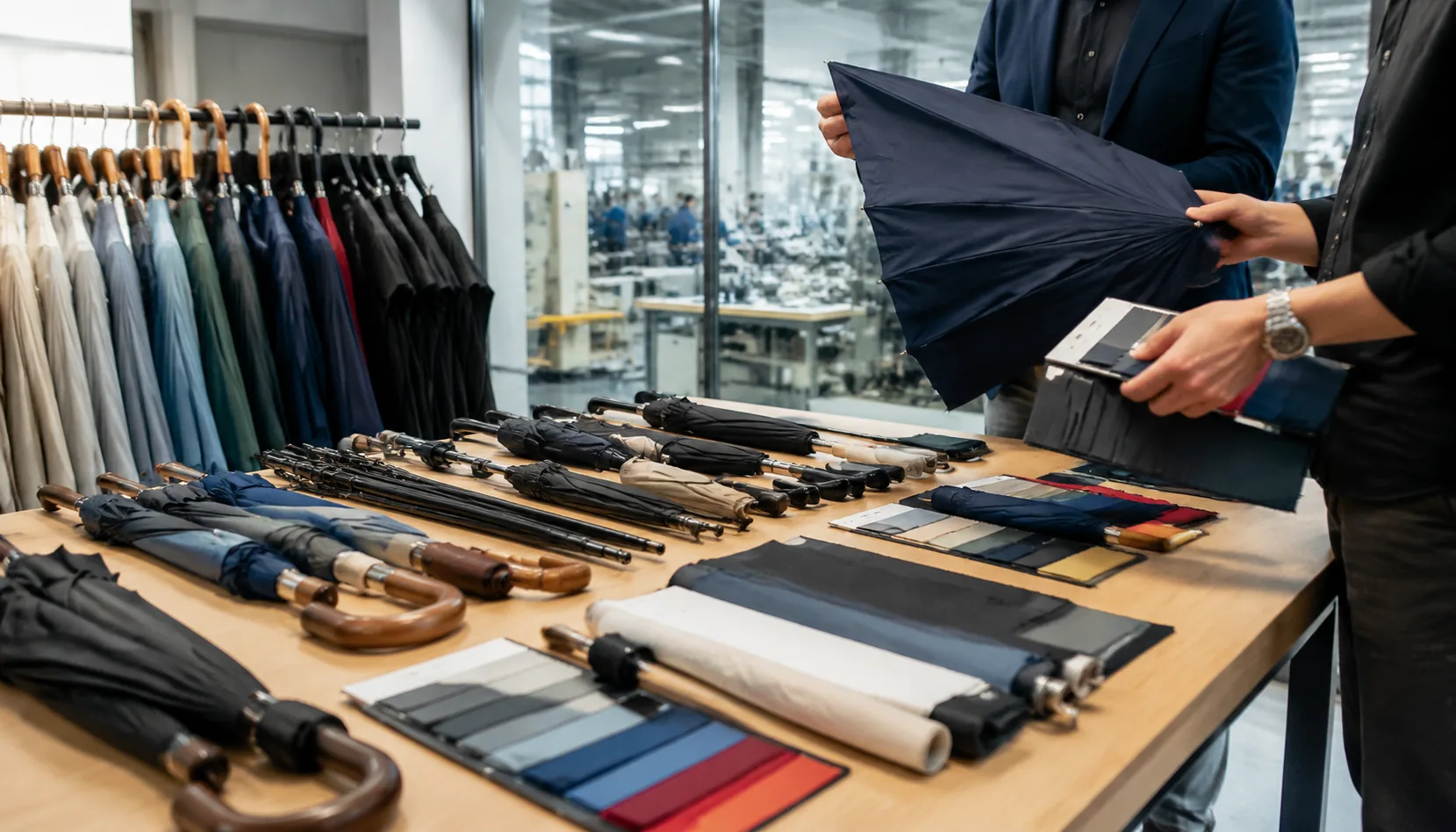
Private Label Umbrella Programs for Retail Buyers
Plan a retail-ready private label umbrella line with clear specs, MOQ tiers, packaging choices, QC checks, and FOB or DD...
Read More »
Private Label Umbrella Programs: SKU Planning for Retail Buyers
Plan retail umbrella SKUs with the right sizes, fabrics, MOQ, packaging, and FOB/DDP timelines before committing to a pr...
Read More »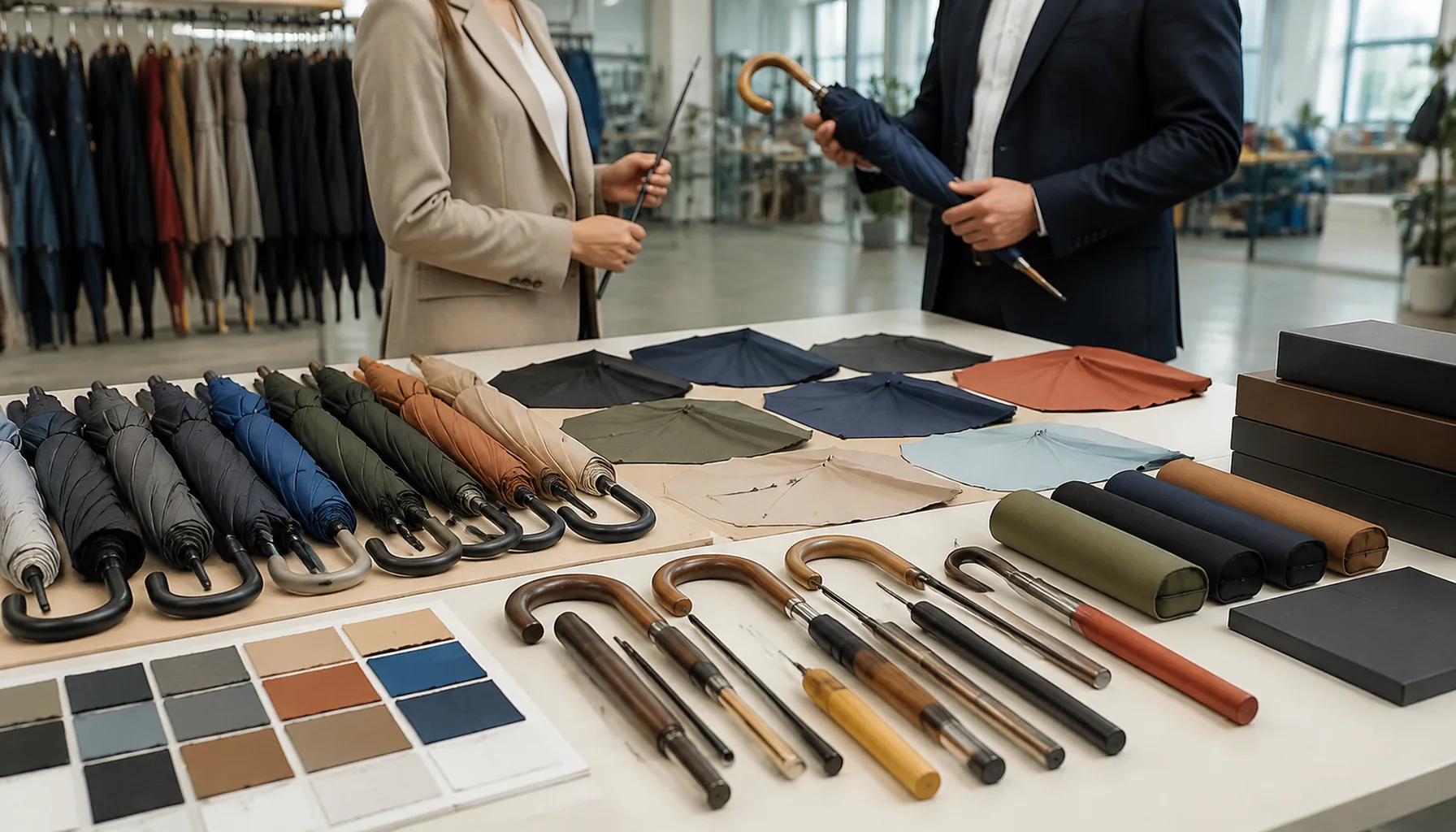
Private Label Umbrella Programs for Retail Buyers and Chains
Plan a private label umbrella line with realistic MOQ, fabric, frame, packaging, AQL, and FOB/DDP details for retail pro...
Read More »