Repeat Pattern Umbrella Printing for Retail Brand Lines
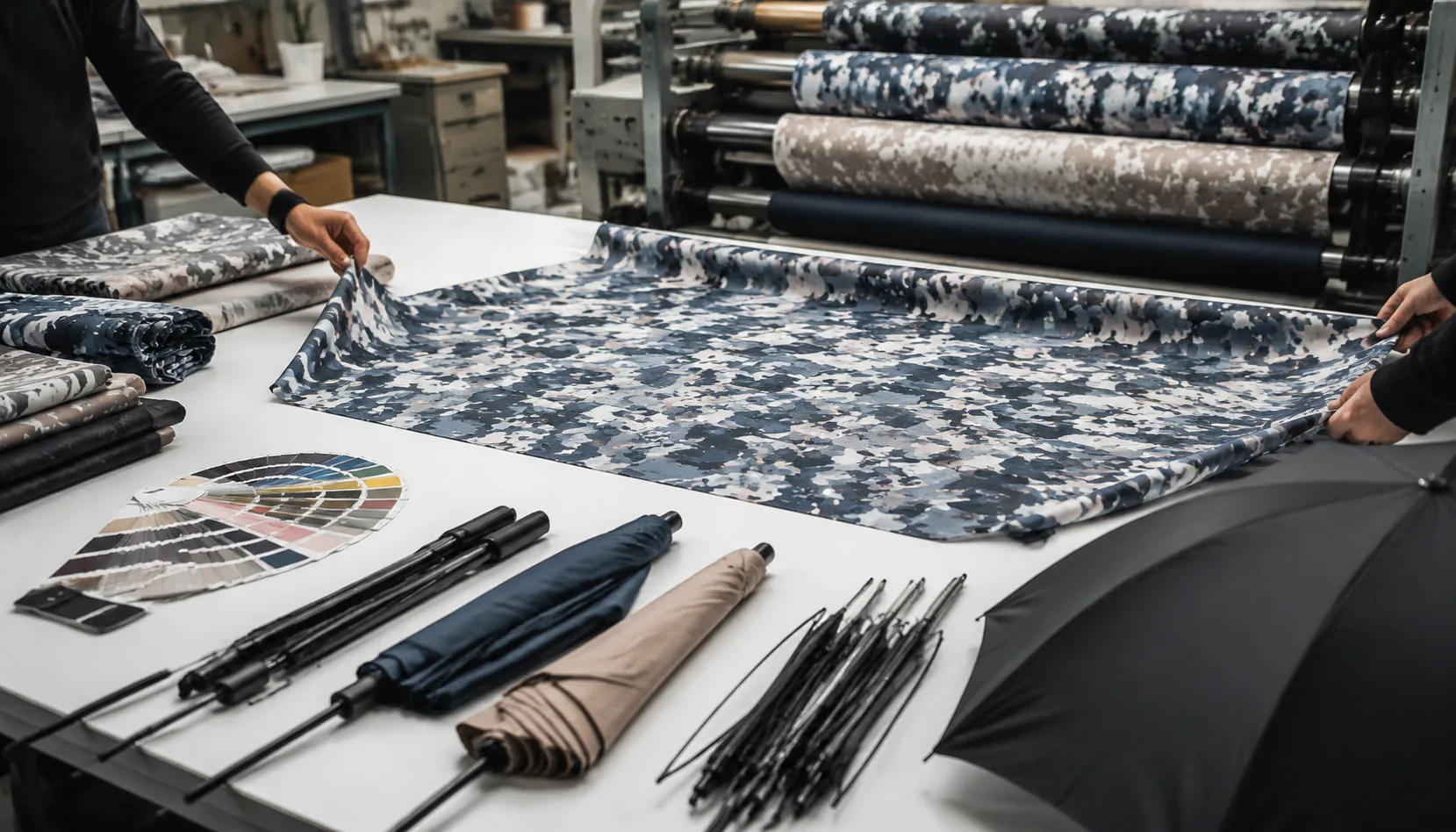
For retail brand lines, repeat pattern umbrella printing can look clean in a mockup but fail on the cutting table if scale, panel breaks, and fabric stretch are not planned together. On our Songxia factory floor, we check artwork against real panel geometry, ink behavior, MOQ targets, and sample approvals before bulk production, because a small mismatch at one seam can become thousands of umbrellas with a visible flaw.
Pattern Scale and Panel Layout Decisions
Printing method also changes the layout tolerance. Pongee umbrella printing by heat transfer or sublimation can hold small details and tight repeats better than basic screen printing, especially on 190T/210T polyester where color registration stays stable after sewing. For a true all-over umbrella print, we normally print fabric rolls or cut panels before sewing, then check panel matching under open-canopy inspection, not flat on the table. Dark grounds hide seam interruptions better, while white or pastel grounds expose every mismatch, needle hole, and slight panel tension difference. Retail buyers should approve a strike-off at actual canopy scale, not just a square artwork swatch, because a 4 inch repeat on paper feels very different once stretched across a 46–54 inch arc. Our standard practice at ZheBrella is to mark top direction, rib line, hem allowance, and logo-safe zones on the artwork before sampling, then inspect open samples under AQL 2.5 criteria for print defects, skew, and repeat alignment.
Fabric and Print Method Selection
For repeat pattern umbrella printing, fabric choice decides whether the buyer gets a crisp retail-grade surface or a muddy promotional look. 190T pongee is the usual cost-control option for custom retail umbrellas: it is lighter, folds smaller on a 21" or 23" compact frame, and keeps FOB pricing attractive when the order is 3,000–10,000 pcs. The tradeoff is yarn density. Fine logo repeats, 2–3 mm line work, and small typography can soften because the weave has more visible texture and slightly more ink spread. 210T pongee costs more, usually by a few cents to over $0.20 per canopy depending on coating and order size, but it gives better print sharpness, a smoother hand feel, and a more premium drape on 23", 27", and 30" umbrellas. For retail brand lines, I push 210T when the design uses tight geometric repeats, small icons, or dark grounds with light details.
Pongee umbrella printing also has to be matched to the artwork, not just the fabric. Digital printing is the safer choice for multi-color repeats, gradients, watercolor effects, photographic motifs, and branded umbrella patterns where every panel must carry a continuous visual rhythm. It avoids screen setup for each color and works well for low-to-mid MOQs such as 300–1,000 pcs per design, especially when a buyer is testing seasonal SKUs. The weak point is cost per unit at high volume and the need to control color under different coatings, especially Teflon water-repellent finish or UV UPF 50+ treatment. Our standard practice at ZheBrella is to run a strike-off on the actual 190T or 210T fabric before bulk cutting, then check ΔE color tolerance under D65 light, because a Pantone match on paper is not the same as ink on woven pongee.
Screen printing still earns its place when the all-over umbrella print is built from clean two- to four-color shapes: dots, stripes, checkerboards, monograms, or simple brand repeats. Once screens are made, the ink laydown is strong, color saturation is stable, and bulk production is faster for 2,000 pcs and above. It is also more forgiving on 190T pongee than digital for bold patterns because the heavier ink film covers weave variation. The limitations are registration and panel geometry. Umbrella canopies are cut into 8K, 10K, or 16K triangular panels, so a repeat crossing seam lines needs careful nesting and sewing allowance; otherwise the pattern jumps at every rib. For AQL 2.5 inspection, we check color consistency, print placement from panel tip to hem, seam alignment, and rub resistance before packing, because retail returns usually come from visible mismatch, not laboratory test failure.
Color Control for Repeat Artwork
Color control for repeat pattern umbrella printing starts with a Pantone target, but the Pantone book is only the language, not the proof. I ask buyers to specify coated or uncoated Pantone references based on the artwork intent, then we convert them against the actual canopy fabric: 190T or 210T pongee, polyester, POE, PVC, or EVA. For pongee umbrella printing, the same ink formula can read slightly cooler on a Teflon-treated 210T fabric than on an untreated 190T because the surface rejects part of the ink film. Dark grounds are even less forgiving; a beige flower over navy may need an underbase or revised ink density, otherwise the repeat looks muddy after drying. Lab dips should be reviewed under D65 daylight and store lighting, not just office LEDs. For custom retail umbrellas, I recommend approving color from fabric swatches, not paper proofs, because the canopy curve and panel seams change how the eye reads saturation.
Strike-off samples are where branded umbrella patterns become production reality. A proper strike-off should include at least one full repeat across multiple umbrella panels, not a small square cut from the print table, because registration and shade continuity are what customers notice on shelf. For an all-over umbrella print, we check whether the repeat crosses the 8K or 10K panel layout cleanly, especially at the front display panel where retail buyers usually place the hero motif. Our standard practice at ZheBrella is to record ink formula, mesh count for screen printing, transfer temperature and dwell time for heat transfer, or ICC profile for sublimation before bulk approval. If the design uses fine outlines, metallic-looking grays, or flesh tones, one strike-off is rarely enough. Two rounds are common, and they are still cheaper than rejecting 3,000 units after canopy sewing because the red logo has shifted toward orange.
Acceptable shade tolerance must be written into the purchase order before bulk cutting starts. For retail programs, I normally define panel-to-panel tolerance as visually consistent at 1 meter under D65 light, with no obvious jump between adjacent sewn panels; for stricter brand work, buyers may reference Delta E, often around 1.5 to 2.5 depending on color family and fabric. Umbrella production adds variables that flat apparel printing does not: water-repellent coatings, PU or silver UV backing, UPF 50+ treatments, and post-print heat can all shift perceived color. A black UV-coated underside can make top colors look deeper, while a silver backing can cool down yellows and light blues. Repeat pattern umbrella printing also needs bulk roll control, so fabric from different dye lots should not be mixed within the same PO unless the factory re-checks shade bands before cutting. During AQL 2.5 inspection, shade variation should be judged on assembled umbrellas, not loose panels, because rib tension changes reflection angle.
MOQ, Sampling, and Production Timing
The schedule for repeat pattern umbrella printing should start with an artwork check, not a factory quotation. A seamless tile that looks clean on a laptop can break badly when it crosses 8K or 10K panel seams, especially on a 23 inch or 27 inch umbrella where each gore has a different curve. We check repeat size, Pantone or CMYK targets, logo clearance from sewing allowance, and whether the pattern direction must match around the canopy. For pongee umbrella printing on 190T or 210T fabric, digital printing usually handles fine gradients, watercolor effects, and small branded umbrella patterns better than screen printing. Screen repeat printing is still stronger for flat spot colors and high-volume retail lines, but every color needs a film, screen, and setup, so the buyer should lock artwork before strike-off.
MOQ depends more on print method than on umbrella frame. For digital all-over umbrella print, a realistic MOQ is often 100 to 300 pieces per design because there is no screen setup, although unit cost is higher and fabric printing time can bottleneck during peak season. For screen repeat printing, I normally advise 500 to 1,000 pieces per design as the practical floor, especially if the pattern uses 2 to 4 spot colors. Below that, setup cost makes the umbrella expensive and color registration risk is not worth it. A strike-off is usually 3 to 5 printed fabric panels, approved before cutting a full pre-production sample. Our standard practice at ZheBrella is to confirm the strike-off first, then make one complete sample with the selected frame, handle, tips, runner, canopy fabric, closure strap, and retail packaging.
Timing should be mapped as milestones: artwork check takes 1 to 2 days, strike-off printing 5 to 7 days, pre-production sample 7 to 10 days after strike-off approval, and bulk production 25 to 40 days depending on quantity and rib specification. Custom retail umbrellas with fiberglass ribs, auto-open mechanisms, double-canopy venting, or UPF 50+ coating need extra coordination because printed fabric, frame assembly, and sewing lines must arrive together. Digital repeat pattern umbrella printing can shorten sampling, but bulk output may not be faster than screen if the order is 5,000 pieces and the printer queue is full. Final inspection should be booked before carton sealing, using AQL 2.5 for major defects: print misalignment, broken ribs, weak stitching, poor opening force, dirty canopy, wrong barcode, or mixed color lots. FOB shipment normally adds 3 to 5 days for booking and customs; DDP timelines depend heavily on destination clearance.
QC Checks Before Shipment
For repeat pattern umbrella printing, the first QC point is seam registration, not color. A beautiful all-over umbrella print fails on the sales floor if the motif jumps 8 mm at every panel seam or the logo lands half under a rib pocket. We check cut panels against the approved paper marker and digital strike-off, then inspect sewn canopies on a light table before mounting. For 8K and 10K retail umbrellas, our normal tolerance is within 3 mm at the panel edge for small geometric branded umbrella patterns; for large floral or mascot artwork, we agree on a visible-match zone before bulk cutting. Pongee umbrella printing on 190T or 210T fabric also needs shade control because heat transfer and sublimation can shift after calendaring. We compare bulk panels to the signed PPS under D65 light, then open finished umbrellas at 45 degrees and full tension to confirm print continuity across seams, tips, straps, and closure bands.
Rubbing fastness and water repellency must be tested after assembly because sewing tension, handling oil, and steam shaping can change the surface. For dark custom retail umbrellas, we run dry and wet crocking checks on printed areas and especially on high-contact parts near the tie strap; a weak print will stain a white sleeve or retail carton during ocean transit. Water repellency is checked with a spray test on the finished canopy, not only raw fabric, and Teflon-coated pongee should bead cleanly without wetting through at needle holes. PVC, POE, and EVA clear panels are inspected differently: we look for ink adhesion, blocking, haze, and cracking around folds. Frame operation is checked on every sampling pull: manual, auto-open, and auto-open-close mechanisms must release smoothly, lock without slippage, and close without rib inversion. Fiberglass ribs are flexed for memory, while steel ribs are checked for plating scratches and bent joints.
Final inspection should follow AQL 2.5 for major defects, with critical defects rejected at zero tolerance. In practice, that means carton-level random sampling after packing, including open-close cycles, canopy diameter checks on 21-inch, 23-inch, 27-inch, and 30-inch sizes, rib count confirmation for 8K/10K/16K frames, handle pull tests, barcode scans, polybag warnings, and master carton drop-risk review. For repeat pattern umbrella printing, I also ask inspectors to photograph at least five opened samples per colorway because pattern drift is easier to judge visually than from a defect code. FOB shipments usually tolerate tighter carton loading because the buyer controls the forwarder, but we still use individual sleeves, tissue on printed PVC windows, and rib-tip guards for glossy handles. For DDP shipments with more courier handling, ZheBrella’s standard practice is stronger 5-ply cartons, inner carton dividers for premium pieces, desiccant when needed, and no metal buckle rubbing directly against printed pongee umbrella printing surfaces.
Frequently Asked Questions
Can a repeat pattern align perfectly across every umbrella seam?
Not perfectly on every unit, because each canopy panel is cut and sewn with normal production tolerance. A good factory can control motif placement and keep seam mismatch within an approved sample standard.
Is digital printing better for branded repeat patterns?
Digital printing is usually better for complex, photo-like, or many-color repeats. Screen printing can be more cost-effective for simple patterns at higher volume, especially on 190T or 210T pongee.
What artwork scale works best for repeat pattern umbrella printing?
For retail umbrellas, most repeat patterns are built at 150–300 dpi at final print size, with motifs sized to remain visible across individual panels. Small patterns under 1 inch can look busy on folded umbrellas, while larger motifs should be checked on a full panel template before sampling.
Can an all-over umbrella print align perfectly across every panel seam?
Exact seam-to-seam matching is difficult because umbrella panels are cut and sewn individually. A tolerance of about 3–5 mm is common, so patterns with forgiving repeats, scattered motifs, or border-free layouts usually produce the cleanest retail result.
What MOQ and sampling timeline should buyers expect for custom pongee umbrella printing?
Typical MOQ for repeat-pattern pongee umbrellas is around 500–1,000 pieces per design, depending on frame style and print method. Pre-production samples usually take 7–15 days after artwork approval, with bulk production often taking 30–45 days after sample confirmation.
Looking to Launch Your Custom Umbrella Line?
ZheBrella is a Zhejiang-based OEM/ODM umbrella manufacturer with 17 years of export experience. Free design, low MOQ from 100 pieces, windproof construction, full-color print.
Get Free Quote Now »People Also Search For
Related Articles
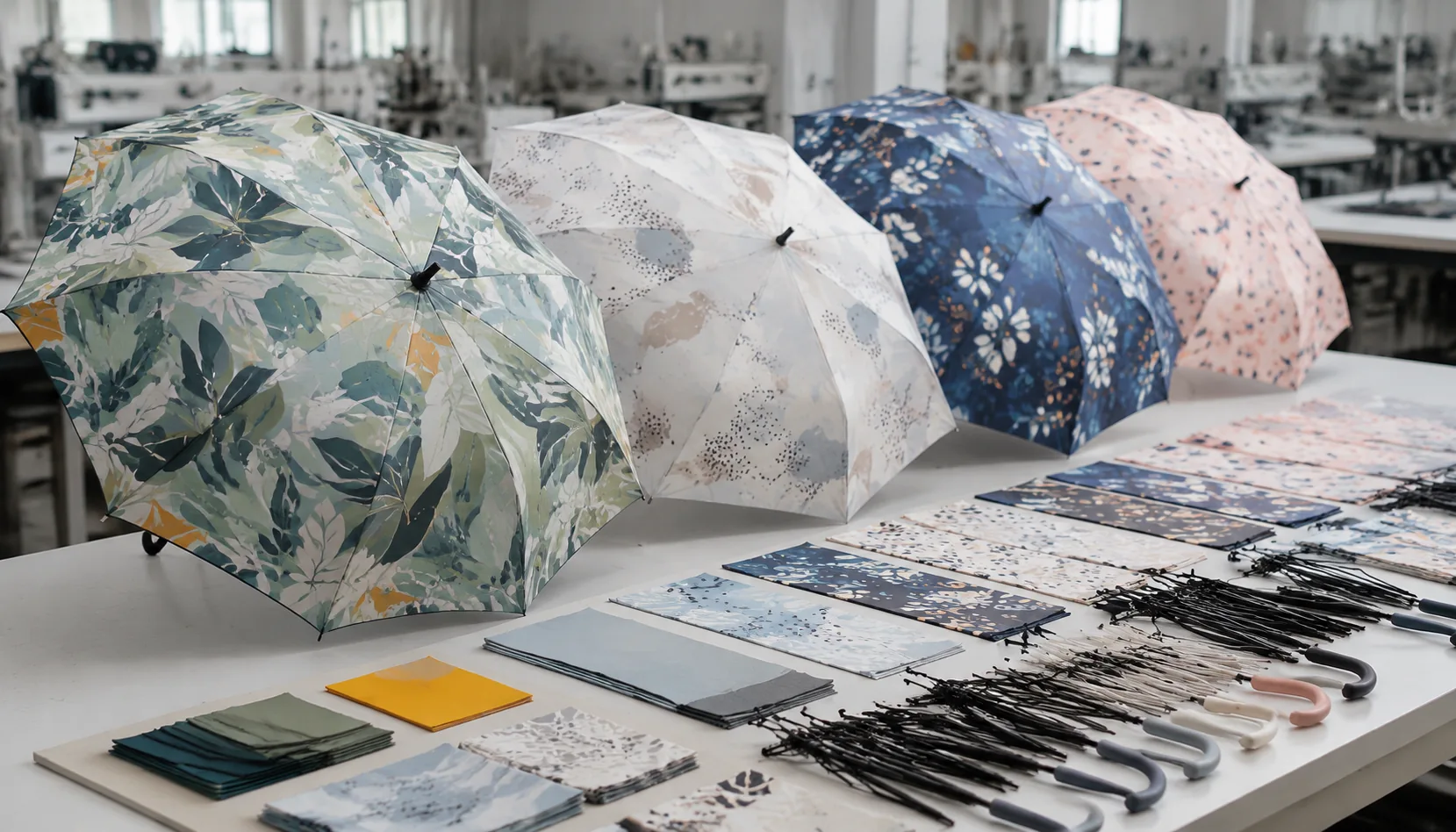
All-Over Pattern Printing for Retail Umbrella Collections
Build retail umbrella patterns with clean repeats, controlled panel alignment, and fabric choices that keep logos sharp ...
Read More »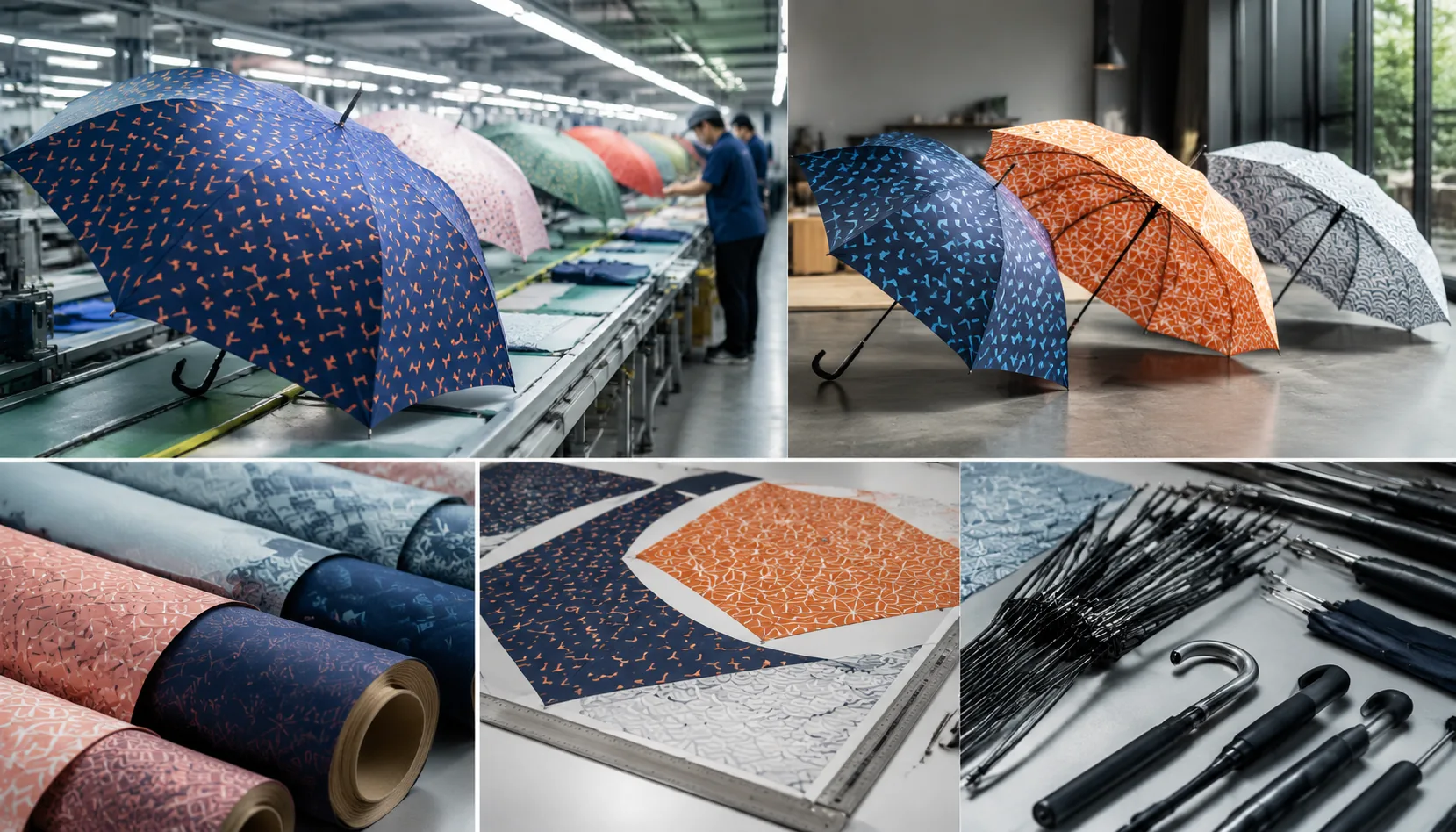
All-Over Pattern Printing for Branded Umbrella Programs
Build repeat-pattern umbrella programs with print-ready artwork, panel planning, fabric choices, and QC steps that prote...
Read More »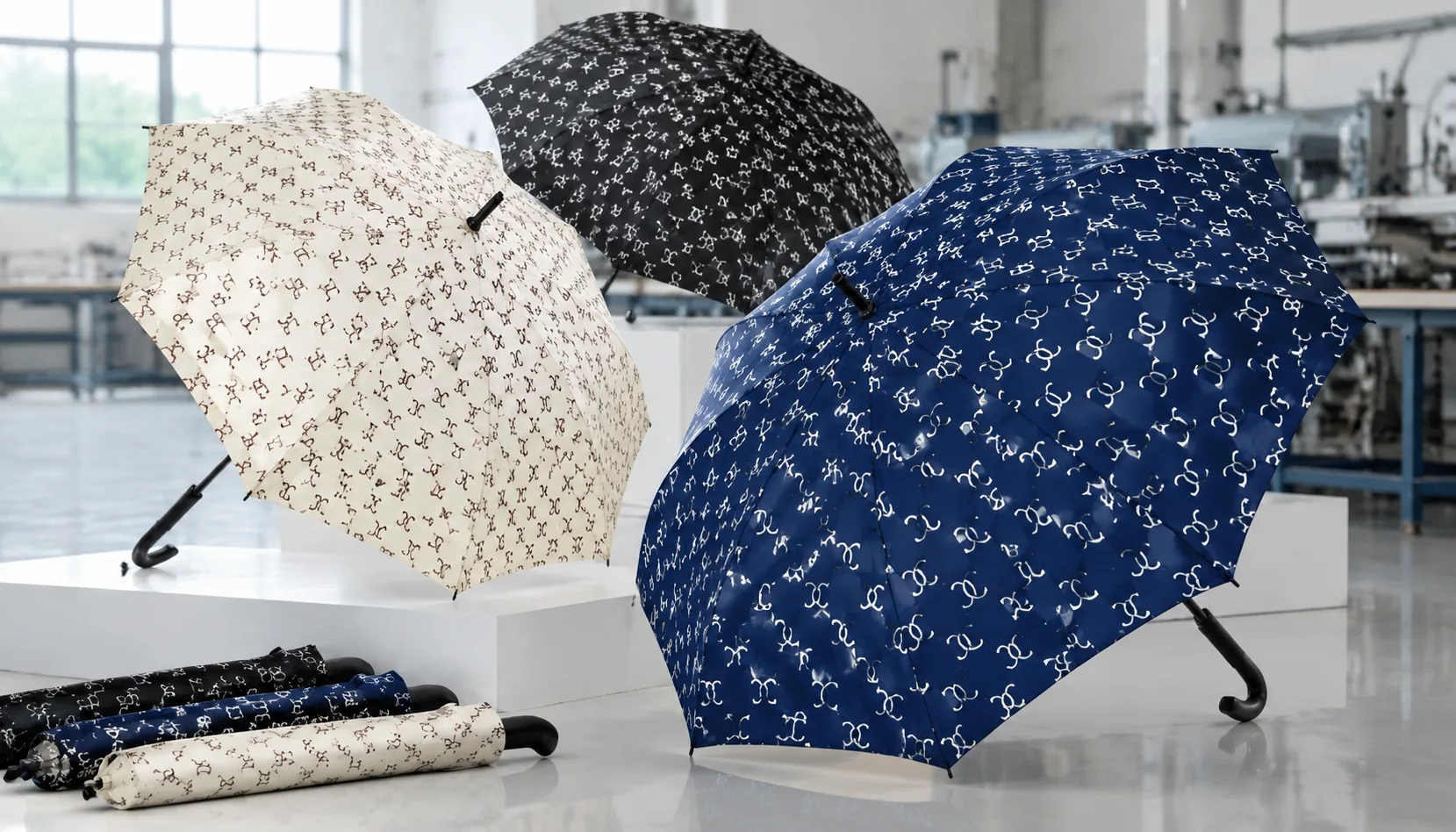
All-Over Logo Patterns for Retail Branded Umbrellas
Build all-over logo umbrella patterns with repeat sizing, panel registration, and fabric specs that reduce distortion, s...
Read More »