Retail-Ready Umbrella Sourcing: Barcodes, Cartons, and QC
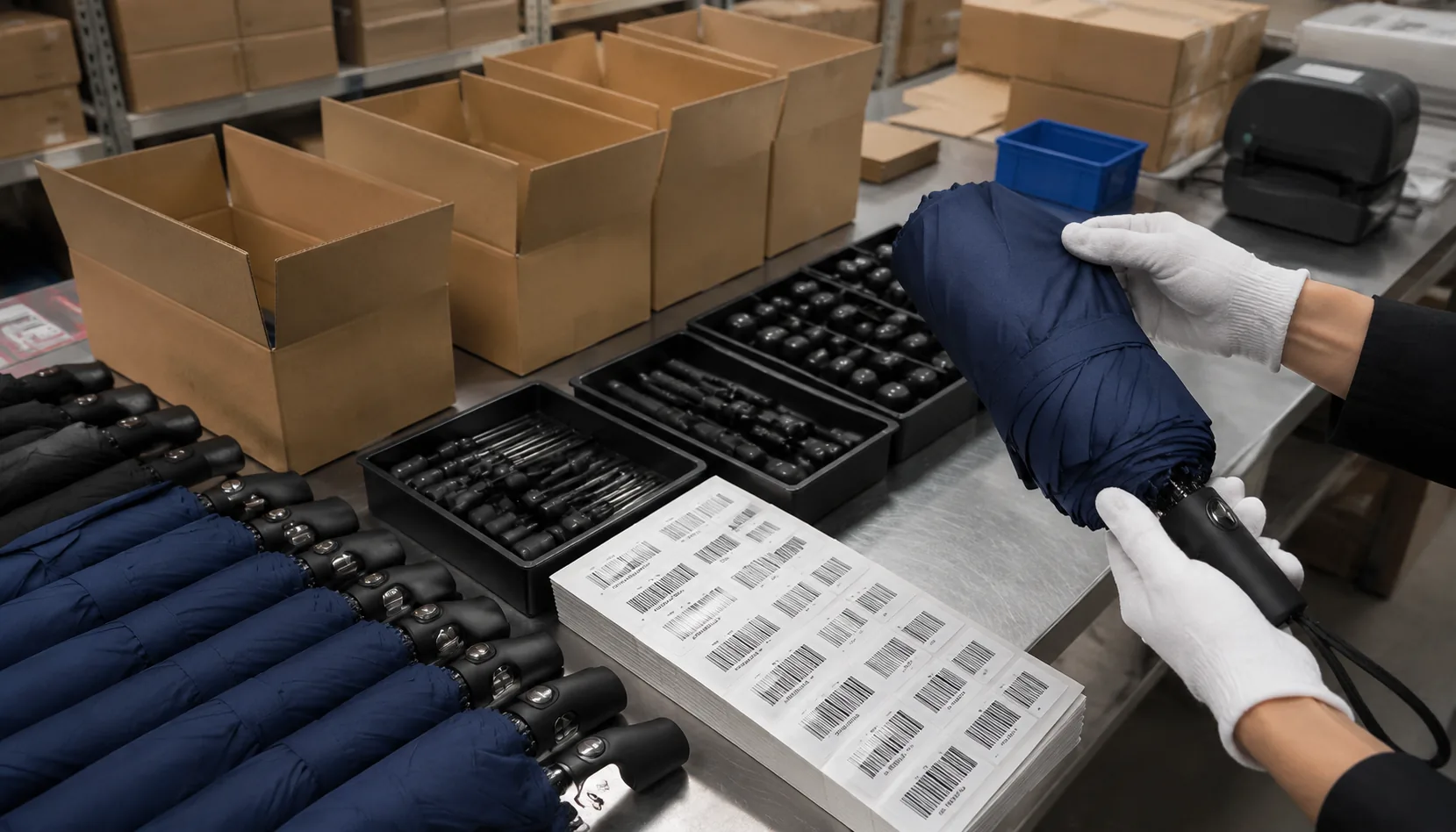
Retail umbrella programs often lose margin after production, when unreadable barcodes, weak cartons, missed AQL points, or late DDP paperwork turn into chargebacks and launch delays. As a retail ready umbrella supplier working from the factory floor in Songxia, we treat labeling, master carton strength, packing audits, and final inspection as production controls—not afterthoughts—so buyers can receive shelf-ready goods without rework at the warehouse.
Define the Retail Pack Before Quoting
Lock the retail pack before you ask for price, because the same 23" auto-open umbrella can land at three different unit costs depending on whether it ships in a clear polybag, printed sleeve, or full color box. A polybag with suffocation warning is cheapest and packs tight, but it looks weak on a store peg unless the hangtag carries the brand story. A paper sleeve adds shelf impact with low material weight, especially for 190T or 210T pongee stick umbrellas, while a color box protects premium 27" golf umbrellas and auto-open-close folding models but increases cube fast. A serious retail ready umbrella supplier should quote the umbrella and the pack as one system, not treat packaging as an afterthought after production starts.
Hangtag placement must be decided with the same discipline as rib count or canopy fabric. For hook display, the hangtag usually sits on the handle strap or sleeve lip; for boxed umbrellas, the UPC/EAN should be on a flat, scan-friendly panel, not across a box edge or glossy fold. For barcode label umbrellas, I prefer a minimum scannable symbol area around 37 mm wide for standard UPC-A, with quiet zones left clean and no varnish overprint that causes scanner reflection. Warning labels also matter: polybags need suffocation text, children’s umbrellas may need age grading, and certain U.S. retailers require country-of-origin on both item and master carton. If the buyer sends GS1 barcode files late, production stops at packing, not sewing.
Umbrella carton specifications directly affect MOQ, freight cost, and damage rate. A 21" compact in sleeve may fit 48 or 60 pieces per export carton, while a 30" vented golf umbrella in color box may drop to 12 or 24 pieces, changing CBM, pallet count, and DDP umbrella shipping estimates. Master carton marks should include PO number, SKU, color, quantity, gross/net weight, carton size, made-in-China wording, and scannable carton barcode if the retailer requires ASN receiving. Our standard practice at ZheBrella is to confirm carton drop strength, inner quantity, and AQL umbrella inspection checkpoints before mass packing; otherwise factories pass canopy QC and still fail the retail warehouse because carton marks, mixed SKUs, or barcode grades were wrong.
Lock Carton Specs for Warehouse Compliance
Carton size is not an afterthought; it decides whether the shipment clears the retail DC without chargebacks. For straight umbrellas, common master cartons run around 104 x 26 x 23 cm for 24 pcs of 23" manual or auto-open models, while golf umbrellas may need 98 x 32 x 28 cm for 12 pcs of 27" or 30" frames. Compact 21" folding umbrellas usually pack tighter, often 48 pcs/carton at roughly 53 x 32 x 28 cm, depending on handle shape and sleeve thickness. Gross weight should stay practical for warehouse handling: 14–18 kg is comfortable, 20 kg is usually the upper limit before buyers start asking for split cartons. Inner pack counts also matter. A 48-piece compact order may need 4 inner cartons of 12 pcs or 8 polybag bundles of 6 pcs, especially when barcode label umbrellas must be scanned by color, SKU, or retail assortment.
A retail ready umbrella supplier should confirm umbrella carton specifications before quoting FOB Ningbo/Shanghai or DDP umbrella shipping because carton cube changes freight cost immediately. A quote based on 36 pcs/carton can be wrong if the buyer later requires 24 pcs/carton for warehouse ergonomics or mixed-color replenishment. For DDP, the difference is bigger because air, truck, and warehouse receiving fees often use volumetric weight, not just gross weight. For example, a 10,000-piece order packed 48 pcs/carton may use about 209 cartons; the same order at 24 pcs/carton doubles carton count, pallet positions, labels, and handling. Pallet height restrictions also bite: many U.S. and EU retailers prefer cartons under 15–18 kg and pallet stacks under 1.6 m, with no carton bulging after compression. If the umbrella has a curved wooden handle, thick EVA case, or retail hang tag, we recalculate the carton before locking the proforma invoice.
Drop-test expectations should be written into the packing spec, not discovered during AQL umbrella inspection. Our standard practice at ZheBrella is to run carton drop checks on export packing from 60–80 cm, covering one corner, three edges, and six faces for retail master cartons, then inspect for broken rib tips, cracked plastic handles, bent shafts, sleeve tearing, and barcode scuffing. Heavy 16K windproof umbrellas with fiberglass ribs need stronger 5-ply K=A or K=K cartons than light 8K promotional models, and long straight umbrellas should use end protection so ferrules do not punch through the carton wall. Retail DCs also care about label placement: shipping mark, SKU, PO number, quantity, gross/net weight, carton dimensions, country of origin, and scannable barcode label umbrellas usually need to sit on the same long side panel. A disciplined retail ready umbrella supplier freezes these details before mass packing, then checks them during final AQL 2.5 inspection against the buyer’s routing guide.
Choose Umbrella Specs That Fit Shelf Price
Shelf price should drive the umbrella spec before artwork, because a small upgrade can destroy margin faster than buyers expect. For a value retail umbrella at $6.99 to $9.99, 190T pongee is usually enough: it prints cleanly, dries reasonably fast, and keeps fabric cost under control. Moving to 210T pongee gives a denser hand feel, better color depth, and a more premium snap when the canopy is tensioned, but it belongs on $12.99+ programs unless the order volume is high. POE or PVC clear canopies can look strong on shelf, especially for dome umbrellas, but they add packing challenges and can show creases if the umbrella carton specifications are too tight. A practical retail ready umbrella supplier should quote both fabric weights with finished unit weight, folded length, and carton cube, not just a pretty sample photo.
Frames are where buyers often overspend in the wrong place. Steel ribs are economical and feel solid in hand, but they add weight and can bend after repeated inversion. Fiberglass ribs cost more but recover better in gusts, especially on 23 inch and 27 inch stick umbrellas. An 8K frame is the standard retail workhorse; 10K can improve canopy shape; 16K looks premium but adds labor, frame cost, and packed weight without always improving sell-through. For wind claims, I would rather see a double-canopy vented 8K or 10K fiberglass frame tested to 50+ mph than a heavy 16K steel frame sold as “stormproof.” Auto-open adds perceived value at the button, while manual open protects margin for giveaways and entry-level retail. Auto-open-close is best reserved for compact folding umbrellas above mid-tier price points.
Straight umbrellas sell well when the handle and silhouette are part of the value story: 23 inch city umbrellas, 27 inch golf promos, and 30 inch oversize rain programs all justify larger shelf space if the retailer can price them properly. Folding umbrellas win on logistics and checkout placement; 21 inch and 23 inch compact models reduce carton cube, simplify DDP umbrella shipping, and fit clip strips or shelf trays. Retail execution also depends on barcode label umbrellas being readable after polybagging, hangtagging, or sleeve packing. Before mass production, lock the target retail, FOB cost, gross margin, case pack, and AQL umbrella inspection level together. A $0.35 frame upgrade may look harmless, but after duty, freight, retailer margin, and markdown allowance, it can push the item out of its intended price band.
Build QC Around Retail Failure Points
Function testing is where many compact and golf umbrellas fail after they already look retail-ready. Manual open models should be checked for smooth runner travel, locking strength, and no rib crossing; auto-open and auto-open-close frames need repeated cycling, usually 5–10 operations per sampled unit during AQL umbrella inspection. On a 21 inch compact, weak springs and misaligned plastic runners show up quickly; on 27 inch and 30 inch golf umbrellas, the bigger risk is bent steel ribs, loose stretchers, or a double-canopy vent that has been sewn too tight and distorts under wind. For fiberglass frames, inspectors should flex ribs and check ferrule joints because hairline cracks are easy to miss under warehouse lighting. Chargebacks often come from the boring details: wrong retail price sticker, barcode that will not scan through a glossy label film, crushed corner cartons, shade difference between approved red and bulk red, or auto-open buttons that stick after heat exposure in transit. A serious retail ready umbrella supplier treats these as shipment blockers, not cosmetic notes.
Plan Lead Time and Shipping Mode Early
Lead time gets lost in the gaps, not on the sewing line. For a retail program, I map the calendar backward from the in-store date: 3–5 days for artwork and barcode proofing, 5–7 days for pre-production sample approval, 20–35 days for bulk production depending on frame type, 7–12 days for printed insert cards, hangtags, sleeves, inner boxes, and master cartons, then 1–2 days for final AQL umbrella inspection. A simple 23" auto-open 190T pongee umbrella with steel shaft and 8K fiberglass ribs can move faster than a 30" golf umbrella with double-canopy venting, 16K fiberglass frame, UV UPF 50+ coating, and multiple heat-transfer logos. If packaging uses GS1 UPC/EAN codes, carton marks, FBA labels, or retailer-specific warning text, lock those files before fabric cutting starts. A serious retail ready umbrella supplier will not wait until packing week to discuss barcode label umbrellas because one wrong digit can hold a whole shipment at the retailer’s DC.
Bulk production capacity is only one part of the schedule; carton and routing decisions matter just as much. Umbrella carton specifications should be confirmed with the PO: units per inner carton, master carton size, gross weight, net weight, barcode placement, country-of-origin mark, and whether the retailer needs ISTA-style drop resistance. For example, 24 pcs per carton may work for 21" folding umbrellas, but 12 pcs is more realistic for 27" stick umbrellas with J-handles, and 6 pcs may be safer for large 30" golf umbrellas to control carton weight under roughly 18–22 kg. Our standard practice at ZheBrella is to run packaging procurement in parallel with fabric printing and rib assembly, then reserve 48 hours before inspection for carton sealing, random pull, and label verification. For AQL 2.5, inspectors need access to finished packed goods, not half-packed pallets, so do not schedule inspection the same morning the truck is supposed to leave.
FOB Ningbo or Shanghai is usually enough when the buyer has a forwarder, stable import records, and wants control over ocean freight, customs, and final delivery. It is also cleaner for distributors consolidating umbrellas with bags, caps, or other promotional goods from multiple factories. DDP umbrella shipping helps when retailers need landed cost certainty, especially for seasonal buys where late delivery destroys margin. Under DDP, the supplier or logistics partner quotes product, export handling, international freight, import duty, customs clearance, and delivery to the warehouse or DC in one number; the buyer avoids surprise demurrage, broker fees, or residential-accessorial style charges. The tradeoff is timing visibility: air DDP can deliver in 7–12 days after inspection but costs heavily on 27" and 30" umbrellas because cartons cube out, while ocean DDP is cheaper but often needs 30–45 days port-to-door. Decide this before production starts, not after goods are packed.
Frequently Asked Questions
Can barcodes and retail carton marks be added at the umbrella factory?
Yes. The buyer should provide UPC/EAN files, carton mark artwork, and retailer routing requirements before mass production. The factory can scan-test barcodes during AQL 2.5 inspection.
What MOQ is typical for retail-ready private label umbrellas?
MOQ depends on frame type, fabric color, and packaging complexity, but many programs start around 1,000-3,000 pcs per SKU. Custom color boxes or exclusive fabric colors may require higher minimums.
Can umbrella cartons be labeled for Amazon, Walmart, or retail DC receiving?
Yes. A factory can apply UPC/EAN labels, FNSKU labels, carton marks, PO numbers, SKU codes, and destination labels before shipment. Buyers should provide the retailer routing guide and label artwork before mass packing starts.
What carton specifications should buyers confirm before approving umbrella production?
Confirm units per inner box and master carton, carton dimensions, gross weight, barcode placement, carton burst strength, and whether hang tags or polybags are required. For retail programs, keeping cartons under 15–20 kg is often preferred for easier DC handling.
When should AQL inspection be done for retail-ready umbrella orders?
Final random inspection is usually done when 80–100% of goods are packed, using AQL 2.5 for major defects and AQL 4.0 for minor defects unless the buyer specifies stricter limits. Inspection should include barcode scanning, carton count, opening/closing function, fabric defects, frame strength, and packaging accuracy.
Looking to Launch Your Custom Umbrella Line?
ZheBrella is a Zhejiang-based OEM/ODM umbrella manufacturer with 17 years of export experience. Free design, low MOQ from 100 pieces, windproof construction, full-color print.
Get Free Quote Now »People Also Search For
Related Articles
Private Label Umbrella Assortment Planning for Retail Buyers
Build a balanced private label umbrella range with clear SKUs, fabric specs, MOQ planning, AQL targets, and retail-ready...
Read More »
Mixed-SKU Umbrella Orders: MOQ, Cartons, and Delivery
Learn how to plan mixed-SKU umbrella orders across colors, sizes, frames, cartons, inspections, and FOB or DDP delivery ...
Read More »
Private Label Umbrella Sourcing for Retail Chains and Brands
A buyer-focused guide to sourcing private label umbrellas with the right MOQ, specs, QC plan, and Incoterms for retail p...
Read More »