RPET Umbrellas for Sustainable Promotional Sourcing
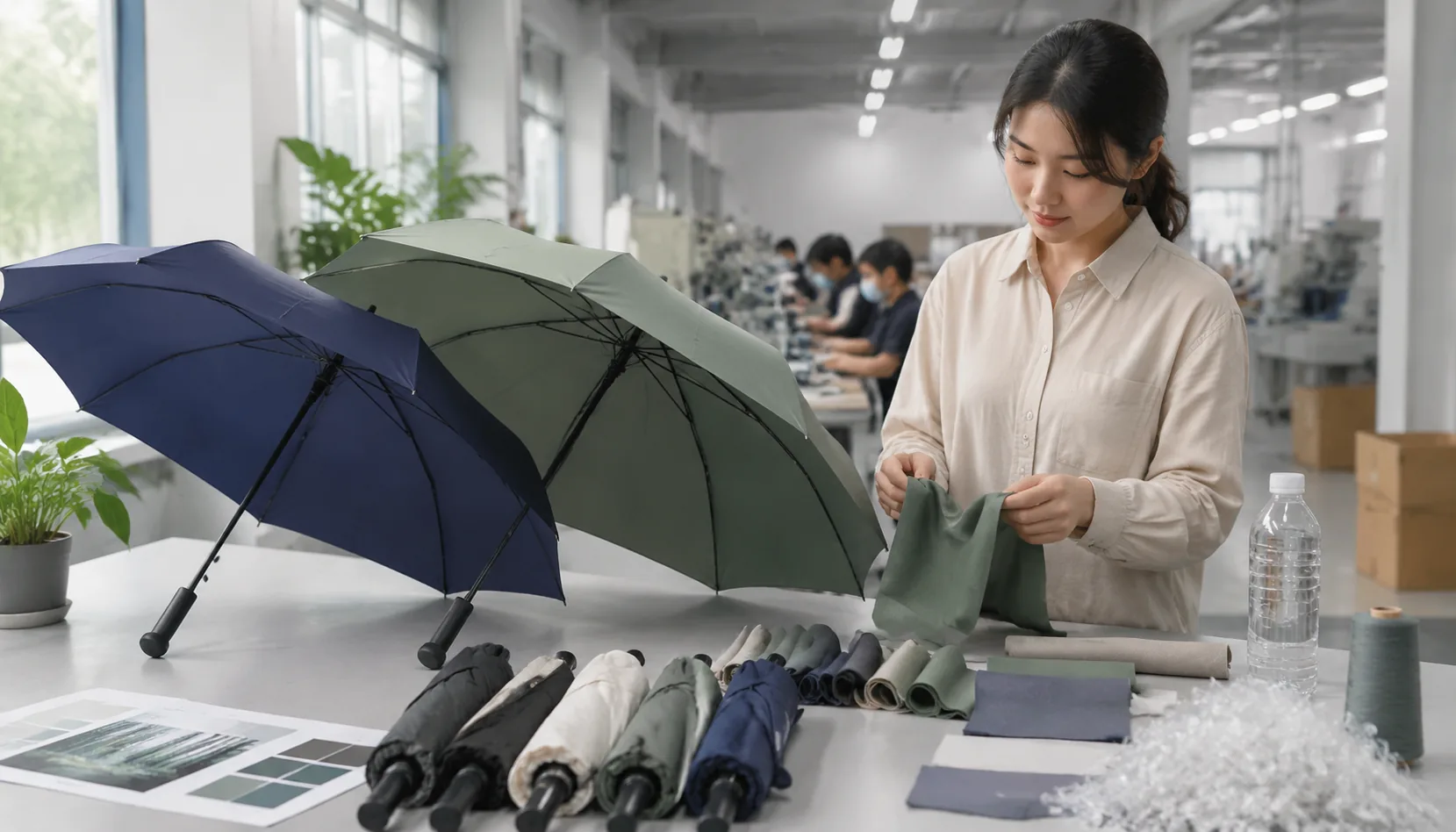
For promo buyers, the hard part is not finding RPET fabric; it is proving the material claim, matching the right hand feel and canopy strength, and keeping the order consistent at scale. On our Songxia production floor, RPET promotional umbrellas usually come down to three practical checks: valid GRS paperwork, the right 190T or 210T fabric for the budget, and frame/QC choices that survive real opening, wind, and carton-drop testing.
What Makes an Umbrella RPET
An RPET umbrella is defined first by the canopy fabric, not by the whole product. RPET means recycled polyethylene terephthalate, usually made from post-consumer PET bottles that are cleaned, chipped, melted, spun into yarn, and woven into umbrella cloth. In our factory, the most common recycled fabric umbrellas use 190T or 210T RPET pongee, because it prints cleanly, folds well, and accepts water-repellent finishing without becoming stiff. The canopy can still receive the same functional treatments as virgin polyester: Teflon-style water repellency, silver or black UV coating for UPF 50+, or digital/sublimation printing for full-panel graphics. For RPET promotional umbrellas, the buyer should ask whether the recycled claim applies to the canopy only, the sleeve only, or every textile component, because those are different bills of material and different certificate scopes.
The tricky part is that umbrella components rarely share one recycled-content percentage. A 23-inch auto-open umbrella may have an RPET pongee canopy, a matching RPET sleeve, a woven label made from virgin polyester, a PP handle, fiberglass ribs, steel shaft, and an OPP bag or recycled kraft carton. Even inside the canopy, the fabric yarn may be recycled while sewing thread, binding tape, hook-and-loop strap, and screen-printing ink are not. Packaging has its own claim: a recycled paper belly band or FSC carton does not make the umbrella itself recycled. For sustainable umbrella sourcing, I separate the claim line by line: canopy fabric composition, sleeve composition, label material, hangtag paper, polybag material, and master carton. That prevents a sales sheet from saying “100% recycled umbrella” when only the 210T pongee panel fabric is RPET.
Marketing claims should be written only after the documents are checked. A GRS umbrella supplier should be able to provide a valid scope certificate for the factory or nominated fabric mill, transaction certificate where applicable, fabric test report showing composition, and purchase records linking the RPET fabric batch to the production order. Our standard practice at ZheBrella is to mark the approved claim on the quotation and pre-production sample record before bulk cutting, because changing wording after AQL 2.5 inspection creates export-labeling risk. Safe wording is usually specific: “canopy made with GRS-certified 100% recycled polyester” or “RPET canopy and sleeve,” not a broad claim that the complete umbrella is recycled. Eco friendly umbrellas still need normal performance checks too: 8K or 10K rib strength, waterproofness after coating, colorfastness after printing, and packaging that survives FOB or DDP handling.
Certificates and Traceability Buyers Should Request
The document that matters most for RPET promotional umbrellas is the GRS transaction certificate, not a nice-looking recycled logo on a quotation sheet. A valid GRS TC should connect the exact material shipment to the fabric mill, the umbrella factory, and the buyer’s PO, with product description, weight, recycled percentage, and date matching the order. I have seen buyers approve “recycled pongee” based on a generic PDF from last year, then discover the actual 190T canopy was cut from a non-certified black stock roll because the certified navy fabric was out of stock. Ask for the supplier’s GRS scope certificate first, then require a TC after bulk material is purchased. The scope certificate proves the factory or mill is approved to handle GRS goods; the transaction certificate proves your specific goods moved through that chain.
Yarn or fabric certificates are useful, but they must match the ordered construction, color, and finish. If your spec says 210T RPET pongee with Teflon water-repellent coating and UPF 50+ treatment, the certificate should not refer only to raw recycled polyester chips or undyed yarn. Color matters because mills often certify a batch after dyeing, and recycled-content claims can become weak if the buyer changes from white to PMS-matched red after approval. For recycled fabric umbrellas, request the mill invoice, fabric roll labels, and cutting-room allocation records in addition to lab reports. Our standard practice at ZheBrella is to reserve certified rolls by PO before canopy cutting, because mixed-roll cutting is where traceability breaks down fastest in umbrella production.
Logo-use rules are another place where sustainable umbrella sourcing gets messy. GRS does not allow every buyer to print the GRS logo freely on hangtags, sleeves, or canopy panels; logo use normally requires approval through the certified organization and must follow Textile Exchange labeling rules. If a distributor wants eco friendly umbrellas with a recycled claim, safer wording is often “canopy fabric made with certified recycled polyester” rather than a broad “100% recycled umbrella,” because the steel shaft, fiberglass ribs, plastic runner, EVA handle, and tips are not RPET. A serious GRS umbrella supplier should tell you this before production, not after inspection. Put the approved claim, label artwork, and certificate requirements into the PO, then check them under AQL 2.5 during final inspection together with carton marks and packing lists.
Canopy Specs: 190T, 210T, Coatings, and Color
For most RPET promotional umbrellas, 190T recycled pongee is the practical baseline: light hand feel, fast drying, good drape on 21" and 23" folding models, and lower fabric cost. The “T” count is yarn density, not thickness by itself, but in our cutting room 190T usually feels slightly softer and more pliable than 210T. It prints cleanly for one- or two-color logos by silk screen or heat transfer, though very fine text under 1.5 mm can lose edge sharpness if the fabric surface is too textured. Opacity is acceptable for dark navy, black, forest green, and burgundy, but lighter RPET colors such as white, yellow, and sky blue may show rib shadowing, especially on steel 8K frames under bright light. If the buyer is chasing a low unit price for event giveaways, 190T is normally the better value, provided the artwork is not photographic and the umbrella is not positioned as retail-grade.
210T RPET pongee is the safer choice when the umbrella needs a denser hand, better opacity, and cleaner print definition. It sits flatter under the screen frame, so PMS color blocks, small QR codes, and thin sans-serif lettering hold better than on cheaper 190T lots. For retail brand owners and premium distributors, I prefer 210T on 23" auto-open, 27" golf, and double-canopy vented windproof umbrellas because the canopy tension looks more even after sewing. The cost increase is usually modest compared with the whole umbrella, but it affects landed price when MOQ reaches 3,000 to 10,000 pieces. For recycled fabric umbrellas, confirm the yarn source and transaction certificate if you need a GRS umbrella supplier; “RPET look” is not the same as verified recycled polyester. Our standard practice at ZheBrella is to approve lab dips and pre-production fabric before bulk cutting, not after 8,000 panels are already printed.
Coating selection changes the product more than many buyers expect. A normal water-repellent finish is enough for daily rain use, but it should bead water after spray testing and not leave oily marks on light colors. For eco friendly umbrellas sold as sun-and-rain models, a black inner coating is the usual way to reach UPF 50+, especially on 190T and light-colored 210T canopies; silver coating is cheaper but often looks promotional and scratches more visibly at fold lines. Teflon-style repellent improves water roll-off but adds cost and should be checked against the buyer’s chemical compliance list. Colorfastness matters because RPET dye lots can shift: we check rubbing fastness, water fastness, and light exposure, then compare bulk fabric to the approved lab dip under D65 lighting. For sustainable umbrella sourcing, do not approve color from a phone photo; require a physical swatch, printed strike-off, and canopy sample before confirming bulk production.
Frame and Mechanism Options for Eco Programs
The biggest mistake in eco programs is treating the RPET canopy as the whole product. A 190T or 210T recycled pongee canopy can carry the sustainability story, but the frame decides whether the umbrella survives real use. For RPET promotional umbrellas, I usually pair the canopy with fiberglass ribs when the buyer expects outdoor events, campus use, or commuter traffic. Fiberglass is lighter than steel rib stock and flexes better in gusts, especially in 8K and 10K layouts. A double-canopy vented 23" model with fiberglass ribs can survive 50+ mph wind-tunnel testing if the rib joints and runner are built correctly. Steel ribs cost less and feel solid, but they bend instead of rebounding, so they fit budget handouts better than long-term brand programs. If the campaign message is “reuse, not discard,” fiberglass ribs are the cleaner engineering choice even when the canopy already uses recycled fabric.
Shaft choice is where weight, price, and perceived quality start fighting each other. A steel shaft gives a 23" straight umbrella a sturdy hand feel and keeps FOB cost under control, but it adds weight in cartons and in the user’s bag. Aluminum shafts and stretchers reduce weight, useful for 21" folding eco friendly umbrellas, though they need tighter tolerance control because thin aluminum dents during assembly and transport. Wooden handles work well for sustainability messaging because they avoid the glossy plastic look, but buyers should specify smooth sanding, consistent varnish, and moisture control; cheap wood handles crack after container humidity swings. Bamboo handles can look more natural, but supply consistency is less stable than beech or maple. Our standard practice at ZheBrella is to confirm frame material, handle finish, and canopy certification together, because a GRS umbrella supplier should not sell the canopy story while ignoring the rest of the bill of materials.
Mechanism selection depends on how the umbrella will be used, not only how it looks in a catalog. Manual-open frames are the simplest, cheapest, and easiest to repair, so they make sense for large-volume sustainable umbrella sourcing where MOQ may be 1,000 to 3,000 pieces per color. Auto-open straight umbrellas add convenience and a higher retail feel, but the spring, runner, and button housing introduce more failure points if the factory uses weak plastic parts. Auto-open-close folding umbrellas are popular for executive gifts, yet they need stronger center rods and careful cycle testing; I would not approve them without opening/closing checks across at least 300 cycles and AQL 2.5 final inspection. For RPET promotional umbrellas, the best balance is often a 23" auto-open steel-shaft model for value, or a 21" auto-open-close folding model with fiberglass ribs and a matte wooden or recycled-plastic handle for premium programs. The sustainability message is strongest when the umbrella feels durable enough to be kept for years.
MOQ, Lead Time, AQL, and Shipping Planning
For RPET promotional umbrellas, the RFQ should lock MOQ by fabric color before anyone talks about unit price. In our factory planning, a practical MOQ is usually 500 pieces per color for 190T RPET pongee on 21" or 23" folding umbrellas, and 1,000 pieces per color when the buyer wants custom-dyed 210T RPET pongee or a matched EVA/POE sleeve. If the frame is standard black steel with 8K ribs, we can often consolidate colors faster; if the program needs fiberglass ribs, 10K construction, auto-open-close shafts, or a vented double canopy, component scheduling becomes the real bottleneck. A proper RFQ should state canopy fabric weight, recycled-content claim, print method, handle material, mechanism, rib count, packed quantity, and whether the buyer requires a GRS umbrella supplier with transaction certificate support. For recycled fabric umbrellas, carton-level traceability should be requested from the start, not after production is packed.
Sampling is normally 5–7 days for an existing RPET fabric color with a screen-printed logo, 7–10 days for heat-transfer panels, and 10–14 days if the buyer needs sublimation, custom color approval, or GRS document matching. Bulk lead time is typically 25–35 days after sample approval and deposit for 1,000–5,000 pieces, but sustainable umbrella sourcing programs with multiple SKUs can run 40–50 days when retail packaging, hangtags, recycled-content labels, and distributor carton marks are added. For eco friendly umbrellas, I recommend approving a pre-production sample that includes the exact RPET label wording, not only the canopy color and logo size. Our standard practice at ZheBrella is to keep fabric roll numbers tied to cutting lots, then reflect that traceability on master carton labels so the buyer can connect cartons back to recycled material documentation during warehouse receiving.
Inspection terms should be written as AQL 2.5 for major defects and AQL 4.0 for minor defects unless the buyer has a stricter retail manual. For umbrellas, inspectors should open and close every sampled unit, check rib alignment, shaft locking, tip sewing, logo placement, water repellency, and color consistency under standard light. RPET promotional umbrellas also need carton labeling that identifies PO number, SKU, fabric color, quantity, gross/net weight, carton size, recycled-content claim, and batch or roll reference for recycled-content tracking. FOB Ningbo or Shanghai is the cleanest term for most importers, while DDP works better for U.S. and EU distributor programs that need landed cost control and delivery to multiple warehouses. DDP planning should include HS code confirmation, carton dimensions, Amazon or 3PL label rules if applicable, and a 7–10 day buffer for customs review when sustainability claims appear on packaging.
Frequently Asked Questions
Is RPET fabric more expensive than standard pongee?
Yes, RPET pongee usually costs more than virgin 190T or 210T pongee because of certified yarn sourcing and documentation. The premium depends on color, certificate requirements, and order quantity.
Can buyers request both RPET fabric and UPF 50+ performance?
Yes, but the UPF 50+ result depends on fabric density, color, and coating. Buyers should request lab testing on the finished canopy material, not only a generic fabric claim.
What GRS documents should a buyer request for RPET promotional umbrellas?
Ask for the supplier’s GRS certificate number, transaction certificate for the order, and material traceability records. For importers, the order should match the certified scope, product description, and recycled content claim on the documents.
Is 190T or 210T better for recycled fabric umbrellas in promo orders?
190T is usually lighter and more cost-effective, while 210T provides a denser weave and better rain resistance. For higher-value campaigns or retail use, many buyers choose 210T; for price-driven giveaways, 190T is often enough.
What MOQ is typical for sustainable umbrella sourcing with RPET fabric?
Many factories set MOQ around 300 to 500 pieces per style for custom RPET umbrellas, with higher minimums for complex prints or special frames. If you need multiple colors or panel layouts, confirm whether the MOQ applies per color or per total order.
Looking to Launch Your Custom Umbrella Line?
ZheBrella is a Zhejiang-based OEM/ODM umbrella manufacturer with 17 years of export experience. Free design, low MOQ from 100 pieces, windproof construction, full-color print.
Get Free Quote Now »People Also Search For
Related Articles
RPET Pongee Umbrellas: Buyer Guide for Sustainable Orders
Source RPET pongee umbrellas with verified recycled fabric, 190T or 210T specs, GRS documents, print options, MOQ planni...
Read More »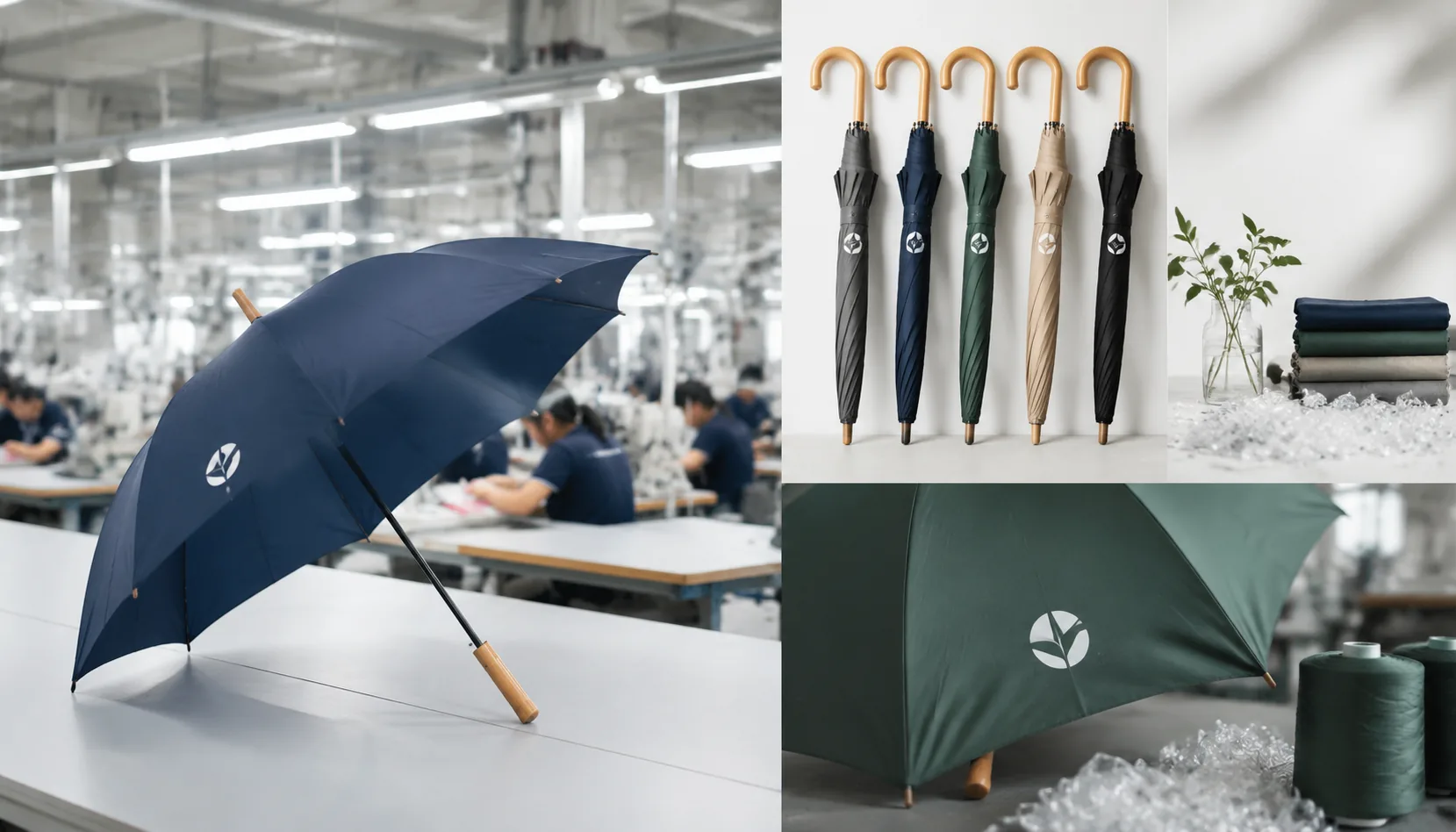
RPET Pongee Umbrellas: Buyer Guide for Eco Programs
Learn how to source RPET pongee umbrellas with verified fabric claims, durable frames, practical MOQs, and retail-ready ...
Read More »
RPET Recycled Fabric Umbrellas: OEM Buyer Guide
Learn how to specify RPET umbrella fabric, coatings, frames, labels, MOQ, and QC requirements for sustainable retail and...
Read More »