Umbrella Color Blocking for Stronger Brand Recognition
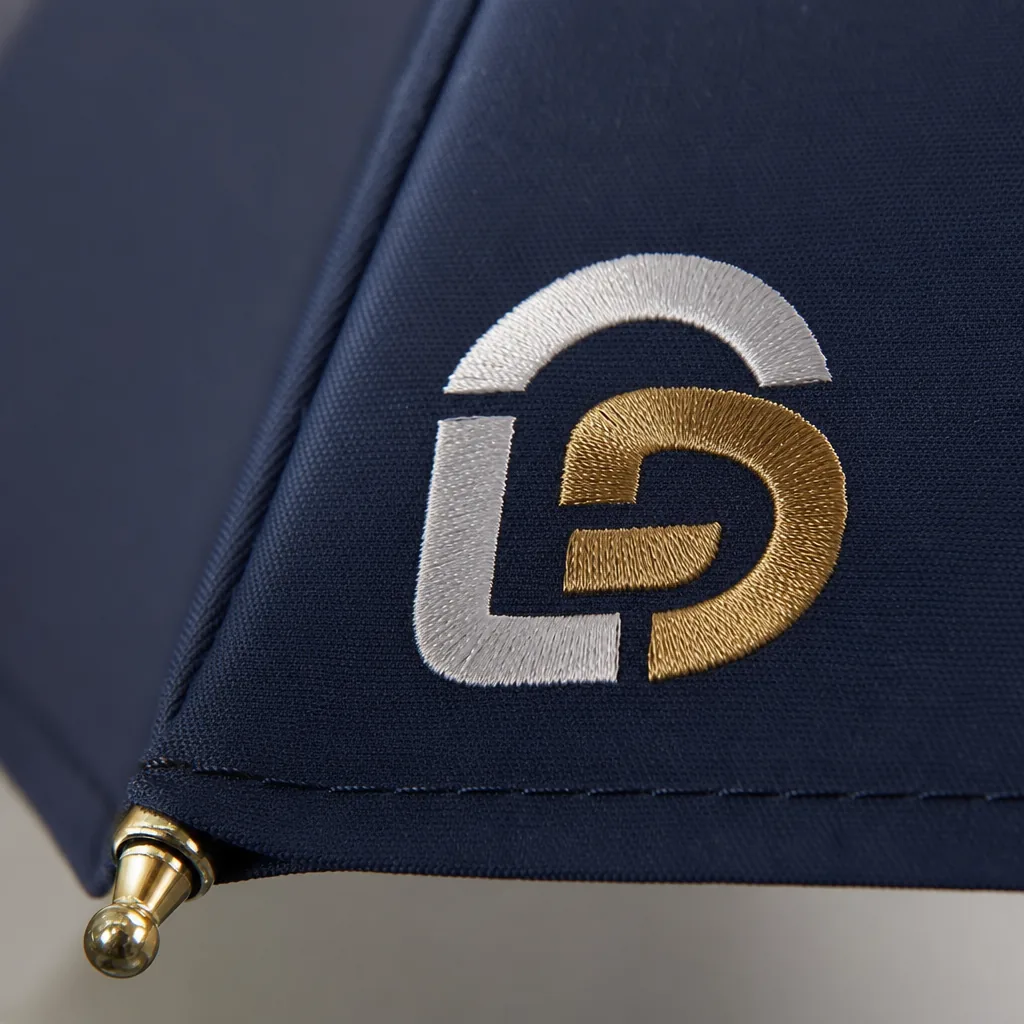
Buyers usually like the idea of bold panel contrast until the first strike-off shows muddy edges, mismatched dye lots, or a logo that disappears once the canopy is open at street distance. On our Songxia production floor, the real work is balancing umbrella color blocking design against panel cutting, fabric denier, and MOQ realities so 190T and 210T canopies stay visually consistent from sample to bulk run.
What color blocking changes in umbrella branding
Umbrella color blocking design changes what people recognize first: the canopy silhouette and panel contrast, not the printed logo. On an all-over navy or black canopy, viewers at roughly 20 to 30 feet often read only the umbrella shape. Alternating branded umbrella panels create a stronger visual cue at that same distance because the canopy itself becomes the identifier. On a standard 8K construction, eight wider wedges give enough uninterrupted area for high-contrast two-color layouts such as red/white or black/yellow to stay readable while the umbrella rotates in wind or moves through foot traffic. A half-and-half canopy increases that effect because the split remains obvious both fully open and partly closed, which matters in street promotions, crowd photography, and event use where a 1-color logo may be too small, folded out of view, or blocked by the user’s hand. For buyers comparing promotional umbrella design options, color blocking is usually a lower-risk way to build recognition because it depends less on print legibility and more on repeatable canopy segmentation and contrast.
Panel count sets the limit on graphic complexity. An 8K frame is the safer choice for corporate logos, sports marks, large icons, and simple seam-to-seam color blocking because each panel is wider and the artwork has more breathing room. A 16K frame splits the canopy into 16 narrower wedges, so the visual read shifts from bold blocks to a more segmented pattern; that works better for ring effects, alternating fashion colors, and repeated small motifs, but it weakens oversized graphics that need width to stay clear. Trim selection also changes brand recognition more than many buyers expect. Matching edge binding, handle, tip caps, ferrule, and strap to one canopy color makes the scheme look intentional, while default black parts can dilute it, especially on 21-inch and 23-inch folding umbrellas where hardware takes up more visual space. A capable OEM umbrella factory should check artwork against the rib layout before sampling and confirm color consistency across 190T pongee, 210T pongee, and POE canopies, since the same Pantone can shift by substrate and increase approval risk.
Match the layout to frame and canopy specs
Frame geometry should set the umbrella color blocking design before artwork is approved, because panel shape changes by umbrella type. Straight 27" and 30" golf umbrellas use longer, flatter panels that support broad contrast areas and alternating branded umbrella panels that stay legible at distance. Compact 21" and 23" folding umbrellas are tighter: shorter ribs create steeper canopy angles, the runner sits closer to the print zone, and fold creases can break clean transitions or distort logos placed near seams. Rib count changes the layout again. An 8K frame gives wider panels and a simpler visual rhythm, while 10K and 16K frames create a more premium look but leave less width for color zones and less tolerance at sewing. On those higher-count frames, 3 to 5 mm of seam drift can show immediately, especially where light and dark colors meet. For that reason, promotional umbrella design should start from the approved frame drawing, rib count, open diameter, and panel map rather than a flat graphic built without the production spec.
Construction details determine whether canopy segmentation survives production, shipping, and daily use. Fiberglass ribs flex and recover better than steel, so they are the standard choice for windproof golf umbrellas and better folding frames tested above 50 mph; that more even canopy tension helps blocked colors hold their shape when the umbrella opens. Steel ribs lower cost and can still work on entry-level straight or compact frames, but on auto-open-close folding umbrellas they add weight and create harder stress points near the rib tips, where puckering usually appears first on dark-to-light transitions. Fabric also matters: 190T and 210T pongee hold sharper screen-print and heat-transfer edges, while POE or PVC clear canopies need simpler layouts because the material shows hem tape, overlap, and seam allowance from the outside. At an OEM umbrella factory, double-canopy windproof styles need the tightest approval process. The vent breaks color continuity, and outer and inner canopies rarely share the same seam positions, so buyers should approve both layers separately before production on 23" folding and 27" golf models.
Choose fabrics and print methods that hold color consistently
For an umbrella color blocking design, fabric choice determines whether the blocks stay crisp or wash out under daylight and backlight. 190T pongee is still the volume standard because it folds compactly and lowers unit cost, but 210T pongee gives higher opacity, a tighter weave, and more consistent color hold from panel to panel. The gap is obvious when white sits next to navy or yellow sits next to black: lower-grade 190T is more prone to yarn shadow and light show-through, so pale panels can read gray instead of clean. A properly specified 210T canopy also has a fuller hand feel and usually takes UV or Teflon finishing with less visible shade shift than low-grade 190T. For retail-facing promotional umbrella design, especially on 23-inch and 27-inch straight umbrellas, 210T is usually the safer buying decision when brand color accuracy matters more than saving a few cents per unit. Ask the OEM umbrella factory to lock the fabric grade before sampling and bulk production. A sample approved in 210T and then produced in 190T is a common cause of color disputes, rework, and delayed shipment.
Piece-dyed panels are more reliable than large printed color fields when branded umbrella panels must match exactly across production lots. Sewing separately dyed red, black, and white panels is easier to repeat than printing a large wedge on white base cloth, where squeegee pressure, ink viscosity, drying temperature, and fabric absorbency can all change the result. Those variables cause mottling, soft edges, and halos near seam allowances after sewing. Panel-color assembly also lowers registration risk on 8K, 10K, or 16K canopy segmentation, where even 2 to 3 mm of drift is visible near the crown. For bold blocks and clean logo contrast, the most dependable specification is piece-dyed 190T or 210T pongee with a one- or two-color screen print for the logo; white and black spot prints hold sharper edges and more predictable opacity than a digital flood, especially on dark panels. Use digital print for gradients, photographic artwork, or short runs, not for geometric solid blocks that need to mimic dyed fabric. On 21-inch, 23-inch, and 27-inch straight umbrellas, panel-color assembly adds cutting and sewing time, but it is easier to control under AQL 2.5 and easier to repeat on 25 to 35 day FOB or DDP orders with less final-inspection color risk.
Control approvals, tolerances, and production risk
Lock the panel map before sampling. In umbrella color blocking design, the costliest approval error is signing off on artwork without a numbered wedge layout tied to the runner, closing strap, and logo orientation. For 8K and 10K canopies, require one pre-production sheet that shows canopy segmentation, seam direction, print area, and the exact panel that faces outward when the umbrella is closed. This matters most on 21" and 23" auto-open frames, where a seam shift can push a logo into rib shadow or split it across a tension line. Set seam tolerances before cutting. On sewn 190T or 210T pongee canopies, panel alignment within plus or minus 3 mm is usually achievable in bulk; specifying under 2 mm across every seam will raise rejection rates, slow sewing output, and increase unit cost. Review the pre-production sample after the canopy is mounted on fiberglass or steel ribs, because panel symmetry, seam stacking, and top-notch centering often change once the fabric is under tension.
Approve color from physical references, not screen files. For branded umbrella panels using two or three canopy colors, request strike-offs on the actual fabric or lab dips matched to Pantone under D65 daylight, then compare adjacent panels side by side. Buyers should review samples under daylight or daylight-balanced light to catch cross-panel shade differences early, especially when one panel is printed and the next is dyed stock, or when POE, PVC, or EVA transparent sections are combined with woven fabric. Record one approved master swatch and a written acceptable-variation standard before bulk production; otherwise the sewing line, printer, and buyer will each apply a different threshold. If the order uses UV coating, Teflon finishing, or sublimation on white panels, reapprove after finishing because tone and gloss can shift enough to make neighboring panels look mismatched. To reduce production risk, an OEM umbrella factory should run AQL 2.5 final inspection, opening finished umbrellas by size and mechanism type to verify panel sequence, print registration, seam skew, and color consistency. Plan 3 to 5 days for lab dips or strike-offs and 5 to 7 days for corrected samples; that is materially cheaper than remaking 3,000 units after a color mismatch is found at final packing.
Budget, MOQ, and shipping factors buyers should price early
SKU complexity, not print count, is usually the first budget issue in an umbrella color blocking design. A standard 23-inch 8K promotional umbrella design in 190T pongee with one stock canopy color can start around 500 pieces, but adding two or three custom-dyed branded umbrella panels typically pushes the practical MOQ to 1,000 to 3,000 pieces per style. The reason is operational, not cosmetic: each canopy color needs its own dye lot, shade check, spreading plan, and cutting lay. Mills also prefer longer runs to control lot-to-lot consistency. Mixed trims raise the floor again because edge tape, strap binding, ferrule color, and handle accents often come from different suppliers with separate minimums and replenishment lead times. Small-run canopy segmentation is least efficient on 210T pongee, 10K auto-open-close frames, and 27-inch vented golf umbrellas, where fabric consumption is higher and cutting loss is harder to absorb. Buyers should lock these variables with the OEM umbrella factory before sampling approval, because once dyed panels and trim matching are fixed, unit cost can move materially.
Lead time expands with every added panel color because each color creates another approval point and another replacement risk. In a segmented canopy, one incorrect red panel can stop sewing entirely: panel sequence must stay exact, especially on 8K and 10K canopies where logo orientation has to align across seams. If a mill ships the wrong dyed lot, the usual remedy is a new fabric batch, recutting, and resewing, which can add 7 to 15 days before final inspection at AQL 2.5. Early lab dips, Pantone sign-off, and a sewn panel mockup reduce that risk and help keep production aligned before frames are queued for 21-inch manual, 23-inch auto-open, or 30-inch golf umbrella runs. Freight terms should be quoted at the same stage. Under FOB Ningbo or Shanghai, the buyer carries more risk if a color correction misses vessel cutoff and the booking rolls; under DDP, that buffer is priced in. That matters on bulky 16K stick umbrellas and POE, PVC, or EVA dome styles that cube out quickly. Freeze panel colors, trim BOM, packing method, and FOB versus DDP early to protect a 35- to 50-day production window.
Frequently Asked Questions
Does color blocking increase the minimum order quantity for custom umbrellas?
Often yes, especially when the design requires multiple fabric colors cut and sewn into one canopy. MOQ usually rises when buyers want several custom panel colors plus matching trims or straps in the same order.
Is color blocking easier on 8K or 16K umbrellas?
8K umbrellas are usually easier because each panel is wider, so color sections read more clearly and sewing complexity is lower. On 16K canopies, narrower panels can look premium but demand tighter panel planning and seam control.
How many canopy panels should carry the accent color for the strongest distance recognition?
For most 8-panel umbrellas, 2 to 4 accent panels create the clearest contrast without making the canopy look visually crowded. Buyers usually test one balanced layout and one alternating layout in sampling to compare visibility from 10 to 20 meters.
Does 190T or 210T fabric affect how sharply color-blocked panel seams look?
Yes. 210T pongee usually gives a slightly cleaner surface and more stable color appearance, while 190T polyester is often the lower-cost option for promo programs. For strict brand matching, many buyers approve a pre-production sample because seam alignment and color contrast can shift slightly by fabric type.
What MOQ is typical if each panel uses different fabric colors instead of full-canopy printing?
A common OEM starting point is 500 to 1,000 pieces per design, depending on frame style and available stock colors. If a project requires custom-dyed canopy fabric instead of stock panel colors, MOQ and lead time usually increase, often adding 7 to 15 days for material preparation.
Looking to Launch Your Custom Umbrella Line?
ZheBrella is a Zhejiang-based OEM/ODM umbrella manufacturer with 17 years of export experience. Free design, low MOQ from 100 pieces, windproof construction, full-color print.
Get Free Quote Now »People Also Search For
Related Articles
Custom Umbrella Color Blocking for Stronger Brand Recognition
Learn how to use panel blocking, trim choices, and stock color programs to boost brand recognition while controlling MOQ...
Read More »
How Umbrella Color Blocking Improves Brand Visibility
See how panel colors, trims, and contrast blocks improve logo visibility on custom umbrellas while keeping brand colors ...
Read More »
Umbrella Trim Color Decisions for Stronger Brand Recognition
Learn how trim colors, piping, and frame accents shape brand recognition, while balancing MOQ, material choices, and pro...
Read More »