Umbrella Final Assembly Line Setup for Bulk OEM Production
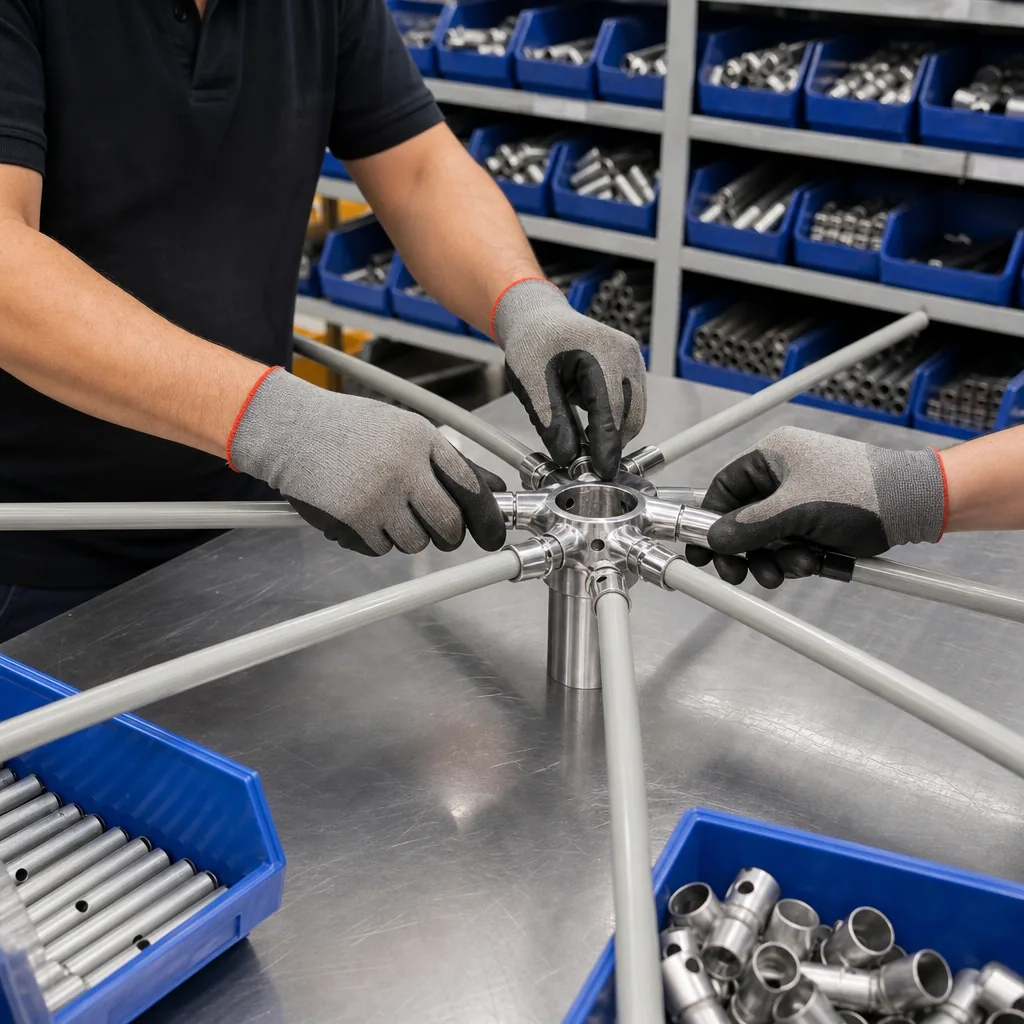
Bulk OEM umbrella orders usually get delayed in the last 20 meters of production, not at fabric cutting or frame making. If the umbrella final assembly line is not balanced by handle fixing, runner testing, canopy touch-up, sleeve packing, and carton sealing capacity, WIP piles up fast and defects hide until inspection day. On our Songxia factory floor, the setup starts with takt time, inline QC points, and carton-level checks matched to the buyer’s shipment window.
Mapping the Final Assembly Workflow
A clean umbrella final assembly line starts with frames that are already sorted by size, rib count, and mechanism before they reach the operators. For bulk umbrella orders, we do not mix a 23-inch 8K steel straight umbrella with a 21-inch 8K auto-open folding frame on the same fixture table unless the line is deliberately rebalanced. The normal sequence is frame preparation, runner and spring check, rib-end inspection, canopy mounting, tip sewing or tip insertion, top cap fitting, handle fixing, open-close testing, labeling, and final packing. In OEM umbrella manufacturing, the biggest hidden delay is not sewing speed; it is mismatched components arriving at assembly, such as 210T pongee canopies cut for a 10K frame but issued with 8K shafts, or plastic tips that do not match rib thickness. We use pre-line kitting by BOM: canopy, frame, handle, top cap, sleeve, hangtag, barcode label, and carton mark all staged together before the first piece is assembled.
Canopy mounting is where the umbrella production workflow starts to show whether upstream cutting and sewing were controlled. The canopy center hole must sit square on the shaft, the notch should align with the runner, and each rib must land naturally under its seam. If operators have to pull the fabric hard to reach the tips, the panel tolerance is wrong or the frame arc is not matched to the pattern. For 190T/210T pongee, slight bias stretch can hide this problem during assembly but it appears later as twisted tips or uneven scallops after opening. Manual umbrellas need simpler runner travel checks, but handle fixing still matters: wood, EVA, ABS, and rubberized handles require different glue, screw, or heat-press settings. Auto-open umbrellas need spring force and button release checked before handle locking, because a weak spring cannot be corrected after the handle is fixed. Auto-open-close models need stricter sequencing: shaft compression, reverse spring tension, button feel, and reset force must be checked before final cap and wrist strap fitting.
The last third of the umbrella final assembly line should be inspection-heavy, not just packing-heavy. Every finished umbrella should be opened fully, checked for rib seating, tip alignment, canopy tension, shaft straightness, handle looseness, and smooth closing. For vented double-canopy windproof styles, inspectors must confirm the upper canopy is not sewn too tight over the lower layer, otherwise a claimed 50+ mph wind rating will fail in real use. UV styles with UPF 50+ coating need clean handling because oily fingerprints and hot-glue marks are visible under strong light, especially on silver or black-out coatings. After functional checks, the line applies woven labels, care labels, hangtags, UPC stickers, polybags, inner boxes, and export cartons according to the packing spec. AQL 2.5 QC normally samples finished cartons after packing, but smart factories also run inline checks every 30 to 60 minutes so defects do not accumulate into a full pallet of rework.
Balancing Labor Across Key Stations
Labor balance on an umbrella final assembly line starts with frame complexity, not canopy size. A basic 8K steel frame with a manual runner can move through rib checking, canopy mounting, tip fixing, top cap tightening, and final folding in about 55–70 seconds per unit when operators are trained and parts are staged correctly. A 16K frame is not simply “double the ribs”; it adds more alignment points, more thread-tacking or tip-lock operations, and more chances for canopy tension to pull unevenly. On a 23" 190T pongee straight umbrella, the 8K station may run 450–520 pieces per 8-hour shift per cell, while a 16K version often drops to 280–350 pieces unless we split tip fixing and runner testing into separate hands. Fiberglass ribs also need more careful flex testing than black-coated steel ribs because cracked rods are not always visible before opening stress is applied.
Double-canopy windproof models create a different bottleneck inside the umbrella production workflow. The vented upper layer must be centered before sewing tabs or tie points are secured, otherwise the umbrella twists when opened and fails visual inspection even if the frame is strong. A 27" golf umbrella with 8K fiberglass ribs and a double canopy may survive 50+ mph wind-tunnel checks, but only if the crown, lower canopy, vent gap, and rib tips are assembled in sequence without forcing fabric tension. In OEM umbrella manufacturing, I normally assign stronger operators to canopy setting and opening-force checks, then use a floating worker to clear pileups at top cap, strap, and sleeve packing stations. If the double-canopy station runs 20% slower than handle fitting, the whole line still outputs at the slower rate; extra handle workers only create semi-finished inventory, not finished cartons.
Premium handles change scheduling more than buyers expect, especially when they involve EVA foam, wood grain ABS, rubberized coating, leather straps, or auto-open-close mechanisms. A standard plastic J-handle may take 12–18 seconds to fit and torque-check, while a custom molded straight handle with logo insert, screw plug, wrist cord, and glue curing control can add 35–60 seconds. That difference matters for bulk umbrella orders: a 5,000-piece MOQ using simple 21" folding frames might finish final assembly in 3–4 production days after printing and sewing, but a 10,000-piece 16K vented golf model with premium handles can require 7–10 days just for balanced assembly and AQL 2.5 QC. Overpromised lead times usually come from ignoring these station timings. For FOB schedules, we lock line capacity before confirming ETD; for DDP orders, we add buffer days because carton inspection, booking, and customs documents cannot fix a late assembly bottleneck.
Inline QC Points That Prevent Rework
The best rework control on an umbrella final assembly line is not the end-table inspector; it is the operator who catches a bad frame before the canopy is locked in. At rib setting, we check 8K/10K/16K spacing with the umbrella fully opened on a flat gauge: rib tips must sit evenly, no twisted fiberglass ribs, no steel rib bowing, and no stretcher rivet sitting proud. Runner travel is checked every piece by hand, not sampled, because a rough runner usually means burrs on the shaft, mis-set notch spring, or paint buildup inside the tube. For manual and auto-open models, the runner must lock without double-pumping. In OEM umbrella manufacturing, our standard practice is to stop the cell if the same rib alignment defect appears 3 times in 50 pieces, because the cause is usually jig drift, wrong rib batch, or a rivet press setting, not operator carelessness.
Auto-open mechanism force needs a defined window, especially on 23 inch and 27 inch straight umbrellas where spring load can vary by shaft supplier. We use a push-pull gauge at the button: too light causes accidental opening in cartons, too heavy gets rejected by retail buyers. Auto-open-close folding umbrellas need separate checks for launch force, closing rebound, and runner lock reset; a smooth sample at pre-production does not guarantee bulk consistency after 2,000 cycles of line assembly. Canopy tension is checked after tie-off: 190T/210T pongee should be tight enough to avoid sagging between ribs but not so tight that seams pull white or distort printed logos. Double-canopy vented windproof styles need extra inspection at the vent overlap, because trapped stitching or uneven panel matching creates flutter noise and weak wind performance. If two adjacent panels show tension wrinkles across multiple pieces, stop the umbrella production workflow and recheck cutting, seam allowance, and rib length before more canopies are mounted.
Cosmetic defects should be separated from functional defects, but both can become expensive once bulk umbrella orders reach carton packing. Loose threads at rib pockets, cap seams, Velcro straps, and sleeve mouths are trimmed inline; repeated loose bar-tacks mean the sewing station needs thread tension adjustment, not more end-line trimming. Handle torque is checked with a torque driver or fixed twist test, especially on EVA foam, plastic crook, rubberized straight, and wooden handles; a loose handle after shrink wrapping is a field complaint waiting to happen. The canopy surface must be inspected under angled light for water-repellent damage, Teflon coating scuffs, UV coating scratches on UPF 50+ goods, and heat-transfer press marks near logos. For AQL 2.5 QC, we still do final sampling, but inline QC protects the shipment. Stop the line immediately for broken ribs, failed runner lock, auto-open misfire, leaking seam tape, coating peel, or any safety-related sharp edge.
Final Inspection and Packing Controls
Final inspection has to be built into the umbrella final assembly line, not treated as a paperwork exercise after cartons are closed. For bulk umbrella orders, I normally set AQL 2.5 QC on major defects and a tighter internal watch list for safety issues: sharp rib tips, loose runners, cracked handles, missing tie straps, and print misregistration over 3 mm. Sampling should pull from finished cartons across different operators and time blocks, not just the cleanest pallet near the QC desk. Every sampled unit is opened fully, checked for canopy tension, seam puckering, ferrule alignment, rib seating, and handle fixing. On auto-open or auto-open-close models, the spring force must be consistent; a weak button on a 23" folding umbrella will become a return claim faster than a small sewing defect.
Open-close cycle spot checks are where many factories expose weak assembly discipline. For straight umbrellas, 10 to 20 cycles per sampled unit usually catches loose stretchers, bent steel ribs, and poor runner riveting; for compact models with fiberglass ribs and 190T or 210T pongee canopies, I prefer extra cycling because the shaft, spring, and rib joints carry more stress. Before carton sealing, humidity must be controlled: wet canopies, damp EVA/POE panels, or moisture trapped in polybags can create odor, mildew spots, and ink transfer during a 30-day ocean shipment. Finished umbrellas should be staged in a dry area, typically below 65% RH, and only packed after fabric, prints, labels, and sleeves are clean and stable.
Packing control protects the whole OEM umbrella manufacturing job after production is already paid for. Each polybag must match the buyer’s warning text, suffocation holes, SKU label, barcode grade, and country-of-origin requirement; mixed barcodes inside one master carton are a common warehouse chargeback. Master carton weight should be checked against the carton mark, because 30" golf umbrellas can quickly exceed safe handling limits if the pack count is copied from a 21" folding style. I also review drop risk: carton flute strength, edge crush, inner dividers for handles, and whether umbrellas can shift enough to puncture fabric or break tips. FOB needs clean packing lists, commercial invoices, and carton measurements; DDP adds HS code confirmation, duties, delivery address format, Amazon/FBA or retailer routing rules, and photo records before dispatch.
Production Data Buyers Can Request
The most useful report from an umbrella final assembly line is not a glossy progress photo; it is a daily production sheet tied to the buyer’s PO, SKU, color, and packing method. For bulk umbrella orders, I would ask for planned output versus actual output by day, for example 6,000 pcs planned and 5,420 pcs completed on a 23 inch auto-open 190T pongee program. Break the figures into frame fitting, canopy attachment, closing strap sewing, handle fixing, final cleaning, and packing, because a line can look “almost finished” while 20,000 handles are still waiting for logo alignment. In OEM umbrella manufacturing, this matters when umbrellas are booked for a trade show, retail floor set, golf event, or rainy-season launch window. A serious supplier should also report inline defect rate by defect type: loose rib tips, crooked heat-transfer logos, oil marks on light canopies, weak auto-open springs, bent steel shafts, or canopy tension imbalance on 8K and 10K frames.
Rework percentage tells you whether the umbrella production workflow is stable or being rescued at the end. A 2% to 4% rework rate on mixed-color promotional umbrellas is normal; 8% to 12% means cutting, sewing, printing, or frame assembly is feeding problems downstream. Buyers should request inline QC photos, not just final inspection photos: open/close testing, logo position checks with ruler, canopy seam tension, tip cup attachment, runner lock engagement, and carton packing condition. For vented double-canopy windproof umbrellas, ask for photos showing the upper and lower canopy overlap, because a poor vent gap can make a claimed 50+ mph design fail in real rain. For AQL 2.5 QC, the report should identify sample size, critical/major/minor defects, acceptance number, rejection number, and whether failed pieces were replaced or the full lot was re-screened. Our standard practice at ZheBrella is to keep defect photos linked to carton or production batch numbers, so corrective action is traceable.
Shipment data should be requested before final payment, especially when the deadline is an event date rather than a flexible warehouse receipt. Ask for master carton dimensions, gross weight, net weight, carton quantity, packing ratio, and CBM; a 30 inch golf umbrella packed 24 pcs per carton behaves very differently from a 21 inch folding auto-open-close umbrella packed 60 pcs per carton. These numbers affect LCL consolidation, FCL loading, DDP quotation accuracy, and whether cartons fit Amazon, retail DC, or distributor warehouse rules. Shipment readiness dates should be split into production complete, internal QC complete, third-party inspection date, cargo pickup date, ETD, and ETA. For FOB Ningbo or Shanghai, a one-day slip may be manageable; for air freight to a product launch or outdoor festival, it can be expensive. Good production data lets buyers decide early whether to approve split shipment, upgrade part of the order to air, or release cartons by priority SKU.
Frequently Asked Questions
How does a 16K umbrella affect final assembly time?
A 16K frame has more rib-tip connections and alignment points than an 8K frame, so canopy mounting, tension checking, and final inspection usually take longer.
Can inline QC reduce third-party inspection failures?
Yes. Inline checks catch issues such as weak auto-open action, loose handles, and canopy misfit before packing, reducing AQL 2.5 failure risk at final inspection.
What stations should a bulk umbrella final assembly line include?
A practical line usually includes canopy trimming, frame check, handle attachment, open-close function test, label application, carton packing, and final carton count verification. For bulk OEM orders, 5 to 8 stations is common depending on umbrella style and daily output.
How does inline QC help reduce shipment delays for OEM umbrellas?
Inline QC catches defects before packing, so cartons are not filled with mixed or unapproved units. Most factories use first-piece checks, random in-process checks, and final AQL sampling to prevent rework at the end of production.
What lead time should a buyer expect after final assembly starts?
For standard OEM umbrella orders, final assembly and packing often take 3 to 7 days after materials are ready, while larger or highly customized orders may take 7 to 14 days. The exact timing depends on order quantity, packaging requirements, and inspection hold points.
Looking to Launch Your Custom Umbrella Line?
ZheBrella is a Zhejiang-based OEM/ODM umbrella manufacturer with 17 years of export experience. Free design, low MOQ from 100 pieces, windproof construction, full-color print.
Get Free Quote Now »People Also Search For
Related Articles
Umbrella Factory Line Setup for Mixed-SKU OEM Production
Plan mixed-SKU umbrella production with better line setup, material staging, QC gates, and realistic lead times for OEM ...
Read More »
Umbrella Factory Line Setup for Mixed-SKU OEM Orders
See how factories plan mixed-SKU umbrella lines, balance frame assembly, canopy sewing, printing, QC, and packing to red...
Read More »Umbrella Final Assembly Line Setup for Consistent OEM Quality
Design an umbrella assembly line with workstations, jigs, torque checks, and inline QC to improve consistency across MOQ...
Read More »