Umbrella Production Line Balancing for Bulk OEM Orders
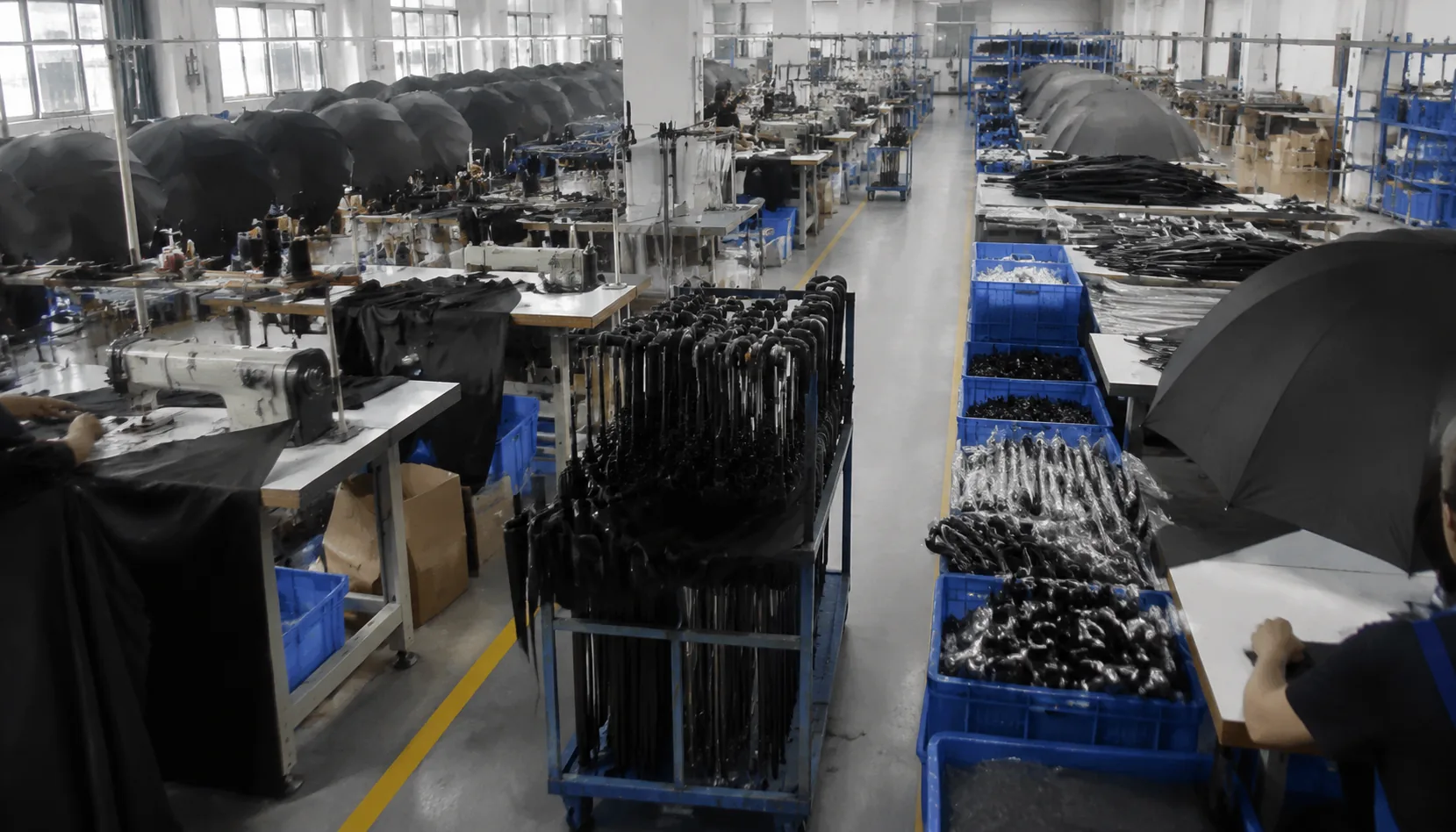
Bulk OEM umbrella orders rarely miss ship dates because one process is slow; they slip when cutting, sewing, frame assembly, QC, and packing run at different rhythms. On our Songxia factory floor, umbrella production line balancing means matching operators, fixtures, WIP buffers, and inspection points to the actual order mix before the first panel is cut. When that balance is wrong, finished frames wait for covers, sewn canopies pile up before tips, and cartons sit open while labels catch up.
How Umbrella Production Flow Is Organized
The fastest OEM umbrella manufacturing flow is not a straight line; it is a controlled set of parallel lanes feeding one final umbrella assembly line. For bulk umbrella orders, we start with incoming fabric inspection before any cutting table is opened: 190T or 210T pongee is checked for shade consistency, coating defects, water repellency, and roll width, while POE, PVC, or EVA clear panels are checked for haze, stickiness, and thickness tolerance. Approved fabric moves to marker making and CNC or die cutting by panel size, usually 8 panels for standard 21", 23", or 27" umbrellas, more for golf or special shapes. At the same time, the frame workshop prepares steel, aluminum, or fiberglass shafts and ribs in 8K, 10K, or 16K layouts, with runner fit, spring tension, and tip alignment checked before the canopy team receives anything.
Printing is the main place where umbrella production line balancing saves days, not hours. Screen printing, heat transfer, and sublimation all have different bottlenecks: screen printing needs setup time but runs fast after registration, heat transfer is slower per panel, and sublimation needs fabric handling before sewing. For a 5,000-piece MOQ order with four logo positions, we do not wait for all panels to finish printing before sewing starts; we release panels by batch, often 500 to 800 sets at a time, so sewing operators can begin panel joining, top cap reinforcement, Velcro strap attachment, and edge hemming while the next print batch is curing or cooling. Our standard practice at ZheBrella is to lock one approved pre-production sample, then control production by shade card, print position template, and first-piece inspection at each process handoff.
Final assembly is where poor umbrella lead time planning becomes visible. Canopy mounting needs matched parts: a sewn canopy, correct frame size, rib tips, ferrule, handle, sleeve, and carton label must arrive together, or operators stand idle even when total WIP looks high. In a balanced flow, frame assembly, canopy sewing, and packing preparation run in parallel, while final QC follows AQL 2.5 sampling plus in-line checks for opening force, auto-open or auto-open-close function, loose stitches, print scratches, rib deformation, and water-shedding after Teflon or UV UPF 50+ coating. For large promotional or retail programs, packing materials are prepared before final QC: individual polybags, hangtags, master cartons, barcodes, and pallet marks are staged by SKU. That is the practical goal of umbrella production line balancing: reduce waiting between departments without pushing defective semi-finished goods downstream.
Finding Bottlenecks Before Mass Production
The first bottleneck check is not a meeting-room capacity chart; it is an hourly output comparison on the actual umbrella assembly line. For bulk umbrella orders, we time each process separately: panel or full-canopy printing, canopy sewing, frame riveting, canopy mounting, top cap and runner fixing, final inspection, sleeve insertion, and carton packing. A simple example: heat-transfer logos on 190T pongee panels may run 700-900 panels per hour per press team, while full-canopy screen printing with four colors can drop below 120 finished canopies per hour because each color needs alignment, flash drying, and handling space. If sewing can finish 1,800 standard 23" 8K canopies per day but printing only releases 900, the sewing line will look idle even when the real issue is upstream. Good umbrella production line balancing starts by measuring release rate, not just worker headcount.
Frame work creates a different kind of bottleneck because rib count and material change the rhythm. A basic 23" 8K steel frame with manual-open hardware can move fast through riveting and mounting, often 1,500-2,000 pcs per line per day when jigs are tuned. A 16K windproof frame with fiberglass ribs, double stretchers, and a vented double-canopy build may cut that to 600-900 pcs because every rib has more rivet points, more tension checking, and more chances for asymmetric pull. Auto-open-close compact umbrellas are slower again, since shaft spring force, runner lock, and rib folding must be tested before packing. In OEM umbrella manufacturing, I do not accept a daily capacity claim until the factory has separated 8K, 10K, and 16K output assumptions; mixing them into one average number is how umbrella lead time planning becomes fiction.
Packing is often ignored until the last week, then it becomes the reason the container misses closing. Carton packing speed depends on sleeve type, hangtag position, barcode scanning, inner box use, moisture control, and AQL 2.5 inspection flow. A line may mount 1,200 umbrellas per day, but if every unit needs individual polybag sealing, retail label matching, and 24 pcs master carton weighing, the packing cell may clear only 800-1,000 pcs. Our standard practice at ZheBrella is to run a pre-production pilot of 100-300 pcs and record output per hour for printing, sewing, riveting, mounting, and packing before locking the shipment schedule. That pilot tells us whether to add another printing table, split sewing by panel type, prepare extra riveting jigs, or stage cartons earlier. This is where umbrella production line balancing protects both FOB dates and DDP delivery promises.
Balancing Labor for Manual and Auto-Open Models
Manual models are usually the easiest place to stabilize labor because the umbrella assembly line has fewer failure points: runner, shaft, ribs, tips, top cap, handle, and canopy mounting. A 23" manual straight umbrella with 8K steel ribs can often be balanced around steady stations for frame loading, canopy fixing, closing strap sewing, and final packing. The operator rhythm is predictable because there is no spring cassette, no release button tuning, and fewer force checks. In practical umbrella production line balancing, I usually treat manual umbrellas as the base takt-time reference for bulk umbrella orders, then add labor minutes only where the specification really creates work: fiberglass ribs need more careful tip alignment than basic steel, 16K frames take longer to spread and inspect than 8K, and 210T pongee with UV coating needs cleaner handling than promotional 190T fabric.
Auto-open and auto-open-close umbrellas cannot be planned like manual models with a small allowance added at the end. The spring mechanism changes the labor balance because each unit needs button response checking, shaft locking confirmation, runner travel inspection, and repeated open-close cycling before packing. A 21" 3-fold auto-open-close model may look smaller than a 27" manual golf umbrella, but the mechanism station often becomes the bottleneck if the team does not split frame assembly, spring loading, handle/button fitting, and function testing. For OEM umbrella manufacturing, our standard practice at ZheBrella is to isolate mechanism QC before canopy mounting; it is cheaper to reject a faulty frame before sewing and printing value has been added. For umbrella lead time planning, auto-open orders normally need extra buffer for incoming mechanism inspection and line rebalancing after the first 300 to 500 pieces reveal the real defect pattern.
Double-canopy windproof designs add another layer of labor because they are not just “two pieces of fabric.” A vented 27" or 30" golf umbrella needs upper and lower canopy panels cut, hemmed, aligned, and sewn with controlled overlap so air can escape without exposing the ribs. Mounting takes longer because the sewer and assembler must keep the vent gap even across 8K or 10K fiberglass ribs, especially on models rated to survive 50+ mph wind-tunnel tests. Printing also affects the balance: screen printing before sewing is simple on flat panels, while sublimation on full-panel artwork may require tighter panel matching at the seams. For reliable umbrella production line balancing, double-canopy auto-open models should be scheduled as a separate production family, not mixed hour-by-hour with single-canopy manual umbrellas, unless the factory accepts lower output and more WIP between sewing, mounting, and AQL 2.5 final inspection.
In-Line QC Gates That Protect Throughput
The first QC gate belongs before cutting, not after sewing. For bulk umbrella orders, we inspect incoming 190T/210T pongee, POE, PVC, or EVA rolls under a light table for oil marks, yarn slubs, shade variation, coating scratches, and weak water-repellent finish. A 2 mm pinhole on a dark 23-inch promotional canopy becomes a customer complaint once the logo is printed, so fabric mapping is cheaper than panel replacement. For printed work, registration is checked on the first 20–30 panels of every color setup, then sampled every 300–500 panels depending on the job. Screen printing needs edge sharpness and ink adhesion checks; heat transfer needs peel temperature records; sublimation needs color drift control against the approved swatch. This is where umbrella production line balancing starts to matter: if printing releases unstable panels, the sewing line keeps moving but builds hidden rework that will choke final inspection.
The second gate sits inside the umbrella assembly line, especially after canopy sewing and before frame fixing. Seam strength is pulled manually and, for retail programs, tested with a small tensile jig at the crown seam, tips, and panel joins; loose stitches, skipped stitches, and uneven seam allowance are easier to repair before the canopy is tied to an 8K, 10K, or 16K frame. Rib alignment is checked after runner installation: steel ribs should sit evenly without twist, fiberglass ribs should flex symmetrically, and tips must point to the same canopy tension line. On auto-open and auto-open-close models, we cycle samples 5–10 times in-line to catch weak springs, sticky runners, bent shafts, and unsafe snap-back. In OEM umbrella manufacturing, I prefer small gates every 1–2 process steps instead of one big audit at the end, because line leaders can correct operator setup while the defect is still fresh.
The final in-line gate is packing, where many factories lose money through avoidable carton mistakes. Each lot should verify closed length, sleeve fit, hangtag, barcode, polybag warning, master carton mark, inner quantity, and export carton strength before the first pallet is built. For FOB or DDP shipments, wrong carton dimensions can affect container loading, courier surcharges, and retailer receiving compliance. We normally check one packed carton per line start, then repeat by style, color, logo, and carton change; mixed-SKU event orders need tighter control because a 27-inch golf umbrella can easily be packed with a 23-inch straight umbrella if the packing table is crowded. These gates do not replace final AQL 2.5 inspection; they protect it. Good umbrella lead time planning assumes final inspection confirms quality, not discovers basic defects. That is the practical value of umbrella production line balancing: fewer stoppages, less rework, and a more predictable ship date.
Planning Capacity, Lead Time, and Shipment Terms
Capacity planning starts with the real bottleneck, not the sales order quantity. For MOQ runs of 500–1,000 pieces, cutting and printing can often be nested between larger jobs, but bulk umbrella orders of 10,000–50,000 pieces need locked slots for fabric inspection, panel cutting, frame assembly, sewing, final assembly, and packing. In umbrella production line balancing, a 23-inch auto-open straight umbrella with 8K steel ribs moves faster than a 30-inch golf umbrella with 16K fiberglass ribs and a double-canopy vent, because the latter has more sewing operations and slower rib alignment. OEM umbrella manufacturing also changes pace when buyers request mixed colors, individual barcodes, hangtags, retail sleeves, or master carton sorting by SKU. Writers should make clear that “same umbrella, different packaging” is not the same schedule: a plain polybag pack may run 1,500–2,000 pcs per line per day, while gift boxes, insert cards, and carton labeling can reduce packing output by 30–50%.
Umbrella lead time planning should connect product construction to export terms. FOB Ningbo or Shanghai usually means the factory controls production, inland trucking, customs paperwork, and delivery to port, so scheduling focuses on vessel cut-off dates and container loading. DDP delivery adds international freight, destination customs clearance, duties, VAT, local trucking, and sometimes Amazon FBA or warehouse appointment rules; that can add 15–35 days depending on destination and season. Carton size matters because umbrellas are long, awkward cargo: 21-inch folding umbrellas cube out differently than 27-inch straight umbrellas or 30-inch golf umbrellas, and oversized cartons can raise courier or LCL costs even when weight is modest. Our standard practice at ZheBrella is to confirm carton dimensions, gross weight, packing ratio, and shipping mark format before mass packing begins, because repacking 20,000 finished umbrellas after inspection is expensive and usually delays shipment.
Seasonal retail programs, outdoor events, and promotional campaigns need capacity reserved earlier than buyers expect. For spring rain season, back-to-school, golf tournaments, trade shows, and Q4 gifting, factories in Songxia often fill sewing and assembly lines 45–90 days ahead, especially for custom printing or UPF 50+ coated pongee canopies. Good umbrella production line balancing means freezing artwork, Pantone colors, sample approval, packaging files, and AQL 2.5 inspection criteria before materials are purchased, not after frames are already in production. Writers should advise buyers to separate “factory lead time” from “calendar lead time”: a quoted 30-day production cycle may become 55–70 days once lab dips, pre-production samples, deposit receipt, carton printing, vessel booking, and destination delivery are included. The practical recommendation is simple: reserve capacity as soon as the campaign date is fixed, then refine quantities before the fabric and frame purchase deadline.
Frequently Asked Questions
What usually slows down a bulk umbrella order most?
Printing, sewing complexity, and frame assembly are common bottlenecks. Full-panel artwork, double-canopy construction, 16K ribs, and auto-open-close mechanisms all add production time.
How can buyers help the factory keep the lead time on schedule?
Approve the PP sample, artwork, packaging layout, and shipping method before mass production starts. Late changes to canopy fabric, handle color, carton specs, or DDP delivery details can reset the production schedule.
Which production stages usually create bottlenecks in large OEM umbrella orders?
Sewing, frame assembly, and final QC are the most common bottlenecks because they require skilled labor and consistent inspection standards. For complex printed or windproof umbrellas, sewing and QC time can increase by 15–30% compared with standard models.
How does line balancing affect lead time for a 10,000-piece umbrella order?
Balanced cutting, sewing, assembly, inspection, and packing lines help prevent idle inventory between stages. For a 10,000-piece repeat OEM order, good line balancing can often reduce production time by several days compared with a workflow where sewing or QC is overloaded.
What information should buyers provide to support accurate umbrella lead time planning?
Buyers should confirm quantity, umbrella type, fabric material, frame specification, print method, packing requirements, and delivery deadline before production planning. Final artwork, approved samples, and deposit payment are usually needed before the factory locks the bulk production schedule.
Looking to Launch Your Custom Umbrella Line?
ZheBrella is a Zhejiang-based OEM/ODM umbrella manufacturer with 17 years of export experience. Free design, low MOQ from 100 pieces, windproof construction, full-color print.
Get Free Quote Now »People Also Search For
Related Articles
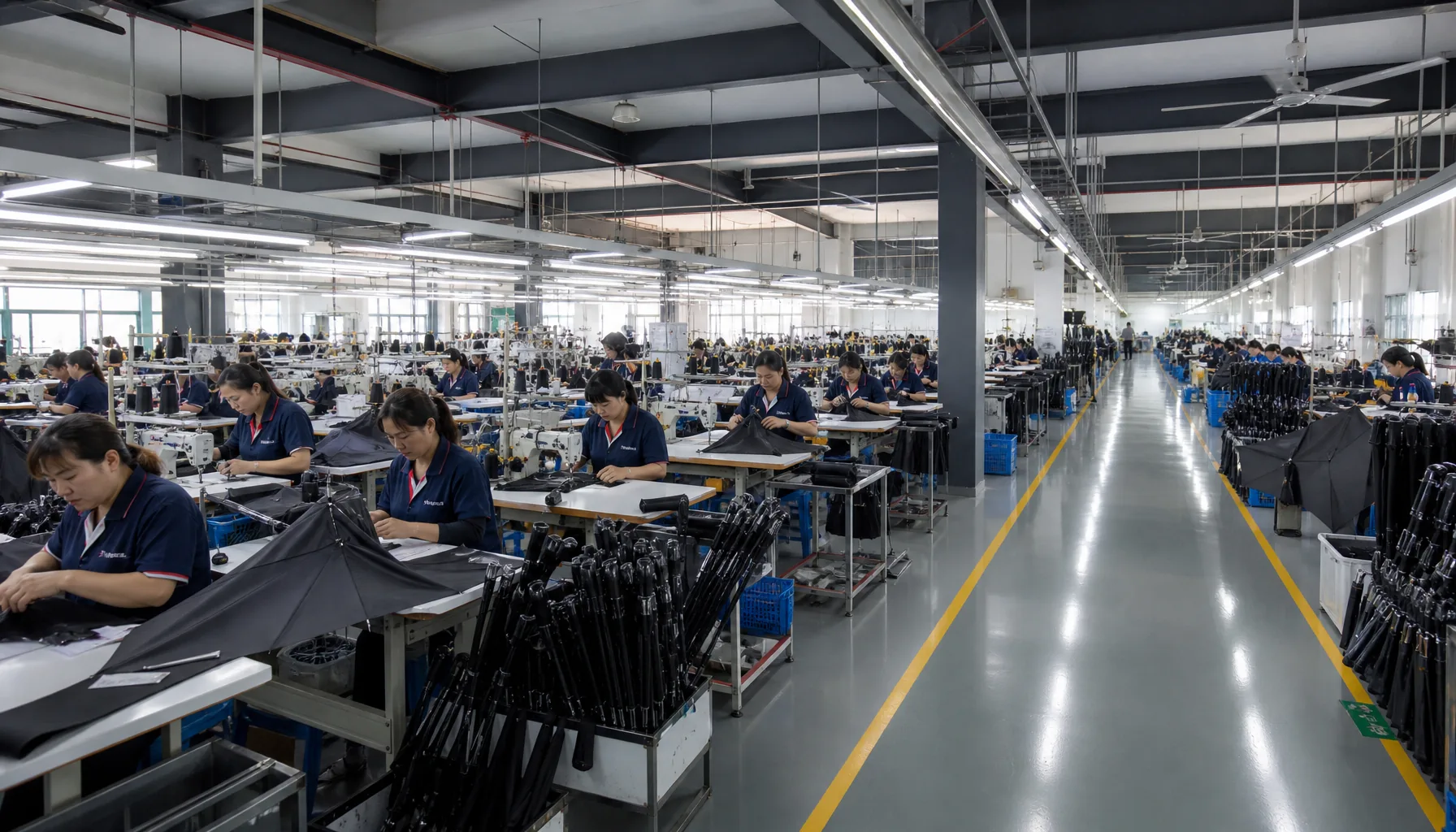
Umbrella Assembly Line Balancing for Reliable Bulk Output
Learn how balanced umbrella assembly lines reduce bottlenecks, stabilize lead times, and protect quality for high-volume...
Read More »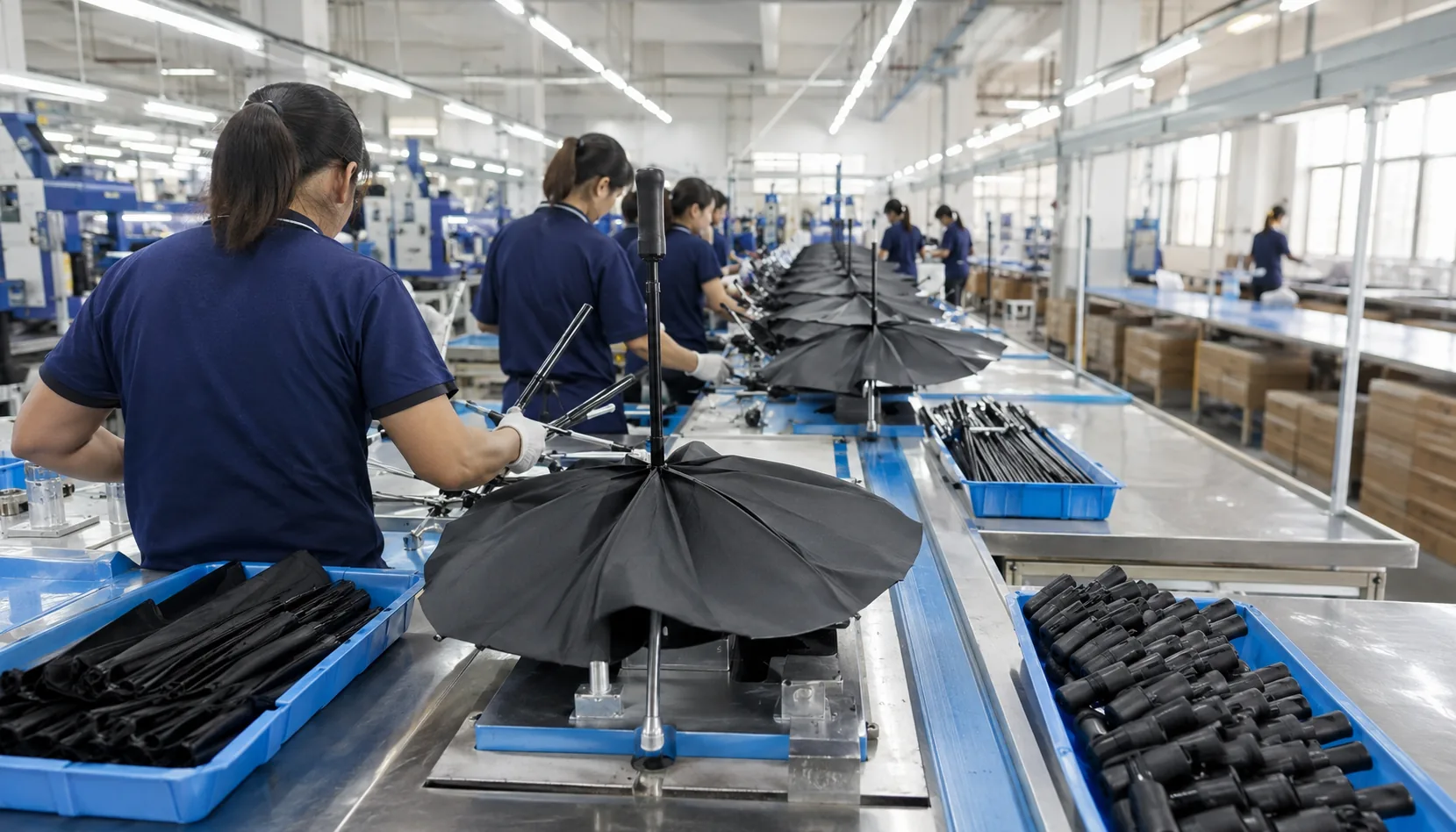
Umbrella Final Assembly Line Balancing for OEM Production
Plan umbrella assembly cells with takt time, inline QC gates, and pack-out checks to stabilize output, lead times, and A...
Read More »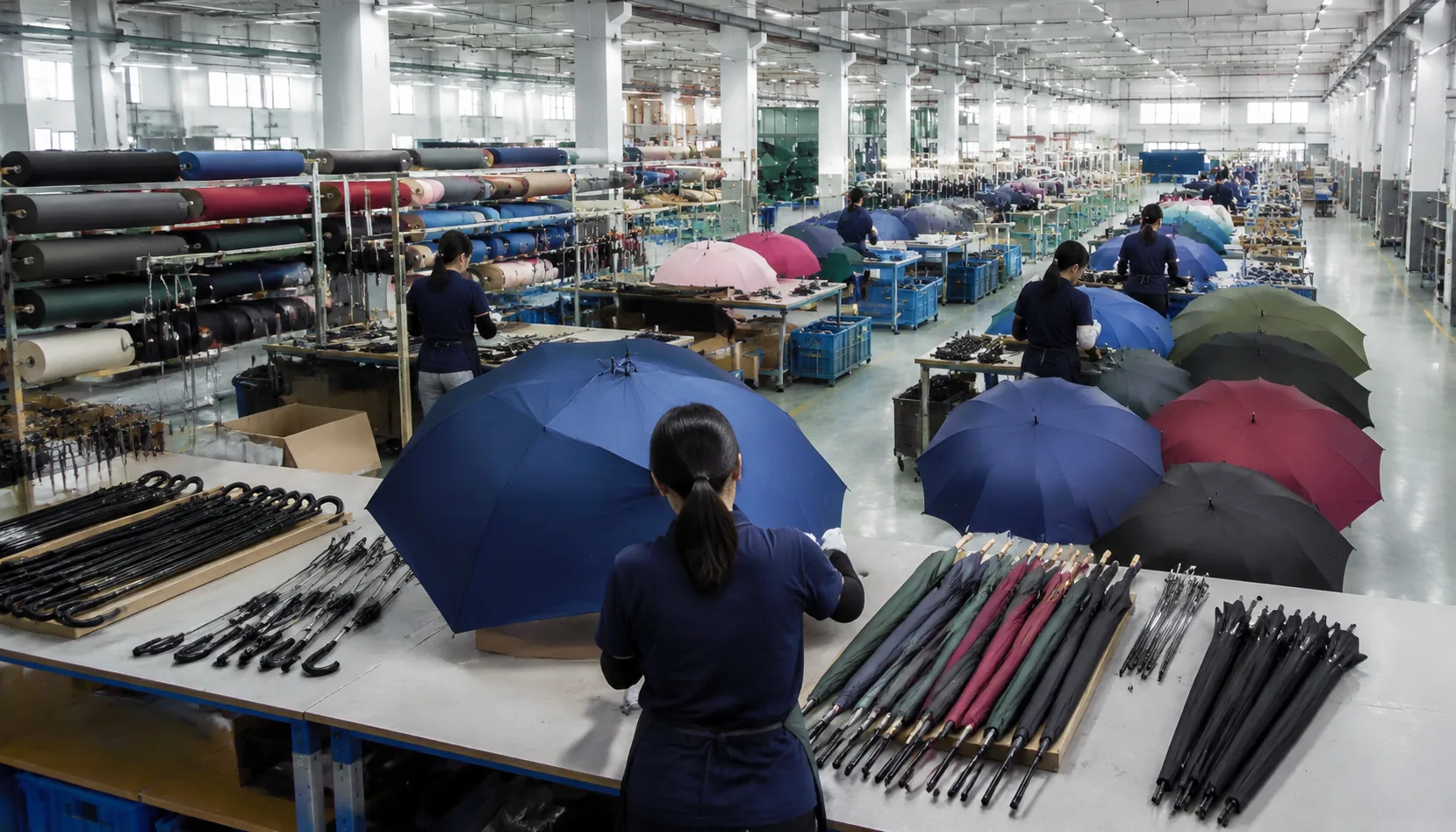
Umbrella Factory Line Setup for Mixed-SKU OEM Orders
See how factories plan mixed-SKU umbrella lines, balance frame assembly, canopy sewing, printing, QC, and packing to red...
Read More »