Umbrella Programs for Pharmacies and Convenience Chains
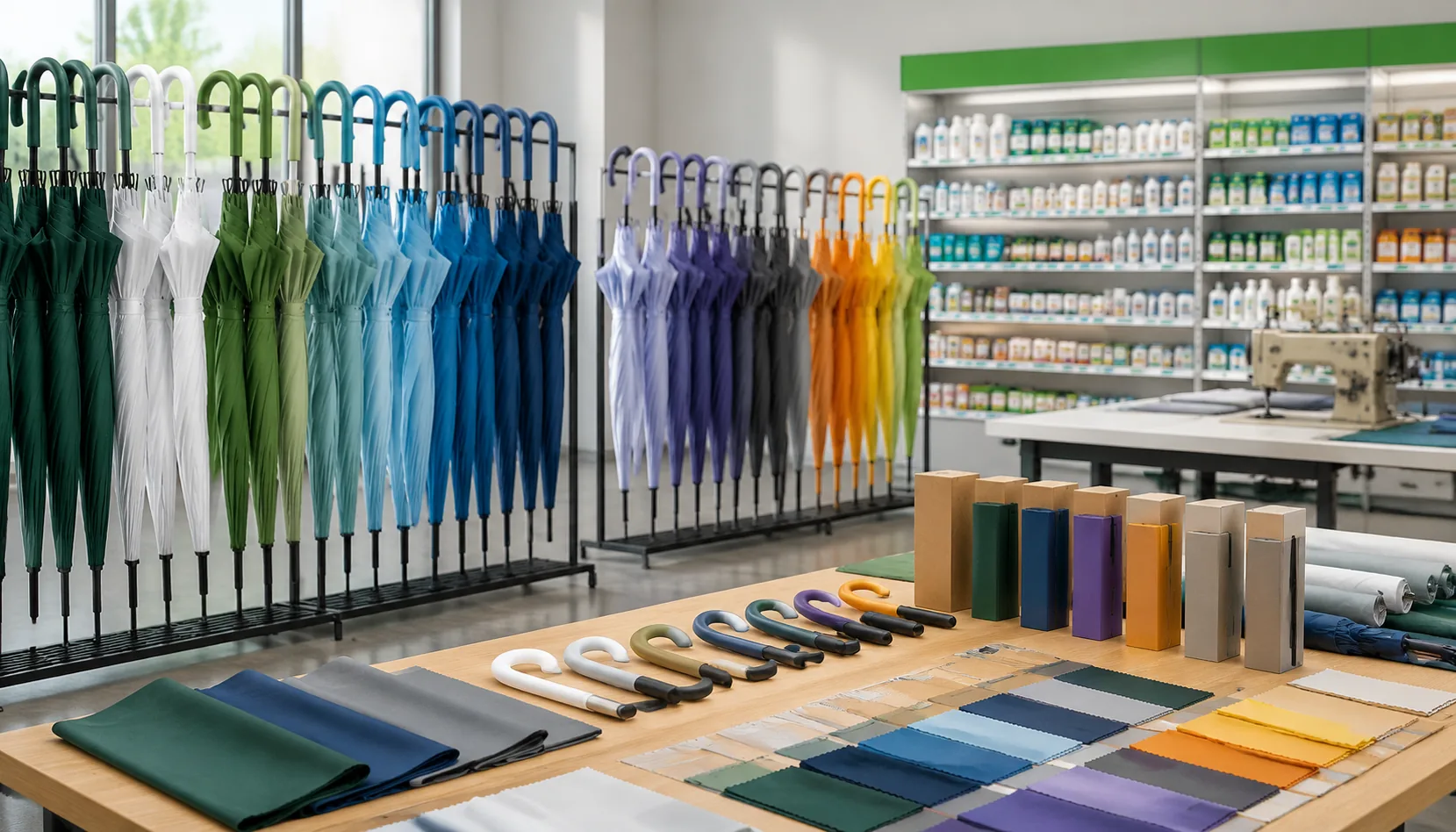
For pharmacies and convenience chains, umbrellas are not just seasonal add-ons; they are weather-triggered impulse items that must fit tight front-end space, scan cleanly, and survive rushed customer handling. On our Songxia factory floor, pharmacy branded umbrellas become workable programs only when canopy size, rib strength, sleeve packaging, carton counts, and reorder timing are planned together before production starts.
Why Umbrellas Work in High-Frequency Retail
Umbrellas sell in high-frequency retail because rain creates an immediate problem, not a browsing decision. A commuter leaving a subway stop, a parent walking out after prescription pickup, or a driver filling gas before work will pay for dry clothes faster than they will compare features. In pharmacies, the best timing is not only storm season; it is the first 20 minutes after rain starts, when customers realize the umbrella in the car or office is useless. For convenience store rain merchandise, the same logic applies at fuel islands and front doors: the customer is already stopped, already spending, and already exposed to weather. A 21" compact auto-open umbrella fits handbags, backpacks, glove boxes, and pharmacy counters better than a long stick umbrella, while a 23" or 27" model can sit near the entrance for higher perceived value.
A small-footprint display works when the assortment is tight. I would rather see 12 to 24 pieces in two SKUs than a messy rack of six colors, three sizes, and mixed mechanisms. For a retail umbrella program, the usual winners are 190T or 210T pongee canopies, steel shaft with fiberglass ribs for better wind recovery, and manual or auto-open frames depending on the price point. An 8K compact is enough for most pharmacy branded umbrellas, while 10K fiberglass upgrades make sense for loyalty members, premium endcaps, or city stores with stronger wind corridors. The display should fit near checkout, prescription waiting areas, or the vestibule without blocking traffic; a narrow floor stand, counter tray, or clip strip can turn rain into basket lift without giving up seasonal shelf space.
Private label umbrellas also support loyalty promotions because the item stays visible long after the transaction. A canopy printed with a pharmacy logo, wellness slogan, or convenience chain mark becomes a walking reminder during every storm, which is more useful than another disposable coupon. For promotions, I recommend separating sellable private label umbrellas from giveaway stock: retail units need stronger packaging, barcode placement, and AQL 2.5 inspection for seams, tips, runner function, and print registration; loyalty giveaways can use simpler sleeves but should not use weak ribs that fail in the first gust. For gas-station stops, put the impulse umbrella display where wet customers enter, not beside unrelated seasonal goods. For prescription pickup, keep it visible from the queue, where dwell time gives customers enough seconds to justify the purchase before they reach the register.
Build a Simple Good-Better-Best Assortment
A good retail umbrella program for pharmacies and convenience chains should start with a tight three-SKU ladder, not a wall of slow-moving colors. The value tier is a 21" or 23" manual compact with an 8K steel frame, chrome-plated shaft, metal ribs, and 190T pongee canopy. It is cheap enough for emergency purchase near the door, checkout queue, or seasonal aisle, but still better than the brittle no-name umbrellas that come back with bent ribs after one storm. For pharmacy branded umbrellas, I would keep this tier to black, navy, or one house color with a one-position screen print; too many prints create carton-level inventory headaches. A manual open also reduces mechanism failures, which matters when staff are not trained to explain returns. For convenience store rain merchandise, this SKU should hit the lowest shelf price and pack densely, usually 48–60 pieces per master carton depending on handle style and sleeve thickness.
The better tier should be an auto-open compact, usually 23" with an 8K frame, steel shaft, and upgraded fiberglass ribs or at least fiberglass tips to improve flex. This is the impulse umbrella display item that customers trade up to when the difference is visible: smoother button action, rubberized handle, 190T or 210T pongee, tighter sewing, and a sleeve that does not look disposable. Auto-open-close is possible, but I do not recommend it as the default mid-tier for drugstores unless the buyer accepts a higher defect allowance and better packaging; the spring load and shaft tolerance are less forgiving than a simple auto-open. Our standard practice at ZheBrella is to test open-close cycles and check canopy tension before AQL 2.5 final inspection, because a compact umbrella can look fine in a photo but fail when the runner sticks or the rib joint is over-riveted.
The best tier should be a stronger stick umbrella or 27"–30" golf umbrella, especially for stores near transit stops, campuses, hospitals, or parking-heavy suburban locations. A 23" straight umbrella with fiberglass ribs and shaft feels more durable than a compact and gives private label umbrellas a higher perceived value without jumping into oversized packaging. For true premium, a 27" or 30" double-canopy vented golf umbrella with 8K fiberglass ribs can survive far better in gusts than steel, often rated around 50+ mph when the canopy vents and rib resin are specified correctly. 16K ribs are worth the shelf price only when the customer can see the story: heavier canopy coverage, rounder profile, windproof positioning, and a handle tag that explains the frame. If the assortment has limited space, use 16K on one hero golf umbrella, not across every pharmacy SKU.
Packaging and Display Specs for Fast Decisions
Packaging decides whether a buyer says yes in 30 seconds, especially for pharmacy branded umbrellas sitting near the door during a storm. For compact 21" auto-open-close models, we usually target a folded length of 11.5" to 12.5" so the umbrella fits standard counter trays and shelf-ready cartons without hanging over the lip. Stick umbrellas need different planning: 23" manual or auto-open units often fold to 32" to 34", while 27" golf umbrellas can run 37" to 39" folded, which makes them better for clip strips, floor bins, or vertical entryway racks than counter displays. Hang tags should carry the opening mechanism, canopy size, rib count such as 8K fiberglass or steel, fabric spec like 190T pongee, and basic weather claims such as UPF 50+ or Teflon water-repellent coating. Do not bury the barcode under the sleeve seam; put UPC/EAN on the lower back of the tag or a flat sleeve sticker where scanners hit it cleanly.
Sleeve windows are worth the small extra cost when the canopy carries a pharmacy logo, seasonal print, or private label umbrellas artwork. A clear POE window, usually 35 mm to 55 mm wide on compact sleeves, lets store staff and shoppers confirm color without removing the umbrella and destroying the retail-ready pack. For convenience store rain merchandise, I prefer simple sleeve structures: hook hole, front logo area, rear barcode, short care text, and a compact warning label if the frame has spring-loaded auto-open parts. Overdesigned boxes look premium but slow down replenishment and take too much cube in distribution centers. PDQ trays should be corrugated E-flute or stronger, printed with one or two colors, and sized for 12, 18, or 24 compact umbrellas. Counter displays normally work best at 12 pieces because a loaded tray stays under about 6 kg, which store clerks can move without tearing the side walls.
Chain distribution centers care less about pretty packaging and more about scannability, carton strength, and predictable pack-outs. A retail umbrella program should define inner pack, master carton, carton barcode, country-of-origin marking, and carton drop-test expectations before sampling, not after production. Typical compact umbrellas ship 12 pieces per inner carton and 48 or 60 pieces per master carton; stick umbrellas often ship 24 pieces per master carton; 27" and 30" golf umbrellas may be 12 or 24 depending on handle shape and shaft length. For pharmacy branded umbrellas, every sellable unit should be individually sleeved or tagged, packed in PDQ or shelf-ready cartons when requested, and inspected under AQL 2.5 for barcode readability, hang-tag attachment, sleeve print alignment, and mixed-color ratio. Clip strips near entrances need reinforced hang holes and balanced weight; six to eight compact umbrellas per strip is practical, while heavier 23" stick umbrellas should use hooks or floor displays instead of thin plastic strips.
Quality Controls for Chainwide Rollouts
Handle pull tests matter because impulse umbrella display units get abused before a customer ever buys one. I like a straight pull test on plastic J-handles and EVA or rubberized grips, plus a twist test to catch weak glue or shallow rivet engagement. Colorfastness checks should cover both wet rubbing and water exposure, particularly on dark navy, red, and black canopies with white pharmacy or convenience store logos. If the program includes heat-transfer or screen printing, inspect logo adhesion after opening cycles because rib contact can scuff a poorly cured print. Pharmacy branded umbrellas also need consistent color between replenishment orders; a delta that looks minor in the factory can look sloppy when old and new stock sit together near checkout. Good inspection prevents the two most expensive problems in convenience store rain merchandise: returns during storms and uneven quality across regions.
Replenishment Timing and Logistics Choices
Replenishment works best when the umbrella calendar is built backward from local rain behavior, not from a generic seasonal planogram. For Northeast and Midwest commuter stores, I would stage the first retail umbrella program 45–60 days before the spring rain cycle, then run smaller top-ups before September school and office traffic returns. Southeast and Gulf Coast chains need a different rhythm: hurricane-season readiness should start in May, with DC inventory in place before June 1 and a second review before the August–October peak. West Coast stores often need inventory tied to atmospheric-river periods rather than summer, while pharmacy locations near transit stops, hospitals, and college campuses sell through faster than suburban drive-up stores. For pharmacy branded umbrellas, the safest base assortment is usually 21" compact auto-open or auto-open-close models near checkout, plus a few 23" straight umbrellas for shoppers leaving with prescriptions, groceries, or health products in heavy rain.
FOB makes sense when a chain has a distribution center that can receive cartons, break cases, and replenish stores on its normal truck schedule. A factory can pack private label umbrellas in inner cartons of 12 or 24 pieces, master cartons around 48–60 compact units depending on handle size, and label by SKU, color, and store allocation if the buyer provides routing files early. FOB Ningbo or Shanghai is usually the lowest landed-cost path for 5,000–50,000 pieces, but the buyer must manage ocean booking, customs, duty, inland freight, and DC appointments. DDP is cleaner for smaller rollout orders, urgent hurricane coverage, or testing convenience store rain merchandise across 50–200 doors. The unit price is higher because freight, duty, brokerage, and final delivery are bundled, but procurement gets fewer surprises and less internal logistics work.
Timing checkpoints matter because umbrellas look simple but still involve frame, fabric, printing, assembly, and AQL 2.5 inspection. A practical schedule is 3–5 days for digital mockups after artwork, 7–10 days for a physical pre-production sample, and 25–35 days for bulk production after sample approval and deposit on standard 190T pongee compact umbrellas. More complex builds, such as vented double-canopy 27" golf umbrellas, custom molded handles, PMS-dyed fabric, or heat-transfer panels across multiple SKUs, can push production to 40–55 days. Ocean freight to a U.S. port often adds 25–35 days, then another 5–12 days for clearance and inland movement, so FOB programs should be locked roughly 90–120 days before peak demand. DDP air or courier options can support an impulse umbrella display in 12–20 days after production, but only for limited quantities where margin can absorb freight.
Frequently Asked Questions
What umbrella SKUs should a pharmacy chain start with?
Start with two or three SKUs: a low-cost compact, an auto-open compact, and a sturdier stick umbrella. This keeps shelf planning simple while covering different price points and shopper needs.
How can convenience chains reduce out-of-stock risk during rain events?
Use regional weather history to pre-position inventory before rainy seasons and set reorder triggers by store cluster. Retail-ready cartons and consistent barcode labeling help distribution centers replenish faster.
What umbrella mix works best for pharmacy and convenience-chain impulse sales?
Most chains start with 70% compact folding umbrellas, 20% auto-open models, and 10% larger stick umbrellas. Compact 21-inch 8-rib umbrellas fit checkout displays well and usually offer the best balance of price, shelf space, and repeat replenishment.
Can umbrellas be packed ready for store-level distribution?
Yes. A factory can pack by store allocation, add UPC or EAN barcodes, price stickers, hang tags, PDQ trays, or floor-display cartons. For chain programs, master cartons are often labeled by SKU, color mix, PO number, and destination warehouse.
What MOQ and lead time should buyers expect for a private label umbrella program?
Typical MOQ is 1,200–3,000 pieces per SKU for custom logos or retail packaging, depending on fabric, frame, and color requirements. Production usually takes 30–45 days after artwork approval, with additional time for sample approval and ocean freight.
Looking to Launch Your Custom Umbrella Line?
ZheBrella is a Zhejiang-based OEM/ODM umbrella manufacturer with 17 years of export experience. Free design, low MOQ from 100 pieces, windproof construction, full-color print.
Get Free Quote Now »People Also Search For
Related Articles
Custom Umbrella Programs for Retail Pharmacy Chains
Build pharmacy umbrella assortments for rainy-day retail, loyalty gifts, and staff use with fabric, UPF, MOQ, packaging,...
Read More »
Private Label Umbrella Programs for Retail Buyers
Plan a retail-ready private label umbrella line with clear specs, MOQ tiers, packaging choices, QC checks, and FOB or DD...
Read More »
Private Label Umbrella Programs for Retail Chains and Hotel Groups
Plan private label umbrella assortments with brand control, packaging, MOQ, and FOB/DDP terms that fit multi-location re...
Read More »