Umbrella Shaft Straightness and Tube Tolerance in Production

When an umbrella feels loose, wobbly, or hard to open, the root cause is often not the canopy but the shaft and tube fit underneath it. In OEM production, umbrella shaft straightness tolerance, concentricity, and tube clearance have to work together, or even a small deviation can turn into friction, side play, and early wear on the line and in the field.
Why shaft geometry changes the whole user experience
In umbrella production, shaft geometry is not a cosmetic issue; it decides whether the product feels solid or cheap the first time a buyer opens it. A tight umbrella shaft straightness tolerance keeps the stick from wandering inside the ferrules, which is what causes wobble, side loading on the runner, and that annoying “gritty” feel during deployment. If the tube is bent even slightly, the locking points do not line up cleanly, and the user ends up forcing the mechanism. In factory terms, that usually traces back to weak straightness control after tube drawing, poor cutting, or mishandled straightening before assembly.
Ovality is the other problem customers feel immediately, even if they cannot name it. When a tube is out of round, the inner and outer sections do not slide with consistent clearance, so the umbrella may open halfway, stick near the top, or bind right when the ribs are trying to seat. That is why telescopic umbrella tube specs cannot stop at diameter alone; you need shaft concentricity control so the wall thickness and centerline stay stable through repeated cycles. Without that, the canopy loads unevenly, one side stretches harder than the other, and the user sees premature wear at the joints, cracked plastic parts, or a runner that starts chewing the tube surface.
In OEM umbrella shaft quality work, I always treat straightness, concentricity, and roundness as one system because the complaints come in as a system: sticky opening, uneven canopy tension, loose locking, and short service life. Export umbrella manufacturing gets exposed fast here, because retail buyers and promotional distributors test the same sample dozens of times, not once. If the shaft tracks true, the umbrella opens smoothly, the canopy sits centered, and the locking collar engages without side drag; if it does not, even a strong frame and good fabric will still feel unreliable in the hand.
Steel, aluminum, and fiberglass tube behavior in production
Steel tubes are still the easiest way to hold umbrella shaft straightness tolerance when the design needs stiffness first. In production, mild steel and high-carbon steel retain straightness better under repeated axial load, and they are less likely to ovalize at the ferrule or inner sleeve than thin aluminum. That makes steel the default for golf umbrellas, large 27" and 30" frames, and lower-cost export umbrella manufacturing runs where the buyer wants a hard, stable feel and can accept more weight. The tradeoff is obvious on the factory floor: steel adds grams fast, dents from bad handling are less forgiving, and corrosion control matters if the plating or paint process is weak.
Aluminum earns its place when weight reduction matters more than brute stiffness. For compact and auto-open styles with telescopic umbrella tube specs, a properly drawn aluminum tube can cut carry weight noticeably and still meet normal shaft concentricity control requirements if the wall thickness and annealing are right. The problem is that aluminum is easier to bend permanently from side load, so it needs tighter handling during punching, flaring, and crimping, and it is less tolerant of poor die setup than steel. In OEM umbrella shaft quality work, I usually treat aluminum as the better option for travel umbrellas, promotional folds, and mid-price retail programs where lighter pack-out helps the buyer.
Fiberglass is not usually chosen as a primary straight tube unless the structure is hybrid, because its value is flex and recovery, not maximum rigidity. In practice, fiberglass is used in mixed shafts, ribs, or lower sections where it can absorb wind shock and reduce breakage without adding the dent issues you see in metal. That makes it useful in wind-resistant concepts and in hybrids that combine a steel main shaft for core straightness with fiberglass components for impact tolerance. The right material choice depends on whether the job is controlling bend under load, protecting the tube from handling damage, or meeting a cost target; for a tight umbrella shaft straightness tolerance, the tube material only works if the cutting, swaging, and concentricity checks are disciplined from the start.
Tube diameter, wall thickness, and nesting fit
On a telescopic umbrella shaft, diameter control matters more than the catalog size on paper. The outer tube has to slide without scuffing, and the inner tube has to stay guided without rattling, so we watch the actual clearance between mating tubes, not just nominal OD and ID. For common 21" to 30" folding and stick umbrella builds, a practical nesting gap is usually around 0.10 to 0.25 mm per side, depending on plating, paint, and whether the shaft is carbon steel or aluminum. If that gap is too tight, opening force spikes and the ferrule starts galling; if it is too loose, the shaft feels sloppy and the canopy tracks off-center under load.
Wall thickness variation is the part buyers miss when they only read telescopic umbrella tube specs. A tube that measures 0.40 mm on one side and 0.52 mm on another can still pass a length check, but it will bend differently in service and make assembly inconsistent from batch to batch. In export umbrella manufacturing, we normally hold wall thickness variation within about 0.03 to 0.05 mm on thin-wall shaft parts, because that is where spring-back, welding distortion, and tube collapse start showing up. End-roundness is just as important: if the tube mouth is out-of-round by more than 0.15 mm, insertion drag goes up and the first few thousand cycles become unpredictable.
This is where umbrella shaft straightness tolerance and shaft concentricity control have to work together. A shaft can look straight on a bench and still fail in nesting because the bore is off-center, so we check runout, straightness, and tube end squareness as a set. For OEM umbrella shaft quality, a realistic target is total indicator runout under 0.30 mm on the finished shaft stack and end cut squareness within 0.5 mm over the tube diameter, with tighter limits on premium windproof frames. If you do not control that relationship, the umbrella opens, but the load path is wrong, which is how you get rub marks, uneven wear, and misaligned ribs after a few dozen cycles.
How factories control bending and runout
Straightness starts with the tube, not the assembly line. In export umbrella manufacturing, the first thing I look at is cut-to-length accuracy, end-face squareness, and whether the tube was drawn or rolled with stable wall thickness; if those are off, you fight runout all the way downstream. For an umbrella shaft straightness tolerance, the factory should define the tube OD, wall thickness, total length, and allowable bow after cutting, then hold the tooling so the clamp points do not crush the shaft during drilling, staking, or riveting. In high-volume runs, especially for auto-open and auto-open-close models, a small bend at the lower tube becomes a hard jam at the runner and the spring seat, so the tolerance has to be set against the finished mechanism, not just the raw tube.
Heat treatment matters when the shaft is spring steel or when the process includes tempering after forming; if that step is uncontrolled, the shaft may pass a visual check and still creep out of line after cycling. Buyers should ask for a process sheet that shows telescopic umbrella tube specs, the heat-treatment condition if applicable, the straightening method, and the in-line gauge points used for shaft concentricity control. I want to see the gauge frequency, the sample size, the rejection limit, and whether the factory measures runout with a V-block and dial indicator or a purpose-built fixture. OEM umbrella shaft quality is only real when those numbers are documented, because hand inspection alone misses slow drift in tooling.
For large orders, the practical question is how the factory keeps the shaft straight after cutting, welding, plating, and final assembly. The best shops use go/no-go fixtures between each critical step, then do a final spin check on the assembled shaft to catch eccentricity before canopy sewing and packing hide the problem. A buyer should ask for the actual umbrella shaft straightness tolerance by tube size, the maximum permitted runout at the tip and mid-span, the rework rule, and the control plan for auto-open models where the inner shaft must slide without scraping. If the supplier cannot show that chain of controls on paper, the order may still run, but consistency will fall apart once production reaches several thousand pieces a day.
Verification methods for shipping approval
Shipping approval should not rely on a visual straightness check alone. For umbrella shaft straightness tolerance, the factory needs a three-part verification: bench bend checks against a reference plate, concentricity gauges on the inner and outer tubes, and full open-close cycling on a sample from each lot. In export umbrella manufacturing, we normally set the bend limit by measuring total runout over the working length, then reject any shaft that shows a persistent bow, localized kink, or a change in axis after cycling. If the telescopic umbrella tube specs call for a snug fit, the gauge check must confirm smooth sliding without binding, because a shaft that looks straight can still scrape internally once the ferrule is loaded.
Purchase specs should also define wobble in measurable terms, not as a vague “loose” condition. A practical requirement is maximum tip deflection under a set side load, plus a limit on rotational play at the handle and locking collar; if the lock engages late, slips under hand force, or needs repeated reseating, the lot should fail. For OEM umbrella shaft quality, I recommend writing the acceptance criteria around shaft concentricity control, visible surface defects, and functional lock engagement: no deep scratches, plating blisters, seam splits, ovality beyond the agreed tolerance, or burrs that can cut the ferrule. Those defects matter because they become wear points after repeated cycling and usually show up in field returns, not at first inspection.
Carton sampling at AQL 2.5 should be the last gate before release, not the only gate. Pull finished cartons randomly across the lot, inspect the shafts for straightness after packing pressure, then reopen a subset to confirm that no tube shifted, bent, or picked up abrasion during boxing and palletization. The purchase specification should state the sample size, the rejection triggers, and whether a single critical defect, such as a shaft that will not lock, is an automatic fail. That level of detail prevents disputes later, because both buyer and factory are judging the same measurable standard instead of arguing over appearance after the goods have already left the line.
Frequently Asked Questions
What shaft issue causes the most warranty complaints?
Excessive bend or poor concentricity is usually the biggest problem because it makes the umbrella feel unstable and hard to open. It also accelerates wear in the runner and lock points.
How should a buyer specify shaft tolerance?
Ask the factory to define straightness, outer diameter, inner diameter, and wall-thickness limits in millimeters. Also require a sample approval before mass production so the production standard is locked in.
What tube clearance is typically used between nested telescopic umbrella shafts?
For small to mid-size folding umbrellas, buyers commonly review a sliding clearance in the range of 0.05-0.15 mm between mating tubes, depending on coating thickness and material temper. If clearance is too tight, opening drag increases; too loose, and the shaft can rattle or wobble.
How is shaft straightness usually checked during OEM umbrella production?
Factories typically use a flat-bed rolling check, dial indicator, or simple runout fixture to measure deviation after tube forming and before final assembly. For export orders, checks are often done by lot with tighter in-line inspection on top shaft sections that most affect opening feel.
Why does concentricity matter more on folding umbrellas than on straight umbrellas?
Folding umbrellas rely on multiple nested tubes moving in sequence, so even small concentricity error can create friction, uneven wear, or intermittent jamming. On OEM orders, poor concentricity usually shows up first in opening smoothness complaints and shortened cycle life after repeated use.
Looking to Launch Your Custom Umbrella Line?
ZheBrella is a Zhejiang-based OEM/ODM umbrella manufacturer with 17 years of export experience. Free design, low MOQ from 100 pieces, windproof construction, full-color print.
Get Free Quote Now »People Also Search For
Related Articles
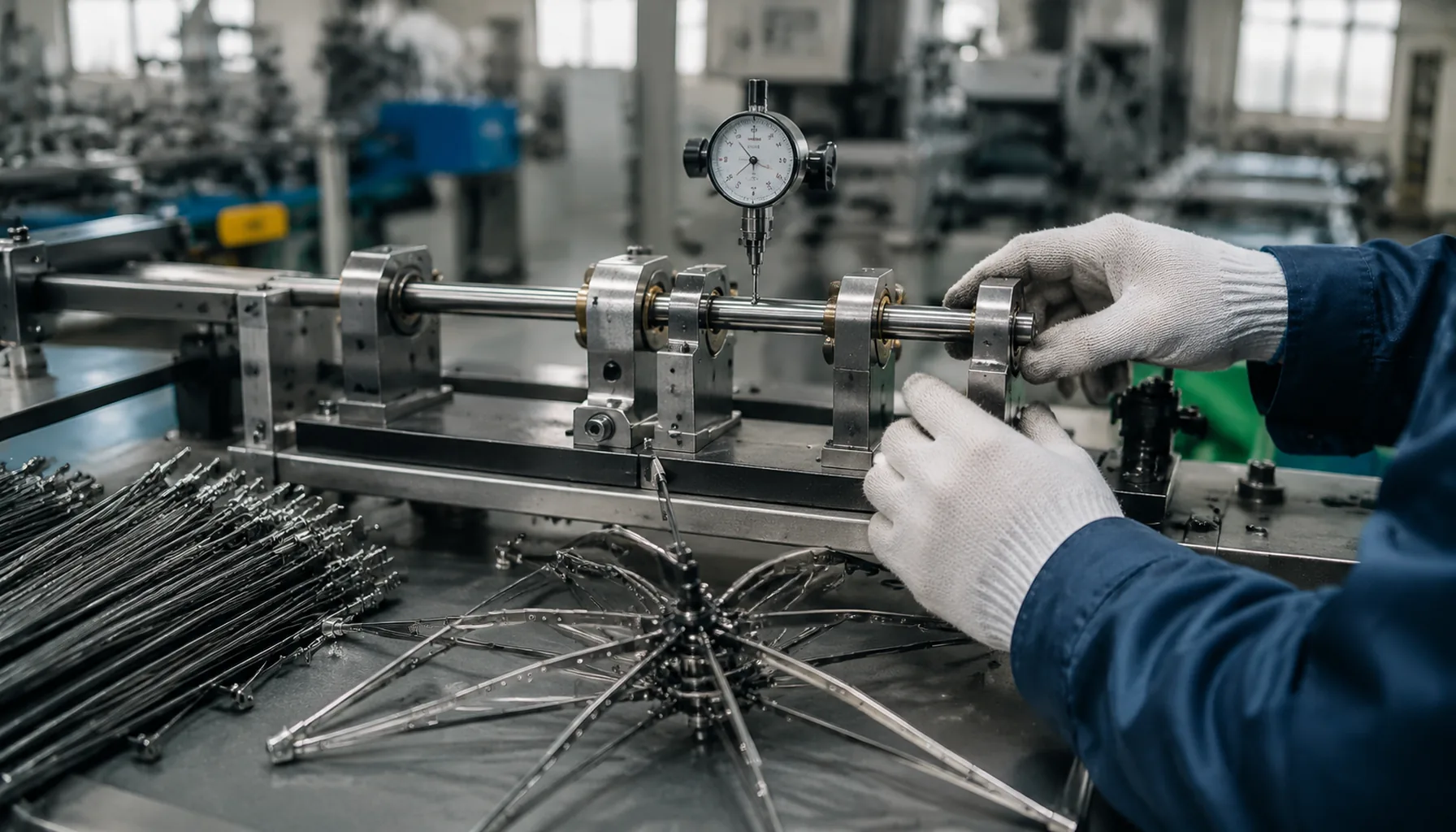
Umbrella Shaft Straightening and Runout Checks in Production
Define shaft runout, tube forming, rolling checks, and packing controls that reduce wobble, poor auto-open action, carto...
Read More »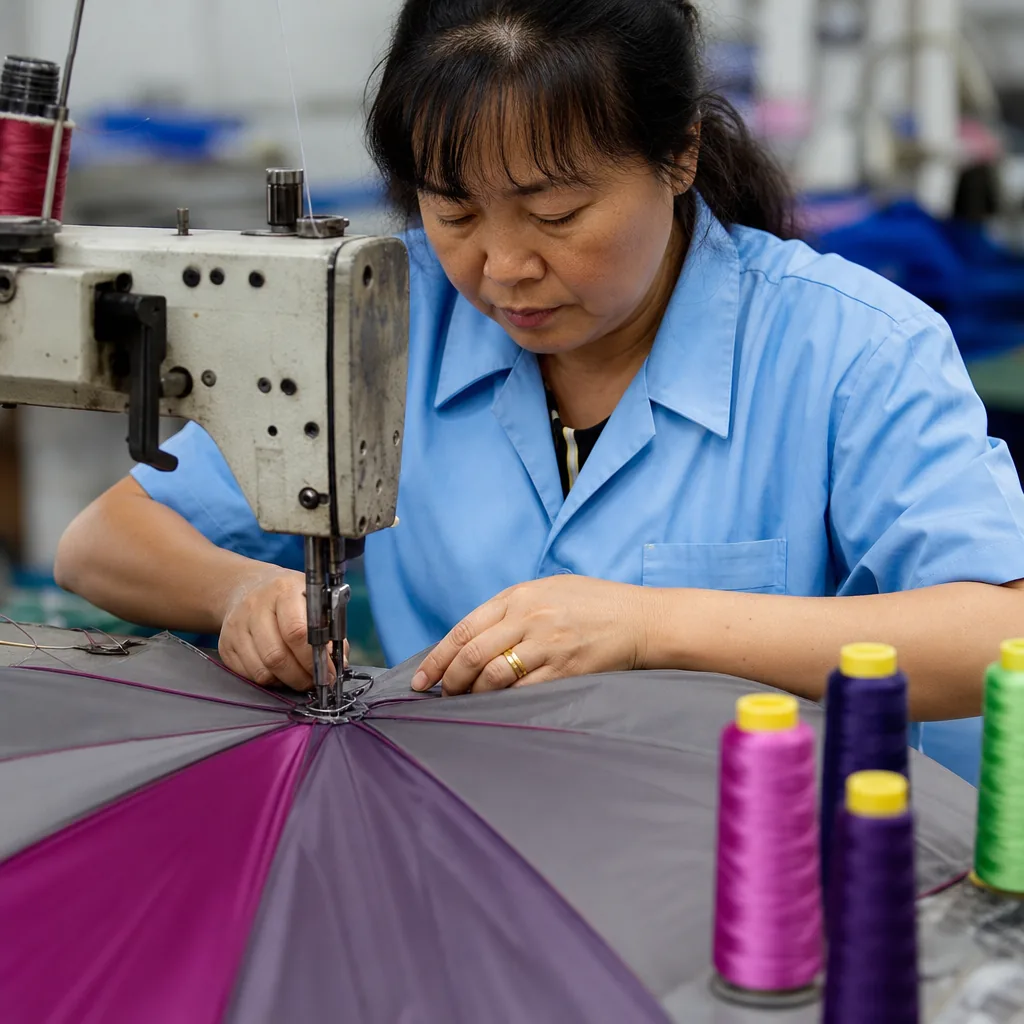
Umbrella Fabric Shrinkage Control in OEM Production
Understand how shrinkage affects panel size, fit, and print alignment, and what factories test to keep umbrella canopies...
Read More »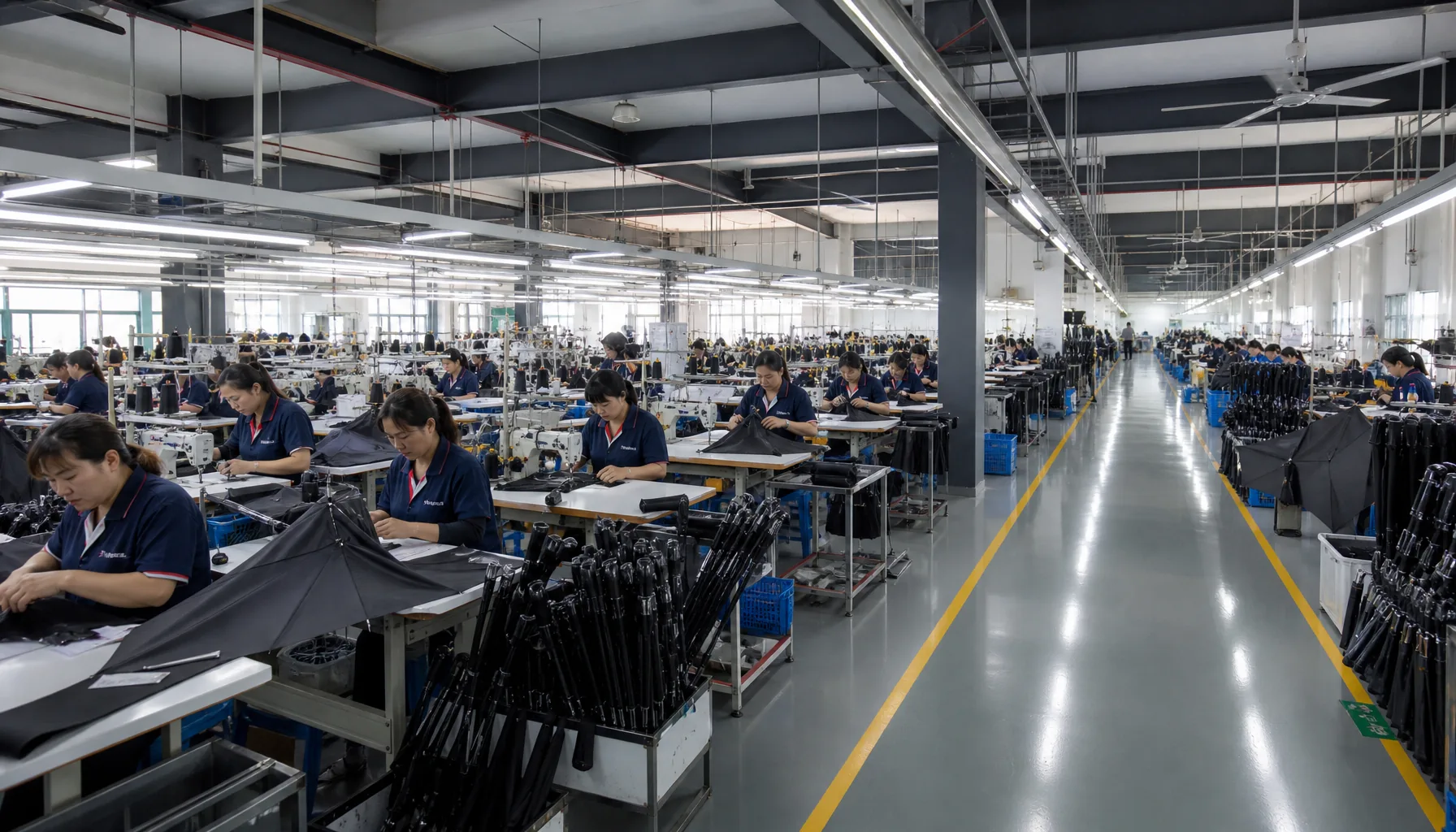
Umbrella Canopy Panel Cutting and Seam Alignment Controls
Understand how panel cutting, seam alignment, and stitch control shape canopy appearance, waterproofing, and rejection r...
Read More »