Umbrella Fabric Shrinkage Control in OEM Production
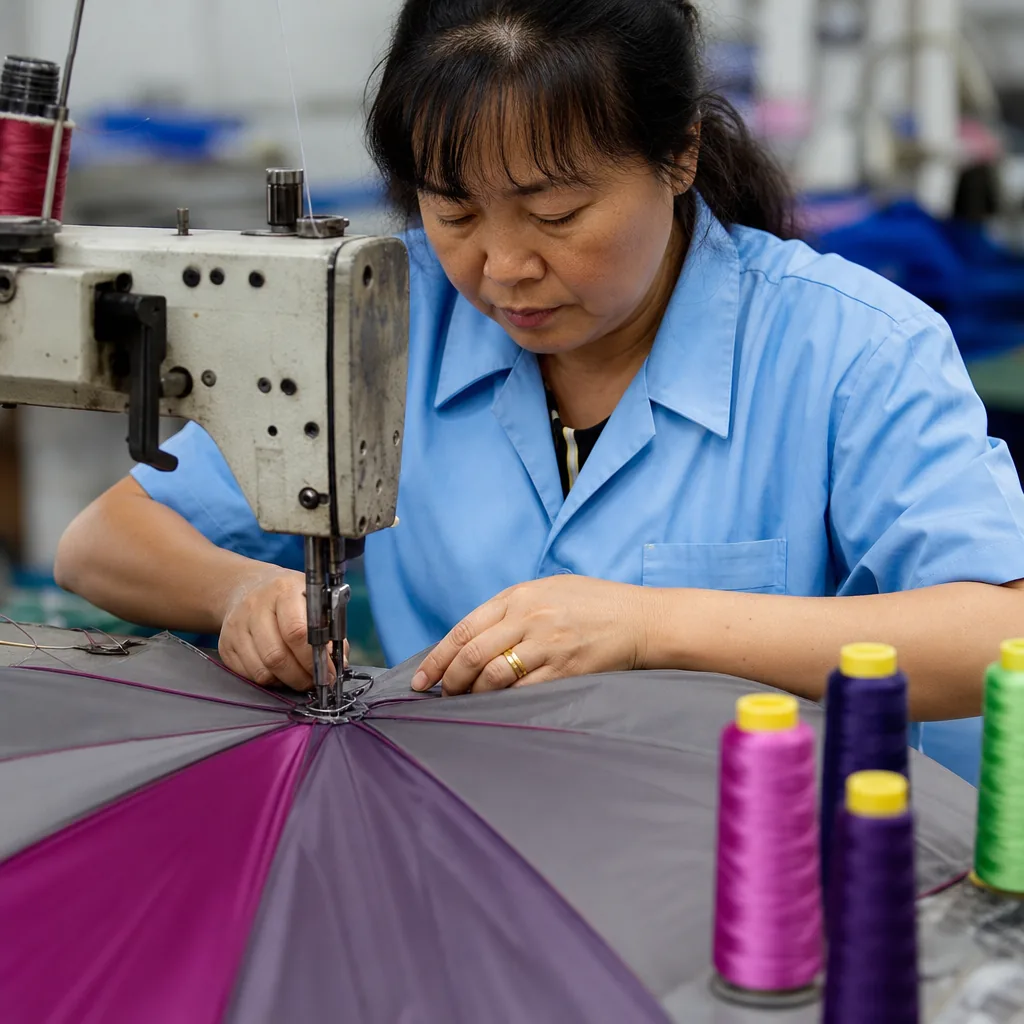
In OEM umbrella production, even small fabric shrinkage can throw off panel size, distort fit on the frame, and shift print alignment enough to create costly rejects. Effective umbrella fabric shrinkage control starts before cutting, with fabric testing, controlled relaxation, and process discipline on the factory floor so each canopy stays consistent from sample to bulk order.
Why fabric shrinkage creates costly umbrella defects
Shrinkage changes the umbrella’s finished geometry, not just the fabric roll. With pongee 190T or 210T, a 1% length loss after printing, steaming, or heat curing can be enough to push a 21" or 23" canopy outside normal canopy dimensional tolerance. That means the cut panel no longer matches the rib span, seam allowance, or stretch path built into the frame. In OEM umbrella fabric testing, the critical check is finished-panel size after stabilization, because if the blank is still moving, the canopy will open with uneven edges, twisted seams, or loose panels at one or two stations. Buyers usually see it first as a warped crown, a lopsided dome, or panels that look tight near the tips and slack across the middle. For umbrella manufacturing quality, the failure starts at layout: the panel shape is right on paper, but the stabilized fabric is shorter, narrower, or both.
The cost shows up in fit, tension, and print placement. When one panel shrinks more than the others, load shifts across the canopy and creates wrinkles near the ribs, scalloped hems, and a loose belly between stations. If the tip pocket is pulled unevenly, the fabric can back off the tip and cause tip pull-out or early seam failure. Shrinkage also moves logos and repeats, so artwork centered on the cut file can drift toward a seam after finishing, which creates a reject even when the frame is correct. The practical control point is to measure finished fabric by lot after coating cure or post-print conditioning, then cut to the actual stabilized dimensions, not the raw roll width. That is the core of umbrella fabric shrinkage control: lock panel size, protect print registration, and keep every canopy within the buyer’s approved fit before assembly starts.
How different umbrella fabrics react to heat and moisture
For umbrella fabric shrinkage control, pongee is the most predictable base fabric in OEM production, especially in 190T and 210T constructions. 210T pongee has a tighter weave, higher yarn coverage, and better cut-edge stability after heat setting, so it holds canopy dimensional tolerance more reliably on 21" and 23" umbrellas. 190T pongee is lower cost and easier to sew, but it moves more if the resin finish or PU coating is thin. In practice, both grades are more consistent than untreated nylon when the target is repeatable panel geometry, because polyester pongee responds more evenly to calendaring, steaming, and drying. For buyers, the tradeoff is straightforward: 210T raises material cost but reduces rework and panel drift, while 190T is acceptable for promotional umbrellas when a small amount of variation stays within spec.
Nylon is the least predictable option for umbrella manufacturing quality because it reacts strongly to heat and moisture. It is light and strong, but steaming can relax the fibers, and humid carton storage or hot warehouses can change panel length, arc points, and seam alignment. Polyester is generally more stable under cutting and storage, provided the yarn count, coating weight, and finishing are kept consistent. It is less likely than nylon to creep after transit, which makes it the safer choice when OEM umbrella fabric testing includes heat exposure, carton storage, and recovery checks. In a controlled process, a heat-set polyester canopy with a stable coating will usually hold shape better than nylon during bulk production and export handling.
The practical test is how the fabric behaves after cutting, steaming, stacking, and several days in damp storage. Good umbrella fabric shrinkage control means measuring pre-shrink, post-heat-set, and post-humidity dimensions, then comparing the panel to the sewing template before bulk stitching. Fabrics with stable weave density and proper finishing keep their shape better through screen printing, seam pressing, and warehouse hold time. A well-finished pongee or polyester canopy should recover more predictably after 60–70°C steam than untreated or lightly finished nylon. That consistency reduces puckering, tip misalignment, and panel mismatch at final inspection, and it is why finish control matters as much as fiber choice in OEM production.
Factory methods for controlling shrinkage before cutting
Umbrella fabric shrinkage control starts at inbound inspection, before the first marker line is drawn. For pongee 190T or 210T, use controlled pre-shrinking by relaxation: unroll each lot, let it rest 12–24 hours in the same temperature and humidity used for cutting, then remeasure width at the left edge, center, and right edge. Record roll number, GSM if available, width, and moisture content by lot. A roll that arrives within spec can still move several millimeters after unwinding, and that is enough to push a 21", 23", 27", or 30" canopy out of tolerance. For OEM umbrella fabric testing, set a clear acceptable variation by roll in the purchase order; for tight programs, a 3–5 mm width drift across usable fabric is usually the practical reject threshold, especially if the selvedge is uneven or the weave is skewed.
Batch conditioning protects umbrella manufacturing quality before cutting. Keep rolls separated by lot instead of mixing stable and unstable material, and reject or downgrade any roll that shows moisture imbalance, edge curling, or recovery after relaxation beyond the agreed limit. Coated fabrics need even tighter control: Teflon-coated polyester, POE, and PVC can all change behavior as coating tension and storage humidity equalize, so they should be conditioned and rechecked before release. The key checks are width stability, moisture content, and roll-to-roll consistency; if one roll is measurably different, do not cut it into the same canopy batch. Once cutting starts, hidden shrinkage shows up later as seam puckering, tip misalignment, and off-center print, which raises scrap and rework costs.
The cleanest factory method is a simple gate: incoming inspection, pre-shrinking by relaxation, batch conditioning, then final release against the approved canopy dimensional tolerance. Hold the cloth under stable room conditions, remeasure after conditioning, and only approve rolls that stay within the allowed width range across the full usable width. Build the tolerance into sourcing documents, along with AQL 2.5 for inspection and a defined roll-to-roll variation limit, so production does not rely on operator judgment. This is the most reliable umbrella fabric shrinkage control step before production because it catches movement early, reduces cutting error, and prevents downstream sewing defects without adding unnecessary processing risk.
How shrinkage affects print registration and seam accuracy
A 3-5 mm fabric loss matters because it compounds through cutting, sewing, and canopy mounting. On pongee 190T 210T, warp and weft can shrink at different rates after dyeing, heat transfer printing, or a high-temperature water-repellent finish. The result is not just a shorter panel; it is uneven finished geometry from gore to gore. On an 8K or 10K canopy, that panel-to-panel variation can pull a ring graphic off-center at the crown or hem and shift logos across seam lines. Small single-panel logos are less vulnerable because the artwork stays within one gore and does not need to meet adjacent panels. Full-wrap graphics are much more sensitive: every panel has to land within the same canopy dimensional tolerance or the visual line will not close cleanly around the umbrella. That is the practical core of umbrella fabric shrinkage control: it must be managed against finished canopy dimensions and print registration, not treated as an isolated raw-material issue.
Shrinkage also shows up as a sewing problem. After printing, a woven canopy can relax in handling, then tighten again under the presser foot; if one panel has shrunk more than the next, the operator has to ease fabric into the seam, which is where seam slippage, puckering, and panel mismatch start. On a 21 inch or 23 inch folding umbrella, a 2 mm difference at the notch end can visibly shift tip alignment and create a twisted canopy after assembly. On 27 inch or 30 inch straight umbrellas, the longer seam makes the same error easier to see, and vented double-canopy styles add a second tolerance stack because upper and lower layers must match the same notch positions. Good OEM umbrella fabric testing happens before bulk cutting: test printed and unprinted rolls for heat and humidity response, compare warp and weft shrinkage, and adjust the pattern before die cutting. Under AQL 2.5, ±2 mm print position may pass for a spot logo, but it is usually too loose for edge-to-edge sublimation. In umbrella manufacturing quality, the lowest-cost fix is umbrella fabric shrinkage control at roll stage, not rework after 500 canopies are sewn.
Buyer specifications that reduce shrinkage risk
Write the tech pack so the factory can buy, test, and cut the exact canopy material without interpretation. Do not specify a generic “polyester canopy.” Call out the fabric by type and construction: pongee 190T or 210T, recycled PET pongee, satin, or POE/EVA for clear styles, plus target GSM, weave, color standard, and finish. Name the finish because PU coating, standard water-repellent, Teflon, and UV treatments change how the fabric relaxes under printing heat, seam setting, and cutting. For price-led promotional programs, 190T often works, but 210T usually improves panel flatness and reduces edge draw after dyeing or coating. If the umbrella is vented, require the top canopy and under-canopy to come from the same fabric lot; mixed lots are a common cause of unequal relaxation, panel mismatch, and logo misregistration. Good umbrella fabric shrinkage control starts with a tight material callout and any yarn-behavior requirement needed to hold print registration or panel stability after finishing.
Add measurable tolerances and a pre-production test gate before bulk cutting. State panel length tolerance and canopy dimensional tolerance in the tech pack, such as ±3 mm on panel length and ±5 mm on open canopy diameter, and define how to measure them on the approved frame size, whether 21 inch, 23 inch, or 27 inch. Require a pre-production wash or controlled heat test even for umbrellas that will never be laundered, because most shrinkage issues come from thermal relaxation during logo curing, seam setting, or hot storage. For OEM umbrella fabric testing, ask for warp and weft shrinkage data after the agreed heat cycle, and require print-process simulation when using heat transfer or sublimation, since those processes move pongee 190T 210T differently than screen printing. Set inspection at AQL 2.5 for both cut panels and finished goods. Panel inspection should cover length, symmetry, grain direction, shade consistency, coating defects, pinholes, skew, and edge fray. Finished-goods inspection should cover open diameter, panel alignment, seam puckering, vent alignment on double-canopy styles, and logo placement from the tip and center point. That level of umbrella manufacturing quality control reduces rework, protects delivery dates, and makes umbrella fabric shrinkage control enforceable at bulk stage, not after shipment.
Frequently Asked Questions
Is 210T pongee less likely to shrink than 190T pongee?
Not automatically. Shrinkage depends more on finishing, heat exposure, and handling than on thread count alone, though higher-density fabrics often hold shape more consistently.
Should shrinkage testing be done before or after printing?
Before printing is ideal for base fabric approval, and again after printing if the design is large or edge-to-edge. That confirms the finished canopy will still meet size and registration requirements.
What shrinkage level is acceptable for OEM umbrella canopy fabric?
Most OEM buyers ask factories to keep fabric shrinkage within about 1% to 3% after heat or water exposure, depending on the material and print method. For tight panel layouts, some brands require even narrower tolerance on cut size, typically around +/- 2 mm to 3 mm per panel.
How do umbrella factories test shrinkage before bulk production?
Factories usually cut sample swatches, measure them before and after washing, steaming, or heat exposure, then compare dimensional change. For printed canopies, they also check whether panel seams and artwork registration still line up after the fabric has stabilized.
Does 190T or 210T pongee shrink differently in production?
Both can shrink if the fabric is not properly pre-treated, but 210T is often slightly more stable because of its denser weave. In OEM production, the real control point is not just thread count but whether the fabric has been heat-set and tested for dimensional consistency before cutting.
Looking to Launch Your Custom Umbrella Line?
ZheBrella is a Zhejiang-based OEM/ODM umbrella manufacturer with 17 years of export experience. Free design, low MOQ from 100 pieces, windproof construction, full-color print.
Get Free Quote Now »People Also Search For
Related Articles
Umbrella Canopy Cutting Tolerances for Consistent Production
See how panel cutting tolerance, fabric shrinkage, and marker layout affect canopy fit, print alignment, and rework in O...
Read More »How Umbrella Canopy Panel Tension Is Measured in Production
See how manufacturers measure canopy tension, seam alignment, and panel fit to cut slack, wrinkling, and leakage risk in...
Read More »
Umbrella Canopy Panel Cutting Tolerances for OEM Production
Learn how panel cutting tolerances, fabric relaxation, and die control affect canopy fit, print alignment, leak risk, an...
Read More »