Umbrella Canopy Panel Cutting Tolerances for OEM Production
When an OEM umbrella order starts showing twisted seams, uneven tips, or prints that miss the rib line, the root cause is often in the cutting room, not final assembly. On our Songxia factory floor, umbrella canopy cutting tolerances are controlled around fabric behavior, die wear, lay height, and relaxation time because a few millimeters of drift across eight panels can change canopy fit, leak risk, and bulk shipment consistency.
- 1. Why Panel Cutting Accuracy Drives Finished Umbrella Quality
- 2. Fabric Behavior: 190T vs 210T Pongee Before Cutting
- 3. Cutting Methods: Hand Templates, Die Cutting, and CNC Cutting
- 4. In-Process Checks for Panel Size, Grain, and Symmetry
- 5. How Buyers Should Specify Cutting Requirements in a Tech Pack
Why Panel Cutting Accuracy Drives Finished Umbrella Quality
Panel cutting accuracy decides whether the finished canopy sits cleanly on the frame or fights it from the first opening. On a standard 23" straight umbrella with 8K steel or fiberglass ribs, a 2–3 mm error on each pongee panel can accumulate into visible loose fabric at one seam and excessive pull at the opposite rib tip. That changes umbrella canopy fit: the crown may sit off-center, the tips may not land evenly, and the runner can feel heavy because the fabric is loading the ribs unevenly. In OEM umbrella manufacturing, I treat umbrella canopy cutting tolerances as a structural control point, not a sewing detail, because the frame and canopy only work when the arc length, seam allowance, and tip positions match the drawing.
Different layouts expose cutting errors in different ways. A 27" or 30" golf umbrella has longer panel edges, so even a small angle error becomes a larger mismatch at the perimeter; this is why double-canopy vented golf models need tighter matching between top and under-canopy panels. Folding umbrellas, especially 21" 3-fold auto-open-close models, are less forgiving around the notches because the panels must collapse neatly between ribs without bunching. A 16K fashion umbrella looks premium only if all narrow pongee umbrella panels are consistent; otherwise the seams wander and the canopy starts to look twisted. For 8K layouts, one bad panel is more visible because each panel occupies more visual area, especially on solid-color 190T or 210T pongee.
Logo position is another reason bulk umbrella quality control must start at cutting, not final inspection. If a screen-printed or heat-transfer logo is placed before cutting, panel die alignment controls whether the artwork lands centered between ribs after sewing. If printing happens after sewing, inconsistent panel width still affects the apparent centerline because the seam path shifts. Our standard practice at ZheBrella is to check first-cut panels against a hard pattern and then recheck stacked cutting height, because too many fabric layers under a straight knife can cause edge drag and size drift. Once seam allowance varies, operators compensate by stretching fabric during sewing, which creates uneven stitch tension, puckering near the cap, and inconsistent rib-to-seam alignment that AQL 2.5 inspection will catch too late.
Fabric Behavior: 190T vs 210T Pongee Before Cutting
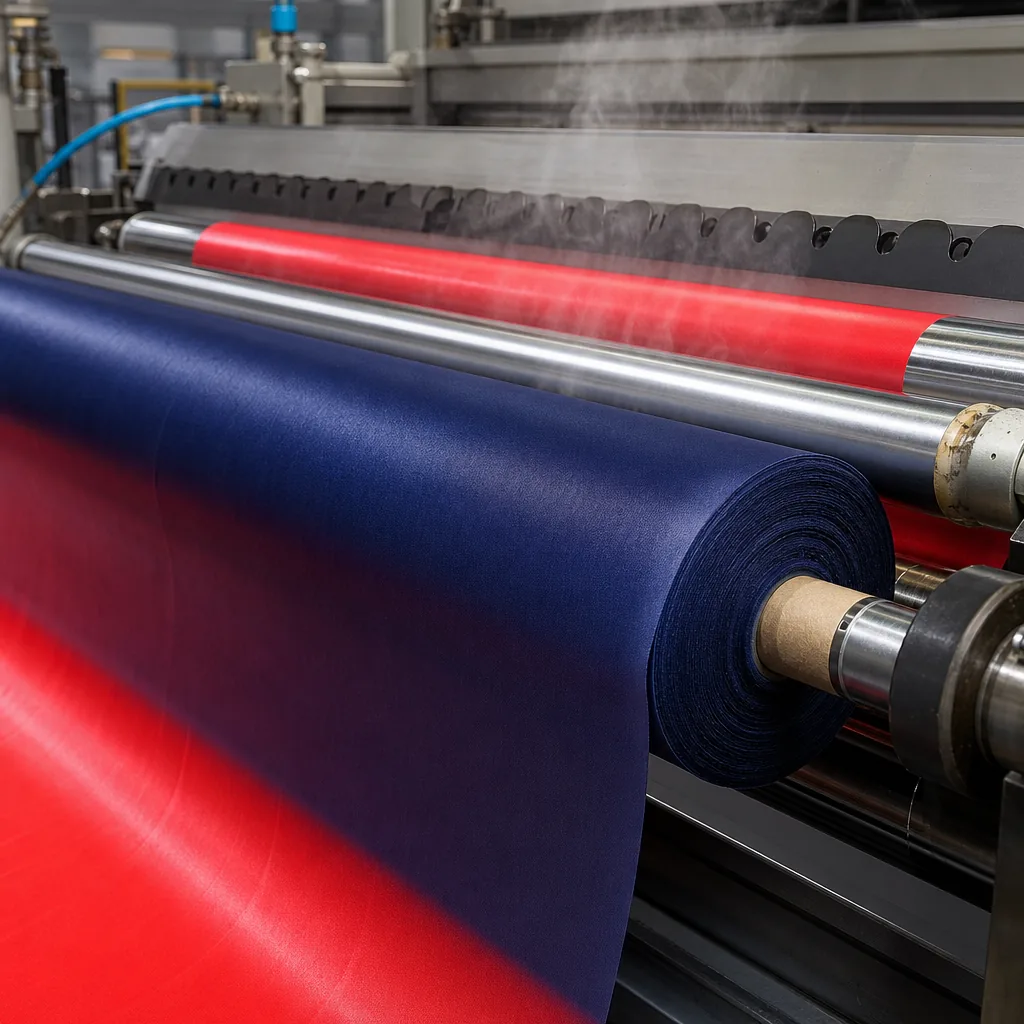
Factories should stage fabric rolls in the cutting room for at least 12–24 hours before spreading, longer in winter or when rolls arrive compressed from dyeing and finishing. The goal is not ceremony; it is to let temperature, humidity, and roll tension settle before the first panel is cut. For 190T pongee, I prefer shorter lays and a relaxation period after spreading, typically 2–4 hours for solid colors and longer for printed fabric. For 210T pongee, especially with dense sublimation or coated black-out backing, we test shrinkage with a 50 cm by 50 cm sample before production because heat transfer, steam pressing, and seam tension can change the final arc length. A reliable cutting room records shrinkage percentage by fabric batch and adjusts the pattern allowance before mass cutting, instead of asking the sewing line to “pull it into shape.” That is how umbrella canopy cutting tolerances stay consistent across 3,000 or 30,000 pieces.
Cutting Methods: Hand Templates, Die Cutting, and CNC Cutting
Hand-template cutting is still used more often than buyers expect, especially for small promotional orders, odd-shaped panels, rush samples, and trial runs below normal MOQ. A steel or acrylic template is placed over layered pongee 190T or 210T fabric, then the cutter follows the edge with a straight knife or rotary blade. On the floor, I treat hand cutting as a flexible method, not a precision method: realistic umbrella canopy cutting tolerances are usually around ±2.0 to ±3.0 mm per panel if the operator is careful and the fabric stack is not too high. It works for solid-color giveaways, simple one-position logos, and 21" or 23" manual umbrellas where price matters more than perfect panel symmetry. The weak point is repeatability. If left and right panel edges vary, the umbrella canopy fit becomes uneven, the seam allowance shifts, and the finished canopy may pull harder on one rib than another.
Die cutting is the workhorse for retail and mid-volume OEM umbrella manufacturing because it gives better consistency without the programming cost of CNC. A shaped steel rule die cuts multiple layers in one press stroke, normally holding about ±1.0 to ±1.5 mm when fabric tension, layer height, and blade condition are controlled. This is a good match for 8K and 10K straight umbrellas, folding umbrellas, and standard pongee umbrella panels with all-over solid color or repeat prints. Nesting efficiency is also strong because the die layout can be arranged tightly across the fabric width, reducing waste by several percentage points versus loose hand marking. The tradeoff is tooling: each size and panel geometry needs its own die, so MOQ must justify it. For promotional umbrellas with 500 pieces, hand cutting may be cheaper; for 3,000 to 10,000 pieces, die cutting usually pays for itself through faster output and more stable bulk umbrella quality control.
CNC cutting is the cleanest option for premium OEM orders, sublimation-printed panels, complex vented double-canopy designs, and artwork that must hit seam lines accurately. A digital cutter follows the CAD pattern, so panel shape, notch placement, and print registration can be controlled to about ±0.5 to ±1.0 mm, assuming the printed fabric has not shrunk or skewed during heat transfer. This matters on 27" and 30" golf umbrellas, 16K windproof frames, and retail canopies where a logo crosses multiple panels. CNC also improves nesting because software can rotate and arrange panels for better fabric yield, but the machine is slower than die cutting on simple repeat jobs. Our standard practice at ZheBrella is to use CNC for pre-production samples and high-registration orders, then decide whether mass production stays on CNC or moves to die cutting after AQL 2.5 pilot inspection confirms the umbrella canopy cutting tolerances are stable.
In-Process Checks for Panel Size, Grain, and Symmetry
For bulk umbrella quality control, in-process inspection should be written into the cutting SOP, not left to the final AQL 2.5 inspection. At ZheBrella, our standard practice is to recheck panel size every 500 to 800 pieces, after any fabric roll change, and whenever the marker is replaced. Coated fabrics such as Teflon-treated pongee, UV UPF 50+ black coating, POE, PVC, and EVA behave differently under pressure and heat, so one tolerance rule cannot be assumed across all materials. Double-canopy vented windproof umbrellas need tighter pairing between upper and lower panels because the vent overlap must stay even around all 8K, 10K, or 16K ribs. Good umbrella canopy cutting tolerances reduce rework before sewing by keeping seam lengths balanced, rib pockets aligned, and printed panels matched. The result is fewer rejected frames during final opening tests, less trimming at the skirt, and a cleaner production flow for FOB or DDP orders with fixed delivery dates.
How Buyers Should Specify Cutting Requirements in a Tech Pack
For OEM umbrella manufacturing, the tech pack should name the exact fabric first: 190T or 210T pongee, polyester, POE, PVC, or EVA, plus whether the canopy is standard solid color, sublimation printed, or coated for UV/UPF 50+. Then define the panel count and layout, because a 6K, 8K, 10K, or 16K frame changes the cut geometry and the seam behavior. Buyers should also state logo position by panel number, distance from the hem, and whether the artwork must be centered on the panel or aligned to the seam line. On pongee umbrella panels, I prefer buyers give both finished canopy diameter and flat panel dimensions, because umbrella canopy fit problems usually start when someone specifies only the open size and forgets the seam allowance and grain direction. For standard promotion umbrellas, a practical starting point is ±2 mm on panel width and ±3 mm on cut length, but the tech pack should say which dimensions are critical and which are not.
Sample approval needs to be written as a gate, not a suggestion. The buyer should approve a pre-production sample against a signed spec sheet that lists panel count, fabric lot, logo position, color swatch, and the measured canopy circumference at the rib tips. If the print crosses multiple panels, the tech pack should define allowable registration shift at the seam, because even a 2 to 3 mm drift can make the logo look crooked once the umbrella opens. This is where umbrella canopy cutting tolerances matter most: one cut that is slightly long is usually tolerable, but one that is short changes the umbrella canopy fit and creates puckering, exposed ribs, or uneven tension. In practice, tighter tolerances on all-over print, small repeat patterns, or high-visibility brand logos cost more because the cutter loses nesting efficiency and the sewing line spends more time correcting panel variation. That is normal in OEM umbrella manufacturing, and it should be priced in before PO release.
Final inspection notes should call out bulk umbrella quality control under AQL 2.5, with clear defect definitions for cut size, panel symmetry, edge fraying, skipped stitches, and visible logo misplacement. I tell buyers to separate critical defects, like a panel that cannot close the canopy evenly or a seam that pulls open, from major defects such as a 3 to 4 mm panel mismatch or a print that lands outside the approved zone. If the buyer wants stricter umbrella canopy cutting tolerances, the tech pack should also say who pays for the extra first-article rounds, because tighter cut control often means slower die adjustment, more fabric waste, and a longer lead time by several days. Our standard practice is to lock the sample after approval and inspect against that exact version at final random inspection; otherwise, bulk rejection gets messy when the buyer’s target moved after production started. For custom umbrellas, that detail saves both sides time and arguments.
Frequently Asked Questions
What cutting tolerance is reasonable for OEM umbrella canopy panels?
For most bulk orders, factories control panel dimensions within a few millimeters, depending on umbrella size and fabric. Large golf umbrellas, 16K frames, and all-over printed canopies usually need tighter first-piece confirmation.
Does 210T pongee require different cutting control than 190T pongee?
Yes. 210T pongee is denser and often used for higher-end orders, so distortion, coating direction, and print alignment are checked more carefully before sewing. The cutting method should match the order volume and branding requirements.
What cutting tolerance is usually acceptable for standard OEM umbrella canopy panels?
For most woven polyester or pongee canopies, buyers typically approve a panel cutting tolerance around ±1 to 2 mm per panel, provided the full canopy still matches frame geometry and print registration. Tighter control may be required for engineered prints or alternating color layouts.
Should panel cutting be approved before or after fabric relaxation?
After relaxation. In OEM production, fabric is usually allowed to rest 12 to 24 hours after spreading so tension can release before cutting; approving dimensions before relaxation can lead to canopy mismatch during sewing and final fitting.
How can buyers verify die wear is not affecting bulk canopy consistency?
Ask the factory to compare first-cut and mid-run panel measurements, especially on tip width, arc edge, and notch positions, and to document die maintenance frequency by production lot. If print alignment or seam overlap starts drifting after several thousand cuts, the die edge or stop position may need correction before bulk continues.
Looking to Launch Your Custom Umbrella Line?
ZheBrella is a Zhejiang-based OEM/ODM umbrella manufacturer with 17 years of export experience. Free design, low MOQ from 100 pieces, windproof construction, full-color print.
Get Free Quote Now »People Also Search For
Related Articles
Panel Cutting Tolerances for Umbrella Production Lines
See how CNC patterns, fabric relaxation, +/-2 mm panel control, and shade-lot batching improve 190T/210T pongee canopy f...
Read More »
Umbrella Canopy Cutting Tolerances for Cleaner Panel Fit
See how die cutting, fabric relaxation, and panel matching for 190T/210T pongee improve canopy symmetry, print alignment...
Read More »
Umbrella Panel Cutting Tolerances for OEM Canopy Fit
Learn how CAD markers, die cutting, and 190T/210T pongee tolerances control canopy tension, seam alignment, and rework i...
Read More »