Wooden Handle Umbrellas vs EVA Grip Builds for Brand Lines
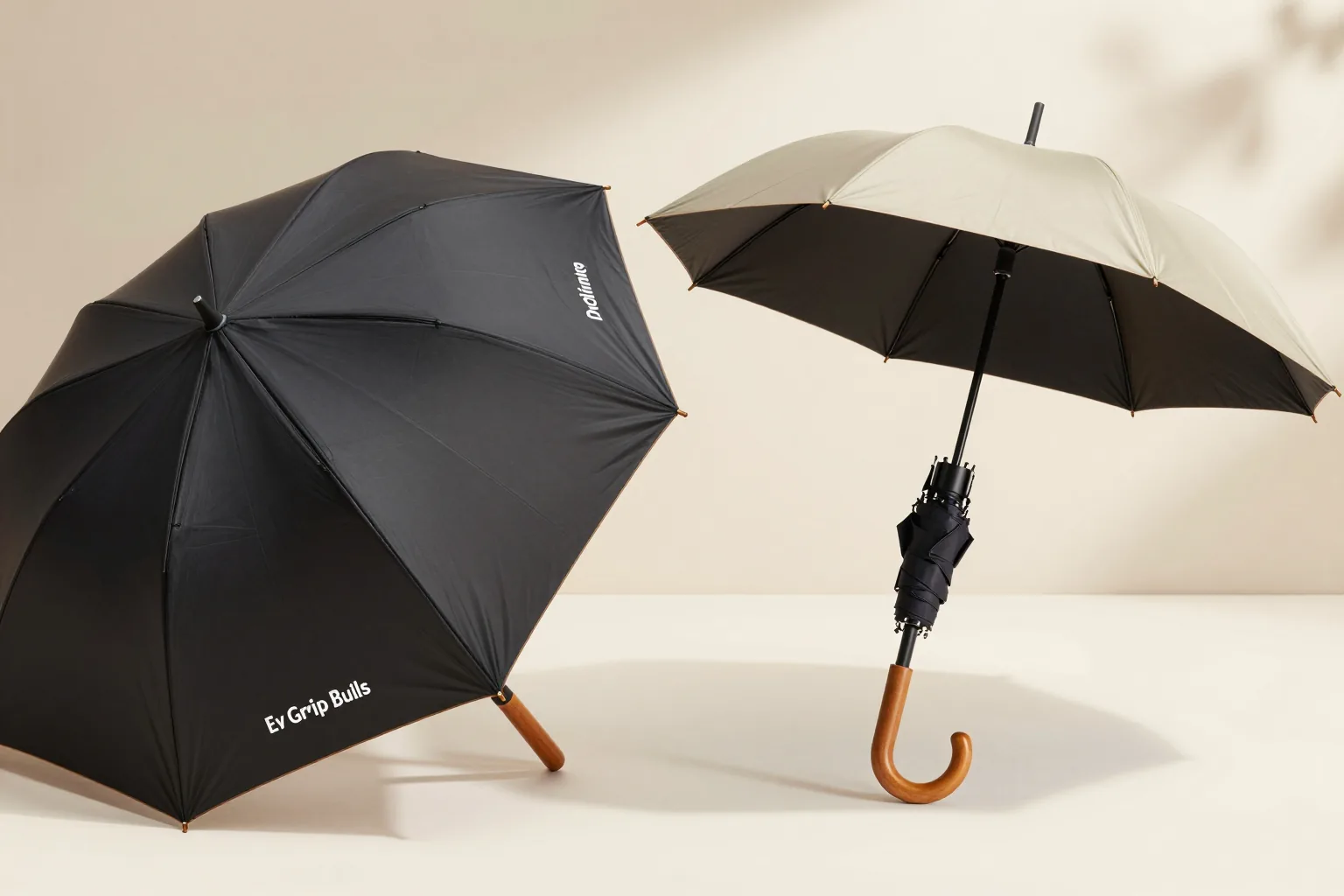
When buyers choose between wooden handles and EVA grips, the real question is not style alone but how the handle will hold up through branding, freight, and daily retail use. On the factory floor, we see the tradeoffs immediately: a wooden handle umbrella can deliver a warmer premium look and stronger shelf appeal, while EVA often wins on comfort, cost control, and consistent assembly. The right build depends on frame balance, finish tolerance, and how much inspection discipline the line can support.
Identify the Right Handle Style for the End Market
A wooden handle umbrella signals higher value before the canopy opens, but the handle style must match the channel. Crook handles suit heritage retail, golf, and gift programs where traditional aesthetics drive shelf appeal; straight wooden handles fit hotel, resort, and modern retail lines that want cleaner lines without losing the natural-material cue. In a B2B quote, the handle can shift the target price band as much as the frame: beech or maple supports a middle-to-upper retail position, while painted or laminated finishes drop perceived value if grain, stain, or joint fit looks cheap. For hotel use, a wooden handle umbrella works best with consistent-tier builds—190T or 210T pongee, not thin PVC—to avoid return risk from an overpromising handle on a basic steel frame.
An EVA grip umbrella belongs in promotions, transit, school, or event programs where cost control and replacement speed matter more than shelf appeal. EVA offers softer feel, better wet grip, and lower-risk specs for high-volume runs, with stable unit pricing and consistent color. It is less persuasive in premium retail because the material reads generic, but it hides tooling marks better than wood and supports fast replenishment. For a retail umbrella product guide, the decision is not which material looks nicer, but which handle supports the intended frame, canopy, and packaging tier at scale. EVA typically sits in a lower target price band and favors simple print or molded branding over laser marking or metal badges.
ZheBrella’s standard approach matches handle to channel. Wooden crook and straight handles fit brands selling story, hospitality, or stronger in-store presence; EVA fits programs where landed cost, grip consistency, and repeatability drive the buy. Decoration follows the same logic: wood works with laser marking, pad print, or small metal badges; EVA favors simple print or molded branding. For procurement teams, the handle is a commercial decision, not just a style choice. A wooden handle umbrella belongs in a higher perceived-value slot with tighter QC on finish, moisture content, and joint fit; an EVA grip umbrella is the practical answer for promotional volume when the buyer needs a controlled cost base and predictable output.
Compare Comfort, Durability, and Weather Performance
The core tradeoff between a wooden handle umbrella and an EVA grip umbrella is wet-weather safety versus long-term aesthetics. Beech or maple handles feel premium but become slick in rain unless coated with high-build lacquer or wax—that coating typically wears off after 200–300 open-close cycles in humid conditions, exposing raw grain that can swell or crack. EVA, a closed-cell foam, stays tacky when soaked, delivering consistent grip in downpours. For daily commuters walking five blocks in drizzle, EVA wins on safety. However, a premium wooden handle umbrella can be salvaged with a replaceable rubberized topcoat if specified during OEM handle prototyping.
Durability under compression diverges sharply. Wood handles—especially turned or carved ones—can develop hairline fractures when dropped on concrete or compressed under a laptop bag in a car trunk; 27-inch wooden handle umbrellas have been returned with a split at the ferrule after three months of heavy use. EVA grips compress and rebound without permanent dents, though they show shiny pressure marks from repeated palm contact over a year. For retail umbrella product guides, the rule: wood suits limited-edition retail where unboxing feel matters; EVA fits promotional lines with high distribution volume where abuse resistance is key.
Weather performance ties to handle design and shaft pairing. A wooden handle umbrella often uses a solid steel shaft with a metal collar, transmitting cold in winter and adding 30–40 grams of weight compared to an EVA grip with a fiberglass or aluminum shaft. That mass helps wood-handled builds with reinforced ribs survive 50+ mph gusts by damping vibration—ideal for outdoor events or golf. EVA's lighter weight and all-weather grip outperform for urban commuters or trade-show giveaways. Match handle material to use case: wood for wind-heavy, premium scenarios; EVA for everyday, high-turnover lines.
Pair Handle Types With Suitable Frame Specs
A wooden handle umbrella is almost exclusively mounted on a straight shaft—never a folding frame—because the weight of turned beech, rosewood, or lacquered bamboo requires the counterbalance of a full-length metal or fiberglass tube. On a 23" or 27" straight stick, a 16K fiberglass rib frame delivers rigidity without top-heaviness, supporting wind ratings up to 45 mph. This build suits gift, hospitality, or high-end retail lines with MOQs of 500–1,000 units and lead times of 25–35 days, not event giveaways where weight and cost are constraints.
An EVA grip umbrella dominates promotional and mid-tier retail. EVA foam is lightweight, shock-absorbing, and ergonomically moldable, making it ideal for auto-open mechanisms on straight or folding builds. On a 21" compact folding umbrella, an EVA handle with an 8K steel rib frame keeps weight under 400 grams and collapsed length around 11 inches—critical for travel. The foam also insulates against cold metal shafts in winter, a practical advantage often overlooked when comparing umbrella handle materials, and auto-open compatibility is standard with steel or fiberglass shafts.
Forcing a premium wood look onto a folding frame is a common mistake. A folding umbrella’s telescoping shaft and short handle (3.5–4 inches) cannot accommodate a full wood grip without making the folded package too thick or the handle too heavy for the spring mechanism. Even a short wood insert raises cost 30–40% versus molded EVA or rubber, and auto-open reliability drops due to extra spring stress. For OEM umbrella handles, keep wood on straight sticks with 16K or 10K fiberglass frames, and reserve EVA for folding builds where grip comfort and weight savings matter more than carved-wood luxury.
Review Branding and Quality Control Requirements
Logo placement on a wooden handle umbrella should be chosen by finish, volume, and wear target, not preference. Laser marking works best on untreated beech or maple because it gives a permanent mark with no ink layer, but the lot must stay within a consistent burn tone so the logo does not look over-charred on lighter wood. Pad printing is better for lacquered handles and colored EVA grip umbrella builds, while metal badges suit premium OEM umbrella handles when the brand wants a raised tactile mark. Specify the method up front, then inspect alignment, edge quality, and glue stability at AQL 2.5. That inspection should include finish consistency, burrs at the ferrule or badge edge, odor after airing, and a pull-force check between handle and shaft so the logo treatment does not hide a weak assembly.
Handle-to-shaft quality is the part that decides return risk. A wooden handle umbrella needs tolerance checks for straightness, grain direction, and centered drilling so the handle sits true to the shaft and does not lean in the hand. Glue stability must survive humidity exposure, because wood moves with moisture and weak adhesive shows up later as wobble or separation. For an EVA grip umbrella, the same control points apply, but the failure mode is slip or creep on the shaft, so the grip must be checked for rotation, axial movement, and surface defects before packing. AQL 2.5 should cover every lot with clear reject limits for burrs, loose badges, uneven lacquer, glue squeeze-out, and any odor that suggests poor curing or contamination.
A retail umbrella product guide should spell out these controls at the quoting stage, because they affect tooling, labor, and warranty cost. If the decoration uses laser marking, pad printing, or metal badges, the supplier should confirm the process, the inspection points, and the pull-force requirement for the handle joint before sampling starts. That is the practical way to compare umbrella handle materials without guessing which build will hold up in retail. For branded programs, the buyer should ask for AQL 2.5 inspection records, in-process alignment checks, and photos of accepted and rejected samples so the factory can prove finish consistency and assembly strength before mass production starts.
Estimate MOQ, Lead Time, and Shipping Impact
A wooden handle umbrella usually needs a higher MOQ than an EVA grip umbrella because the handle is no longer a stock part. Standard EVA or plastic handle builds often start at 300 to 500 pieces per color or size, while custom wood handles with laser engraving, staining, or a special ferrule usually require 1,000 pieces or more. If the program needs new OEM umbrella handles tooling, add 25 to 40 days for sampling, tool approval, and fit checks against the shaft ferrule. Mixed-material builds can work well in a retail umbrella product guide, but every added step, such as a metal collar, painted wood, or a wrapped EVA sleeve, raises labor cost and makes schedule control tighter.
Lead time depends more on parts readiness than on canopy sewing. A stock-handle order using 190T or 210T pongee, a standard steel shaft, and an auto-open frame can usually ship in 25 to 35 days after deposit and sample approval. A wooden handle umbrella with custom color matching, tighter grain selection, or a matched gift box usually needs 35 to 50 days. In peak season, wood-handle programs should be booked earlier because handle supply tightens before canopy fabric does. Lock the handle spec first, then confirm the frame and print, because late changes to umbrella handle materials are where schedules slip.
FOB and DDP change the shipping picture as much as unit price. FOB keeps factory pricing separate from freight, so buyers can compare carton weight and volume across styles more cleanly. A wood-handle build typically adds about 40 to 90 grams per unit versus an EVA grip umbrella, depending on handle size and ferrule hardware, and that difference compounds in cartons of 24 to 48 pieces. DDP is easier for landed-cost planning, but the forwarder still prices carton volume, destination duty, and breakage risk from harder handles pressing against canopy tips. For heavier retail programs, quote both terms so procurement can compare true landed cost, not just ex-factory pricing.
Frequently Asked Questions
Do wooden handle umbrellas usually require higher MOQ than EVA grip styles?
Often yes, especially when buyers request custom shapes, stains, or branded metal badges. Stock wooden handle options can reduce MOQ, but fully custom wood components usually add sampling time and raise the opening order quantity.
Which handle type is better for rainy city commuter umbrellas?
EVA grips are usually better for wet-hand comfort and repeat daily use because they stay grippy and resist minor impact well. Wooden handles suit premium brand positioning, but they need tighter finish control to avoid visible wear over time.
Which handle type is better for premium retail umbrellas?
Wooden crook or straight handles usually fit premium city, fashion, and gift umbrellas because they look more traditional and pair well with 8-rib steel or fiberglass frames. Buyers should verify the wood species, varnish finish, moisture control, and pull-test requirement in the supplier quote.
When should a buyer choose EVA grips instead of wooden handles?
EVA grips are usually better for golf, sport, storm, and promotional umbrellas where wet-hand comfort and lower unit weight matter. As an example calculation to verify in the quote, an EVA grip can reduce handle weight by about 20-40 grams per umbrella compared with some solid wood handles, depending on size and insert structure.
Do wooden handles and EVA grips have different MOQ or tooling needs?
Standard wooden and EVA handles often use existing molds or shapes, so MOQ can follow the umbrella factory's normal fabric and frame MOQ, commonly around 500-1,000 pieces per color as an example assumption to verify. Custom-molded EVA shapes or private handle tooling may require a tooling charge and longer sampling, often adding 7-15 days before bulk approval.
Looking to Launch Your Custom Umbrella Line?
ZheBrella is a Zhejiang-based OEM/ODM umbrella manufacturer with 17 years of export experience. Free design, low MOQ from 100 pieces, windproof construction, full-color print.
Get Free Quote Now »People Also Search For
Related Articles
Wooden Handle vs EVA Grip Umbrellas for Retail and Promo
Choose between wooden handles and EVA grips by comparing feel, durability, branding options, cost, and buyer specs for r...
Read More »
Umbrella Handle and Tip Options for Retail and Promo Buyers
Compare handle shapes, grip materials, and tip constructions so buyers can match comfort, branding, and durability to ea...
Read More »
J Hook vs EVA Umbrella Handles for OEM Buyer Programs
Compare J hook and EVA handle options by grip, durability, branding, carton impact, and target market fit for OEM umbrel...
Read More »