All-Over Pattern Printing for Branded Umbrella Collections
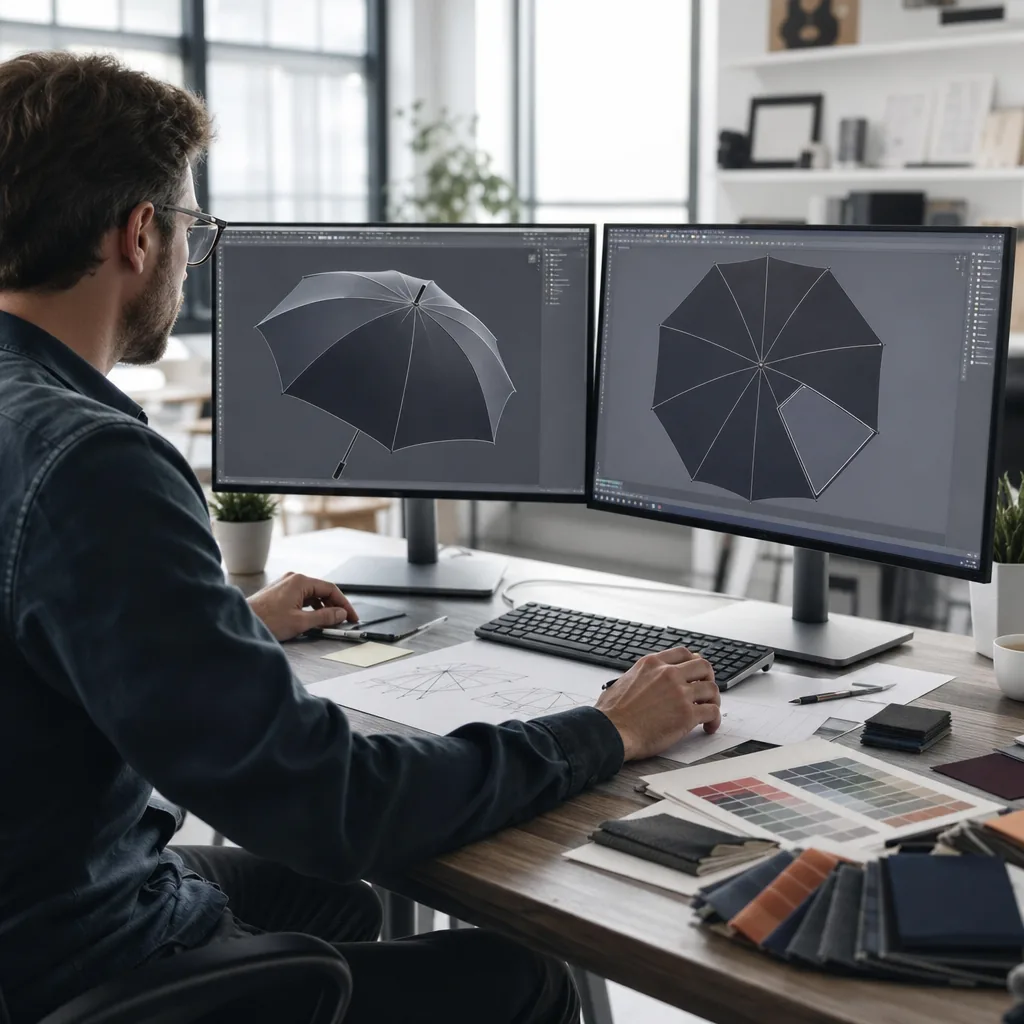
A branded umbrella pattern can look perfect on a screen and still fail once it crosses eight curved panels, sewn seams, rib positions, and fabric stretch. On the factory floor, all-over umbrella printing is less about filling every inch with artwork and more about controlling repeat scale, panel alignment, ink behavior, and color tolerance so the finished collection looks consistent from sample to bulk production.
When to Use an All-Over Brand Pattern
Use all-over umbrella printing when the umbrella needs to function as merchandise, not as a one-panel giveaway. It is the better fit for fashion retail collections, resort merchandise, museum shops, and lifestyle brand drops because the pattern stays legible from multiple selling views: folded on shelf, hanging on a peg, open on the sales floor, and in e-commerce photography. The base umbrella spec affects how well the repeat reads. A 23-inch auto-open stick with 8K fiberglass ribs and 190T pongee gives wider panels, so small monogram repeats stay cleaner and less interrupted. A 21-inch auto-open-close compact has narrower panels and multiple fold points, so larger motifs break more easily and usually need a tighter repeat. For resort programs, low-contrast micro-prints on navy or black are a weak choice; salt, sand, and strong sun reduce contrast quickly in use. A two- or three-color repeat on pongee with UPF 50+ and water-repellent finishing typically holds outdoor visibility better and keeps the brand recognizable after repeated use.
Branded umbrella patterns require different prepress control than single logo placement or full-photo custom canopy printing. A single logo on one, two, or four panels is usually a simpler screen-print job in 1-4 spot colors, where the main production risks are registration and ink opacity. Repeat patterns must be engineered panel by panel before cutting, with seam allowance and repeat direction locked in. On stripes, grids, or architectural motifs, even 3 mm of sewing drift becomes visible after 8K or 10K rib assembly, so a pre-production canopy mockup should be approved before bulk cutting. Full-photo canopy artwork, often produced by digital heat transfer or sublimation on polyester pongee, is better for museum ceiling graphics, skyline art, or event campaigns where the open umbrella is the hero image. It is usually weaker for retail umbrella design because the image fragments when folded. In OEM umbrella production, repeat layouts scale more reliably across 21-inch compact, 23-inch stick, 27-inch golf, and 30-inch vented styles, and AQL 2.5 inspection should check print continuity, shade variation, coating marks, and folded presentation, not only open-canopy appearance.
Designing Repeats Around Umbrella Panel Geometry
Build the repeat on the umbrella gore template, not on a flat square tile. An 8K canopy divides artwork into eight triangular panels, so every seam and rib line interrupts the image; a 16K canopy doubles those breaks and makes wide logos, bands, stripes, and large branded umbrella patterns look chopped even when sewing registration is acceptable. For all-over umbrella printing on a 23 inch straight umbrella, 70 to 120 mm motifs usually read cleanly within each 8K panel. A 16K fashion frame works better with 25 to 60 mm elements, scattered icons, or a radial layout that deliberately uses ribs as design dividers. Review logo grids, waves, diagonals, monograms, and border systems on the actual 21 inch, 23 inch, 27 inch, or 30 inch panel template, checking the center cap, rib line, outer hem, and tip area before sampling custom canopy printing.
Treat seam movement as a production limit, not a prepress flaw. Printed 190T and 210T pongee can move 2 to 4 mm through die cutting, heat setting, sewing tension, and canopy stretch; PVC, POE, and EVA may pucker or shift differently because they do not absorb needle tension like woven polyester. For OEM umbrella production at ZheBrella, keep an 8 to 12 mm no-critical-art zone along each panel edge, and increase the margin on 30 inch golf umbrellas or double-canopy vented windproof frames. Continuous diagonal stripes across an 8K canopy can be matched more tightly, but buyers should price and approve that as a premium tolerance request, not a standard AQL 2.5 inspection expectation. Scattered icons, textures, tonal gradients, and broken-line geometry hide seam movement better than checkerboards, hairline borders, or exact logo-to-logo joins.
Keep URLs, legal copy, phone numbers, QR codes, sponsor names, and other critical text away from seams, rib pockets, tips, and the top notch because those zones are folded, stitched, tensioned, and distorted when the frame opens. Use at least 20 mm clearance from a panel edge; increase to 25 to 35 mm on auto-open-close folding umbrellas, where the canopy compresses harder during closing. If text must appear in all-over umbrella printing, make it a secondary motif with enough x-height to survive curvature and repeat it inside the center field of each gore instead of bridging seams. For retail umbrella design, create one master repeat direction, then adapt separate panel files for each canopy size, rib count, and frame type. Scaling one file across manual, auto-open, 8K, 16K, and windproof frames raises sampling risk and usually costs more time than preparing correct artwork upfront.
Print Methods for Patterned Canopies
Digital printing is the best fit for all-over umbrella printing when the artwork uses gradients, watercolor textures, photographic elements, or tight multi-color repeats across all panels. Print the artwork before cutting, then set the repeat through the seam allowance so the pattern does not jump from rib to rib after stitching. On 190T pongee, proper pre-treatment keeps the hand feel soft and helps the ink sit evenly; 210T pongee has a denser face, so fine-line motifs and small logo repeats read cleaner for retail umbrella design inspected at close range. The risk is color control. Polyester lots can shift digital output, so Pantone approval should come from a lab dip or strike-off, not a screen proof. For OEM umbrella production, digital is most efficient when one 23 inch or 27 inch frame carries 6 to 12 SKUs with different branded umbrella patterns.
Screen printing is the stronger choice for bold motifs, 1 to 4 solid colors, and order volumes high enough to absorb screen costs. It delivers better opacity on dark 190T or 210T pongee, clean edge density on large logos, and stable repeatability once mesh count, squeegee angle, and ink viscosity are locked. The cost rises quickly on complex custom canopy printing because every color needs a separate screen, registration slows on 8K or 10K panel sets, and full-canopy repeats become harder when artwork crosses seams. Heavy coverage can stiffen 190T panels and affect folding; 210T handles ink load better, but thick ink near stitched valleys still abrades after repeated opening. Before bulk production, run rubbing, water-spray, and folding checks, especially when Teflon coating or UPF 50+ treatment is applied after printing.
Transfer printing works for smaller runs, event programs, and test launches where buyers need branded umbrella patterns without committing to high MOQ screens. Heat-transfer and sublimation can give clean color on polyester pongee, but temperature, dwell time, and pressure decide the result: excess heat can make 190T shiny or distort panel edges, while low pressure leaves weak saturation near seams. Double-canopy windproof umbrellas need stricter artwork planning because the upper and lower vent layers do not behave like one flat surface. A pattern that aligns on a single 23 inch canopy can break visually when the vent opens under wind load, especially on fiberglass 8K or 10K frames rated around 50 mph. For all-over umbrella printing on vented construction, repeating motifs, scattered logos, or directional patterns reduce alignment risk, keep AQL 2.5 inspection realistic, and cut rework before FOB or DDP shipment.
Color Control Across Samples and Bulk Runs
Lock color before bulk cutting because each canopy is sewn from 8K, 10K, or 16K panels; even minor shade drift becomes obvious at the seams. For all-over umbrella printing, specify Pantone TCX or TPX targets for every colorway and key motif instead of approving JPEG, AI, or monitor color. Use lab dips for solid grounds and print strike-offs for repeat artwork on the final substrate: 190T or 210T pongee, POE, PVC, or EVA. Review samples under D65 light, then sign a written shade tolerance before fabric release. A workable tolerance is Delta E 1.5-2.0 for brand-critical logos and hero colors, and Delta E 3.0 for background shades. Without that agreed limit, QC has no objective basis to accept or reject shade movement in a 3,000-piece OEM umbrella production run.
Darker grounds, UPF 50+ coatings, and heavy ink coverage can shift the result even when the Pantone target is correct. Black, navy, forest green, and burgundy grounds reduce brightness, so a mark that matches coated paper may look 5% to 10% duller on pongee after drying and water-repellent finishing. UPF 50+ layers can warm white areas and mute pale yellow, mint, sky blue, and light gray. Sublimation works best for sharp detail on white polyester but cannot print true white onto dark fabric; screen printing gives stronger opacity, with tighter control needed for registration and curing. For custom canopy printing and retail umbrella design, approve a real strike-off on the selected 23 inch or 27 inch canopy material, not a paper proof, because fabric tension, rib shadows, and panel curvature change perceived color.
Put bulk shade control in the purchase order. For branded umbrella patterns, retain one approved fabric swatch, one approved printed panel, and one assembled pre-production sample as the control set, then compare bulk panels before sewing. Keep panels for each umbrella within the same dye lot and avoid mixing rolls across one canopy; adjacent panels can pass separately but fail visually after assembly. During AQL 2.5 inspection, check open canopies from 1 meter and inspect seams, tips, and the top cap where panels converge. If the order includes multiple SKUs, such as manual 21 inch folding umbrellas and auto-open 30 inch golf umbrellas, approve each construction separately. Larger canopies expose repeat mismatch and shade variation faster, so a tolerance that passes on a compact model may be too loose for a retail golf umbrella.
Production Planning for Retail-Ready Programs
For retail-ready programs, the print method sets MOQ before the frame does. For all-over umbrella printing, dye sublimation on white 190T or 210T pongee is the most efficient option for dense repeats, gradients, and full-canopy color; plan on 300-500 pieces per SKU when fabric is shared across colorways, with stronger unit economics near 1,000 pieces. Screen printing is better for simpler branded umbrella patterns with 1-4 spot colors, but registration across 8K or 10K panels slows output and raises panel waste, so practical MOQ is usually 500-1,200 pieces per colorway. Heat transfer can support low-volume retail umbrella design tests or fast artwork changes, but the unit cost climbs quickly and panel-to-panel consistency is weaker, especially on dark canopies. To protect lead time in OEM umbrella production, freeze canopy fabric, rib count, shaft finish, handle mold, and packaging structure before adding colorways; late hardware changes usually delay production more than artwork edits.
Use sampling to remove the highest commercial risk first. A digital strike-off for custom canopy printing typically takes 3-5 days and confirms color, scale, and repeat logic; a true pre-production sample with final 21", 23", or 27" frame, sewn canopy, hangtag, barcode, and retail sleeve usually takes 7-12 days after artwork approval. Add 5-10 days if the order needs a new auto-open-close jig, tolerance adjustment, or custom handle. Bulk production commonly runs 25-35 days after deposit and sample approval for stocked frames with standard fiberglass-plus-steel construction, and 35-50 days for fully custom multi-SKU assortments with vented double canopies or bespoke packaging.
Plan cartons by SKU and colorway unless the retailer requires mixed ratios. Single-SKU cartons simplify barcode mapping, DC receiving, replenishment, and AQL 2.5 inspection; mixed-ratio cartons may reduce cube but increase picking and shortage claims. Outer marks should match the packing list, PO, barcode file, and carton count before booking. Under AQL 2.5, inspectors should check pattern alignment at panel seams, logo orientation to the closing strap, top-view balance, color consistency by lot, waterproof coating, open-close cycling, and assortment accuracy. Treat a 3-5 mm seam shift on key motifs as a major defect even if function passes. FOB Ningbo fits buyers consolidating multi-SKU assortments through their own forwarder; DDP reduces launch risk when one supplier must control duty, labeling, booking, and final delivery, but it requires earlier carton dimensions, confirmed HS codes, and tighter packing-list discipline.
Frequently Asked Questions
Can an all-over pattern line up perfectly across every umbrella seam?
Minor variation is normal because umbrella panels are cut and sewn under tension. The artwork should be designed so small seam shifts are not visually obvious.
Which umbrella fabric is best for detailed repeat patterns?
210T pongee usually gives a smoother print surface than lower-density fabrics and is a strong choice for retail-grade patterns. Final results still depend on ink system, coating, and sample approval.
How do factories keep a repeating pattern from looking broken at the panel seams?
Artwork is built to the panel template first, then adjusted for seam allowance, cutting angle, and stretch during sewing. For retail programs, buyers should ask for a digital panel layout proof and one pre-production sample to confirm repeat flow before bulk cutting.
What print limitations affect all-over canopy designs on OEM umbrellas?
The main limits are panel shape, color tolerance, printable area near tips and seams, and the difference between digital and screen printing methods. Fine lines, small text, and exact cross-panel registration usually need a larger pattern scale and a tolerance review during sample approval.
What MOQ and lead time are typical for a custom all-over printed umbrella collection?
For OEM production, many factories quote around 300-500 pieces per design for standard styles, with sample lead times of about 7-14 days and mass production around 30-45 days after artwork and deposit approval. Exact timing depends on frame stock, handle customization, and whether color matching is required.
Looking to Launch Your Custom Umbrella Line?
ZheBrella is a Zhejiang-based OEM/ODM umbrella manufacturer with 17 years of export experience. Free design, low MOQ from 100 pieces, windproof construction, full-color print.
Get Free Quote Now »People Also Search For
Related Articles
Repeat Pattern Umbrella Printing for Retail Collections
Plan repeat-pattern umbrella canopies for retail lines with panel layout, fabric choice, color control, sampling, MOQ, a...
Read More »
Custom Umbrella Pattern Printing for Retail Brand Collections
Plan repeat patterns, panel joins, and fabric choices for branded umbrellas that look consistent across retail assortmen...
Read More »
Repeat Pattern Umbrella Printing for Branded Collections
Plan repeat logo, monogram, or pattern umbrellas with clear rules for panel layout, fabric choice, sampling, MOQ, and pr...
Read More »