Brand Color Control for Branded Umbrellas in Production

Brand color control umbrellas sound simple until the first production run reveals how fabric base, dye lot, print method, and coating can shift a logo shade by eye. Buyers need a process that protects brand consistency without slowing delivery, and that starts on the factory floor with Pantone targets, approval samples, and inspection checks that catch drift before it reaches the carton.
Start with Pantone targets and fabric limits
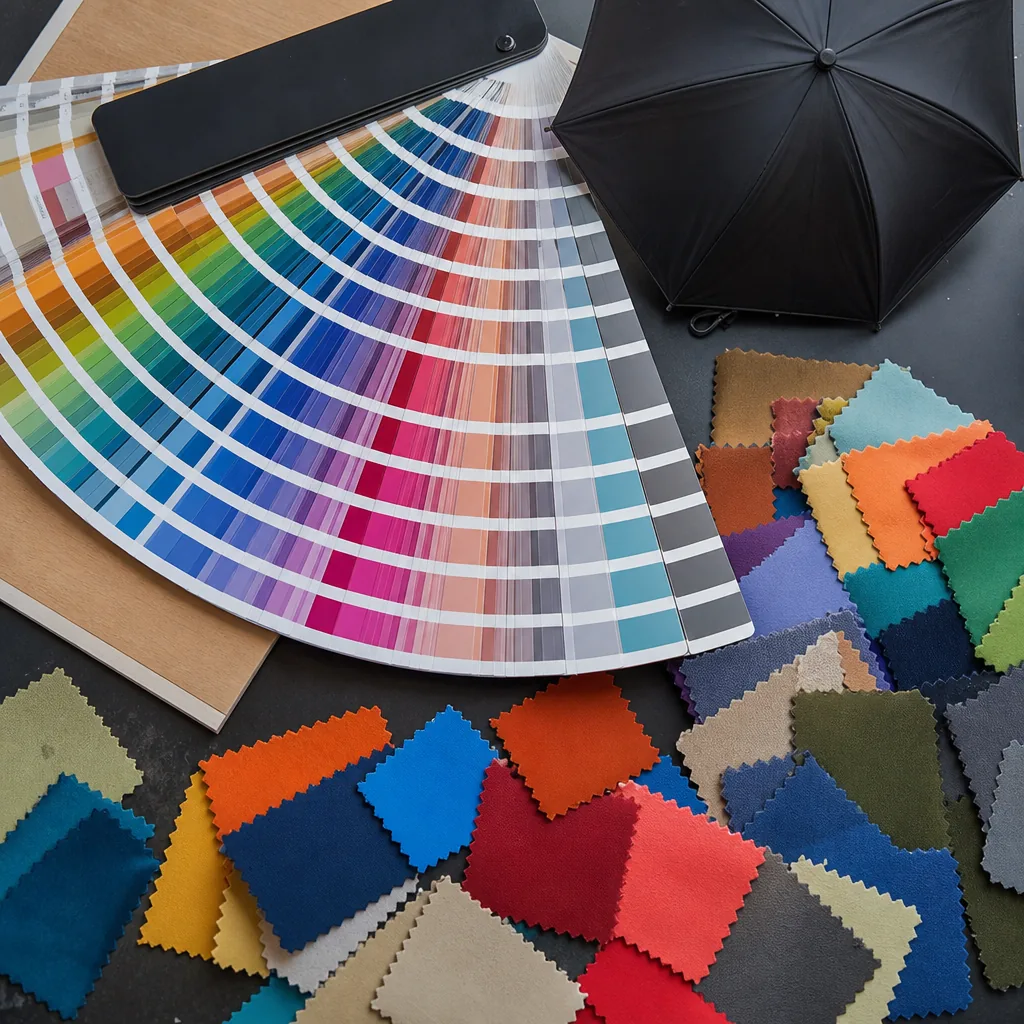
Pantone umbrella matching starts on paper, but the factory has to convert that reference into two different things: the canopy fabric and the logo decoration. With brand color control umbrellas, the first risk is assuming a Pantone chip will land exactly on dyed polyester or pongee. It won’t. The same red can look deeper on 210T pongee than on 190T because the tighter weave reflects less light and shows more surface saturation. That is why custom umbrella color approval should always be done on the actual fabric base, not on a screen file or a paper swatch alone. The cleanest workflow is to lock the target Pantone, confirm the fabric construction, and approve a lab dip or strike-off before mass cutting begins.
Color drift shows up most often in three places: dye lot variation, coating or lamination differences, and printed logo ink on top of a colored canopy. A black logo printed on a light canopy is easy; a PMS logo printed on a tinted panel can shift visibly if the ink opacity is weak or the mesh count changes. Canopy color consistency is harder on large orders because panels are often cut from multiple rolls, and adjacent rolls can vary slightly even when the supplier says they match. For branded umbrella QC, we check roll-to-roll shade, panel-to-panel shade, and finished umbrella appearance under daylight and standard shop lighting, because a color that passes in the workshop can still read off-tone in retail or event photos.
The weave matters more than most buyers expect. 190T pongee usually looks a little softer and less dense, so a mid-tone blue may appear lighter and more matte; 210T has a finer, tighter face and tends to hold the color with more depth and cleaner edges around printed graphics. That difference can be useful if you want a richer brand presentation, but it also means the same Pantone reference can need different tolerance windows depending on fabric choice. Our standard practice is to treat the fabric spec, coating, and logo method as one approval package, because changing any one of them can move the final shade enough to fail a visual match even when the lab numbers look close.
Canopy, trim, and logo colors that stay consistent
Brand color control umbrellas only work when you lock the reference sample before cutting fabric, not after sewing. For canopy color consistency, we approve the master Pantone against the exact fabric base first, then check the same lot under D65 light, because pongee 190T and 210T will read differently than POE or PVC even when the dye formula is nominally the same. The practical way to keep canopy panels, binding, straps, and printed marks aligned is to treat them as one color system: panel fabric, webbing, thread, and ink all need a written tolerance, not just a general “match the umbrella.”
On production floors, the biggest mistake is assuming a dark trim will hide variation. It won’t, especially on branded umbrella QC where black binding can turn brown-gray if the resin finish, thread, or heat transfer ink comes from a different batch. Our standard practice is to issue a custom umbrella color approval sheet that names the Pantone target, acceptable Delta E range, and the exact part-by-part split; that keeps the handle strap, canopy tip, and logo print from drifting in opposite directions. If the brand wants contrast colors, I only recommend using them where a small shift is acceptable, such as a secondary binding edge or interior vent trim, never on the main canopy field or the primary logo face.
The safest production rule is to sample every visible component together, then approve the full build under normal indoor light and direct daylight, because some blues, reds, and grays flip tone badly once stitched and heat-set. For printed marks, use the same ink base across the run and hold the logo location to a fixed panel, otherwise slight panel-to-panel shade changes become obvious when the mark crosses a seam. That is the difference between real brand color control umbrellas and a shipment that only looked right in the sample room; the buyer gets predictable canopy color consistency, and the factory avoids arguments over what “close enough” means.
Approval samples and lab dips before mass run
Before bulk sewing starts, we lock color with three checkpoints: lab dips for the fabric base, strike-offs for any print or logo area, and a sealed reference sample that stays on the line as the master standard. For brand color control umbrellas, this is not paperwork theater; it is the only practical way to prevent a 200-gross order from drifting from the approved shade because one dye lot ran slightly warmer or the coating batch changed. On polyester pongee 190T or 210T, even a small shift in pigment load shows up fast once the canopy is stretched over curved panels, so the approval sample has to be judged on the actual umbrella shape, not a flat swatch.
For Pantone umbrella matching, buyers should sign off on the strike-off and the production-approved lab dip under both daylight and indoor lighting, ideally under neutral white light around D65 and under typical office LEDs. That matters because a navy that looks clean outside can turn purple-gray inside, and a red with a fluorescent cast often reads louder on polyester than it did on paper. The signoff should also confirm canopy color consistency panel to panel, because dye lot variation across panels is one of the most common branded umbrella QC failures we see before final inspection.
Our standard practice is to keep the sealed master sample at the sewing and printing stations, then compare first-run canopies against it before the batch moves forward. A proper custom umbrella color approval should note the fabric lot number, ink or transfer method, and any acceptable tolerance for minor shade variation, especially if the order mixes manual-open and auto-open-close frames across 21-inch or 23-inch styles. If the buyer wants tight brand color control umbrellas, the approval needs to be written down before cutting starts; once 5,000 canopies are sewn, fixing a wrong green is far more expensive than rejecting one lab dip at the sample stage.
How QC teams measure color variation
For brand color control umbrellas, we never rely on “looks close enough” under warehouse lights. The floor standard is a signed master swatch or approved lab dip, then a visual check under a D65 light box against the same canopy panel fabric, because side-by-side comparison catches obvious shade drift faster than any device. In practice, Pantone umbrella matching only works if the buyer locks the reference early, because 190T pongee, 210T pongee, POE, and PVC each read differently once dyed and finished. On branded umbrella QC, the first question is not whether the color is pretty; it is whether every panel matches the approved standard within the agreed viewing condition, including zipper tape, binding, stitching thread, and printed logos.
Spectrophotometer reading is the second gate, not the first. We measure L*a*b* values on cut panels and finished canopies, then compare delta E against the approved target; for most promotional work, a tight batch usually stays within about ΔE 1.0 to 1.5, while higher-end retail programs may demand even less drift. Canopy color consistency also needs panel-to-panel checks, because a center panel can pass while edge panels pick up dye or curing variation. With custom umbrella color approval, I insist the buyer signs off on both the reference sample and the tolerance band before bulk cutting starts, otherwise disputes show up after sewing when it is expensive to separate good stock from scrap.
AQL 2.5 sampling is the practical checkpoint that decides whether a lot ships, gets held, or goes back for rework. We sample across cartons, not just from the top of the stack, and any batch with repeated shade shift, uneven spray, or obvious lot-to-lot mismatch is stopped before packing. If the variation is minor and isolated, panels can sometimes be sorted into a secondary grade; if the full load drifts beyond the approved band, the batch should be held and re-dyed or remade, because branded umbrella QC is more expensive after export than in the sewing room. Our standard practice is to document the actual measured values, the visual reject count, and the approval record together so the buyer has a clear trail when the shipment is reviewed.
Cost, MOQ, and lead-time impact of custom color
Stock colors are the cheapest way to do brand color control umbrellas because the fabric is already dyed, the mill has repeat history, and the cut-and-sew line can start as soon as the panel layout is approved. Once a brand asks for exact shade control, the job usually moves to custom dyed pongee 190T or 210T, and that adds lab dip time, minimum dye-house batching, and more material waste during shade correction. Pantone umbrella matching sounds simple on paper, but on a real canopy the same color can read warmer or darker depending on weave density, coating, stitching thread, and daylight exposure, so you need custom umbrella color approval before mass cutting or you will pay for rework.
MOQ rises because the dye mill and factory cannot run a tiny lot economically when the color is being locked to a specific brand reference. For stock black, navy, or red, the fabric can often be pulled from inventory in manageable cartons; for a custom shade, the order has to cover a full dye batch, plus extra meters for canopy color consistency checks, seam allowances, and replacement panels if the first bulk lot drifts. In practice, branded umbrella QC gets stricter too: we hold pre-production swatches, inline shade checks by bundle, and final AQL 2.5 inspection against the approved sample, because one slightly off-tone panel is enough to make the whole run look cheap.
FOB schedules are easier to keep tight than DDP when color approvals move slowly because FOB lets the factory release goods as soon as production and export paperwork are ready, while DDP adds inland delivery, destination customs handling, and final-mile coordination that all depend on a firm ship date. If a brand is still debating a lab dip or asking for another Pantone umbrella matching round, a DDP promise can slip fast and create storage, booking, and duty-cost problems on the destination side. With FOB, the factory can sequence dye approval, cutting, sewing, and carton-out more cleanly; with DDP, any delay in custom umbrella color approval tends to cascade into freight rebooking and higher landed cost, especially on seasonal programs where the window is already narrow.
Frequently Asked Questions
Can a factory match exact brand colors on umbrella fabric?
Exact matching is possible only within fabric and dyeing limits, so some variation is normal. The safest path is to approve a physical sample under daylight before bulk production starts.
Why do logos look different on the same color canopy?
Texture, weave density, and ink absorption can change how a logo reads on 190T or 210T fabric. A darker or glossier canopy can also make the same color appear deeper than it looks on a proof.
Can Pantone colors be matched exactly on umbrella canopy fabric?
Not always. Polyester pongee, oxford, and recycled fabrics absorb dye differently, so most factories work with an acceptable tolerance, often around ΔE 1.5–3.0 depending on fabric, color depth, and order volume.
What samples should buyers approve before bulk umbrella production?
For strict brand color control, buyers should approve a fabric color swatch, a strike-off for logo printing, and ideally a pre-production umbrella sample. Bulk production should not start until these are signed off in writing.
How is color consistency checked during branded umbrella QC?
QC teams compare bulk canopy panels and printed logos against the approved swatch or Pantone reference under standard light conditions, usually D65 daylight. Checks should include random panels from different rolls because shade variation can occur between dye lots.
Looking to Launch Your Custom Umbrella Line?
ZheBrella is a Zhejiang-based OEM/ODM umbrella manufacturer with 17 years of export experience. Free design, low MOQ from 100 pieces, windproof construction, full-color print.
Get Free Quote Now »People Also Search For
Related Articles
Color Accuracy for Branded Umbrellas Across Product Lines
Learn how to keep brand colors consistent across umbrella styles, fabrics, and factories with practical guidance on matc...
Read More »
Color Consistency Across Umbrella Branding Programs
Build repeatable umbrella branding with controlled canopy colors, trim rules, and approval steps that keep retail and co...
Read More »
Pantone to Canopy: Approving Umbrella Colors for Brands
Learn how to approve umbrella colors with Pantone references, swatches, and lab dips to reduce mismatch, rework, and bra...
Read More »