Color Accuracy for Branded Umbrellas Across Product Lines
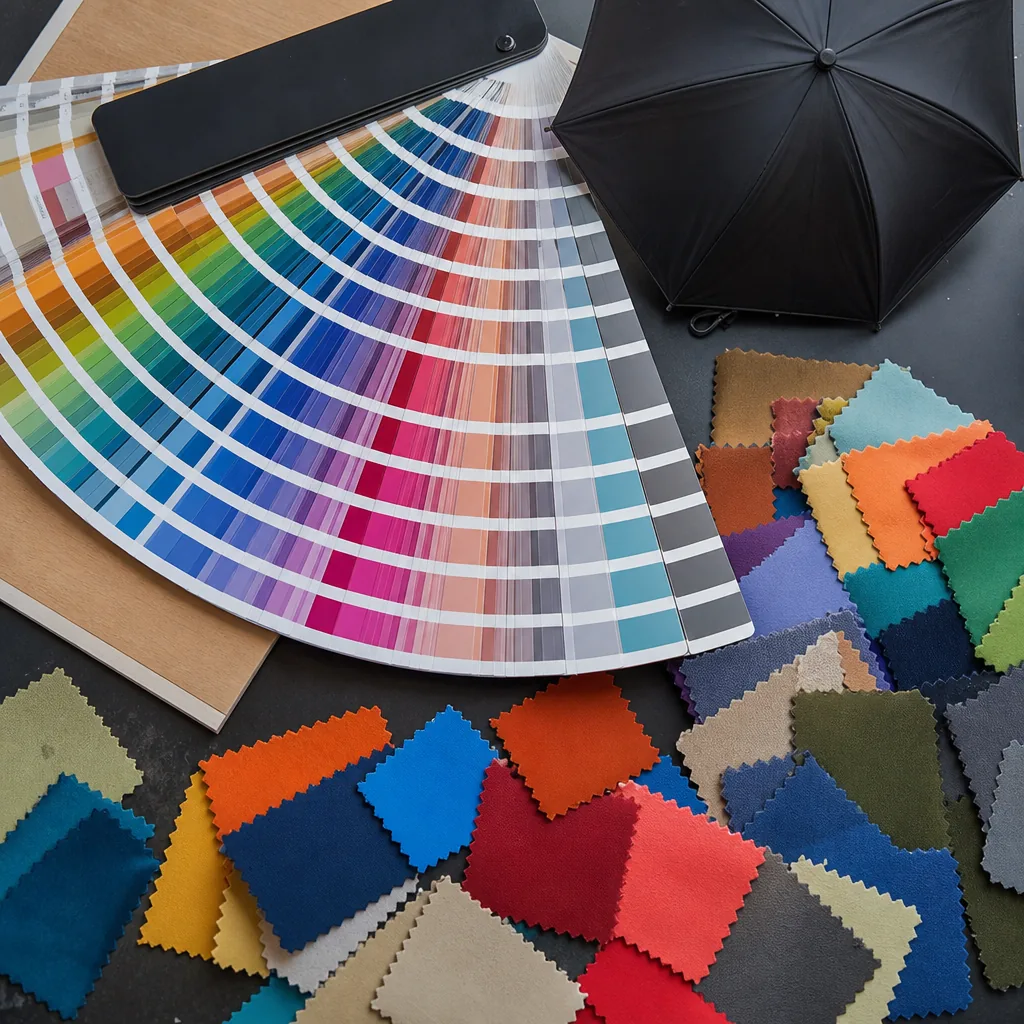
For buyers managing multiple umbrella styles, color drift is rarely a cosmetic issue; it can turn a clean brand program into mismatched inventory, rejected shipments, and costly rework. In factory production, the hardest part is not choosing a Pantone value but holding branded umbrella color accuracy across different fabrics, coatings, panels, and production lots while keeping output repeatable from sample to bulk order.
Why color shifts happen in umbrella production
The biggest reason branded umbrella color accuracy slips is that the canopy is not a neutral surface. Pongee 190T and 210T take dye differently because of weave density and resin finish, so the same Pantone target can read darker, duller, or slightly shifted once the fabric is cut and sewn. Add a UV coating or Teflon finish and you change how light reflects off the surface; a color that looked clean on an uncoated swatch can look cooler, flatter, or less saturated on the finished canopy. In pantone umbrella production, that is normal, not a defect. What matters is controlling the target against a physical strike-off, not trusting a screen color on a monitor.
Print method changes the result again. Screen printing lays down a heavier ink film and usually gives stronger edge definition, while heat transfer and sublimation can push the color into the fiber more evenly but often with a softer visual density. If the same logo or background color appears across 21-inch folding umbrellas, 23-inch golf umbrellas, and 27-inch promotional models, buyers should compare actual production samples from each construction, not assume one approved swatch transfers across all lines. For umbrella color matching, I always tell buyers to check the fabric base, print method, and coating level together, because brand color consistency fails most often when one of those three changes without a new approval.
If a custom canopy color will be used across multiple product lines, the buyer should ask for one master standard, then separate pre-production approvals for each fabric/coating combination. A color that holds on plain pongee may drift after a UV layer, and a color that looks right on a 10K manual umbrella may read differently on an auto-open-close frame simply because the canopy tension and panel curvature affect how the eye sees it. The practical check is simple: approve a lab dip or strike-off, then a sewn sample, then a finished goods sample under daylight and warehouse lighting. That is the only reliable way to protect brand color consistency across mixed umbrella constructions.
How to build a usable color standard
For branded umbrella color accuracy, the first mistake is treating a brand guideline as if it were a factory instruction sheet. A brand book might say “navy” or show a Pantone reference, but production needs a working standard that names the exact target, the fabric base, the acceptable delta, and the approval method. In umbrella work, I would always define the target with a Pantone number, then tie it to the specific canopy material, because 190T pongee, 210T pongee, POE, and PVC all read differently under the same light. That is where umbrella color matching either holds or falls apart.
The production-ready standard should start with a physical master swatch, not just a screen file. In pantone umbrella production, we normally request lab dips against the chosen reference, then compare those dips to the approved swatch under D65 light and also under store lighting, because blue and red shifts show up fast on glossy or coated fabrics. If the fabric supplier and sewing factory are not using the same approved sample, brand color consistency becomes guesswork. For a custom canopy color, the approved swatch should be signed off before bulk cutting, with one retained standard at the factory and one at the client side.
A usable spec also needs a clear rule for tolerance and re-approval. I would separate the brand guideline, which defines the identity color, from the factory working standard, which defines how the color is measured, cut, sewn, and inspected on the finished umbrella. That means documenting the substrate, coating, yarn lot, and any print layer so the shade does not drift between a 21-inch folding umbrella and a 30-inch golf umbrella. When those details are fixed up front, branded umbrella color accuracy is much easier to control across product lines, and there is less back-and-forth when the first bulk run comes off the line.
Material and finish effects on color appearance
Matte, satin, and water-repellent finishes all change how a logo color reads on an umbrella, even when the ink formula is correct. Matte pongee usually knocks the brightness down a step and makes dark reds, navy, and black-based brand colors look deeper and less reflective; satin adds more surface return, so the same blue can look cleaner and slightly lighter under retail lighting. Water-repellent topcoats are where buyers get surprised, because the beading effect and sheen can make a dark custom canopy color look patchy in angled light, which is why branded umbrella color accuracy has to be judged on the finished fabric, not just a swatch card.
Metallic-looking inks are even more sensitive to finish because the pearl or aluminum particles depend on how much light the surface returns. On a matte base, metallic gold may look subdued and close to a warm tan; on a satin base it can read closer to true metallic, but it can also shift warmer or cooler depending on the weave and coating. In pantone umbrella production, the practical rule is to approve the Pantone on the actual canopy substrate after coating, because umbrella color matching on paper is not a reliable proxy for brand color consistency on polyester pongee, POE, or PVC.
Contrast panels, piping, and inside-canopy colors can also make the same palette look like a different shade altogether. A white underside will brighten the outer color by comparison, while a black liner will make the outside color feel more saturated and heavier; trim in a complementary tone can pull the eye and exaggerate minor deviations in the main field. For that reason, when a buyer wants tight branded umbrella color accuracy across product lines, I treat every visible surface as part of the color system, not just the face panel, and I verify the whole assembly before sign-off.
Sample approval and inspection process
For color-sensitive programs, the approval chain should be simple and non-negotiable: proto sample, pre-production sample, then mass-production audit. The proto sample proves the canopy construction, rib set, and print method are workable; the pre-production sample is the real color gate, where we check branded umbrella color accuracy against the buyer’s master reference under D65 light and on a second pass under shop-floor fluorescent light. On umbrellas, a shade that looks acceptable on a flat swatch can drift once it is cut, seamed, and tensioned over the frame, so umbrella color matching has to be judged on the finished shape, not just on loose fabric.
The pre-production sample should confirm custom canopy color, panel-to-panel shade continuity, and print registration on every visible location: crown, lower panels, tie wrap, sleeve, and case if those carry branding. For pantone umbrella production, the buyer’s Pantone target needs a physical lab dip or approved standard panel before cutting starts, because dye lots change and coated fabrics read darker after lamination or heat. In practice, brand color consistency is lost most often at the seam line and at the edge fold, so we inspect those areas first and reject any sample where the logo shifts, bleeds, or lands off-center.
Mass production should not wait until the end of the order; it needs an in-line audit and a final lot check against the approved sample. Our standard practice is to verify the first output lot for shade continuity across cartons, then run AQL 2.5 on the finished umbrellas, with extra attention to color-sensitive programs and any SKU that mixes 8K or 10K frames across the same order. A lot only passes when the visible color stays within the approved tolerance, the print registration holds, and the carton sample matches the retained master; if one panel or one print station drifts, the whole lot gets held before packing.
Ordering strategy for multi-SKU branding
The fastest way to lose branded umbrella color accuracy is to treat every SKU as if the same ink formula will behave the same on every canopy. A 23" 8K fiberglass frame with 190T pongee does not read color like a 30" 16K steel frame, and auto-open-close models often distort panel tension enough to shift perceived saturation. I always lock the color standard first, then build every SKU around that standard: one approved Pantone target, one lab dip, one fabric reference under D65 light, and one tolerance window for all canopy sizes, whether the body is pongee, POE, or PVC. That is the only way umbrella color matching stays consistent across different rib counts, frame materials, and opening mechanisms.
For multi-SKU programs, brand color consistency depends on process discipline, not just good intent. If the order includes a vented double-canopy style, a compact manual foldable, and a full-size golf umbrella, each structure should still reference the same master shade and the same approval sample, but you should expect small visual differences from stitching density, seam layout, and coating chemistry. Pantone umbrella production works best when the factory confirms the color against the actual fabric roll, not just a digital swatch. For custom canopy color work, I recommend one written standard that names the Pantone code, fabric base, coating type, and acceptable delta, because buyers often discover too late that a “navy” on 210T pongee is visibly different from the same navy on EVA or UV-coated material.
MOQ planning should follow the color standard, not the other way around. If three SKUs share one custom canopy color, it is usually better to consolidate the fabric order and split the frame assembly later, because the dye lot is what protects consistency; that reduces the risk of shade drift between 8K, 10K, and 16K builds. Lead times usually run 25 to 40 days after sample approval for stocked components, and longer if the canopy base or coating needs a fresh production run. For shipping terms, FOB is usually cleaner when multiple SKUs share one color standard because the buyer controls consolidation, inspection timing, and onward freight; DDP only makes sense when the recipient wants one landed price and accepts less control over how mixed-SKU cartons are grouped.
Frequently Asked Questions
Is Pantone always enough to control umbrella color?
Pantone is a useful reference, but it is not enough by itself because fabric and ink behave differently on canopy materials. Buyers should approve a physical sample on the actual umbrella before production.
How do we keep a brand red consistent across different umbrella styles?
Lock the target color in a written spec, approved swatch, and production sample for each model. Then require the factory to confirm any fabric or coating changes before repeat orders start.
What color standard should buyers provide for branded umbrella production?
For fabric canopies, provide Pantone TCX or a physical fabric swatch whenever possible. Pantone C or U can be used for logos and printed artwork, but the factory should convert and confirm the closest fabric or ink match before sampling.
How much color variation is acceptable between umbrella styles?
A common tolerance is Delta E 1.5–2.0 for strict brand programs and up to Delta E 3.0 for standard promotional orders. Buyers should define the tolerance in the purchase order and approve pre-production samples for each fabric type and umbrella model.
Why can the same brand color look different on different umbrella fabrics?
Color can shift because pongee, polyester, rPET, and coated fabrics absorb dye or ink differently, and finishes such as UV coating or water-repellent treatment can change the visual shade. For multi-style orders, request lab dips or strike-offs on the actual production fabric before bulk manufacturing.
Looking to Launch Your Custom Umbrella Line?
ZheBrella is a Zhejiang-based OEM/ODM umbrella manufacturer with 17 years of export experience. Free design, low MOQ from 100 pieces, windproof construction, full-color print.
Get Free Quote Now »People Also Search For
Related Articles

Brand Color Control for Branded Umbrellas in Production
Learn how to control brand color on custom umbrellas, from Pantone matching and fabric dye limits to approval samples an...
Read More »
Color Consistency Across Umbrella Branding Programs
Build repeatable umbrella branding with controlled canopy colors, trim rules, and approval steps that keep retail and co...
Read More »
Brand Color Consistency Across Umbrella Collections
Keep umbrella colors and logo finishes consistent across multiple SKUs with clear Pantone targets, fabric limits, and fa...
Read More »