Branded Umbrellas for Insurance Claims and Roadside Teams
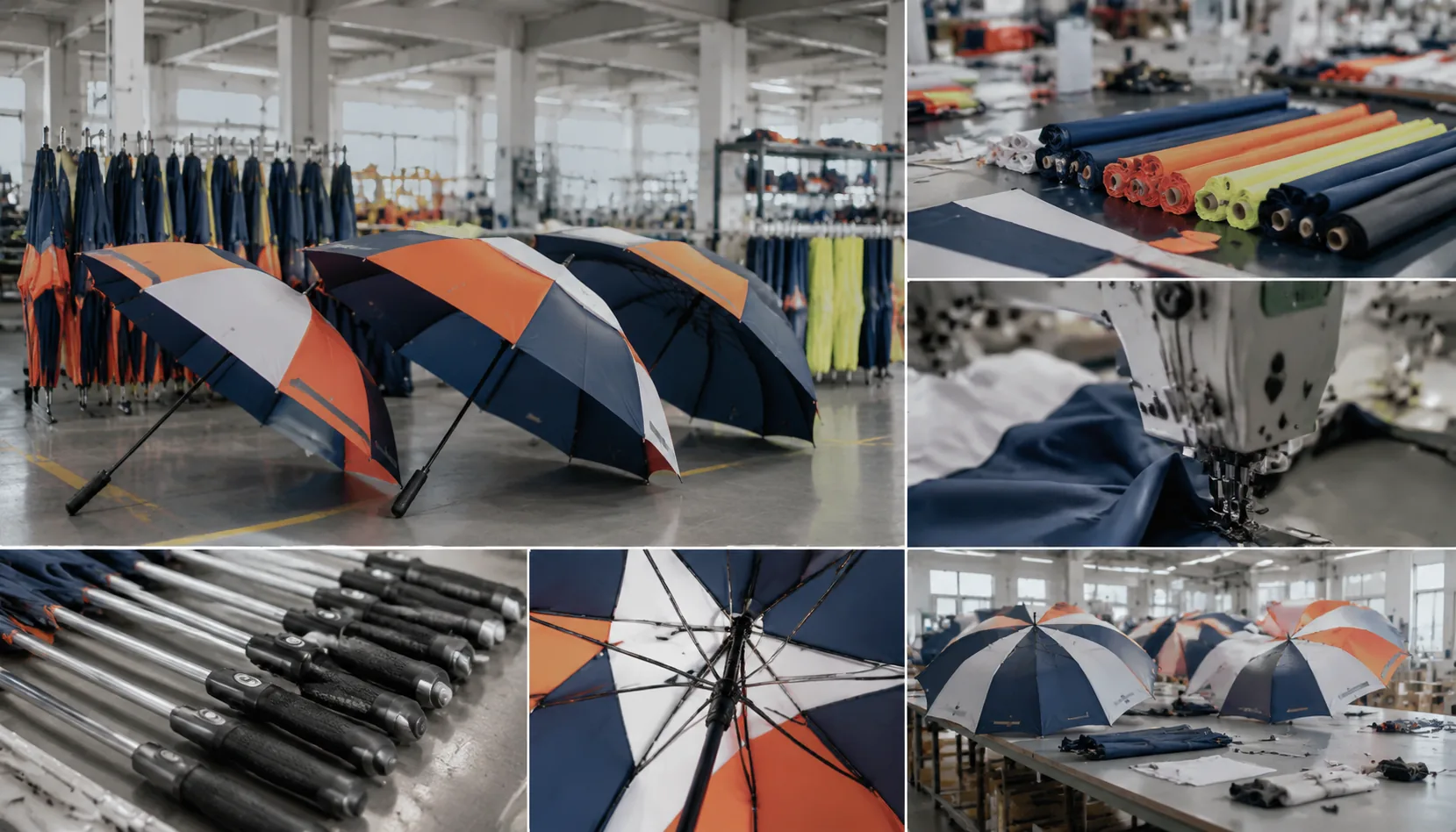
Storm season exposes every weak point in a field kit: adjusters standing in rain beside damaged roofs, roadside teams working near traffic, and procurement teams trying to reorder after the first surge. When buyers source branded umbrellas for insurance claims, the real risk is not just logo quality, but frame failure, inconsistent color, and lead times that miss the weather window. On our factory floor, those decisions start with rib strength, canopy fabric, print placement, and reorder control.
Match Umbrella Specs to Field-Response Conditions
For branded umbrellas for insurance claims, the frame spec matters more than the logo method because field teams are not standing still under light rain. An 8K frame is acceptable for urban adjusters walking from a parked car to a front porch, especially in 23" or 27" sizes with 190T pongee. But for roadside assistance umbrellas used beside disabled vehicles, tow trucks, or accident scenes, I prefer 16K fiberglass ribs because the load spreads across twice as many support points and the canopy holds shape better in gusts. Steel ribs look cheaper on a quote sheet, but they bend permanently and rust at the rivets after repeated wet storage in a trunk. Fiberglass flexes, recovers, and survives rough handling better, especially when paired with a metal shaft and reinforced runner.
Double-canopy windproof construction is the right upgrade when the umbrella may face open-road wind rather than building-sheltered rain. A vented 27" or 30" canopy lets pressure escape instead of turning the umbrella inside out, and our standard practice at ZheBrella is to test sample builds against 40–50+ mph wind-tunnel conditions before confirming bulk logo umbrellas for field programs. For insurance adjuster rain gear, a 210T pongee canopy with water-repellent coating is usually the best balance of dry feel, print sharpness, and pack weight. If the team works storm claims in summer sun as well as rain, add UV coating to reach UPF 50+, but avoid over-specifying heavy coatings that slow drying and make the umbrella unpleasant to carry all day.
Auto-open shafts are not a luxury for claims and roadside calls; they are a safety feature when one hand is holding a tablet, clipboard, phone, flashlight, or vehicle door. Manual-open golf umbrellas are stronger in some large-format builds, but field users often delay opening them, which defeats the purpose of issuing windproof work umbrellas in the first place. For most programs, I would specify a 27" auto-open stick umbrella with 16K fiberglass ribs, EVA or rubberized handle for wet grip, 210T pongee canopy, reflective edge option, and AQL 2.5 inspection on runner action, rib alignment, canopy tension, and print placement. Typical MOQ starts around 500–1,000 pieces depending on print complexity, with 25–35 days production after artwork approval and FOB Ningbo or DDP delivery available for distributor programs.
Choose Fabrics and Branding for Professional Visibility
For branded umbrellas for insurance claims, I normally push buyers toward 210T pongee when the logo has fine text, gradients, or small policy-service icons. The tighter weave holds screen print edges cleaner than 190T, especially on white, silver, or light-blue ink over navy and charcoal panels. 190T pongee is still serviceable for simple one-color logos and lower-cost bulk logo umbrellas, but it feels thinner in hand and shows more distortion when the canopy is tensioned over 8K or 10K frames. For adjusters and roadside crews who open and close umbrellas 20 times a day, 210T with a water-repellent coating gives better abrasion resistance at the rib tips and seams. If the program needs UPF 50+ sun protection for storm assessment and daytime roadside work, specify a UV coating on the underside rather than assuming standard pongee will block enough light.
Dark canopy colors are practical, but they need contrast planning or the brand disappears in rain. Black hides mud and trunk grime best, while navy, graphite, and deep forest green look less harsh in claim-site photos and still conceal dirt better than royal blue or white. I prefer large panel logos on two opposite panels for field visibility, then a smaller logo on the tie wrap so the brand shows when the umbrella is closed. Reflective piping is worth the small cost increase for roadside assistance umbrellas because headlights catch the canopy edge before they catch a jacket logo. On windproof work umbrellas, reflective tape should be sewn into the panel seam, not heat-applied across the canopy surface, because repeated flexing on a double-canopy vented design can lift cheap reflective film.
Insurance adjuster rain gear has to look professional after being tossed into trucks, not just look good on a catalog mockup. Our standard practice at ZheBrella is to test logo placement on a fully assembled 23-inch or 27-inch sample because print artwork that looks centered on a flat panel can shift visually once the rib arc pulls the fabric into shape. For branded umbrellas for insurance claims, avoid putting the logo too close to the hem; rib-tip wear, seam allowance, and reflective piping can crowd the artwork. A safe layout is 180 to 220 mm wide for a panel logo on a 23-inch umbrella, larger on 27-inch golf models, with at least 25 mm clearance from seams. For higher-volume orders, approve a pre-production sample under wet fabric conditions, then inspect printing under AQL 2.5 so ink bleed, registration drift, and skipped reflective stitching are caught before cartons leave the line.
Build Kits for Adjusters, Agents, and Roadside Crews
For storm-response claim teams, the umbrella kit has to work from a wet trunk, not a showroom shelf. I would spec 23" auto-open stick umbrellas or 27" golf umbrellas for adjusters walking roofs, driveways, and flooded basements, with fiberglass ribs rather than steel because bent steel ribs come back after one hard gust. A 190T or 210T pongee canopy with Teflon coating dries faster before the adjuster puts it back in the sleeve; for coastal hurricane work, a double-canopy vented windproof build with 8K or 10K fiberglass ribs is worth the extra cost. Branded umbrellas for insurance claims should carry a clean one- or two-color logo on two panels, not full-panel art that disappears in heavy rain. Add a reflective sleeve pull tab, printed owner label, and barcode sticker if the carrier tracks field equipment by region or CAT event.
Branch-office loaners and customer handoff gifts need different packing discipline. Loaners should use a thicker sleeve with drain eyelet, because wet umbrellas stacked behind a reception desk will mildew if PVC sleeves trap water; pongee sleeves with mesh bottoms hold up better. Customer gifts can be 21" auto-open-close folding umbrellas, but do not mix them in the same carton with 30" roadside assistance umbrellas unless the warehouse is set up for SKU-level pick control. Our standard practice at ZheBrella is inner cartons of 12 pieces for compact umbrellas and 24 pieces for stick umbrellas, then master cartons kept under roughly 18–22 kg so branch staff can move them without pallet jacks. For bulk logo umbrellas, specify carton markings on two sides: program name, branch code, color, rib count, and quantity.
Roadside assistance umbrellas live in vans, tow trucks, and service SUVs, so sleeve and storage requirements matter as much as canopy size. A 27" or 30" manual-open windproof work umbrella with 10K fiberglass ribs, EVA handle, and a longer pongee sleeve is easier to grab with gloves than a compact folding model. For roadside assistance umbrellas, I prefer high-visibility yellow, orange, or navy with reflective piping, plus UPF 50+ coating if crews also use them during summer lockouts and battery calls. Vehicle kits should be packed 6 or 12 per export carton, each umbrella individually sleeved and polybagged, with cartons sized to fit depot shelving and rear cargo bins without crushing tips. If these are bundled with insurance adjuster rain gear, keep umbrellas in a separate dry carton from rain jackets and boot covers to avoid zipper abrasion during FOB or DDP transit.
Plan Procurement Around Storm Season Demand
Storm demand punishes buyers who treat umbrellas like ordinary promo stock. For branded umbrellas for insurance claims, I would set the MOQ around actual field deployment: one umbrella per adjuster vehicle, roadside van, CAT-response trailer, and supervisor kit, plus 15-25% reserve for loss and new hires. A practical custom MOQ is often 500 pieces for a single 23" auto-open model, 1,000 pieces if you need sharper unit cost or multiple shipping cartons by region. If the team works shoulder seasons in the Midwest, Gulf, and Northeast, do not split the first order into too many colors or handle variants; keep the frame, canopy, and print process stable so replenishment is easy. For field use, 190T or 210T pongee on fiberglass ribs beats cheap steel-rib giveaways because adjusters are opening them beside vehicles, roofs, and tow trucks in gusty rain.
Reserve stock should be planned before the first named storm, not after claims volume spikes. I like reorder triggers based on both inventory and calendar: place a repeat PO when warehouse stock drops below 35-40% of the seasonal forecast, or when there are 45 days left before the highest-risk month in your region. Typical production is 25-45 days after artwork approval and deposit, depending on whether the order uses screen print on stock pongee, heat transfer logos, or a custom PMS canopy fabric. Add 7-10 days if you need pre-production samples, barcode labels, individual sleeves, or carton marks by state. Our standard practice at ZheBrella is to lock the rib count, shaft, handle, canopy spec, and AQL 2.5 inspection checklist on the first PO so reorder lots match the original bulk logo umbrellas instead of drifting in color or mechanism feel.
FOB makes sense when your company or 3PL already controls ocean freight, customs brokerage, and inland distribution to multiple depots. It gives procurement better visibility on freight cost, especially for full-carton programs of roadside assistance umbrellas going into regional warehouses. DDP is cleaner when marketing or claims operations needs a landed price to several U.S. addresses and does not want to manage duties, bonds, drayage, or appointment delivery. For multi-state distribution, I normally quote both: FOB Ningbo or Shanghai for centralized importers, DDP to two or three hubs for insurers that want predictable budgeting. Windproof work umbrellas with 8K or 10K fiberglass frames, double-canopy venting, and UPF 50+ or Teflon-coated 210T pongee cost more upfront, but they reduce embarrassing breakage during storm response when insurance adjuster rain gear is visible to policyholders.
Control Quality Before Field Deployment
Quality control has to start before the first bulk logo umbrella is cut, because field teams will punish weak parts faster than any showroom buyer. For branded umbrellas for insurance claims, I would not approve mass production from a PDF mockup alone; the buyer should sign off on a physical pre-production sample with the exact canopy fabric, logo method, frame, handle, sleeve, and carton mark. Check the 190T or 210T pongee color under D65 light, then compare logo ink or heat-transfer film against the Pantone target after the canopy is stretched on the frame, not while the panel is lying flat. A navy that looks correct on loose fabric can shift once tension opens the weave. For insurance adjuster rain gear, the logo also needs practical placement: visible when the umbrella is open beside a damaged vehicle, but not so large that it cracks across seam lines or rib tips.
Mechanism testing is where many cheap roadside assistance umbrellas fail. Before bulk release, run manual, auto-open, or auto-open-close samples through at least 300 open-close cycles, checking spring rebound, runner lock, shaft straightness, and finger-pinch risk. On windproof work umbrellas, inspect rib flex one by one: fiberglass ribs should bend and recover cleanly, while steel ribs should not show whitening, loose rivets, or twisted U-channel sections. For 23 inch 8K models, I expect consistent rib tension and no canopy sag between panels; for 27 inch or 30 inch golf umbrellas, a double-canopy vent needs even overlap so gusts can escape instead of flipping the frame. If a supplier claims 50+ mph wind resistance, ask whether it was tested on a finished production frame or only on a reinforced showroom sample.
Final inspection should be boring, documented, and done before the goods leave the factory gate. Our standard practice at ZheBrella is AQL 2.5 for major defects, with checks covering canopy stains, missed stitches, logo position, broken tips, loose handles, sharp burrs, sleeve fit, carton strength, and moisture level before packing. Barcode and carton labeling matter more than buyers think: roadside programs often ship to multiple depots, so each carton should show SKU, color, size, quantity, PO number, gross/net weight, carton dimensions, and scannable barcode if the warehouse requires it. For branded umbrellas for insurance claims, I also recommend a drop check on export cartons and a random count of inner polybags or sleeves. A clean FOB or DDP shipment is not just about clearing customs; it means the field team receives the right umbrellas, in usable condition, before the storm season starts.
Frequently Asked Questions
What umbrella size works best for insurance adjusters in the field?
A 23-inch or 27-inch auto-open umbrella is usually easier to carry than a golf umbrella. For roadside or two-person coverage, a 30-inch double-canopy model with fiberglass ribs is more practical.
Can we ship umbrellas directly to regional claim offices?
Yes. Orders can be packed by branch or region with carton marks and delivered FOB to a forwarder or DDP to office locations, depending on the buyer's import setup.
What umbrella specs work best for insurance adjusters in wet, windy conditions?
A 60- to 68-inch canopy with a fiberglass frame and vented windproof design usually performs well for field inspections. Many buyers also choose rubberized grips and a sleeve or tie strap for easy storage in vehicles.
What MOQ and reorder timing should a procurement team expect for branded field umbrellas?
For OEM/ODM orders, MOQs commonly start around 300-500 pieces per design, depending on canopy style and print complexity. Reorders are usually faster if the frame and panel layout stay the same, with repeat production often taking 25-35 days after approval.
How do you keep company logos compliant on insurance and roadside umbrellas?
Use the insurer or contractor's approved Pantone colors, logo placement, and artwork file format before production starts. Most suppliers will send a digital proof or pre-production sample so compliance issues are caught before bulk printing.
Looking to Launch Your Custom Umbrella Line?
ZheBrella is a Zhejiang-based OEM/ODM umbrella manufacturer with 17 years of export experience. Free design, low MOQ from 100 pieces, windproof construction, full-color print.
Get Free Quote Now »People Also Search For
Related Articles
Branded Umbrellas for Insurance Claims Field Teams
Specify umbrellas for insurance adjusters with durable frames, fast deployment, professional branding, QC standards, and...
Read More »
Custom Umbrellas for Insurance Claims and Adjuster Teams
Plan durable branded umbrellas for insurance adjusters, with windproof frames, fast deployment, logo visibility, MOQ, le...
Read More »
Custom Umbrellas for Insurance Claims and Roadside Teams
Design insurance and roadside-assistance umbrellas for field inspections, policyholder support, and storm response with ...
Read More »