Canopy Cutting and Panel Alignment in Umbrella Production
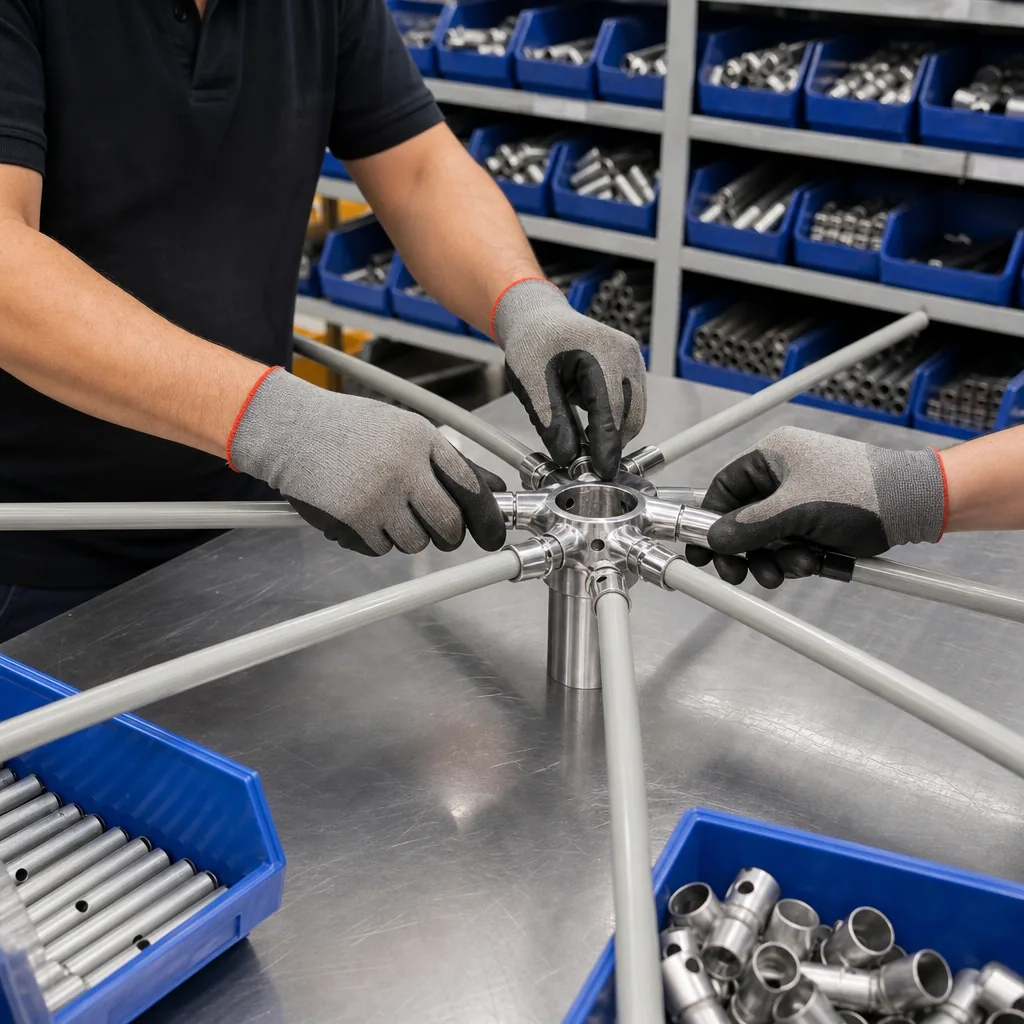
Getting a printed canopy to close cleanly starts long before sewing, and most alignment problems begin at the cutting table. In mass production, the umbrella canopy cutting process has to account for fabric relaxation, grain direction, die accuracy, panel numbering, and seam allowance control, especially with 190T and 210T pongee that can shift after printing and heat setting. At factory scale, small cutting errors quickly become crooked seams, mismatched logos, and rejects.
From Fabric Roll to Cutting Table
The umbrella canopy cutting process starts before a blade ever touches the cloth. On 190T and 210T pongee, we check roll width, shade lot consistency, coating side, water repellency, and obvious defects like slubs, pinholes, edge waviness, oil marks, and splice joints. On an OEM umbrella factory floor, the wrong coating orientation is a common mistake: if the water-resistant face is flipped, the canopy will sew fine but perform poorly and print unpredictably. For printed umbrella production, we also flag dye-band variation early, because even a small shade shift shows up as a mismatch between panels after assembly.
Fabric relaxation is not optional; it is how you keep a pongee umbrella canopy from moving after cutting. Rolls are opened and rested so tension from winding and warehouse storage can release before nesting and die cutting. If you skip that step, the cloth can shrink unevenly after heat, humidity, or steam in later sewing, which turns a clean template into a distorted panel set. In practice, this is where most umbrella panel alignment problems start, not at the sewing machine.
Once the fabric stabilizes, we lay out the markers according to the actual usable width, not the catalog width printed on the roll core. That matters because some 210T pongee runs a little narrow at the selvage, and a few millimeters lost on each side can change panel yield and create a visible twist at the crown. Good umbrella panel alignment depends on consistent grain direction, matched panel pairs, and cutting against the same reference edge every time; otherwise the ribs may be correct but the canopy will sit off-center when stretched over the frame.
Cutting Methods and Tolerance Control
Cutting accuracy matters more than most buyers realize because a canopy is not one piece of fabric; it is 8, 10, or 16 triangular panels fighting to become a clean dome. In the umbrella canopy cutting process, manual cutting is still acceptable for small OEM sample runs, low-MOQ promotional orders, and solid-color 190T pongee umbrella canopy jobs where artwork registration is not critical. A skilled cutter using a paper marker and straight knife can hold panel edge tolerance around ±1.5 mm, but fatigue shows up after a few thousand panels. Die cutting is faster and more repeatable for standard 21", 23", and 27" models, usually holding ±0.8–1.0 mm on panel edges and notch points if the steel rule die is maintained. CNC knife cutting is slower than die cutting but better for mixed sizes, custom arcs, and frequent pattern changes.
For printed umbrella production, I prefer CNC knife cutting or laser alignment with camera registration when the logo crosses seams or a full-panel sublimation layout must meet at rib lines. Screen-printed solid panels can tolerate more variation because each panel is decorated separately, but heat-transfer and sublimation artwork expose every millimeter of drift. Laser cutting seals some polyester edges cleanly, but on 190T or 210T pongee it can leave a hard edge or slight discoloration if power is set too high, so we test before bulk cutting. Our standard practice at ZheBrella is to keep seam allowance at 7–10 mm depending on fabric stretch, with notch points controlled within ±0.5 mm for printed canopies and ±1.0 mm for plain canopies.
Small cutting errors multiply quickly after sewing. On an 8K umbrella, a 1 mm panel-width error can create an 8 mm circumference mismatch; on a 16K golf umbrella, the same error can become 16 mm, forcing operators to stretch fabric, shift seam lines, or accept wrinkles near the tips. Poor umbrella panel alignment also affects rib binding: tip pockets may pull off-center, the runner may feel tight, and the canopy can twist when opened. In an OEM umbrella factory, tolerance control should start with fabric relaxation before cutting, marker verification, first-piece inspection, and in-line checks every 300–500 panels. For AQL 2.5 final inspection, we check seam symmetry, tip-to-tip balance, printed logo position, and whether the canopy sits evenly on steel or fiberglass ribs without diagonal tension lines.
Panel Numbering for Logos, Patterns, and Wrap Prints
Panel numbering is the cheapest insurance against a crooked brand mark. In the umbrella canopy cutting process, we mark each gore as 1 through 8 for standard 8K frames, 1 through 10 for 10K golf umbrellas, and up to 16 for premium fashion or patio-style constructions. The number is not only a sewing sequence; it tells the operator where the top point, outside edge, logo face, and handle-facing direction should sit after assembly. On a pongee umbrella canopy, especially 190T or 210T polyester, we usually add small chalk marks, heat-erasable pen dots, or notch cuts inside the seam allowance so they disappear after stitching. For OEM orders, ZheBrella’s standard practice is to bundle cut panels by umbrella, not by panel position, when artwork must match across the full canopy.
Full-panel sublimation is where poor umbrella panel alignment becomes expensive fast. Each triangular panel shrinks slightly differently after heat pressing at roughly 190–205°C, so a wrap print that looks perfect on the digital template can drift 2–4 mm at the sewn seam if the grain direction, pressing time, or fabric tension is inconsistent. For city skylines, racing stripes, checkerboards, and circular border prints, we print directional arrows and panel IDs on the waste margin before cutting. Operators then stack panels in clock order, usually starting at the panel opposite the handle strap, so the sewing line follows the intended visual rotation. With border prints, the bottom arc must stay consistent within about 1.5–2 mm, otherwise the eye catches the wave immediately when the umbrella is open.
Screen-printed logos create a different problem because the artwork is usually applied after cutting but before sewing, so the jig must know which panel will face front when the umbrella is carried. In printed umbrella production, a single-panel logo on a 23 inch auto-open umbrella may tolerate minor panel variation, but a two-panel logo crossing a seam needs tighter control of seam allowance, needle feed, and fabric stretch. Double-canopy vented windproof umbrellas add another layer: the outer canopy and inner vent panels must be numbered separately, then paired so vent gaps do not cover logos or break wrap graphics. On 27 inch and 30 inch golf umbrellas with fiberglass ribs, we also check that the logo orientation matches the runner, strap, and case artwork before bulk sewing, because fixing a reversed bundle after assembly usually means scrapping the canopy, not reworking it.
Sewing Alignment Checks During Canopy Assembly
Sewing alignment checks have to happen before the canopy ever touches the frame, because a crooked cover can hide for a while on the sewing table and then fail badly during mounting. In our line, operators first confirm seam straightness panel by panel, usually on 8K and 10K canopies where one bad seam is easy to see against the rib layout. For a standard 23" pongee umbrella canopy in 190T or 210T fabric, the seam allowance is typically controlled around 6–8 mm; if one sewer drifts to 4 mm and the next runs 9 mm, the canopy may still look round, but leak resistance drops because the stitch line sits too close to the cut edge. That variation also changes how the cover fits over fiberglass or steel ribs, especially on auto-open frames where the spring force exposes uneven tension immediately.
Peak matching is the second checkpoint, and it matters more in printed umbrella production than many buyers realize. On solid-color canopies, a 2–3 mm mismatch at the top notch may pass visual inspection, but with logos, stripes, or full-panel sublimation, poor umbrella panel alignment makes the artwork look twisted once the umbrella is opened. During the umbrella canopy cutting process, panels are bundled by layer sequence so print direction, grain, and coating side stay consistent; sewing QC then checks that all panel peaks meet cleanly at the crown hole before top cap assembly. For vented double-canopy windproof models, we also verify the upper and lower canopy registration separately, because a misaligned vent can block airflow and reduce real wind performance even if the ribs are fiberglass.
Before final frame mounting, the sewn canopy is opened on a checking jig for tip-to-tip symmetry and tension balance. Each tip pocket should land at the same radius, with no more than about 3 mm variation on regular rain umbrellas and tighter control for retail orders inspected under AQL 2.5. If the canopy is too tight, steel ribs may bow and fiberglass ribs may preload, making the umbrella harder to close; if it is too loose, the fabric flaps in 30–50 mph wind testing and the tips can pull unevenly. At ZheBrella, our standard practice for OEM umbrella factory orders is to catch these issues before frame mounting, because repairing a sewn canopy is still cheaper than removing tips, runner, and top hardware from a finished umbrella.
What Buyers Should Approve Before Bulk Cutting
Before bulk cutting starts, buyers should approve five things in writing: the pre-production sample, the fabric shade, the print strike-off, the cutting template, and the tolerance standard for panel width and seam allowance. That is the only way to control the umbrella canopy cutting process before 5,000 or 10,000 panels are on the table. In an OEM umbrella factory, a one-millimeter error on the template can turn into visible canopy waviness, broken panel alignment, or a crooked logo once the umbrella is sewn and opened.
For printed umbrella production, the strike-off matters more than most buyers think. Ink gain, registration, and color shift on pongee umbrella canopy fabric are different from what you see on paper or a screen, especially on 190T and 210T material with water-repellent or UV coatings. If the order uses custom print placement, matched panels, or a UPF 50+ coated fabric, build in extra inspection time for shade matching and alignment checks; that usually pushes lead time by several days and can affect the MOQ if the factory has to run a dedicated cutting layout or separate printing batch.
Buyers should also lock the tolerance standard before cutting begins, not after the first shipment sample fails. Our standard practice is to define acceptable deviation for panel angle, tip-to-strap position, and repeat placement so the sewing line can hold consistent umbrella panel alignment across the full run. If the order combines low MOQ with exact logo placement, ask for a written lead-time commitment and confirm whether the factory will inspect every panel or only AQL 2.5 by lot, because custom inspection on coated fabric is slower and mistakes are much harder to hide after stitching.
Frequently Asked Questions
Why can the same logo look slightly different on each umbrella panel?
Small cutting, sewing, and fabric-stretch tolerances can shift artwork at the seams. For wrap prints or edge-to-edge graphics, buyers should approve a layout tolerance before bulk cutting.
Is 210T pongee harder to cut than 190T pongee?
It is slightly denser and may require sharper tooling and tighter lay-up control. The benefit is a smoother hand feel and stronger canopy when the cutting and sewing process is well controlled.
How long should 190T or 210T pongee rest before cutting?
Most factories allow the fabric to relax for about 12 to 24 hours after rolling or printing, especially for wider rolls. This helps reduce shrinkage and panel length variation during die cutting.
What cutting tolerance is acceptable for umbrella canopy panels?
For standard mass production, many OEM factories target about ±1 to 2 mm per panel edge, depending on panel size and print complexity. Tighter tolerance is usually needed for logo-heavy or striped designs.
How do factories keep printed patterns matched across all panels?
They use panel numbering, fixed nesting layouts, and registered cutting marks so each piece follows the same print repeat position. For multi-panel umbrellas, the cut order and seam allowance are controlled to keep the final canopy symmetrical.
Looking to Launch Your Custom Umbrella Line?
ZheBrella is a Zhejiang-based OEM/ODM umbrella manufacturer with 17 years of export experience. Free design, low MOQ from 100 pieces, windproof construction, full-color print.
Get Free Quote Now »People Also Search For
Related Articles
Canopy Cutting and Panel Matching for OEM Umbrella Orders
Learn how canopy panels are cut, sorted, and matched to keep OEM umbrella prints aligned, colors consistent, and waste u...
Read More »
Canopy Cutting and Panel Matching for OEM Umbrella Production
See how CAD cutting, panel batching, and print alignment control canopy fit, waste, and shade consistency in bulk OEM um...
Read More »
Umbrella Canopy Cutting and Panel Alignment for OEM Orders
Learn how cutting tables, panel tolerances, grain direction, and 190T/210T pongee controls reduce twist, wrinkles, and p...
Read More »