Canopy Cutting and Panel Matching for OEM Umbrella Production
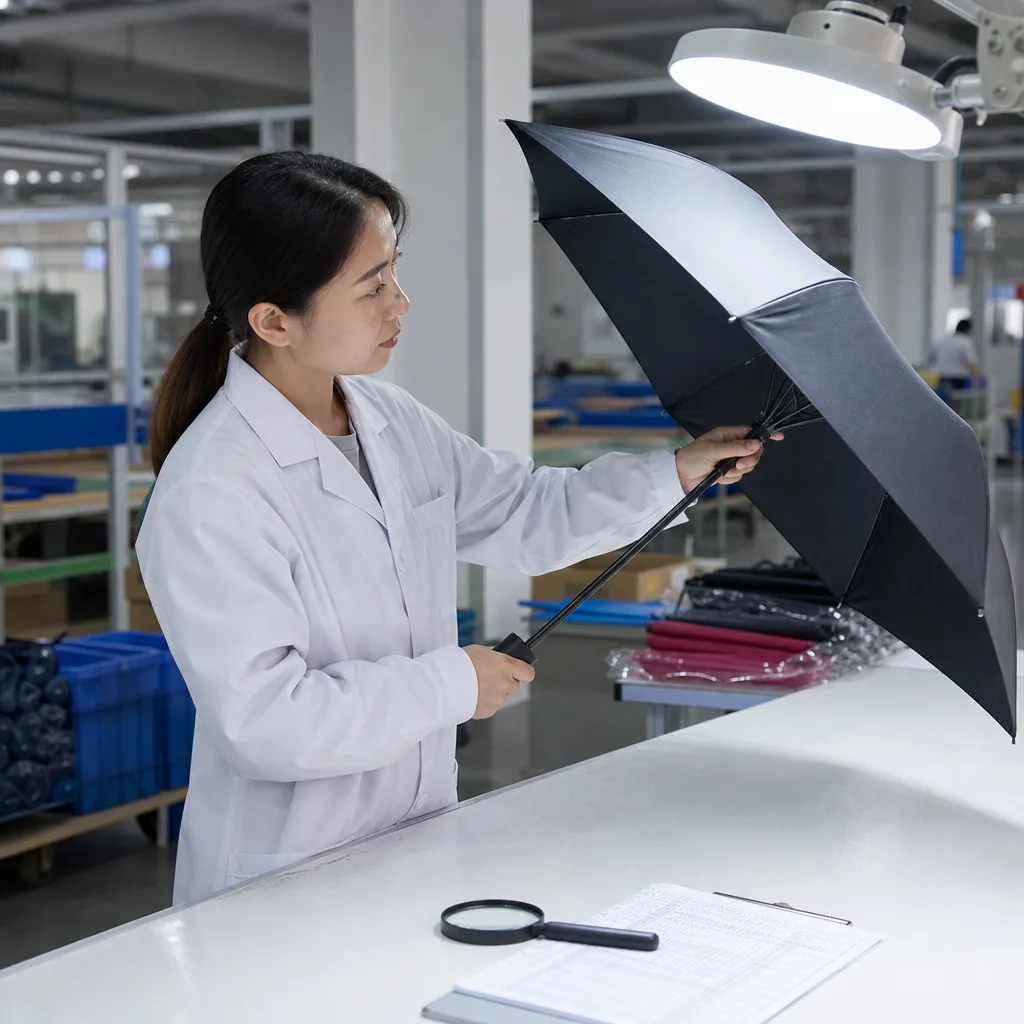
A small error at the cutting table becomes a crooked seam, a tight frame fit, or a visible shade mismatch once thousands of umbrellas reach assembly. In OEM production, the umbrella canopy cutting process is where CAD markers, fabric tension, panel batching, and print direction have to work together before sewing ever starts. On our Songxia factory floor, this is one of the first checkpoints we use to control canopy shape, waste, and lot-to-lot consistency.
From Approved Sample to Cutting Pattern
The approved PP sample is not just a visual reference; it becomes the control document for the umbrella canopy cutting process. We first measure the frame, not the cloth, because rib length and rib arc decide the finished panel geometry. A 23-inch straight umbrella with steel ribs, a 21-inch 3-fold auto-open-close frame, and a 30-inch golf umbrella may all use 8K construction, but their panel height, base curve, seam allowance, and tip overhang are different. For OEM umbrella production, our pattern room records rib length from notch to tip, runner travel, crown height, ferrule position, and the requested canopy overhang, usually 8–15 mm beyond the rib tip depending on style. Too little overhang exposes the tips and stresses the stitching; too much creates loose fabric and poor water runoff.
For 8K umbrellas, one panel pattern is repeated eight times, but that does not mean the triangle is mathematically simple. The top angle, lower arc, and side seam allowance must compensate for the frame’s actual spread and fabric behavior after sewing. On a pongee umbrella canopy, 190T and 210T polyester have different shrinkage after coating, printing, and steam pressing, so we build a small allowance into the cutting template. A folding umbrella normally needs tighter control because short ribs and multiple joints amplify small errors; a 2 mm mistake per panel can show up as wrinkles near the tips. Golf umbrellas, especially 27-inch and 30-inch models, need a broader lower curve and more stable grain direction so the canopy does not twist under wind load.
For 16K construction, the umbrella panel matching standard becomes stricter because twice as many seams means twice as many chances to accumulate error. The panel is narrower, the seam allowance is still typically 6–8 mm, and any uneven cutting will make the canopy pull off-center when the umbrella is opened. Double-canopy vented umbrellas require two separate pattern sets: the lower canopy follows the main rib line, while the upper vent canopy is shorter and must overlap enough to block rain but leave airflow space. For printed umbrella alignment, especially logos crossing seams or full-panel sublimation artwork, the cutting pattern includes registration marks, top orientation, and panel numbering before bulk cutting. Our standard practice at ZheBrella is to lock these measurements after PP approval and only revise them if the buyer changes frame supplier, fabric weight, coating, or finished diameter.
Fabric Preparation and Shade Lot Control
The umbrella canopy cutting process starts with incoming fabric control, not the cutter. For 190T and 210T pongee rolls, we check actual width against the pattern marker, confirm GSM consistency, and verify which face carries the PU or WR coating before anyone lays out panels. If the coating side is wrong, the stitch line will trap moisture or the print will wash out unevenly. Shade is checked against the approved master under standard light, because pongee can look close in the warehouse and still drift once it is opened and tensioned on the frame. We also do a simple repellency test with water spray, since a pongee umbrella canopy that beads poorly usually means the finish was applied unevenly at the mill.
In OEM umbrella production, roll batching is where most shade complaints are prevented. We keep one color lot per order whenever possible, and we do not mix rolls just because the shade difference seems minor on the shelf. If a style needs multiple rolls, they must come from the same dye batch or the same sealed incoming lot, with roll numbers recorded on the cutting ticket. For retail programs, the rule is tighter: the same retail carton should not contain panels from different shade groups, because the customer notices variation when two umbrellas sit side by side on a display. This is especially important for printed umbrella alignment, where a slightly darker base fabric can make the logo look off-center or muddy after heat transfer or screen print.
Before cutting, we inspect each roll for edge curl, coating streaks, broken ends, and width loss at the selvedge, because these defects affect panel yield and umbrella panel matching later on the sewing line. The lay plan is built to keep all panels in one umbrella from the same shade group, and we mark each bundle by lot, size, and panel count so cutters do not cross-mix parts during a rush order. On a pongee umbrella canopy, even a 3 to 5 percent visual shade shift can show up after sewing, especially on light colors like ivory, sky blue, and red. That is why the umbrella canopy cutting process is as much about lot control as it is about knife work: if the fabric is not matched at the start, no amount of final inspection will hide the variation in the finished OEM umbrella production run.
CAD Cutting, Die Cutting, and Manual Cutting Options
Manual cutting still has a place, but it should be used deliberately, not because the supplier lacks better equipment. Skilled workers can handle low-MOQ samples, urgent pre-production runs, unusual panel shapes, PVC or POE transparent canopies, and small batches where making a CAD file or die setup would slow the order. For a custom golf umbrella at 27 or 30 inches, manual cutting may also be used during development to fine-tune the canopy depth before confirming bulk patterns. The downside is variation: stacked fabric can shift, chalk lines can widen, and hand pressure changes from worker to worker. In the umbrella canopy cutting process, that variation becomes visible later as puckering near the cap, loose valleys between ribs, or mismatched print edges after sewing. For promotional orders under a few hundred pieces, this may be acceptable if the inspection standard is clear. For brand retail or repeat OEM programs, manual cutting should be limited to sampling and corrections, then converted to CAD or die cutting once the approved panel is fixed.
Panel Matching for Logos, Stripes, and Borders
Panel matching starts before a sewing operator ever touches the fabric. In a disciplined umbrella canopy cutting process, the cutting room marks face direction, grain direction, panel number, and top/bottom orientation on every bundle, especially when the canopy uses stripes, edge borders, or a centered logo. A standard 8K umbrella has eight triangular panels, but the real difficulty is not the quantity; it is keeping the artwork sequence correct after cutting, stacking, transport, and sewing. For a pongee umbrella canopy in 190T or 210T, we normally align the warp direction from panel to panel so the finished dome opens evenly and does not twist. If alternating colors are used, the bundle ticket must show the exact order, such as navy-white-navy-white, because one reversed panel can ruin the full canopy even when stitching quality is acceptable.
Printed umbrella alignment is most sensitive on logos crossing seam lines, circular border bands near the hem, and all-over artwork that must continue across ribs. For screen printing, panels are usually printed after cutting, using a jig that locates the apex and hem points; for sublimation, the artwork may be printed first and cut with registration marks, but fabric shrinkage must be tested before mass production. In OEM umbrella production, we check the first sewn canopy on a frame, not flat on a table, because tension changes the visual result. A 23-inch 8K canopy may look matched when flat, then show a 3–5 mm border jump once stretched over steel or fiberglass ribs. Our standard practice at ZheBrella is to approve one mounted pre-production canopy before bulk sewing, with photos taken from top view and side view.
The common failures are predictable: upside-down panels, left-right swapped artwork, inconsistent fabric grain, and border distortion near the tips. Vented double-canopy umbrellas add another problem because the upper vent layer is smaller and floats above the lower canopy; if the print repeats are not scaled correctly, stripes or logos appear offset when the wind vent opens. On auto-open and auto-open-close models, higher spring force can also exaggerate seam pull, so the matching tolerance should be tested on the real frame, not a sample skeleton. For umbrella panel matching, I prefer a controlled tolerance of 2 mm at logo seams and 3 mm at hem borders for mid-range promotional orders; retail programs with large geometric prints may need tighter inspection under AQL 2.5. The cheapest mistake is caught in the cutting room. The most expensive one is found after 5,000 sewn canopies are already packed for FOB shipment.
Cutting Room QC and Buyer Specifications
Cutting-room QC has to start before the knife touches fabric, because most canopy defects cannot be repaired after sewing. For a pongee umbrella canopy, our normal panel size tolerance is ±1.5 mm on short ribs and ±2.0 mm on 27" and 30" golf umbrellas; anything wider will show as twisted seams or uneven tension after assembly. Fabric rolls are checked by lot number, GSM, width, water-repellent finish, and shade under D65 light, especially on 190T and 210T pongee where navy, red, and black can shift between dye batches. Operators also inspect for slubs, oil marks, needle lines, coating scratches, and pinholes, then mark defects outside the cutting yield area. In the umbrella canopy cutting process, one missed defect often becomes eight rejected panels, so a simple four-point fabric inspection is cheaper than sorting finished umbrellas under AQL 2.5.
For printed umbrella alignment, the cutting marker must match the approved artwork file, not a screenshot copied from a sales email. Each panel position should be controlled by center line, seam allowance, top notch, and logo baseline, particularly on full-panel sublimation, screen-printed promotional umbrellas, and repeating border graphics. Umbrella panel matching is checked by laying a complete 8K, 10K, or 16K set on the table before bundling; the QC inspector confirms that color direction, grain direction, and print sequence are consistent. On double-canopy vented windproof models, the upper and lower canopy panels need separate matching because the vent overlap can hide or expose 3–5 mm of print. At ZheBrella, cutting tickets are reconciled against the work order by color, size, rib count, and print version before release to sewing, which prevents mixed logos in OEM umbrella production.
Buyers should put measurable cutting requirements in the tech pack instead of relying on the factory to guess. I recommend specifying panel tolerance, fabric type such as 190T pongee with Teflon finish or UPF 50+ coating, approved Pantone or lab-dip reference, print placement tolerance, seam allowance, artwork file format, and whether the logo must align across adjacent panels. The tech pack should also state overage rules for printed panels, because rejecting 2% at cutting is normal on screen print and heat transfer jobs. Lead-time buffers matter: add 2–3 days for fabric relaxation and shade approval, 3–5 days for printed strike-off confirmation, and more if the order uses multiple SKUs or 16K panels. A clear umbrella canopy cutting process reduces rework, but only when quantity reconciliation is strict: cut panels, replacement panels, defect panels, and sewing output must balance before final packing.
Frequently Asked Questions
How much cutting tolerance should buyers allow on umbrella canopy panels?
Tolerance depends on the model, but buyers should usually define panel width, height, and print-position limits in millimeters. Tighter tolerances are needed for border prints, alternating-color panels, and premium retail umbrellas.
Can different fabric rolls be mixed in one custom umbrella order?
They can be mixed only after shade and coating checks confirm they match the approved sample. For retail orders, factories usually batch rolls carefully so one carton or one store shipment does not contain visible shade differences.
What panel alignment tolerance is acceptable for a repeat logo across adjacent umbrella gores?
For most OEM printed umbrellas, buyers should target a panel-to-panel print alignment tolerance of about 2-3 mm at the seam. Tighter control may be needed for stripes, checker patterns, or logos that cross multiple panels.
How does panel batching help reduce shade variation on pongee canopy orders?
Factories typically batch-cut panels from the same dye lot and production roll so each umbrella set uses fabric with near-identical shade. This is especially important on 190T and 210T pongee, where cross-roll variation becomes visible under daylight.
At what stage should a buyer approve print alignment before full canopy sewing starts?
Approval should happen after test cutting and panel layup, before mass sewing begins. A pre-production sample or pilot run of 1-3 umbrellas is usually enough to confirm seam match, logo position, and canopy balance.
Looking to Launch Your Custom Umbrella Line?
ZheBrella is a Zhejiang-based OEM/ODM umbrella manufacturer with 17 years of export experience. Free design, low MOQ from 100 pieces, windproof construction, full-color print.
Get Free Quote Now »People Also Search For
Related Articles
Canopy Cutting and Panel Matching for OEM Umbrella Orders
Learn how canopy panels are cut, sorted, and matched to keep OEM umbrella prints aligned, colors consistent, and waste u...
Read More »Canopy Cutting and Panel Alignment in Umbrella Production
Learn how fabric relaxation, die cutting, panel numbering, and seam allowances keep printed 190T/210T pongee canopies al...
Read More »
Umbrella Canopy Cutting and Panel Alignment for OEM Orders
Learn how cutting tables, panel tolerances, grain direction, and 190T/210T pongee controls reduce twist, wrinkles, and p...
Read More »