Custom Reflective Umbrellas for Night Safety Campaigns
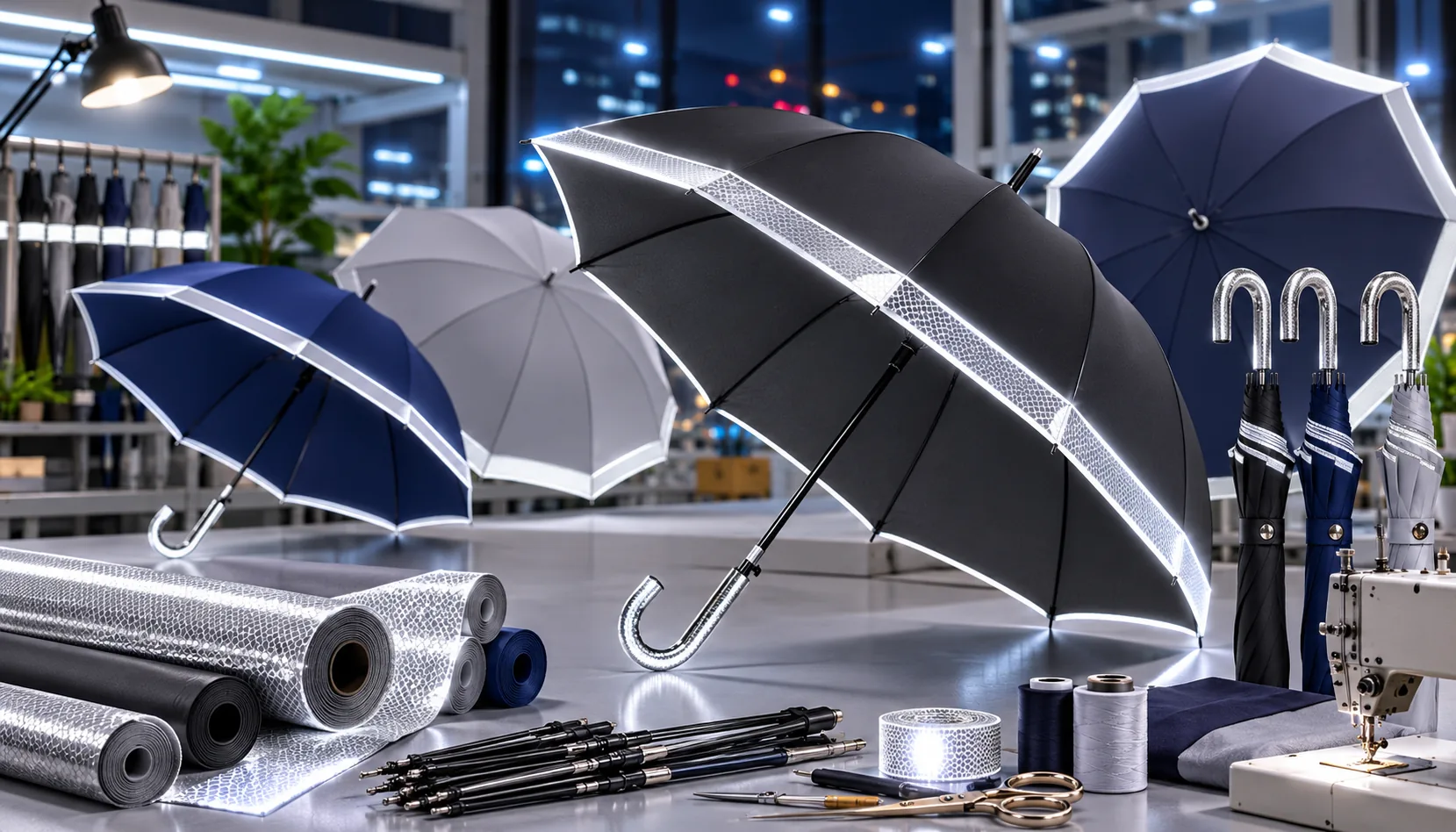
Night safety campaigns fail when the umbrella looks bright in a sample room but disappears under rain, headlights, and daily commuter wear. For custom reflective umbrellas, buyers need to confirm reflective tape grade, panel fabric coating, logo print method, rib strength, and inspection points before mass production. On our Songxia factory floor, the biggest risks are usually tape adhesion, seam alignment, and print curing—not the catalog photo.
Match the Umbrella Format to the Safety Use Case
For commuter giveaways, I usually steer buyers toward 21" or 23" 3-fold compact custom reflective umbrellas because the product actually gets carried. A folded length around 11" to 12" fits a backpack, office drawer, or subway tote; a 190T or 210T pongee canopy with reflective edge tape gives visibility without making the umbrella look like construction gear. Steel shafts keep cost down, but fiberglass ribs are worth the upgrade if the campaign runs in coastal or windy cities. Manual open is cheapest, yet auto-open-close is better for commuters stepping out of buses, parking garages, or train stations with one hand full. For reflective umbrella printing, keep the main logo on 1 or 2 panels and use reflective piping or a reflective transfer strip near the canopy perimeter, where headlights catch it. Typical MOQ is 500 to 1,000 pieces per colorway, with pre-production samples in 5 to 7 days after artwork approval.
Straight umbrellas fit staff safety programs better than pocket-size models because they are faster to deploy, easier to control, and look uniform in photos. A 23" or 27" straight umbrella with 8K fiberglass ribs, black metal shaft, EVA or rubberized handle, and 190T pongee canopy is a practical spec for security teams, school crossing staff, hotel doormen, parking attendants, and factory shift-change teams. Auto-open improves usability here because the user may be holding a radio, clipboard, flashlight, or gate pass; I would not save a few cents by forcing manual open on a staff-issued umbrella. Safety promotional umbrellas for these programs often combine a printed logo, reflective binding, and one high-contrast panel in yellow, orange, or lime green. MOQ commonly starts at 300 to 500 pieces for a standard frame, while custom handle colors or special reflective panel layouts usually push the order to 1,000 pieces. Our standard practice at ZheBrella is to run the sample through opening-cycle checks before quoting bulk lead time.
For roadside crews, charity walks, emergency response teams, and outdoor night events, the 27" golf umbrella is the safest format because coverage and visibility matter more than storage size. A 27" or 30" canopy gives enough diameter to protect a person wearing a vest or carrying equipment, and the larger print area supports bold branded rain gear without crowding the safety graphics. I prefer 8K or 10K fiberglass frames with a double-canopy vent if the team may face gusts; a decent windproof build should survive 50+ mph in a controlled wind-tunnel test, while cheap steel ribs often invert and stay bent. Night visibility umbrellas in this category should use reflective tape around the outer edge, not only a small reflective logo, because drivers see the moving perimeter first. MOQ is usually 300 pieces for a stock-frame golf umbrella and 500 to 1,000 pieces for custom reflective layouts. Digital mockups take 24 to 48 hours, physical samples take 7 to 10 days, and bulk production normally runs 25 to 35 days after deposit.
Choose Reflective Materials That Stay Visible
Reflective performance starts with material choice, not artwork size. For custom reflective umbrellas, I usually separate the options into four zones: reflective piping on the canopy edge, reflective panel strips sewn into 190T or 210T pongee seams, sleeve accents for visibility while carried closed, and logo applications using heat-transfer reflective film. Piping gives the cleanest 360-degree outline when headlights hit from the side, but it must be stitched evenly or the umbrella looks twisted after opening. Panel strips are stronger visually from the front, especially on 23-inch and 27-inch straight umbrellas used for walking teams, school escorts, and traffic volunteers. Sleeve accents are often forgotten, yet they matter because many safety promotional umbrellas spend half their life folded in a hand or backpack pocket. For night visibility umbrellas, I prefer combining edge piping with two or four vertical strip panels instead of making every rib seam reflective; full-strip designs cost more, add stiffness, and can distort the canopy if the cutting tolerance is loose.
Reflective film does not behave like ordinary screen ink on pongee, and buyers should not treat it as a simple print color. Screen ink soaks and bonds into 190T or 210T pongee differently depending on water-repellent coating, while reflective heat-transfer film sits on top and needs controlled temperature, pressure, and dwell time to avoid edge lift after wet folding. On Teflon-coated fabric, adhesion testing is mandatory because the same film that works on uncoated polyester can peel at the rib contact points after 200 open-close cycles. Reflective umbrella printing also has limits on fine detail: small QR codes, thin serif fonts, and tight registration marks lose clarity because glass-bead or micro-prismatic films are thicker than standard PU transfer. Our standard practice at ZheBrella is to test transfer adhesion after 24 hours, then do a wet rub and fold test before approving bulk production, especially for branded rain gear ordered for municipal, utility, or campus safety programs.
Placement decides whether the reflective work is useful in real rain. When a person tilts a 23-inch auto-open umbrella forward against wind, the top-center logo may disappear from driver view, while the lower front edge, left and right shoulder-side panels, and rear outer arc remain visible. That is why I tell writers and buyers to specify visibility zones, not just “reflective logo.” For walking campaigns, place reflective piping around the full canopy perimeter, add strips on alternating panels near the outer third of the canopy, and keep at least one reflective mark on the sleeve. For event staff standing near roads, a larger reflective logo on two opposite panels works better than one oversized top print. Avoid placing film directly over heavy seam intersections or near rib tips where tension is highest. A good production sheet should mark panel numbers, strip width, distance from canopy edge, logo size, and whether the umbrella is manual, auto-open, or auto-open-close, because mechanism geometry changes how the canopy folds and where reflective film gets stressed.
Build the Frame for Wet, Windy Night Conditions
For night safety campaigns, the frame matters more than the logo area because a failed umbrella becomes a hazard in traffic, parking lots, and event queues. Fiberglass ribs are my first choice for custom reflective umbrellas used in wet, windy conditions because they flex and recover instead of taking a permanent bend like low-cost steel ribs. Steel ribs can be acceptable on budget 23" manual stick umbrellas, but once you add reflective tape, heavier 190T or 210T pongee, and repeated opening in gusts, fiberglass gives better service life. An 8K frame is the normal promotional choice: eight ribs, stable canopy shape, good print registration, and reasonable weight. A 16K frame looks premium and holds a rounder canopy, but it adds cost and more stitch points; I recommend it when the buyer wants retail-grade branded rain gear, not when the only goal is low-cost handout volume.
Double-canopy windproof construction is worth specifying when the umbrella will be used near open streets, coastal venues, school crossings, or outdoor security posts. The vent lets wind pressure escape between the upper and lower canopy layers, so the frame is less likely to invert; with fiberglass ribs and a correctly tensioned runner, a 27" or 30" straight umbrella can be built to survive 50+ mph wind-tunnel testing. For reflective umbrella printing, the vent seam placement needs planning because reflective panels, silver piping, or heat-transfer logos should not cross high-stress fold lines. Our standard practice at ZheBrella is to pair vented canopies with 190T pongee and water-repellent coating, then inspect rib tips, stretchers, and rivets under AQL 2.5 because weak hardware usually fails before the fabric does.
A lighter compact frame is acceptable when the campaign targets commuters, office staff, conference guests, or hotel customers who need something portable in a bag. In that case, a 21" or 23" 3-fold auto-open-close umbrella with fiberglass ribs and a chrome-plated steel shaft can work, but I would avoid ultra-thin aluminum shafts for night visibility umbrellas unless the use is clearly light-duty. For crossing guards, police volunteers, road crews, campus patrols, or marathon staff, a stronger straight umbrella is safer: 23", 27", or 30" arc, fiberglass ribs, steel or fiberglass shaft, larger runner, and preferably EVA or rubberized handle for wet grip. Safety promotional umbrellas should prioritize controlled opening, stable canopy tension, and reflective coverage visible from multiple angles; a cheap compact umbrella with reflective print is still a poor safety tool if it collapses in the first gust.
Control Branding Without Reducing Visibility
The safest branding layout is a high-contrast logo on one or two normal canopy panels, with reflective trim kept clean and uninterrupted around the edge. For custom reflective umbrellas, I usually advise buyers to avoid gray-on-black or navy-on-black logos because they disappear under street lighting and wet glare. White, safety yellow, orange, and light silver print best on black 190T or 210T pongee, while dark blue or black logos work well on yellow, orange, or white canopy panels. Pantone matching is possible, but buyers should understand that coated pongee, especially with Teflon or UV treatment, shifts color slightly after heat setting. Our standard practice at ZheBrella is to approve a printed strike-off under both daylight and low-light flashlight checks before bulk production, not only by looking at the Pantone book in the office.
Reflective border spacing matters more than many promotional buyers expect. If the reflective tape sits too close to the seam allowance, stitching can wrinkle it; if it is too narrow, the umbrella looks branded but performs poorly as a visibility item. For night visibility umbrellas, I prefer 10–15 mm reflective piping on compact 21 inch models and 20–25 mm reflective border tape on 23 inch or 27 inch stick umbrellas, placed outside the main logo area. Leave at least 8–12 mm clearance between printed artwork and reflective trim so the logo does not visually fight the safety feature. This is especially important on 8K and 10K frames because the canopy folds create regular ridges; a logo that crosses those folds may distort, while a clean reflective perimeter still catches headlights from multiple angles.
For reflective umbrella printing, the method should match the fabric and folding stress. Screen printing with flexible ink is reliable for simple one- or two-color logos on pongee, while heat transfer works for gradients but needs a soft, stretchable film to avoid cracking at fold lines. Sublimation is good for full-panel polyester artwork, but it will not replace true reflective tape for night safety campaigns. I do not recommend printing directly over reflective tape because ink reduces retroreflective performance, flakes faster, and often fails rub testing after repeated opening and closing. A better build for safety promotional umbrellas is one branded rain gear panel with a clear Pantone-matched logo, plus reflective edge binding, reflective piping, or reflective striping on alternating panels. That combination keeps the campaign message visible in daylight and keeps the safety function working at night.
Inspect Reflective Umbrellas Before Shipment
Inspection has to treat the reflective material as a safety component, not just decoration. For custom reflective umbrellas, I would specify AQL 2.5 final inspection with separate checkpoints for reflective strip adhesion, strip position tolerance, and nighttime visibility under angled light. On the floor, we test adhesion by rubbing the strip edge and flexing the canopy panels several times, because weak heat-press bonding often looks fine when flat but starts lifting around the fold line. For reflective umbrella printing, the inspector should confirm that logos or campaign slogans do not cover the reflective tape and that ink does not bleed into the reflective area. Canopy symmetry also matters: an 8K or 10K umbrella with one panel cut 5 mm short will twist the reflective band and make the product look cheap in bulk distribution. Measure arc alignment, check panel seams, and open at least the sampled pieces fully before approving shipment.
Mechanical checks should be written into the QC sheet, not left to the inspector’s memory. Runner smoothness is especially important on safety promotional umbrellas handed out at schools, transit stations, roadwork briefings, or night events, because users will reject a sticky frame after one bad opening. For manual models, the runner should travel cleanly without catching at the notch; for auto-open models, the spring must open the canopy fully without hesitation. If the order uses auto-open-close folding umbrellas, cycle the sampled units several times and check that the shaft locks firmly after closing. Our standard practice at ZheBrella is to combine function testing with water repellency checks: spray the 190T or 210T pongee canopy, confirm beading after 30 seconds, and inspect for leakage at the top cap, seams, and reflective tape stitching. Night visibility umbrellas should still perform as rain gear first.
Shipment planning is where many campaign orders fail even after the product passes inspection. If the buyer controls the forwarder, FOB Ningbo or Shanghai can work, but the schedule must include production days, inspection booking, carton drop test if required, and port cut-off time. For fixed campaign dates, DDP is often safer because customs clearance, duty, and last-mile delivery are planned backward from the event date instead of treated as separate problems. Bulk carton labeling should be confirmed before packing: campaign name, SKU, color, quantity per carton, gross weight, carton dimensions, country of origin, and destination warehouse code if needed. Branded rain gear for public safety campaigns is often distributed by region, so mixed or vague carton marks create expensive sorting work. I would also require one approved carton photo set before sealing the full lot, including side marks, inner polybag labeling, and any warnings required for local distribution.
Frequently Asked Questions
Can reflective tape be added to every umbrella panel?
Yes, but most buyers choose alternating panels or canopy-edge piping to control cost and folding bulk. Full-panel reflective layouts need extra sampling because tape stiffness can affect closing and sleeve fit.
What fabric works best for reflective promotional umbrellas?
190T pongee is common for budget campaigns, while 210T pongee gives a smoother hand feel for corporate or retail programs. Reflective trims should be tested after opening, folding, and wet-dry cycles.
What reflective materials should buyers specify for night visibility umbrellas?
For safety campaigns, specify reflective piping, reflective tape, or reflective panel printing with a minimum reflective width of 10–20 mm. Ask the factory to confirm whether the trim is sewn-in reflective fabric or heat-transfer reflective film, because durability and wash/rub resistance differ.
Can reflective umbrellas include both a logo print and reflective safety trim?
Yes. Most OEM orders combine screen-printed or heat-transfer logos on the canopy with reflective edging around the panels or ribs. Buyers should confirm logo placement does not cover reflective areas and request a pre-production sample before mass production.
What inspection points are important for bulk reflective umbrella orders?
Inspect reflective strip alignment, stitch strength, canopy water repellency, frame opening/closing function, and logo color accuracy. For campaign orders, many buyers use AQL inspection with separate checks for reflective material adhesion and nighttime visibility under direct light.
Looking to Launch Your Custom Umbrella Line?
ZheBrella is a Zhejiang-based OEM/ODM umbrella manufacturer with 17 years of export experience. Free design, low MOQ from 100 pieces, windproof construction, full-color print.
Get Free Quote Now »People Also Search For
Related Articles
Reflective Umbrella Printing for Nighttime Brand Visibility
Plan reflective logos or trims that improve night visibility, with fabric, ink, MOQ, testing, and lead-time notes for B2...
Read More »
Reflective Umbrellas for Safety Programs: Materials and QA
Source reflective safety umbrellas with the right tape, prints, windproof frames, and AQL checks for utilities, campuses...
Read More »
Reflective Umbrella Logos for Safety Brand Campaigns
Specify reflective logo films, panel locations, and AQL checks for promotional umbrellas used in night events, campuses,...
Read More »