Logo Scaling Rules for Golf, Folding, and Stick Umbrellas
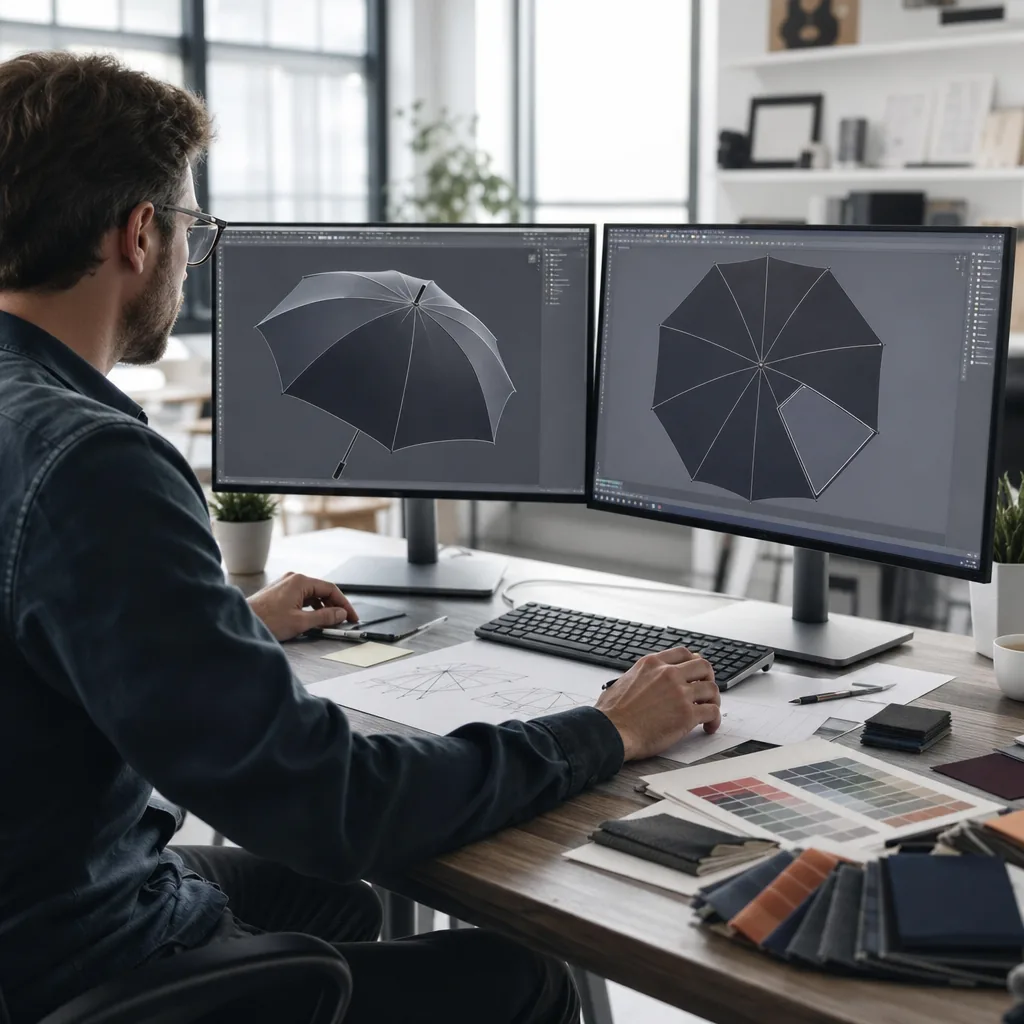
A logo that looks correct on a golf umbrella can become cramped on a folding panel or distorted near the rib line of a stick umbrella, especially once fabric tension and seam allowances come into play. On our Songxia production floor, an accurate umbrella logo size guide starts with the actual panel shape, printable area, rib clearance, and the limits of silk screen, heat transfer, or digital print—not just a flat artwork mockup.
Why One Logo Size Does Not Fit Every Umbrella
A logo does not scale by simple percentage across umbrella types because the usable print field changes with canopy arc, panel height, and the number of seams. A 30-inch golf umbrella usually has large panels, a wide arc, and enough flat visual real estate for a centered mark, so branded golf umbrellas can carry a 10 to 14 inch logo without crowding the panel edges. A 21-inch folding model is a different animal: the canopy is shorter front to back, the panel width narrows, and the ribs create more visible interruption. What looks balanced on a golf canopy can run into stitch lines, get chopped by panel curvature, or sit too close to the vent seam on a compact frame. That is why an umbrella logo size guide has to start from the physical panel, not the artwork file. On a folding frame, the same art often needs a reduced width and simplified detail so the logo reads cleanly instead of fighting the folds.
Viewing distance matters just as much as panel size. Golf umbrellas are often seen from across a tee box, parking lot, or event tent, so stick umbrella branding and large canopy marks need bolder line weights and stronger contrast to survive distance. A logo that is 8 inches wide may be perfectly legible on a straight stick umbrella because the canopy stays taut and the viewer usually stands farther away. On a compact folding umbrella, the customer is often holding it at chest level on a sidewalk, so the mark is read at arm’s length and then repeatedly broken up by fold lines as the canopy opens and closes. Fine gradients, tiny text, and thin strokes disappear fast. For promotional umbrella artwork, I usually tell buyers to prioritize one clean symbol or short wordmark over a crowded lockup, especially when the umbrella is 23 inches or smaller.
The practical rule is to match the artwork to the frame geometry and not the sales catalog image. Straight stick umbrellas give the most stable print area because the canopy opens into a more consistent cone, while folding umbrellas introduce more curvature, more seam interference, and more distortion near the tips. That means a folding umbrella logo often needs to be smaller in width, taller in proportion, and placed where the panel is least distorted, usually mid-panel rather than near the hem. On a 30-inch golf umbrella, the same artwork can be scaled up aggressively because the panel height supports longer words and larger icons without looking cramped. Our standard practice at ZheBrella is to proof logos against the actual panel template, not just the flat art board, because the umbrella logo size guide has to account for fold lines, rib spacing, and the way a canopy looks when it is both open and moving in wind.
Recommended Print Areas by Umbrella Type
For branded golf umbrellas, the safe print area is larger, but it is not unlimited. On a common 27" or 30" golf umbrella with 8K construction, I usually keep a single-panel logo around 9" to 11" wide and 4" to 6" high for screen printing, or up to about 12" wide if the artwork is low and horizontal. On 16K golf frames, each panel is narrower, so the same canopy diameter does not mean the same printable width; 7" to 9" wide is often more realistic. A practical umbrella logo size guide should start from the actual panel layout, not the umbrella diameter printed on the quotation sheet. The logo must stay clear of the rib line, top seam allowance, and edge binding, otherwise the print will distort when the canopy is tensioned over fiberglass or steel ribs.
For stick umbrella branding on 23" or 25" models, the normal logo range is about 7" to 9" wide and 3" to 5" high on one panel. If the panel is deep and the customer wants a centered brand mark, I prefer leaving at least 1" from the lower edge binding and 0.75" to 1" from both seam stitch lines. That clearance matters more on 190T pongee than many buyers expect, because the fabric stretches slightly during sewing and final fitting. On 8K stick umbrellas, a rectangular logo usually sits cleanly between two ribs; on 16K stick umbrellas, tall artwork can look crowded unless it is reduced or split across alternating panels. Our standard practice at ZheBrella is to check promotional umbrella artwork against the cutting die before approving the digital mockup, especially for repeat logos or border-position prints.
For a folding umbrella logo, the recommended size is smaller because 21" and 23" compact umbrellas have shorter, steeper panels and more visible fold creases. A safe range is 5" to 7" wide and 2.5" to 4" high for manual or auto-open folding models, and sometimes only 4" to 6" wide on mini 5-fold frames. Auto-open-close umbrellas also need attention near the rib tips because the canopy pulls tighter during closing, which can stress thick ink deposits or heat-transfer edges. This is where an umbrella logo size guide becomes a production control tool, not just a design suggestion. Final approval should account for seam allowance, rib position, edge binding clearance, and whether the print method is screen print, heat transfer, or sublimation, because each process tolerates distortion differently.
Scaling Artwork Without Losing Brand Detail
The starting point for any umbrella logo size guide is the file format, not the artwork itself. For branded golf umbrellas, folding umbrella logo layouts, and stick umbrella branding, insist on vector files such as AI, EPS, or PDF with all fonts outlined and any embedded images removed from the master. That lets you scale cleanly across 23" folding canopies, 27" golf panels, or larger 30" stick umbrellas without the jagged edges you get from a low-resolution PNG. In production, I look hard at minimum line weight: anything thinner than about 0.35-0.5 mm is likely to disappear in screen printing, heat transfer, or embroidery once the canopy flexes. Small text is where most promotional umbrella artwork fails. If the copy is below roughly 6-7 pt equivalent at final print size, it may still look fine on a monitor but will blur or break on fabric.
Gradient-heavy artwork is another trap, especially when the logo has to move from a flat proof to a curved, stitched canopy segment. On pongee 190T or 210T fabric, gradients can band, shift color under different lighting, or lose the intended edge definition after transfer or curing. For that reason, the umbrella logo size guide should always specify a simplified fallback version for one-color printing. A clean one-color mark often performs better than a full-detail brand mark when the panel is narrow, the logo sits near a seam, or the artwork must be repeated across multiple panels. That is especially true for folding umbrella logo placement, where limited real estate forces you to prioritize silhouette and legibility over decorative detail.
QR codes need even stricter rules than logos because scanability depends on contrast, quiet zone, and a stable print field. Keep the code large enough to survive panel curvature and avoid placing it across a seam, vent, or hem; on a real umbrella, a code that looks acceptable in artwork can fail once the canopy is tensioned. I usually advise testing QR codes at final print size with the actual output method, not just on screen, and using a plain one-color version when possible. The same principle applies to promotional umbrella artwork overall: if the mark relies on tiny type, layered gradients, or hairline detail, simplify it for production. ZheBrella’s standard practice is to prepare a detailed version for approval and a reduced one-color version for backup, because in the factory the version that prints cleanly is the one that matters.
Frame and Fabric Factors That Change Visibility
Frame stiffness changes perceived logo size before the buyer ever measures the print. On branded golf umbrellas, fiberglass ribs are usually the safer choice because they flex and return without permanently bending, so the canopy stays flatter in wind and the artwork remains readable across a 23", 27", or 30" panel. Steel ribs can be cheaper and acceptable for city stick umbrellas, but once a steel frame distorts, the canopy develops diagonal stress lines that break up text and fine icons. Rib count matters too: an 8K frame gives wider triangular print zones, while 10K and 16K frames create more seams and smaller visual windows. My practical umbrella logo size guide rule is to reduce logo width by 10–15% on high-rib-count models unless the artwork is repeated on multiple panels.
Double-canopy windproof vents improve survival in gusts, often tested around 50+ mph on better fiberglass golf frames, but they also interrupt the print field. The upper vent layer overlaps the lower canopy, so a logo placed too close to the vent seam can look clipped when the umbrella is open and almost invisible when viewed from a low angle. For promotional umbrella artwork, we normally keep the main logo below the vent seam and away from rib stitching by at least 20–25 mm. Auto-open and auto-open-close mechanisms add another constraint: the spring action snaps the canopy tight, which is good for presentation, but repeated closing creates fold memory. On a folding umbrella logo, that fold tension can crack thick heat-transfer ink or create shiny pressure marks on dark pongee if the print crosses the main fold valleys.
Fabric is not just a background color; it determines edge sharpness and opacity. 190T pongee is common for cost-sensitive folding and stick umbrella branding, but its slightly more open weave can let screen ink spread if the mesh, squeegee pressure, and curing temperature are not controlled. 210T pongee gives a smoother print face and usually holds small lettering better, especially with white underbase on navy, black, or red panels. UPF 50+ coatings add another variable: silver or black UV layers improve sun protection and opacity, but they can reduce ink bite if the coating side is printed by mistake or if sublimation is used on the wrong polyester finish. In our umbrella logo size guide checks, we test the actual fabric lot before mass production, because two suppliers can both label material 190T while behaving differently under screen print, heat transfer, and AQL 2.5 inspection lighting.
Approval Samples and Bulk Inspection Standards
Approval should move in three gates: digital mockup, print strike-off, then pre-production sample. The digital mockup confirms panel placement, logo scale, orientation, and safe distance from seams, tips, and the ferrule line; it is not a color approval. For branded golf umbrellas, we normally check the artwork against the actual 30" or 27" panel shape because the curve near the rib makes a 220 mm logo look different on paper than on sewn pongee. A folding umbrella logo needs tighter control because a 21" or 23" canopy has shorter panel height and more fold memory, so artwork placed too low can crease across the print. For stick umbrella branding, especially 23" straight umbrellas, the larger visible panel allows cleaner centering but seam allowance still eats 8–12 mm per side. A practical umbrella logo size guide should always include finished-panel dimensions, not just open-diameter size, because cutting tolerance and sewing shrinkage affect the visible print area.
The print strike-off is where ink, fabric, and process are tested before we cut bulk panels. Screen printing on 190T or 210T pongee must be checked for edge sharpness, opacity, hand feel, and color shift after drying; heat transfer must be checked for bonding and cracking when the panel is folded; sublimation needs attention to CMYK drift, especially red, navy, and gray. Our standard practice at ZheBrella is to approve strike-offs under D65 light and compare against Pantone coated or uncoated references depending on the artwork file. A pre-production sample then uses real bulk fabric, real ribs, real handle, and the approved print process, so buyers can verify logo position after sewing and stretching on the frame. For promotional umbrella artwork, this sample is the last safe point to adjust size by 5–10%, because changing artwork after bulk printing usually means scrapping panels, not simply reworking finished umbrellas.
Bulk inspection should use AQL 2.5 for major logo defects, with a clearly written checklist before the cartons are sealed. Logo position tolerance is typically ±5 mm from the approved sample on golf and stick umbrellas, and ±3 mm on compact folding models because the visible panel is smaller. Logo size tolerance should be held to ±3% for screen print and heat transfer, while sublimation may need a slightly wider tolerance if the fabric stretches during heat pressing. Color consistency is judged against the approved strike-off, not the digital PDF; obvious Pantone mismatch, uneven ink density, or panel-to-panel variation beyond one visual shade step should be counted as a major defect. Smudging, ghosting, pinholes in solid artwork, transfer-film outlines, and ink bleeding into the weave are major defects when visible at arm’s length. Minor defects include tiny registration drift or very small specks outside the main logo area, but repeated minors across many panels should trigger carton-level sorting.
Frequently Asked Questions
What logo size is safest for most promotional umbrellas?
A medium logo placed within the central safe area of one panel is usually safest. Exact dimensions should be based on the umbrella’s panel template, not a generic mockup.
Should the same artwork be used for golf and folding umbrellas?
The same brand file can be used, but the production artwork should be scaled and sometimes simplified for each frame size. Folding umbrellas often need reduced detail because folds and smaller panels affect readability.
What logo size usually works best on a 62-inch golf umbrella?
For a standard 62-inch golf umbrella, a side panel logo is often around 8 to 12 inches wide, depending on panel shape and rib layout. Large canopy prints can go wider, but the final size should be checked against the panel seam and vent structure before sampling.
How much safe space should be left around umbrella artwork?
A safe margin of at least 0.5 to 1 inch from seams, tips, and rib lines is commonly recommended. This helps prevent distortion when the canopy is stretched and reduces the risk of the logo being cut off by stitching or panel overlap.
What is the usual approval process before mass production?
Most buyers first confirm a vector artwork file, then review a digital mockup or physical pre-production sample. After sample approval, production usually follows with final AQL inspection before shipment.
Looking to Launch Your Custom Umbrella Line?
ZheBrella is a Zhejiang-based OEM/ODM umbrella manufacturer with 17 years of export experience. Free design, low MOQ from 100 pieces, windproof construction, full-color print.
Get Free Quote Now »People Also Search For
Related Articles
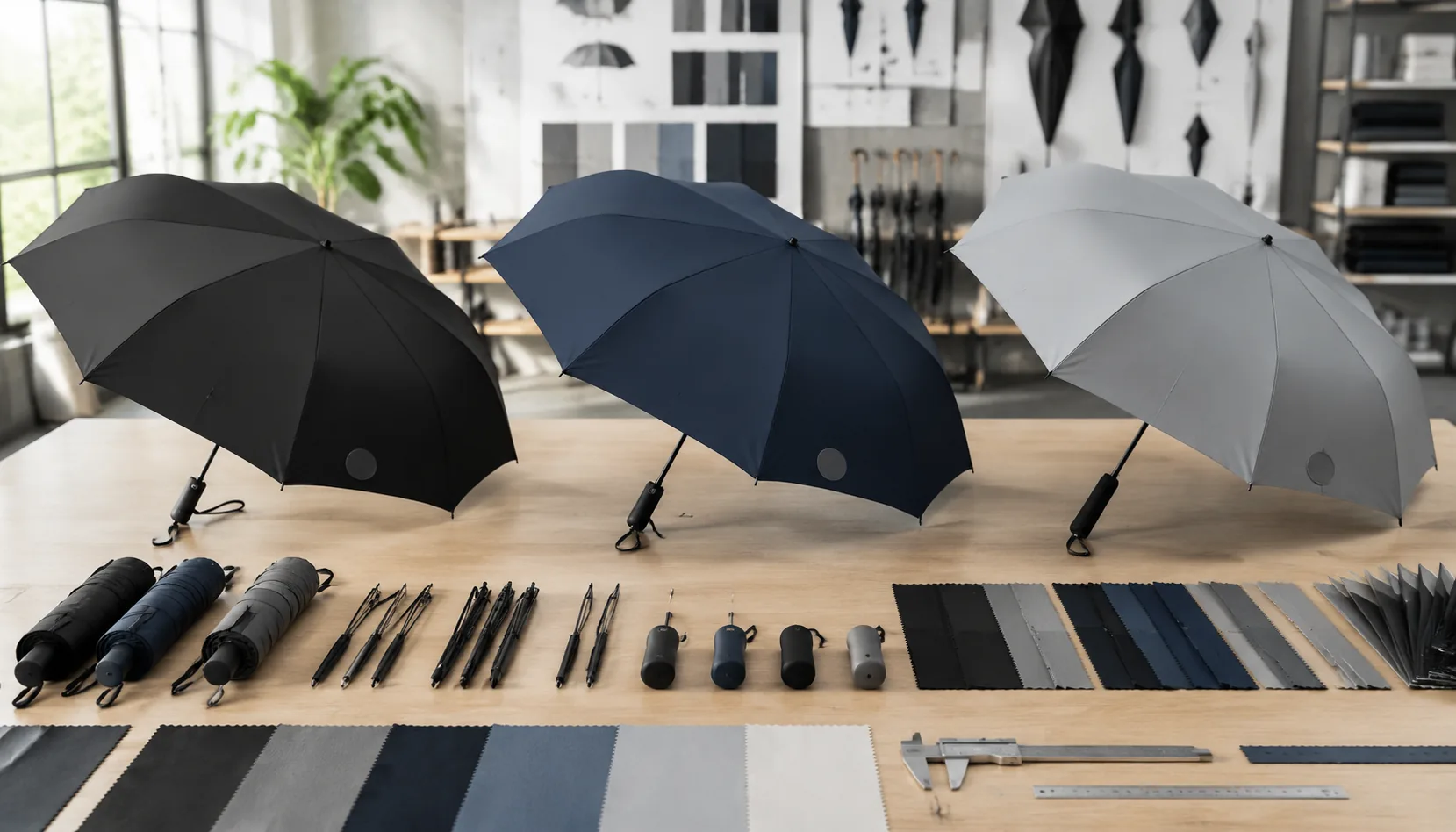
Scaling Logo Sizes Across Folding, Golf, and Stick Umbrellas
Set practical logo size rules across 21-inch folding, 23-inch stick, and 30-inch golf umbrellas without losing visibilit...
Read More »
Logo Size Standards for Folding, Stick, and Golf Umbrellas
Set practical logo sizes by umbrella type so artwork stays readable, print costs stay controlled, and production approva...
Read More »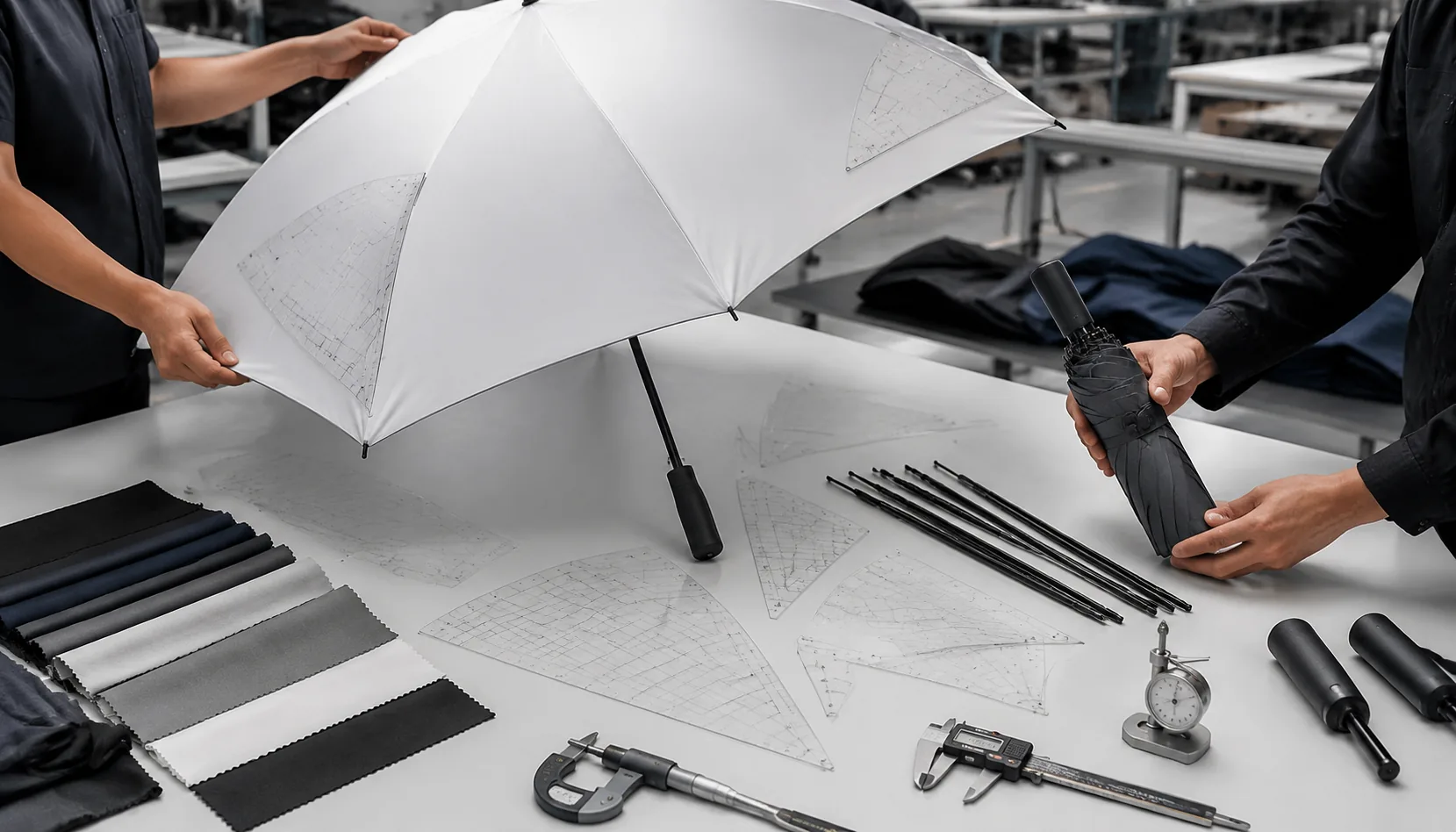
Logo Scaling on Folding and Golf Umbrellas for Brand Teams
Set practical logo sizes across folding, stick, and golf umbrellas while accounting for ribs, panels, print methods, mec...
Read More »