Matching Logo Scale to Umbrella Size and Buyer Use Case
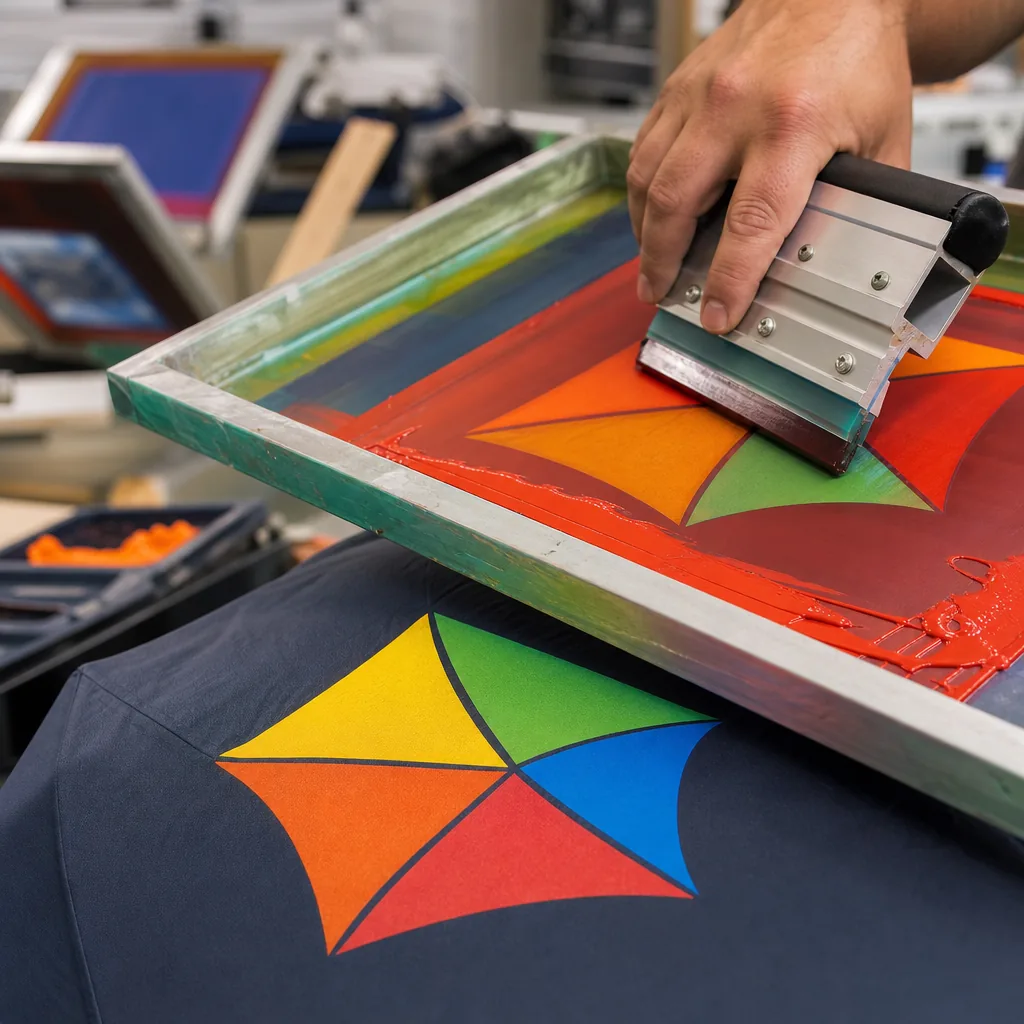
Choosing logo scale for a custom umbrella sounds simple until the artwork that looked balanced on a 21-inch compact disappears on a golf canopy or blows past print tolerances on a budget giveaway. From our production floor in Songxia, we use an umbrella logo size guide built around real panel geometry, rib length, fabric stretch, and imprint method so buyers can match visibility, cost, and end use before sampling starts.
Start with umbrella type and viewing distance
Start with canopy geometry, not the artwork file. In a practical umbrella logo size guide, a 21-inch mini folding umbrella has the least forgiving print area: short panels, steeper curvature, more seam interruption, and partial blockage from the runner when the frame is not fully open. An 8K compact does not equal eight full branding zones. On a 3-fold frame, usable space shrinks further because the fold structure and panel tension on 190T pongee pull differently from crown to hem, which increases distortion on larger graphics. In real production terms, most mini and 3-fold umbrellas work best with a 5-7 inch logo on one panel or a repeated 3-4 inch mark on alternating panels. That scale stays readable at roughly 3-10 feet, which matches how an event giveaway umbrella is actually seen at registration tables, during transit, or in hand-to-hand distribution. Go larger, and the tradeoff is predictable: circles flatten, text bends near the edge, and the branding looks stretched rather than deliberate.
Golf and stick umbrellas are built for longer viewing distances and give buyers more usable area per panel. A 27-inch or 30-inch umbrella, especially an 8K or 16K model with a vented double canopy, has a larger uninterrupted field than a folding frame, so single-panel graphics hold their shape better on 210T pongee. A front-facing logo can usually print at 8-11 inches wide with solid legibility; simple icons or short wordmarks can reach about 12 inches when the goal is retail umbrella design or outdoor promotional umbrella branding. That size range reads more reliably at 15-40 feet, which fits hotel entrances, golf events, sports hospitality, and curbside staff use. The use case should decide the scale: corporate gifting typically looks better with a restrained 4-6 inch panel logo plus a strap label or sleeve print; public-event umbrellas can go larger if the artwork is reduced to a clean icon and short name; retail display depends on both the open canopy and the closed presentation, including the sleeve, tie strap, and outer panel. Match logo scale on umbrellas to the first viewing moment: arm's length for retail, about 5 feet for giveaways, and 20 feet or more for crowd visibility.
Calculate printable area by panel count and canopy shape
Start with the rib count, because printable area is not the open diameter on the spec sheet. On a standard 23-inch straight umbrella in 8K construction, each panel usually gives you about 18 to 21 cm of usable width at the lower third, but only after you subtract seam loss and edge distortion. In production, I budget 8 to 12 mm per side for stitched seams and another safety margin near the skirt, because ink or heat-transfer film placed too close to the binding will read warped once the canopy is under tension. A 16K fashion umbrella has more, narrower panels, so the same overall canopy diameter produces less uninterrupted artwork space per panel. That is why an umbrella logo size guide should be based on panel geometry, not just umbrella size; a 30-inch golf umbrella in 8K can often carry a clean chest-width logo, while a 21-inch 16K compact may force you into a stacked mark or repeated small placements.
Canopy shape changes the math more than most buyers expect. A flatter golf canopy gives a broader central field, so logos hold their proportions better across the middle half of the panel. A deeper dome, especially on POE bubble or EVA fashion shapes, pulls the print vertically and visually narrows it when viewed at eye level. On double-canopy vented windproof models, the overlap near the vent cut reduces safe print area again, and the outer shell may look generous on paper while the truly readable zone is much smaller. For branded umbrella sizing, I normally map artwork to the panel’s lower-middle section where the curve is predictable and the customer sees the mark in motion. This matters for promotional umbrella branding and retail umbrella design alike: event giveaway umbrella artwork needs quick legibility from 10 to 20 feet, while retail graphics can tolerate more panel-to-panel segmentation if the concept is decorative rather than logo-led.
Fabric spec also changes how the exact same logo reads after printing. On pongee 190T, the weave is slightly more open and the hand is softer, so under strong canopy tension the logo edge can look a touch lighter or less sharp, especially in large solid areas done by screen print. On 210T pongee, the denser construction gives better ink holdout and usually cleaner small text, but coatings matter: a heavy water-repellent or Teflon finish can reduce ink bite, and sublimation on white polyester behaves differently than spot color on dyed fabric. Our standard practice at ZheBrella is to test final art on the actual canopy cloth and frame combination, because logo scale on umbrellas is not only a file-size question; fabric stretch between rib and stretcher, coating slickness, and panel curvature all affect readability. A practical umbrella logo size guide should therefore include print method and fabric tension, not only centimeter dimensions.
Balance readability, cost, and print method limits
The biggest mistake buyers make is treating logo size as a pure artwork decision when it is really a geometry and budget decision. On a standard 21-inch or 23-inch folding umbrella, each panel narrows sharply toward the tip, so a logo that looks modest on a flat proof can eat up too much usable print area once the canopy is tensioned over the ribs. In any practical umbrella logo size guide, I tell buyers to start from readable width, not maximum width: for a single-panel promotional umbrella branding job, about 18 to 22 cm wide is usually the safe range on 190T or 210T pongee before the mark starts running into seam allowance, panel curve, or rib shadow. Once you try to scale the art larger, especially for long brand names or stacked logos, you often move out of simple 1-color spot printing territory and into larger screens, more careful panel registration, or print layouts that carry more setup waste.
Multi-panel branding is where cost climbs fast. A buyer may want the logo repeated across 4, 6, or all 8 panels on an 8K straight umbrella, or spread one oversized graphic over adjacent panels for stronger event visibility. On the factory floor, that means more than just adding ink: alignment tolerance becomes tighter, canopy cutting has to be consistent panel to panel, and any seam shift becomes visible when the umbrella opens. For an event giveaway umbrella, that usually makes poor economic sense unless the order volume is high enough to absorb the setup and inspection time. By contrast, on a 27-inch golf umbrella or a 30-inch vented double-canopy model, the larger panel gives more room for readable art without forcing the print right up against the stitch line, so branded umbrella sizing can stay visually bold while remaining production-friendly.
The tradeoff between promo and retail is blunt. For low-to-mid budget campaigns, I usually recommend a disciplined logo scale on umbrellas: one or two printed panels, moderate artwork size, and leaving enough negative space so the canopy still looks intentional from 10 to 20 feet away. That keeps MOQ and unit cost under control and reduces fallout at AQL 2.5 because inspectors are not rejecting pieces for distorted placement or seam crowding. Premium retail umbrella design follows a different logic. Buyers there often accept higher decoration cost if the larger mark supports shelf impact, coordinates with hangtag and handle details, or wraps consistently across a 16K fashion frame. Our standard practice is to mock the artwork against the actual panel shape before sampling, because the right answer in an umbrella logo size guide is rarely the biggest logo the fabric can physically hold; it is the largest logo that still reads cleanly, fits the print process limits, and does not push the program into the wrong cost bracket.
Use frame and mechanism choices to protect brand presentation
Frame choice should determine logo scale, not the flat mockup. On 23-inch and 27-inch straight umbrellas, a vented double-canopy with fiberglass ribs and a fiberglass or steel shaft keeps the print field more stable under wind load, so large chest-of-panel artwork stays closer to its approved shape. That matters because a logo that looks balanced on a pre-production sample can distort once ribs bow and the canopy tension changes. In any practical umbrella logo size guide, larger marks belong on stronger hardware: 8K or 10K windproof frames rated around 50 mph, 190T or 210T pongee, and double-canopy construction, which presents a flatter visual surface than low-cost single-layer polyester. For commuter programs and retail umbrella design, this is not just a print issue; it is a durability and brand-risk issue. If the frame flexes early, the logo starts to look uneven long before the canopy itself fails.
Steel-frame umbrellas can still work for budget event giveaway umbrella programs, but logo scale on umbrellas needs tighter limits. A basic 21-inch or 23-inch manual or auto-open model with steel ribs and a single canopy can meet budget, MOQ, and FOB targets, but wide artwork should be reduced and kept clear of seams, rib pockets, and tip zones where stretch lines show first. Compact 3-fold umbrellas are less forgiving: deeper panel curvature, shorter print windows, and more seams make the same 18 cm mark read much larger than it does on a straight frame. Mechanism changes perceived proportion as well. Auto-open and auto-open-close structures tension the canopy quickly, yet on small 8-rib 21-inch folding frames the spring geometry and shorter runner travel usually create a more domed profile. For promotional umbrella branding and branded umbrella sizing, use larger, bolder marks on windproof straight umbrellas; on compact or lower-cost steel models, simplify the artwork, increase stroke weight, and leave more negative space. At ZheBrella, artwork is approved against the exact frame, opening method, and fabric spec, then print centering and seam clearance are checked under AQL 2.5 before bulk production.
Build a buyer approval workflow before mass production
Lock the approval workflow before fabric booking, not after. For any umbrella logo size guide that covers 21-inch folding, 23-inch straight, and 27-30-inch golf styles, require three approvals in sequence: a scaled digital art proof, a print-position drawing with panel measurements, and one physical pre-production sample. The art proof must show logo width and height in inches or millimeters on the actual canopy panel, with panel count called out as 8K, 10K, or 16K; panel width changes how copy reads and how close artwork sits to the seams. The print-position drawing should fix seam clearance, logo orientation, and placement for each SKU so retail umbrella design does not drift between sizes. If the program includes sleeve print, hangtags, or handle medallions, approve those items in the same file set. That keeps promotional umbrella branding consistent across canopy and accessories, and it prevents last-minute art changes that delay sampling or force a second approval round.
Use the pre-production sample to convert design approval into measurable bulk acceptance criteria. The buyer should sign off the exact substrate—190T or 210T pongee, or clear POE on an event giveaway umbrella—because ink spread, white underbase coverage, and edge sharpness will not match across materials. Mark both the sample and outer cartons with PO number, style code, canopy color, print orientation, quantity per carton, gross and net weight, and destination marks under FOB or DDP terms. Then define the bulk standard in plain language: print-size tolerance, placement tolerance from seam, acceptable color variance to the Pantone target, opening and closing performance, and whether the approved sample governs every SKU or only the master SKU. Align MOQ before art is frozen—for example, 500 pieces per color for screen print versus 1,000 for heat transfer—so logo scale on umbrellas does not create quantity splits or a higher unit cost. Finish with AQL 2.5 final inspection and defect definitions: major defects include wrong logo size, upside-down panel print, canopy stains, broken auto-open, or rib damage; minor defects include loose threads or carton scuffs. Build the calendar backward: 3-7 days for revised proofs, 5-10 days for the sample, 25-40 days for production, plus booking and port cutoff for FOB or transit and customs clearance for DDP. That workflow reduces approval risk before bulk orders ship.
Frequently Asked Questions
What logo size is usually readable on a compact folding umbrella?
A compact folding umbrella typically needs a simpler, bolder mark because the visible panel area is smaller and more curved. Buyers should review a scaled proof on the actual canopy size rather than rely on flat artwork alone.
Should event planners choose larger logos than retail buyers?
Often yes, because event umbrellas are viewed from farther away and need quick recognition in crowds. Retail buyers may prefer more restrained scaling if the product is positioned as premium or fashion-led.
What logo width is usually workable on a 21-inch folding umbrella versus a 27-inch golf umbrella?
On a 21-inch folding style, buyers often keep a single-panel logo around 5-7 inches wide so it stays readable without crowding seams. On a 27-inch golf umbrella, 8-10 inches wide is more common, especially for bolder retail graphics or sponsor marks.
If I need to hit a lower unit cost, is it better to reduce logo size or reduce print colors?
Reducing print colors usually saves more than trimming logo width by an inch or two, because umbrella print pricing is often tied to color count and print method. For many OEM orders, a 1-color or 2-color logo on one or two panels is the most cost-efficient setup while keeping branding visible.
How should I size logos differently for giveaway umbrellas and retail umbrellas in the same order?
For giveaway units, buyers typically choose a simpler logo with stronger stroke weight and moderate coverage to control cost and improve readability at a distance. For retail units, larger placement, repeat panel graphics, or edge-to-edge transfer printing may be worth the added cost, especially when MOQs start around 300-500 pieces per colorway.
Looking to Launch Your Custom Umbrella Line?
ZheBrella is a Zhejiang-based OEM/ODM umbrella manufacturer with 17 years of export experience. Free design, low MOQ from 100 pieces, windproof construction, full-color print.
Get Free Quote Now »People Also Search For
Related Articles
Umbrella Sleeve Logo Design for OEM Retail and Promo Orders
Plan umbrella sleeve branding with the right print area, fabric, MOQ, and QC standards to improve retail presentation wi...
Read More »Custom Umbrella Cases and Bottles as Branded Carry Assets
Evaluate branded umbrella cases and bottle-style carriers for retail and promo programs, including print areas, material...
Read More »
Umbrella Logo Size Guide for Retail and Promo Orders
Plan readable branding across compact, golf, and stick umbrellas with practical logo size ranges, panel limits, and fact...
Read More »