Private Label Compact Umbrellas for Retail Chain Buyers
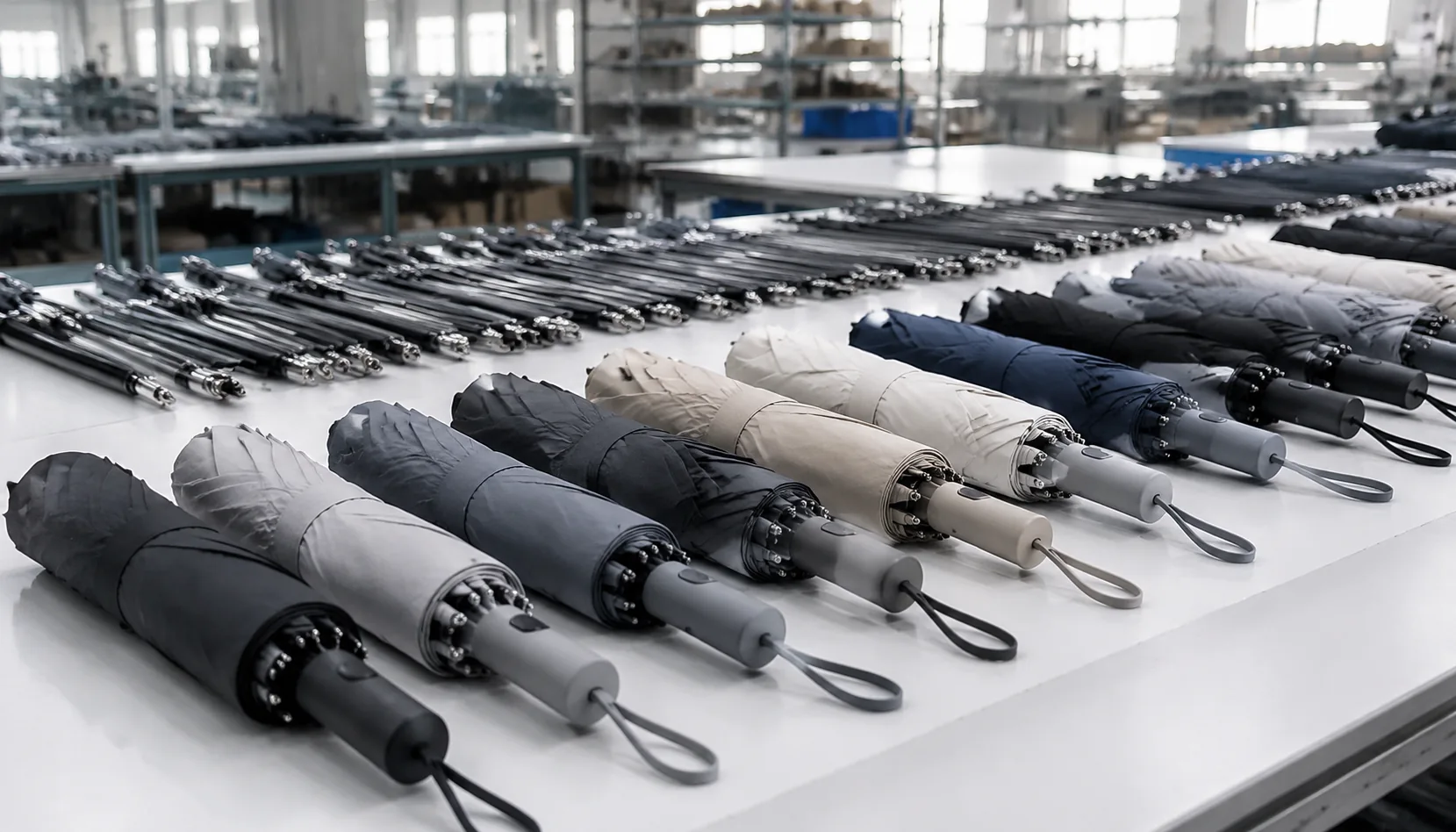
Retail chain buyers do not just need a small umbrella; they need a shelf-ready program that survives store handling, barcode scanning, repeat orders, and margin pressure. On our Songxia factory floor, private label compact umbrellas usually come down to the right 3-fold or 5-fold frame, 190T or 210T pongee, packaging discipline, AQL inspection points, and MOQ tiers that match a real retail rollout instead of a sample-room wish list.
Frame Format: 3-Fold vs 5-Fold for Retail Shelves
For retail shelves, the 3-fold umbrella is the safer volume item because it balances folded length, hand feel, and return rate. A typical 21–23 inch 3-fold frame closes to about 28–31 cm, usually 300–380 g depending on whether the shaft is all steel, aluminum-steel mixed, or upgraded with fiberglass ribs. That size still fits a handbag or car door pocket, but it opens with enough arc to feel like a real rain umbrella, not a toy. For private label compact umbrellas, I usually advise retail buyers to start with a 21 inch 8K or 23 inch 8K 3-fold model using 190T pongee, black electroplated steel shaft, and fiberglass end ribs if the target is mid-market. Full steel ribs reduce cost but bend after repeated inversion; fiberglass tips add a little cost but protect against the most common consumer complaint: “one rib snapped in wind.”
The 5-fold format wins on pocket size, not durability. A 21 inch 5-fold umbrella can fold down to 17–19 cm, which looks excellent in a gift box, checkout display, or travel accessories wall. The tradeoff is weight distribution and mechanical complexity: more joints, shorter rib segments, and a smaller shaft diameter mean more possible failure points. Most 5-fold umbrellas use aluminum or aluminum-steel shafts to keep weight around 240–320 g, but if the runner, spring, and rib rivets are too light, the umbrella feels flimsy after 50–100 open-close cycles. A good 5-fold can work for fashion retail, airline amenity, or commuter programs, but I would not position it as a heavy storm umbrella. As a retail umbrella supplier, our standard practice is to reinforce the first rib joint and test runner smoothness before approving mass production, because stiffness at that joint is where small umbrellas usually fail first.
Perceived value is different in each format. A 3-fold umbrella gives buyers more room for an auto-open mechanism, thicker 210T pongee, Teflon water-repellent coating, UPF 50+ black coating, and a larger handle that can carry a logo cleanly. A 5-fold umbrella feels more technical and giftable when packed well, but branded umbrella packaging must compensate for its smaller canopy presence: rigid PET box, color sleeve, hang tag, barcode label, and clear folded-size callout all help justify the shelf price. For private label compact umbrellas, I would segment 3-fold umbrellas as the core replenishment SKU and 5-fold umbrellas as a travel or impulse SKU. If the retail chain has high return sensitivity, specify AQL 2.5 inspection, cycle testing on opening mechanism, rib pull checks, and carton drop testing. The cheapest frame often passes showroom review but fails after the first windy parking-lot use.
Canopy Fabric and Finish Choices Buyers Should Lock Early
Fabric choice should be locked before handle tooling or packaging artwork because it affects the retail price tier, print result, and color repeatability across reorders. For most private label compact umbrellas, 190T pongee is the practical entry-to-mid choice: tight enough for clean panel sewing, light enough for 21" and 23" 3-fold umbrellas, and stable under basic screen printing or heat-transfer logos. 210T pongee costs more but feels denser in hand, sheds water better after finishing, and gives a smoother surface for sharp edge detail on retail graphics. Polyester taffeta is cheaper, but I avoid it for retail chain programs unless the target is a very low opening price point; it wrinkles harder after folding and often looks thin under store lighting.
DWR finish is not a marketing afterthought; it changes how the umbrella looks after the first rain. A standard durable water repellent coating gives decent bead-off, while a stronger Teflon-type finish improves water roll-off and helps compact umbrellas dry faster before customers fold them into sleeves. If the assortment includes summer, travel, or pharmacy channels, UPF 50+ backing is worth pricing early because silver or black UV coatings change fabric hand feel, panel opacity, and print behavior. A good retail umbrella supplier should run strike-offs on the exact fabric and coating stack, not just send a color card from last season.
Color consistency is where buyers get burned on repeat orders. Dark navy, burgundy, forest green, and charcoal can shift noticeably between dye lots, especially when mixing 190T pongee, 210T pongee, and polyester alternatives in the same retail wall display. For branded umbrella packaging, match the hangtag, sleeve, and canopy under D65 light before approving bulk fabric; otherwise the umbrella may pass AQL 2.5 function checks but still look wrong at shelf level. For private label compact umbrellas with all-over prints or fine logos, approve digital lab dips and one printed pre-production sample before bulk cutting, especially on 5-fold umbrellas where tighter folds create more panel creasing and make poor print registration easier to see.
Mechanism Options for Everyday Consumer Use
For private label compact umbrellas sold through retail chains, the mechanism choice should follow the shelf price and expected return rate, not just the buyer’s preference sample. Manual open is still the most stable option for entry and mid-tier 3-fold umbrellas because it uses fewer springs, fewer plastic trigger parts, and a simpler runner. A good manual compact should open without a hard thumb push, lock with a clear click, and close without the runner scraping the shaft coating. On the line, we check runner travel before canopy attachment because a tight runner often becomes worse after fabric tension is added. For family retail channels, manual also gives the best child-safety profile: less sudden movement, lower pinch risk, and fewer complaints from parents when children play with display samples.
Auto-open is the practical upgrade when the retail umbrella supplier needs a stronger feature callout without pushing the product into a premium price band. It adds a spring-loaded shaft and button release, so spring fatigue becomes the main durability issue. Cheap springs feel fine for the first 20 cycles, then lose snap after 200–300 openings, especially on heavier 210T pongee canopies or UV-coated fabric. We normally cycle-test auto-open samples before confirming bulk specs, then inspect button rebound, runner lock engagement, and shaft straightness under AQL 2.5. For 3-fold umbrellas, auto-open is manageable if the frame uses decent steel or fiberglass ribs and the button housing is not thin recycled ABS. For 5-fold umbrellas, auto-open is less forgiving because the shorter shaft sections create more friction and more places for wobble.
Auto-open-close mechanisms raise both unit cost and QC risk, so I recommend them only when the retail price supports the feature and the buyer accepts tighter inspection. Compared with manual, the frame needs stronger springs, a more accurate telescopic shaft, a reliable release button, and better runner alignment; one weak part can cause partial closing, button jamming, or the common complaint that the umbrella is “too hard to reset.” This matters for private label compact umbrellas because retail returns damage the brand more than a slightly higher FOB cost. Child-safety labeling and clear hangtag instructions are important, especially because the closing force can surprise first-time users. If branded umbrella packaging includes a window box or printed sleeve, we add a short mechanism instruction panel and avoid over-compressing the canopy, since tight packing can deform the runner and make the first in-store opening feel rough.
Retail Packaging, Barcodes, and Carton Planning
Retail packaging should be locked before canopy cutting, not after final inspection, because sleeve size, hangtag hole position, belly band width, and color-box dimensions affect packing speed and carton cube. For private label compact umbrellas, we usually prepare four retail options: clear OPP sleeve for low-cost promotional racks, sewn matching fabric sleeve for mid-tier 3-fold umbrellas, belly band plus sleeve for department-store display, and full color box for gift or travel categories. Hangtags need the same SKU logic as the buyer’s ERP: item number, color name, canopy size such as 21" or 23", mechanism type like manual or auto-open-close, country of origin, care wording, and any claims such as UPF 50+ or Teflon coating. If the umbrella has POE windows, EVA handle trim, or 210T pongee canopy, those material claims must match the approved test report, not just the artwork file.
GS1 barcode work is where many retail launches get delayed. The buyer should provide GTIN-12 or GTIN-13 numbers by SKU, and the factory should print barcode proofs at actual size for scan testing before mass printing. I do not recommend putting the same barcode on assorted colors unless the retailer’s POS system is intentionally set up for assortment selling; most chain buyers want black, navy, red, and custom Pantone colors separated by barcode. Branded umbrella packaging also needs carton marks that match the purchase order: PO number, SKU, color, quantity, gross/net weight, carton size, destination, and any store-allocation code. Our standard practice at ZheBrella is to place one readable shipping mark on the long side and one on the short side, with no glossy laminate over the barcode area because warehouse scanners hate reflection.
Carton planning should start from store allocation, not from the maximum carton quantity the factory can squeeze in. A common plan for 3-fold umbrellas is 12 pieces per inner carton and 48 or 60 pieces per master carton; for heavier auto-open-close models with fiberglass ribs and rubberized handles, 36 or 48 pieces is safer to control crushing. 5-fold umbrellas pack smaller, but color boxes often remove that advantage because box corners need protection. For mixed-color retail orders, specify whether each master carton is solid color, pre-assorted such as 12 black, 12 navy, 12 red, 12 gray, or store-ready with inner cartons labeled for individual doors. A retail umbrella supplier should also confirm pallet height, carton burst strength, desiccant use, and AQL 2.5 inspection access so the warehouse receives cartons that can be cross-docked without repacking.
MOQ, Sampling, Inspection, and Shipping Terms
MOQ should be counted by color and SKU, not by the total order value, because fabric dye lots, frame inventory, logo plates, and barcode labels all move separately on the production floor. For private label compact umbrellas, a practical starting point is 1,000 pieces per color for 3-fold umbrellas using standard 190T or 210T pongee, with lower risk if the buyer accepts black, navy, or gray from stocked fabric. Custom Pantone canopy colors usually need 2,000 to 3,000 pieces per color because the dyeing mill will not run a tiny lot cleanly. 5-fold umbrellas are more sensitive: the frame is smaller, the shaft tolerance is tighter, and the folding sequence creates more rejection risk, so I prefer 1,500 pieces per SKU as a safer MOQ. If a retail chain wants six colors, two handle finishes, and two packaging styles, that is not one SKU; it is usually twelve SKUs, and the MOQ math changes quickly.
Sampling needs a written specification before the first cut: open diameter, folded length, rib count, shaft material, canopy fabric, coating, logo position, sleeve, hangtag, carton mark, UPC/EAN sticker, and any retail compliance language. A blank fit sample can be ready in 5 to 7 days if we use existing 21 inch or 23 inch molds; a printed pre-production sample normally takes 10 to 15 days after artwork approval. Our standard practice at ZheBrella is to freeze the gold sample before bulk cutting, especially for branded umbrella packaging, because packaging errors are expensive and hard to rework. Buyers should reserve an extra 7 to 10 days for color box dielines, warning labels, barcode scans, drop-test requirements, and retailer packaging sign-off. This buffer matters more than people think: the umbrella may be approved, but the shipment cannot leave if the inner carton label or retail hangtag is still under review.
Bulk lead time for a retail umbrella supplier is usually 30 to 45 days after deposit and approved pre-production sample, but it can stretch to 55 to 70 days before rainy-season peaks, Chinese New Year, or when custom POE windows, UV UPF 50+ coating, or Teflon water-repellent finishing are involved. Inspection should be booked before final packing, not after cartons are sealed. For compact models, AQL 2.5 inspection should check auto-open or manual mechanism function, rib alignment, seam strength, logo registration, canopy stains, handle torque, sleeve fit, carton quantity, and barcode readability. FOB Ningbo or Shanghai works best when the buyer has a strong forwarder and wants control of consolidation, insurance, and destination charges. DDP is easier for chain buyers without import staff, but the quote must define duty, VAT, final-mile delivery, appointment fees, and warehouse pallet rules. For private label compact umbrellas, unclear DDP terms often create more disputes than production defects.
Frequently Asked Questions
What MOQ should a retail buyer expect for private label compact umbrellas?
A practical starting point is often 1,000–3,000 pieces per style, with higher MOQs when each color has custom pongee, handle color, or printed packaging. Mixed-color assortments are easier when the frame and canopy fabric stay the same.
Is 210T pongee worth the upgrade over 190T for retail umbrellas?
210T pongee gives a denser hand feel and better perceived quality, especially for mid-tier retail. 190T pongee is still common for value programs if coating, stitching, and color matching are well controlled.
What MOQ should retail buyers expect for private label compact umbrellas?
For stock fabric colors with custom logo printing, typical MOQ starts around 500-1,000 pieces per SKU. For custom canopy colors, handle colors, or fully customized retail packaging, MOQ is usually 1,000-3,000 pieces per design.
Can compact umbrellas be packed with retail barcodes and shelf-ready packaging?
Yes. Common retail options include printed sleeves, hang tags, barcode stickers, UPC/EAN labels, inner cartons by color, and export cartons marked by SKU. Buyers should provide barcode files and carton labeling requirements before sampling.
How long does production take for branded 3-fold or 5-fold umbrellas?
Sampling usually takes 7-10 days after artwork approval. Bulk production typically takes 30-45 days depending on order quantity, frame type, packaging complexity, and fabric availability.
Looking to Launch Your Custom Umbrella Line?
ZheBrella is a Zhejiang-based OEM/ODM umbrella manufacturer with 17 years of export experience. Free design, low MOQ from 100 pieces, windproof construction, full-color print.
Get Free Quote Now »People Also Search For
Related Articles
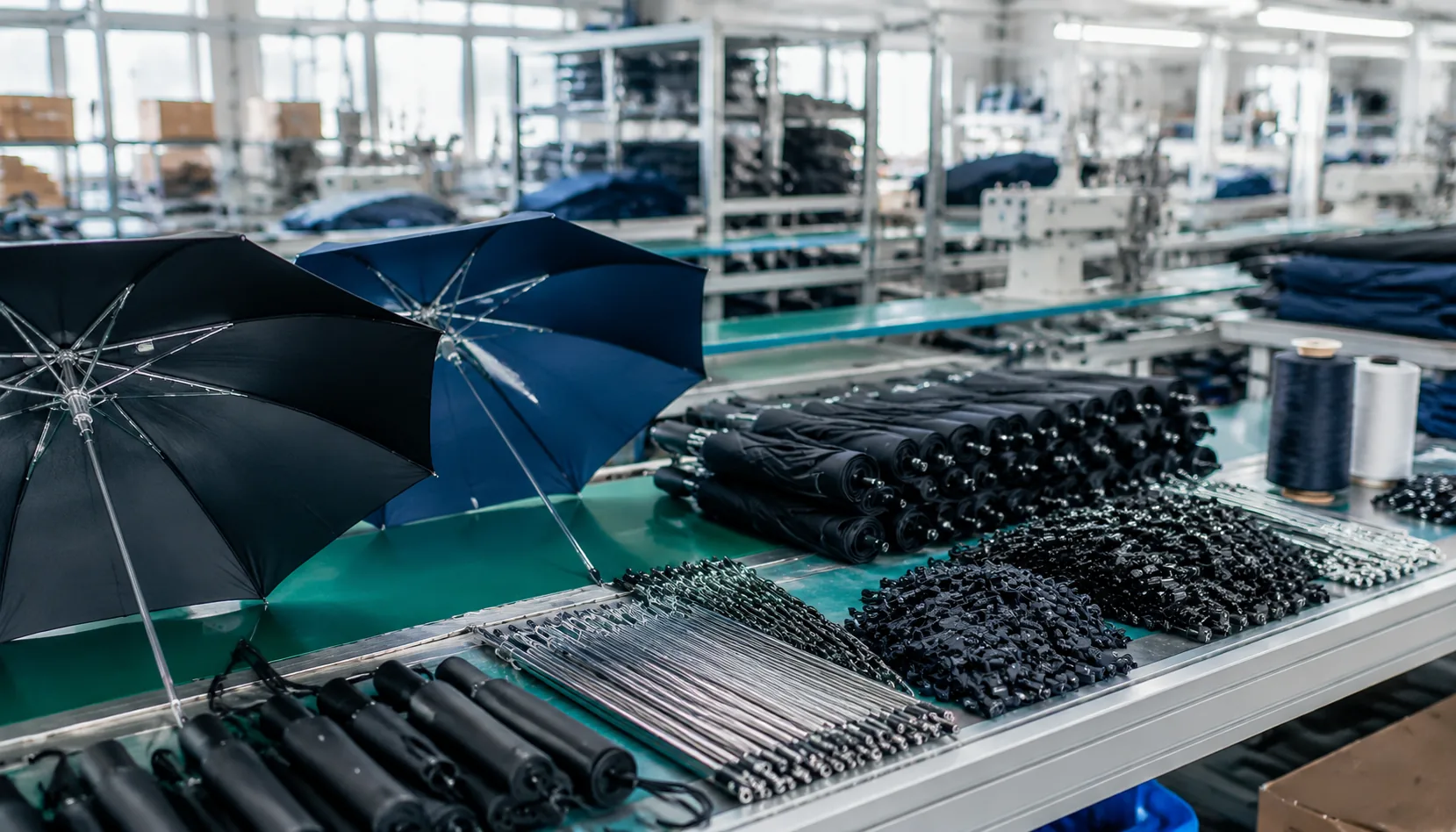
Mini Pocket Umbrellas: Sourcing Guide for Promo and Retail Kits
Compare mini pocket umbrella builds, 5-fold frames, pongee fabrics, auto-open limits, MOQ, QC, and packaging for retail ...
Read More »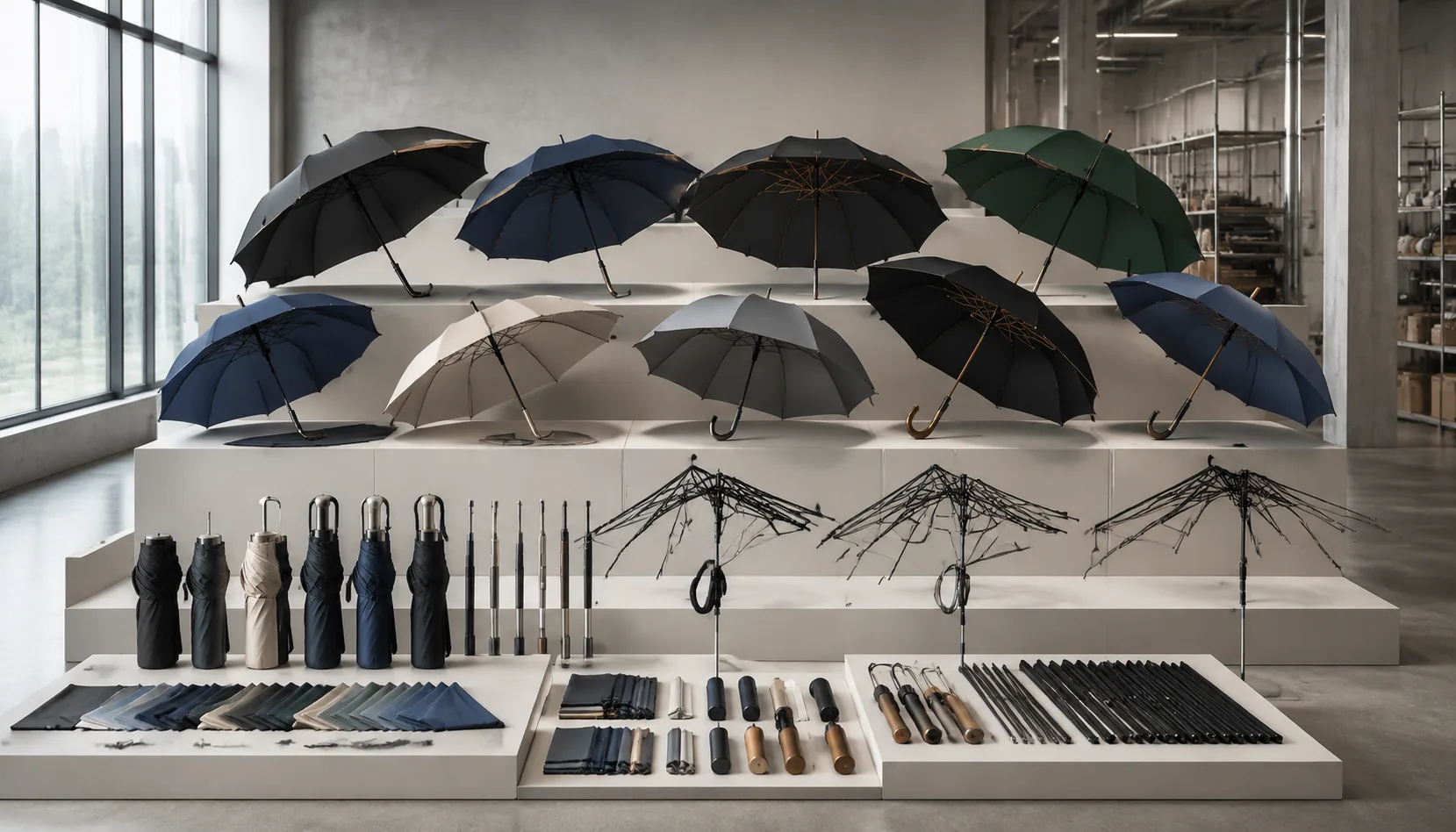
Retail Umbrella Assortment Planning: Specs by Price Tier
Plan a private-label umbrella range with 3-fold, stick, and golf models, clear good-better-best specs, realistic MOQs, F...
Read More »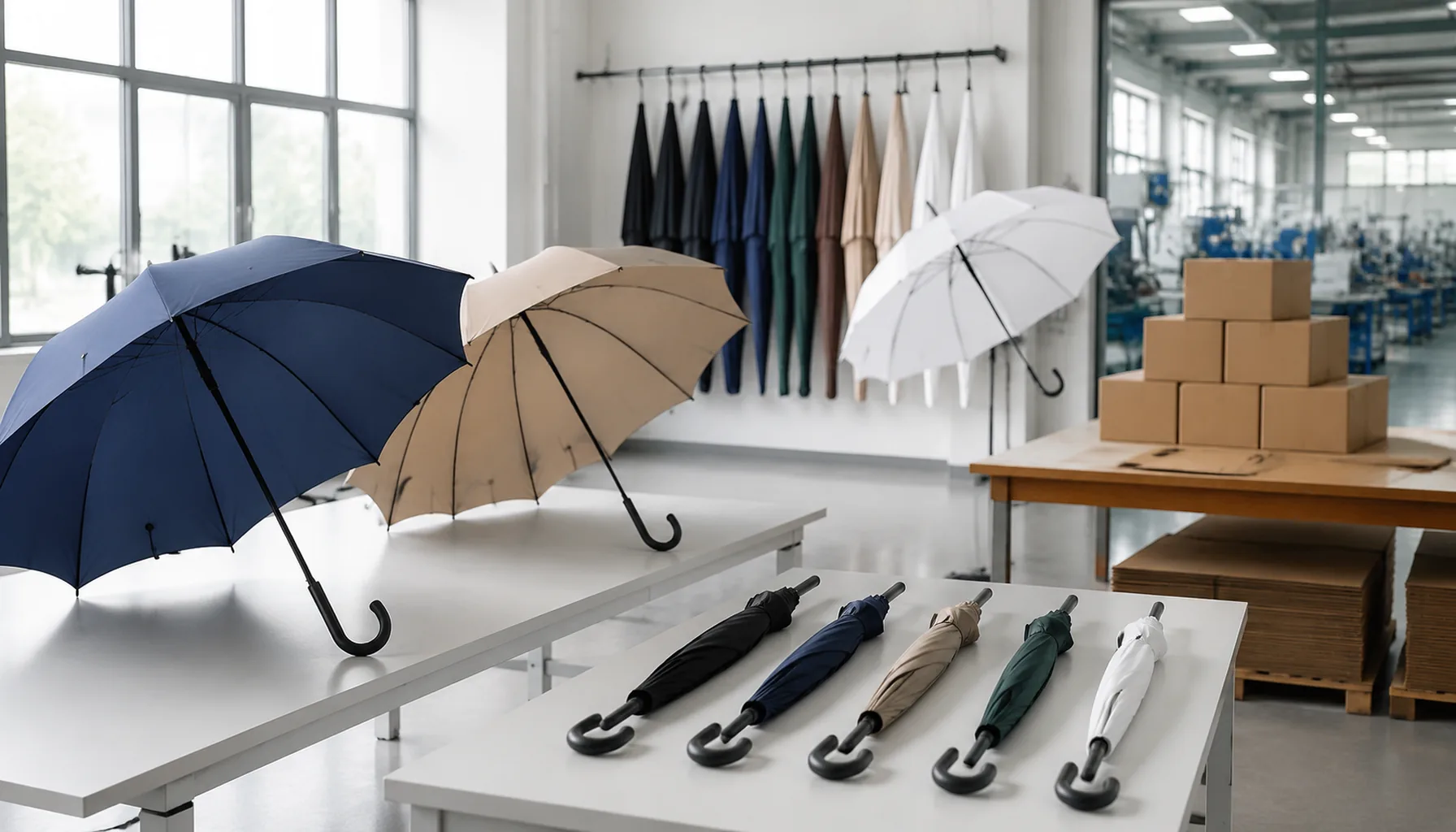
Private Label Rain Umbrellas: Retail Specs and Carton Planning
Plan retail-ready private label umbrellas with fabric, frame, packaging, barcode, carton, MOQ, and inspection specs buye...
Read More »