Reflective Safety Umbrellas: Spec Guide for Night Events
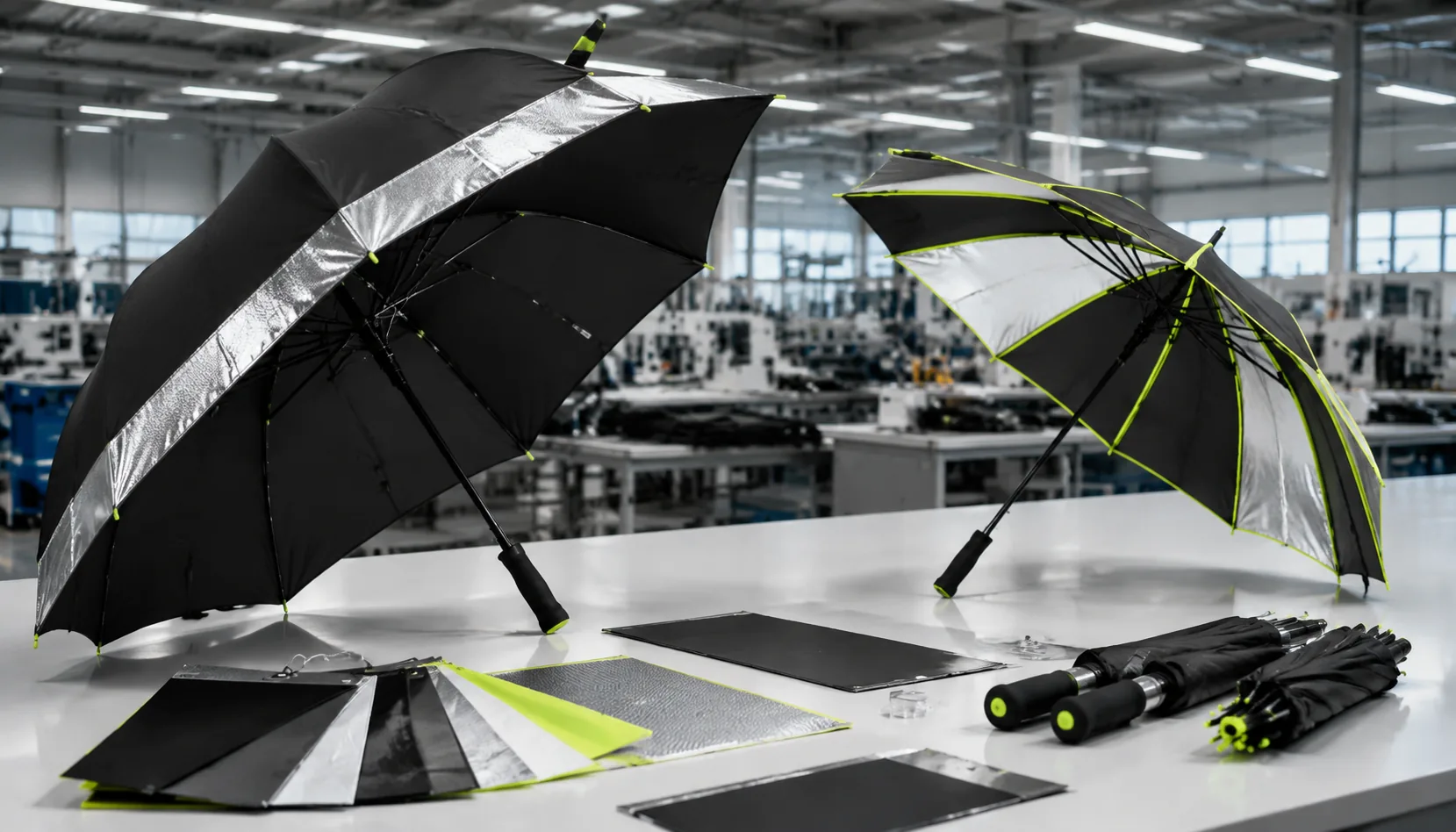
For night events and outdoor teams, the umbrella spec has to do more than look good under venue lights—it must stay visible, hold shape in gusts, and still carry a clean brand print. On our Songxia factory floor, reflective safety umbrellas are checked around trim placement, rib tension, pongee coating, seam alignment, and logo zones because small choices there decide whether a bulk order performs safely after dark.
Where Reflective Umbrellas Fit the Buyer’s Program
Reflective safety umbrellas make sense when the umbrella is part of a traffic-control or crowd-management system, not just a giveaway. The best programs we see are night races, university security teams, hospital parking staff, roadside service crews, shuttle queues, and outdoor event volunteers working after sunset or in heavy rain. In those jobs, a 42-inch logo printed on 190T pongee is less important than whether a driver can identify a person from the side at 80 to 120 feet. For night event umbrellas, I usually push buyers toward reflective trim on the canopy edges, rib seams, and sometimes the carry sleeve, because movement catches headlights better than a flat printed panel. A 23-inch auto-open straight umbrella works for volunteers who need one-hand operation, while 27-inch and 30-inch golf sizes cover staff with radios, clipboards, or handheld scanners.
Spec the visibility first, then place the brand around it. Reflective trim umbrellas can use 10 mm to 25 mm silver reflective tape, heat-transferred reflective logos, or high-visibility panels in lime, orange, or white pongee. If the team stands near vehicles, I prefer a fiberglass shaft and fiberglass ribs over steel because the frame flexes in gusts and avoids the sharp deformation we see after a steel-rib inversion. For open parking lots and roadside teams, an 8K or 10K frame with a double-canopy vent is more useful than a cheap 16K fashion frame; wind behavior matters more than rib count alone. A realistic target is passing 30 to 40 mph field use, with higher-grade vented models tested to 50+ mph in a wind tunnel. Our standard practice at ZheBrella is to sample reflective tape adhesion after wet cycling, because poor tape edges start lifting before the canopy fabric fails.
For custom reflective rain umbrellas, the purchasing mistake is treating the item like a normal promotional umbrella with one extra strip added at the end. Reflective placement affects cutting, sewing allowance, folding bulk, and carton compression, so it should be locked before the pre-production sample. A safety umbrella OEM should confirm tape width, reflectivity grade, seam position, canopy fabric such as 190T or 210T pongee, coating requirements like Teflon water repellency or UPF 50+, and whether the mechanism is manual, auto-open, or auto-open-close. For event work, I also ask who carries the umbrella: a runner escort needs a lighter 21-inch or 23-inch model, while a parking marshal benefits from a 27-inch straight handle that stays visible above parked cars. For bulk orders, set AQL 2.5 inspection around reflective alignment, open-close function, rib tension, and print registration, not only canopy stains and logo color.
Reflective Materials and Placement Options
Reflective piping is the cleanest option when the buyer wants visibility without turning the canopy into a billboard. On a standard 8-panel 23" or 27" pongee 190T umbrella, we usually place 3–5 mm reflective piping in the seam between panels or around the outer arc, because it follows the umbrella geometry and stays visible from several angles. Edge tape gives a stronger outline effect, but it adds sewing bulk at the tips and must be checked carefully for skipped stitches after the final press. For reflective safety umbrellas used at night races, parking-lot staff programs, school escorts, or outdoor concerts, I prefer a continuous perimeter plus two opposite vertical seam lines; that gives 360-degree recognition without fighting the main logo print.
Panel strips are more aggressive visually and work well for night event umbrellas where the user may be walking through traffic or crowds. A 15–25 mm reflective strip can be heat-transferred or sewn onto each panel, but placement must respect the canopy fold lines; if the strip sits too close to the rib pocket, repeated closing will crease the film and shorten reflectivity. On 8-panel canopies, a good rule is to keep reflective strips 35–50 mm away from the main seams and at least 70 mm above the edge if the umbrella has a curved valance or scalloped profile. Reflective trim umbrellas with alternating bright panels and dark panels need extra sampling, because silver reflective material can look clean on navy or black pongee but weak on white, yellow, or fluorescent fabric.
Print registration near seams is where many custom reflective rain umbrellas fail in production. Screen print and heat-transfer logos should not cross raised seam piping unless the buyer accepts distortion; even a 2 mm seam height can break a fine logo line after curing. For safety umbrella OEM orders, our standard practice at ZheBrella is to mark panel centerlines on the cutting table, then allow a ±2 mm registration tolerance for one-color prints and ±1 mm only when the artwork has tight reflective-to-ink alignment. Sleeve accents are also useful: a 10–15 mm reflective band on the carry sleeve or strap improves visibility when the umbrella is folded, especially for compact 21" auto-open-close models where the canopy is not always deployed.
Frame Builds for Outdoor Staff Use
For exposed venues, double-canopy windproof construction is usually the smartest upgrade before jumping to exotic materials. A vented double canopy lets wind pass through the upper layer instead of forcing the umbrella inside out, especially in open parking lots, waterfront events, and temporary festival corridors. On custom reflective rain umbrellas, I specify fiberglass ribs, a reinforced top notch, and a vent overlap deep enough to prevent rain blowback; shallow vents look tidy but fail when wind-driven rain hits at an angle. A proper 8K fiberglass double-canopy umbrella can survive 50+ mph wind-tunnel testing when the shaft, runner, and rib joints are matched correctly. A 16K vented version feels more stable under constant load but should be paired with a straight EVA or rubberized handle, not a tiny plastic crook handle. For safety umbrella OEM orders, confirm AQL 2.5 inspection points for rib symmetry, runner lock strength, reflective tape adhesion, and canopy leakage before approving bulk production.
Canopy Fabric, Color, and Printing Choices
For reflective safety umbrellas, the canopy starts with fabric choice, and 190T or 210T pongee is the practical baseline. I prefer 210T when the umbrella will carry a full-size print or take harder use, because the tighter weave holds pigment better and feels less flimsy in hand, while 190T is acceptable for lower-cost night event umbrellas where weight and price matter more than abrasion resistance. In either case, the cloth should have a smooth face so the reflective trim does not look muddy at the seam. On a safety umbrella OEM program, I usually avoid very open polyester because the weave telegraphs through lighter inks and makes edge finishing harder. For custom reflective rain umbrellas, a clean hem, consistent panel tension, and controlled sewing shrinkage matter as much as the base fabric grade.
Color choice matters more than buyers usually admit. High-contrast canopy colors such as black, royal blue, red, and deep green make the silver reflective trim umbrellas effect visible from a distance, especially under headlights, stage lighting, or venue floodlights. White can look clean on paper, but in low light it reduces contrast and can flatten the reflective edge visually; very dark canopies usually give the best outline. If the goal is real nighttime visibility, the canopy panels should not compete with the reflective band or fill too much edge space with busy artwork. On reflective safety umbrellas, I also avoid tonal patterns near the rim, because they weaken the silhouette that helps security staff, pedestrians, and event crews identify movement quickly.
For logo decoration, the safest methods are small placements that stay away from the reflective border: center-panel screen print, one-color heat transfer, or sublimation on the lower third of the canopy. Anything that crosses the silver reflective trim can reduce return brightness, especially heavy ink layers, foil, puff print, or large solid blocks. On reflective safety umbrellas, the reflective strip should remain exposed at the edge, with at least a clear margin so the tape can catch light directly instead of being shadowed by artwork. ZheBrella’s standard practice is to approve a print mockup against the panel layout before sampling, because the wrong logo size can ruin the nighttime effect even if the fabric and trim are correct. For branded night event umbrellas, the best result is usually a restrained logo and a clean reflective perimeter, not a full-bleed graphic.
QC, Compliance, and Bulk Delivery Planning
For reflective safety umbrellas, the first QC risk is not the frame, it is trim adhesion after water, folding, and abrasion. We test reflective tape or heat-transfer reflective film on 190T/210T pongee by cross-hatch adhesion, 3M tape pull, wet rub, and a 24-hour room-temperature recovery check after rain exposure. On POE, PVC, or EVA transparent canopies, the issue changes: reflective print can migrate or crack if the ink system is wrong, so we run a flex-fold test at the seam and panel edge before approving bulk. Rain testing should include at least 30 minutes under controlled spray, then inspection for seam leakage, delamination, ink bleed, and water pooling near the ferrule. For night event umbrellas with reflective piping, I also want a dark-room flashlight check from 10–20 meters because some low-cost trims look silver in daylight but return almost no light at angle.
Opening-cycle checks catch the failures that usually appear after the event team has already distributed the umbrellas. For manual stick umbrellas, we cycle open and close 300–500 times depending on price tier; for auto-open and auto-open-close models, we check spring force, runner lock, button response, and shaft wobble after cycling. Frame choice matters: 8K steel ribs are economical for giveaways, but fiberglass ribs or fiberglass-reinforced 8K/10K frames are safer if guests will walk between venues in wind. Double-canopy vented windproof construction is worth considering for 23 inch and 27 inch reflective trim umbrellas, especially if the event is in a coastal city or open parking area. AQL 2.5 inspection should cover major defects like broken ribs, failed opening, sharp burrs, loose tips, cracked handles, wrong logo position, poor reflective alignment, and canopy stains; minor defects include light thread ends, slight print shade variation, and small packing scuffs.
Bulk delivery planning has to work backward from the event date, not forward from the purchase order. A realistic schedule for custom reflective rain umbrellas is 3–5 days for artwork confirmation, 5–7 days for strike-off or pre-production sample, 18–30 days for bulk production after approval, and 3–5 days for final inspection and export packing. MOQ is usually 500–1,000 pieces for simple reflective piping and 1,000–3,000 pieces for custom panel printing, special reflective layouts, or mixed colors. As a safety umbrella OEM, our standard practice at ZheBrella is to freeze the logo file, trim position, carton marks, and AQL checklist before fabric cutting starts, because late changes create mismatched panels and missed shipping windows. FOB Ningbo or Shanghai works for buyers with forwarders; DDP is cleaner for event planners who need cartons delivered to a hotel, warehouse, or venue, but it needs earlier booking and accurate consignee details.
Frequently Asked Questions
Can reflective trim be added to every umbrella panel?
Yes, but full-panel reflective layouts increase labor cost and may affect folding neatness. Many buyers use edge piping plus selected panel strips for a balance of visibility and cost.
Do reflective safety umbrellas need a double-canopy design?
Not always. Double-canopy construction is useful for windy outdoor sites, while standard 8K fiberglass builds may be enough for short-duration urban events.
What reflective options can be added to umbrellas for night events?
Common options include reflective piping around canopy edges, reflective tape on panels, reflective logos, and reflective sleeve details. For event use, 360-degree edge piping is usually the most visible option from a distance.
What specifications should buyers request for outdoor staff safety umbrellas?
A practical spec is 190T or 210T pongee fabric, fiberglass ribs, a windproof frame, reflective trim, and a comfortable straight or automatic open handle. For branded orders, logos are typically printed on 1–4 panels plus the sleeve.
What is the typical MOQ and lead time for custom reflective rain umbrellas?
MOQ is usually around 500–1,000 pieces depending on the frame, reflective material, and print method. Sampling often takes 7–10 days, while bulk production is commonly 30–45 days after artwork and sample approval.
Looking to Launch Your Custom Umbrella Line?
ZheBrella is a Zhejiang-based OEM/ODM umbrella manufacturer with 17 years of export experience. Free design, low MOQ from 100 pieces, windproof construction, full-color print.
Get Free Quote Now »People Also Search For
Related Articles
Reflective Safety Umbrellas: Buyer Spec Guide for Brands
Specify reflective safety umbrellas with proper tape, print zones, frame strength, and QC tests for commuter, school, an...
Read More »
Reflective Safety Umbrellas for Promo Buyer Spec Guide
Specify reflective safety umbrellas with 190T/210T pongee, fiberglass ribs, reflective piping, QC checks, MOQ, and shipp...
Read More »
Reflective Commuter Umbrellas: OEM Safety Spec Guide
Specify reflective commuter umbrellas with 190T pongee, fiberglass ribs, safety trim, and QC points for retail or corpor...
Read More »