RPET Umbrellas for Sustainable Retail and Promo Programs
Retail and promo buyers often want a greener umbrella, but the risk sits in the details: recycled fabric claims, color consistency, print adhesion, frame strength, packaging, and delivery timing all have to line up before production starts. As an RPET umbrella manufacturer working daily with fabric mills, printing lines, frame assembly, and final QC in Songxia, we see how small specification gaps can turn a sustainable program into rework, delays, or failed inspections.
What Makes an Umbrella an RPET Product
An RPET umbrella is not automatically “green” from top to bottom; the RPET part usually refers to the canopy fabric. In factory specifications, this is most often written as RPET pongee, typically 190T or 210T, woven from recycled polyester yarn made by processing used PET bottles or other polyester waste into chips, then spinning it back into filament yarn. The hand feel, printability, and water resistance are close to virgin polyester pongee, so buyers can still specify common treatments like waterproof coating, Teflon finish, or UV coating for UPF 50+ sun protection. A serious RPET umbrella manufacturer should be able to state the recycled content percentage, fabric weight, yarn source, and whether the fabric is piece-dyed or yarn-dyed. Without those details, “recycled fabric umbrellas” can become a loose marketing phrase rather than a controlled material specification.
The most common mistake I see in sustainable promotional umbrellas is assuming every visible part is recycled because the canopy is RPET. In many orders, only the main canopy panels are recycled polyester, while the sleeve may be virgin pongee, the closing strap may be standard polyester, and the woven label, hangtag string, polybag, and inner carton are conventional materials. That may be acceptable if declared clearly, but it should not be sold as a fully recycled product. For better alignment, buyers can request RPET fabric for the sleeve, RPET webbing for the strap, recycled paper hangtags, FSC or recycled kraft packaging, and reduced-plastic carton packing. If the umbrella uses a POE or EVA transparent canopy, that is a different material route and should not be described as RPET unless a specific recycled content claim is documented.
For retail and corporate ESG programs, documentation matters as much as the fabric. GRS certified umbrellas require a certified supply chain, transaction certificates where applicable, and clear scope: fabric certification alone is different from a finished umbrella made under a certified process. Ask whether the mill, dyeing plant, and umbrella factory are covered, and confirm the claim wording before printing it on the sleeve or retail label. A qualified RPET umbrella manufacturer should also keep the normal performance controls in place: seam strength after sewing, colorfastness after printing, water repellency testing, frame cycle testing, and AQL 2.5 final inspection. Eco friendly umbrellas still need to survive real use, whether that is a 23-inch auto-open promo umbrella, a 21-inch folding auto-open-close model, or a 30-inch golf umbrella with fiberglass ribs and a vented double canopy.
Fabric Specs: RPET Pongee, Coatings, and Performance
RPET 190T pongee is the workhorse fabric for price-sensitive recycled fabric umbrellas because it gives a smooth enough hand feel, stable sewing behavior, and acceptable print definition without pushing canopy cost too high. The yarn count is lighter than 210T, so the fabric feels slightly softer and less dense when you rub it between your fingers, especially after water-repellent finishing. For straight logos, one- or two-color screen printing, and most heat-transfer marks, 190T performs well if the fabric is properly heat-set before cutting. Where buyers get into trouble is asking for fine gradients, tiny QR codes, or full-panel artwork on low-grade RPET; the weave can open slightly under tension, and registration becomes less forgiving across eight panels. A serious RPET umbrella manufacturer should test fabric shrinkage, color migration, and coating adhesion before bulk printing, not after the first shipment is already packed.
RPET 210T pongee is the better choice when the retail program needs a tighter hand, cleaner print edge, and a more premium canopy appearance. The denser weave improves opacity and helps the umbrella hold a sharper dome shape on 23-inch and 27-inch frames, particularly on 8K or 10K fiberglass rib structures. For sustainable promotional umbrellas with all-over sublimation, 210T usually gives stronger color saturation and less panel-to-panel variation, though it requires better cutting control because printed panels must be matched before sewing. Water repellency depends less on 190T versus 210T and more on finishing quality: a C6 or C0 water-repellent treatment should bead rain cleanly after initial testing, but poor curing will fail after rubbing or carton storage. Our standard practice at ZheBrella is to check spray rating, seam puckering, and print fastness together, because a beautiful recycled canopy is useless if water tracks through needle holes in the first storm.
For sun-and-rain programs, coating selection changes the whole product brief. Black coating gives the best light blocking and is common on golf umbrellas, beach-style umbrellas, and retail UV models where buyers request UPF 50+ performance; it also hides the inside of the printed canopy, which can be useful for corporate artwork. Silver coating is cheaper and reflects heat well, but it can scuff during folding if the coating formulation is too brittle. Some eco friendly umbrellas use uncoated RPET pongee with only water-repellent finishing to keep the hand feel lighter, but then UPF claims must be tested instead of assumed. If a buyer wants GRS certified umbrellas, the fabric mill, dyeing process, and transaction certificate must line up with the final PO quantity. I recommend confirming UPF 50+ testing on the finished fabric color, not only on a lab swatch, because dark navy, white, and sublimated panels can produce different results.
Certifications and Claims Buyers Should Verify
The first document I ask for on an RPET order is not a pretty certificate PDF; it is the recycled-content trail behind the fabric. For serious retail and promo programs, buyers should verify whether the mill, dye house, and finished-goods factory are covered under GRS scope, and whether the canopy fabric is actually listed as recycled polyester, not just “polyester.” A valid GRS certificate has a scope certificate number, issuing body, expiry date, and material category. For larger runs, especially 3,000 to 10,000 pcs, ask whether a transaction certificate is available for the fabric lot. It may not always be issued for small mixed orders, but when available it is stronger evidence than a supplier statement. As an RPET umbrella manufacturer, we also check that purchase orders, fabric invoices, and cutting records match the claimed recycled percentage before hangtags are approved.
Claims should be tight and defensible. “Made with recycled polyester canopy fabric” is usually safer than saying “100% sustainable” or “zero-waste,” because the frame, shaft, runner, tips, handle, ferrule, thread, strap, and sleeve may still use virgin materials. For recycled fabric umbrellas, specify the part being claimed: for example, “Canopy: 190T RPET pongee, made from recycled PET bottles” or “Canopy fabric contains 100% recycled polyester; metal and plastic components are not recycled unless otherwise stated.” If the buyer wants GRS certified umbrellas, the wording should align with certification rules and artwork approval should happen before mass printing. Unsupported claims on sustainable promotional umbrellas create risk for distributors because the final logoed product is often resold into regulated markets like the U.S., EU, UK, Canada, and Australia.
Retail buyers should treat hangtags, QR codes, and packaging as controlled documents, not afterthoughts added two days before shipment. A good hangtag can show the recycled-content statement, fabric specification such as 210T RPET pongee, care instructions, country of origin, importer details, and certification reference where permitted. QR codes can link to a landing page with scope certificates, test reports, factory audits, and batch-level information, but the page must stay live after delivery, not disappear after the campaign. For eco friendly umbrellas, packaging should support the same story: recycled kraft paper belly bands, FSC paper sleeves, water-based ink, and reduced polybag use where the destination retailer allows it. If individual polybags are required for barcode scanning or warehouse handling, state the material and recycling mark honestly rather than hiding it behind a vague green message.
Frame and Mechanism Choices for Sustainable Lines
The biggest mistake I see in sustainable lines is treating the RPET canopy as the whole product. A recycled 190T or 210T pongee canopy is only one part of the umbrella; the frame decides whether the buyer gets repeat use or a landfill claim with a green label. For entry retail and promo, a 3-fold 21" or 23" travel umbrella usually pairs RPET fabric with a steel shaft and steel ribs to control cost, but I prefer fiberglass ribs on any program claiming durability. Fiberglass flexes instead of permanently bending, especially on 8K frames where wind load is concentrated. Steel shafts are stronger and cheaper, but they add weight; aluminum shafts reduce carry weight by 20–30% but need tighter wall-thickness control or they deform at the runner. As an RPET umbrella manufacturer, we normally push buyers to specify the frame material clearly, not just “eco fabric,” because the claim means little if the mechanism fails after 200 open-close cycles.
For sustainable promotional umbrellas, the mechanism choice should match the use case and the budget, not just the catalog photo. Manual-open 3-fold umbrellas are the safest low-cost option for giveaways because there are fewer springs, buttons, and linkages to fail during AQL 2.5 inspection. Auto-open folding umbrellas feel better in corporate gifting, but the shaft, notch, runner, and spring must be tested together; a weak spring gives a lazy pop, while an overpowered spring stresses the rib joints. Auto-open-close mechanisms are convenient for commuters, but they add cost, weight, and a higher failure risk if the buyer insists on the cheapest frame. On recycled fabric umbrellas, I recommend reserving auto-open-close for 23" mid-tier models with fiberglass ribs and a tested center rod system, not for bargain campaigns. If the program is event-based and needs 5,000–20,000 pieces quickly, manual or auto-open is usually more reliable and easier to deliver within a 35–45 day lead time.
Straight umbrellas and golf umbrellas give more room to build a serious sustainable line because the frame can carry a stronger structure without feeling cramped. A 23" or 27" straight umbrella with an RPET pongee canopy, steel shaft, and fiberglass ribs is a practical retail tier: durable enough for daily rain, still cost-controlled for department stores and brand programs. For premium eco friendly umbrellas, a 30" or 32" golf umbrella should use a fiberglass shaft or reinforced steel shaft, 8K or 10K fiberglass ribs, and preferably a double-canopy vented design if the buyer wants wind performance above 50 mph. A 16K rib count looks substantial, but it increases labor, sewing alignment requirements, and carton weight, so it should be used for style or luxury positioning rather than pure wind resistance. For GRS certified umbrellas, procurement also needs chain-of-custody documents for the RPET yarn and fabric, while the frame specification remains a separate engineering decision.
MOQ, Lead Time, and Quality Control for RPET Orders
MOQ for RPET orders is usually higher than standard 190T or 210T pongee because the recycled yarn supply, dye lot control, and GRS paperwork have to be coordinated before cutting. For plain stock-color pongee umbrellas, many factories can run 500 to 1,000 pieces per color; for recycled fabric umbrellas, a realistic MOQ is often 1,000 to 3,000 pieces per fabric color, and custom-dyed RPET can move to 3,000 to 5,000 pieces depending on mill schedule. As an RPET umbrella manufacturer, we also separate MOQ by construction: a 21" 8K folding umbrella with steel ribs is easier to consolidate than a 30" golf umbrella with fiberglass frame, double-canopy vents, and color-matched sleeve. Buyers should also budget for slightly higher wastage on RPET cutting, especially when panel printing, because shade variation between rolls is less forgiving than commodity pongee.
Lab dip and pre-production approval are where many sustainable promotional umbrellas lose time. A normal polyester pongee lab dip may take 3 to 5 days, but RPET fabric with GRS chain-of-custody documentation commonly needs 5 to 8 days, especially for corporate PMS colors on darker grounds. After lab dip approval, the pre-production sample usually takes 7 to 10 days for a basic manual-open model and 10 to 14 days for auto-open-close, vented double-canopy, or heat-transfer logo layouts. For GRS certified umbrellas, the buyer should approve not only canopy color and logo placement, but also recycled content claims, hangtag wording, and transaction certificate requirements before bulk fabric is cut. If a distributor waits until final inspection to ask for certificate wording changes, the carton marks, labels, and documents may all need to be reworked.
For quality control, I would not loosen standards just because the order is positioned as eco friendly umbrellas. Our standard practice at ZheBrella is AQL 2.5 for major defects and AQL 4.0 for minor defects, with checks on opening force, rib alignment, tip stitching, seam leakage, print adhesion, sleeve fit, and carton drop condition. Lead time after approved sample is typically 30 to 40 days for repeat RPET folding umbrellas and 45 to 60 days for custom golf or vented windproof models, with another 3 to 7 days reserved for final inspection, repacking, and export documents. FOB Ningbo or Shanghai works best when the distributor controls ocean freight; DDP should be planned earlier, especially for seasonal retail campaigns, because customs, duty classification, inland delivery appointments, and peak-season vessel space can add 20 to 35 days beyond factory completion.
Frequently Asked Questions
Is RPET umbrella fabric as durable as standard pongee?
Yes, when the yarn, weave, and coating are specified correctly. Buyers should compare RPET 190T or 210T pongee samples against standard pongee for hand feel, print result, and water repellency.
Can RPET umbrellas be printed with full-color artwork?
Yes. RPET pongee can support screen printing, heat transfer, and digital printing depending on artwork complexity and order volume. A print strike-off is recommended before bulk production.
What proof should a buyer request to confirm an umbrella is really made with RPET fabric?
Ask for the GRS transaction certificate for the fabric lot, the fabric composition spec sheet, and a clear bill of materials showing which parts are recycled. If you need retail compliance, also confirm whether the claim applies only to the canopy fabric or to the finished umbrella.
Which decoration method works best on RPET umbrella canopies for promotional orders?
Silkscreen is usually the most cost-effective option for 1-2 spot colors and medium to large runs. Heat transfer or digital printing is better for complex artwork or multiple colors, but unit cost is higher and lead times may extend by 3-7 days depending on panel coverage.
How should MOQ differ between sustainable promo umbrellas and retail-packaged RPET umbrellas?
Promotional orders can often start around 300-500 pieces for a standard custom style if stock frames and colors are used. Retail programs with custom hangtags, barcode stickers, color boxes, and verified recycled packaging often start closer to 1,000-3,000 pieces per SKU.
Looking to Launch Your Custom Umbrella Line?
ZheBrella is a Zhejiang-based OEM/ODM umbrella manufacturer with 17 years of export experience. Free design, low MOQ from 100 pieces, windproof construction, full-color print.
Get Free Quote Now »People Also Search For
Related Articles
Recycled PET Umbrellas: OEM Spec Guide for Buyers
Learn how to specify rPET umbrella fabric, GRS claims, frame options, print limits, MOQ, QC, and lead times for sustaina...
Read More »
RPET Umbrellas for Retail Brands: Buyer Specification Guide
Compare RPET pongee, recycled-content claims, frame options, MOQ, and QC points for branded umbrellas that meet retail a...
Read More »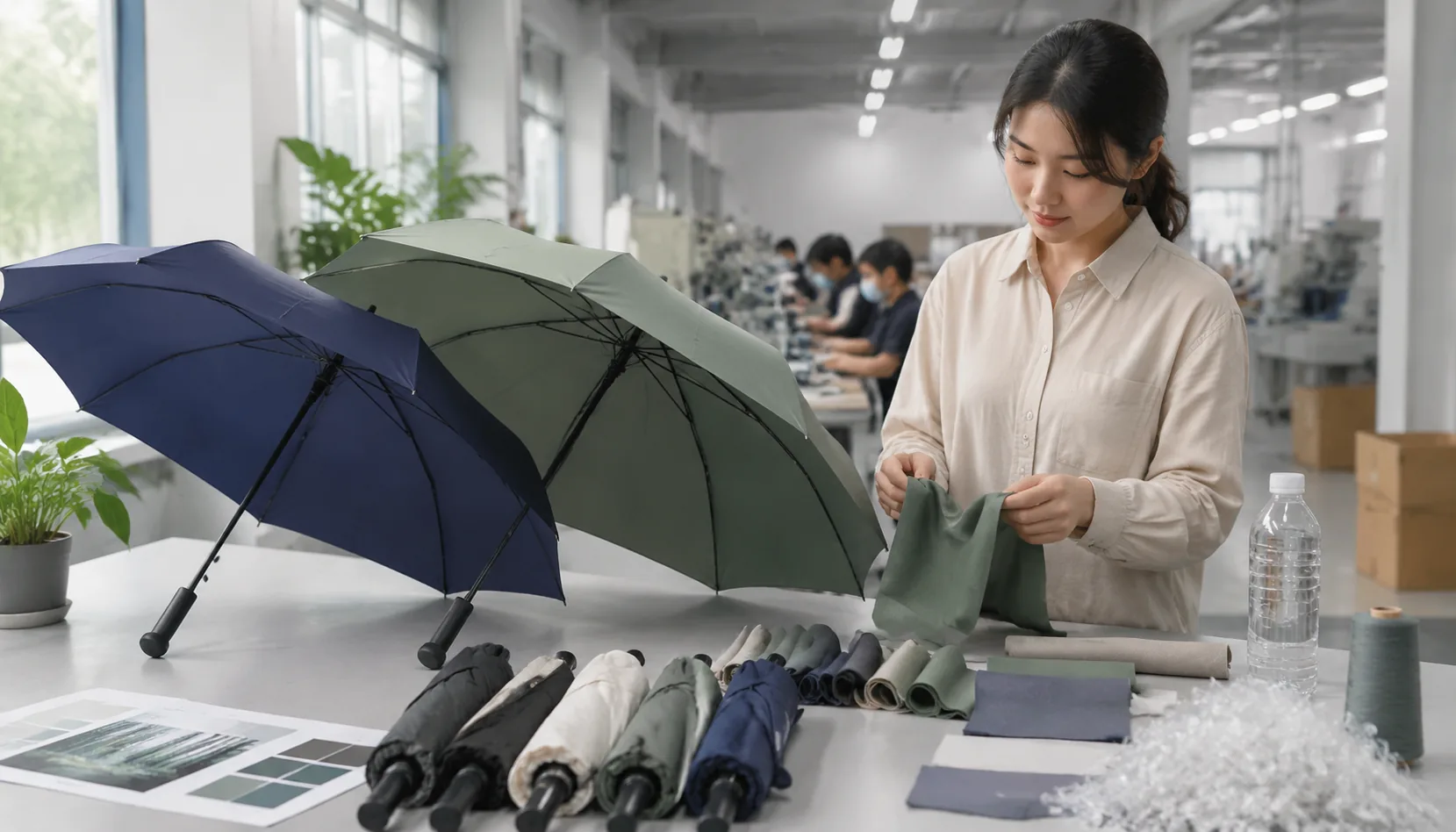
RPET Pongee Umbrellas: Buyer Guide for Sustainable Orders
Source RPET pongee umbrellas with verified recycled fabric, 190T or 210T specs, GRS documents, print options, MOQ planni...
Read More »