Tone-on-Tone Umbrella Branding for Subtle Retail Programs
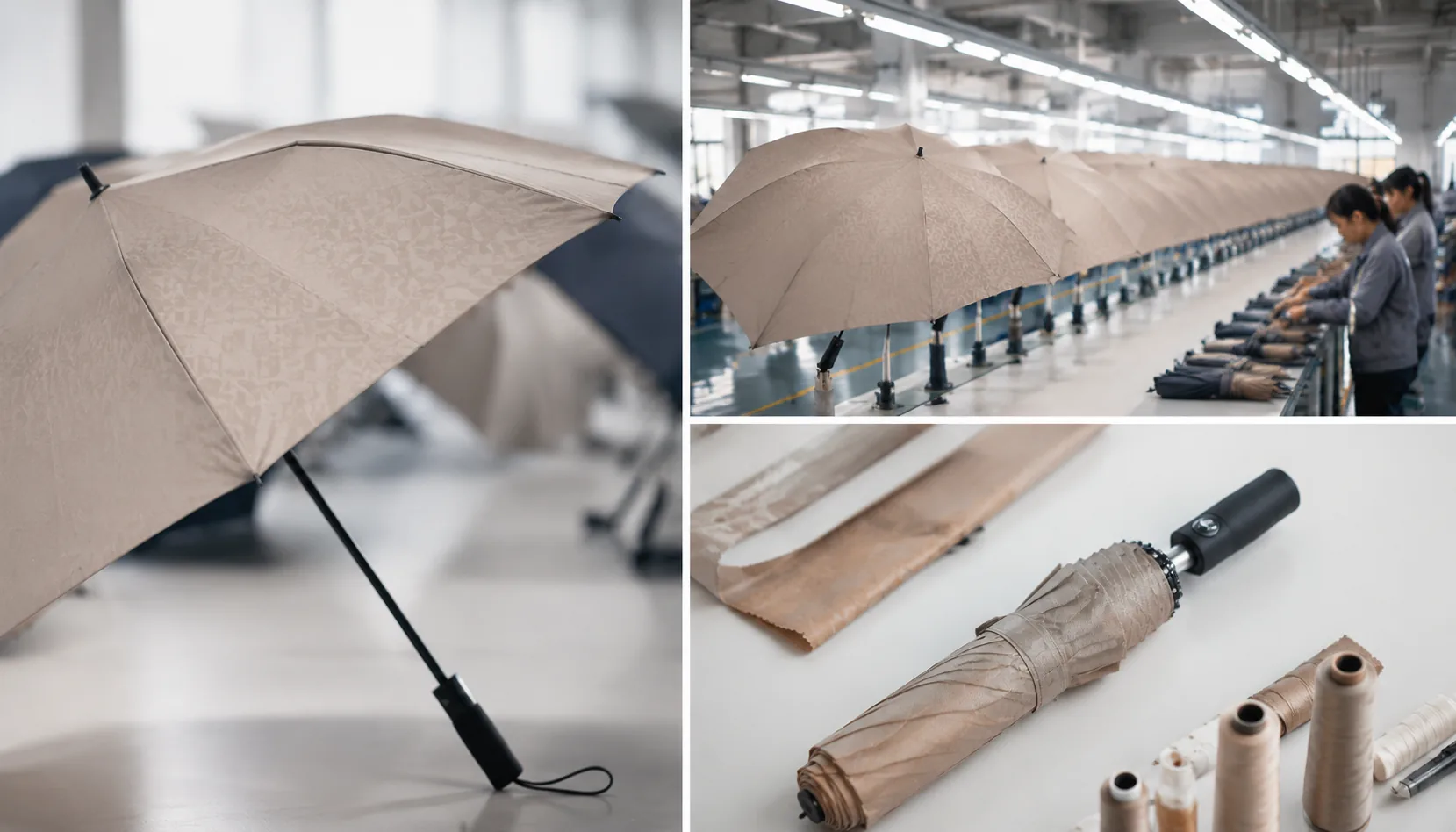
When a retail buyer asks for subtle branding, the risk is usually not the logo concept but the execution: one shade too much contrast, a glossy print on matte fabric, or trims that make the umbrella look mismatched on the shelf. On our Songxia production floor, tone on tone umbrella branding means controlling fabric lot, ink hand-feel, webbing, snaps, sleeve, and QC lighting together so the mark reads premium without shouting.
When Subtle Branding Works Better Than High Contrast
Subtle branding works best when the umbrella is expected to feel like part of a paid retail product, not a giveaway. For luxury retail, boutique hotels, executive gifts, and fashion collaborations, a large white logo on black 190T pongee often makes the item look cheaper, even if the frame is good. Tone on tone umbrella branding solves that problem by keeping the mark close to the canopy color: dark gray ink on black, navy on navy, cream on beige, or a gloss clear print over matte fabric. On a 23" auto-open stick umbrella or 21" auto-open-close folding model, I usually keep the logo under 80-120 mm wide on one panel, especially when the umbrella uses a wood handle, fiberglass ribs, or a UPF 50+ coating.
The production method matters because “subtle” can turn into “invisible” if nobody controls contrast. Screen printing with low contrast logo printing is stable for 190T and 210T pongee, but the ink recipe needs a Delta E target and a wet/dry sample check before bulk production. Heat transfer can hold fine lines better, but on dark canopies the film edge may show under angled light, which hurts premium branded umbrellas. For hotel programs, our standard practice at ZheBrella is to run one pre-production sample under indoor lobby lighting and outdoor daylight, then confirm logo position against the seam tolerance of plus or minus 3 mm before cutting bulk panels.
High contrast still has its place. If the umbrella is for a marathon sponsor, outdoor festival, university welcome kit, or street promotion, visibility from 20-30 meters may matter more than perceived luxury. A bold one-color logo on a 27" manual golf umbrella with 8K fiberglass ribs and a double-canopy vent can be the right choice because the user is effectively carrying a moving billboard. But for retail umbrella branding, the buyer is usually protecting margin and brand taste, not chasing maximum impressions. In those cases, a subtle umbrella logo makes the product feel designed, while a loud logo makes it feel distributed.
Choosing Canopy and Logo Color Combinations
The safest tone on tone umbrella branding starts with same-family colors, not identical colors. If the canopy is navy 296C, I usually test logo ink around 289C, 2955C, or a custom mix with 5–12% value shift; anything closer can disappear after rain darkens the fabric. Black-on-charcoal, forest-on-olive, burgundy-on-wine, and sand-on-khaki all work when the logo has enough edge definition. For retail umbrella branding, I avoid pale gray logos on light beige canopies unless the artwork is bold and at least 40 mm tall, because store lighting washes it out. A subtle umbrella logo should still be readable at arm’s length, especially on 21" folding umbrellas where panel curvature distorts thin strokes. On larger 23" and 27" stick umbrellas, low contrast logo printing gives more room to breathe, but fine serif fonts and thin line icons still need a slightly stronger contrast step.
Ink finish changes the result as much as color. Matte screen-print ink sinks visually into 190T pongee, giving a quiet retail look, while glossy ink catches light and makes the logo appear brighter than the Pantone chip suggests. On 210T pongee, the tighter weave reflects more evenly, so the same low-contrast logo can look cleaner and a little more premium. I prefer 210T for premium branded umbrellas when the buyer wants controlled subtlety, especially with Teflon coating or UPF 50+ treatment, because the smoother hand reduces speckling around logo edges. With 190T, the yarn texture breaks up the ink film, which can be useful for a soft heritage look but risky for small logos under 25 mm. POE, PVC, and EVA panels behave differently again; glossy plastic can turn a dark-on-dark logo into a highlight effect, so the sample must be judged on the actual canopy material, not on paper proofing.
Lab dips should include both canopy fabric and printed logo, not just a loose color swatch. Our standard practice at ZheBrella is to request Pantone TPX/TCX references for fabric and Pantone C/U references for ink, then make a strike-off on the production pongee before bulk cutting. Buyers should approve samples under three conditions: 5000K daylight lamp, typical indoor retail light around 3000–4000K, and outdoor daylight, including shade. A charcoal logo on black 210T pongee may look elegant beside a window but vanish under warm hotel lobby lighting; a dark green logo on bottle-green fabric may look too obvious in direct sun. For tone on tone umbrella branding, I recommend photographing the sample from 1 meter and 3 meters, both dry and misted with water. If the logo only reads in a close-up photo, it is decoration, not branding; if it jumps out from across the room, it is no longer subtle.
Print Techniques for Low-Contrast Logos
Embroidery is not practical on the main canopy because needle holes compromise water resistance, but it works very well on straps, sleeves, and fabric carry cases. For retail sets, we often embroider the closure strap with tonal thread and leave the canopy plain; the umbrella looks quiet on the shelf, but the brand is visible when the customer handles it. Keep embroidery simple: satin stitches under 1 mm can snag, small text below 5 mm height becomes muddy, and dense logos can stiffen a narrow strap so it no longer wraps cleanly around a 23 inch or 27 inch frame. Our standard practice at ZheBrella is to review a physical strike-off from both 1 meter and 3 meters before bulk production, because CAD mockups lie about contrast. For tone on tone umbrella branding, the real approval question is not “can we see the logo?” but “can the right customer notice it without turning the umbrella into a giveaway item?”
Frame, Trim, and Hardware Coordination
Tone on tone umbrella branding only works when the frame and trim are planned with the canopy, not selected afterward from stock parts. For retail programs, I usually start with rib material because it changes both appearance and price position. Black electroplated steel ribs give a slim, formal look on 21" and 23" city umbrellas, but fiberglass ribs are better for 27" and 30" golf models where wind recovery matters. An 8K frame keeps the silhouette clean and familiar; a 16K frame looks more architectural and premium, but every extra rib creates another visible line under a low contrast logo printing layout. If the canopy is navy 190T pongee with a slightly darker subtle umbrella logo, bright zinc-plated ribs will ruin the quiet effect immediately. Matte black, gunmetal, champagne, or color-dipped fiberglass keeps the product disciplined.
Ferrules, tips, end caps, and straps are small parts, but they decide whether premium branded umbrellas feel intentional or assembled from a catalog. On a tone-on-tone design, I prefer matching plastic tips for casual retail umbrellas and painted metal tips for department-store or gift-with-purchase programs. The strap should use the same canopy fabric when possible, not a random webbing tape, and the snap button should be dyed, rubber-coated, or finished in matching gunmetal instead of shiny silver. On POE or EVA transparent canopies, the trim becomes even more visible, so the ferrule color and rib coating must be approved against real production material, not a screen rendering. Our standard practice at ZheBrella is to make a trim board with canopy swatches, printed logo panels, handle samples, and hardware finishes before releasing bulk production.
Handles and auto-open buttons are where retail umbrella branding often becomes inconsistent. A wooden crook handle can support a warm beige, brown, or charcoal tone-on-tone concept, while EVA foam or rubberized straight handles suit sport and commuter umbrellas. For auto-open and auto-open-close mechanisms, the push button should match the runner, shaft, and handle insert; a glossy chrome button on a matte black umbrella draws the eye away from the low-contrast logo. If the retail line includes compact 21" umbrellas, 23" stick umbrellas, and 30" golf umbrellas, keep the hardware language consistent even when frame construction changes from steel to fiberglass or from 8K to 16K. Buyers should also lock the approved hardware finish in the specification sheet, because factories may otherwise substitute standard black or nickel parts during peak-season production to protect lead time.
Approval Standards for Repeat Production
Repeat production for tone on tone umbrella branding should start from a signed golden sample, not a PDF mockup. For low contrast logo printing, a half-step difference in ink density can decide whether the mark looks premium or simply invisible under store lighting. I normally require one signed canopy panel, one complete umbrella, and one print strike-off kept in the QC room; the buyer keeps matching copies. Color tolerance should be written as Pantone target plus Delta E, usually Delta E 1.5–2.0 for fabric and Delta E 1.0–1.5 for hard trims if the handle is color-matched. On 190T or 210T pongee, black-on-charcoal, navy-on-navy, and cream-on-white all behave differently after Teflon coating, so approval must be done after coating, not before.
AQL 2.5 inspection for premium branded umbrellas needs more than opening and closing a few pieces. For a retail umbrella branding repeat, inspectors should check logo position within ±3 mm, print coverage, rib alignment, runner smoothness, strap length, snap strength, handle shade, ferrule tightness, and carton labeling against the repeat-order spec sheet. For 8K or 10K compact umbrellas, we also test auto-open or auto-open-close function for at least 20 cycles on sampled units; for 23", 27", or 30" stick umbrellas, we check shaft straightness and windproof frame recovery, especially on fiberglass ribs. A subtle umbrella logo can hide defects from a distance, so close-range inspection under 6500K light is necessary before final packing.
The repeat-order spec sheet should lock every detail: canopy fabric lot, rib material, frame count, logo size, ink formula, strap width, woven label, sleeve, carton mark, MOQ, and packing method. For most repeat programs, MOQ is usually 500–1,000 units per SKU if standard black or navy trims are used, but custom-matched straps, EVA handles, rubber-coated crook handles, or plated tips can push MOQ to 2,000–3,000 units and add 7–15 days. Our standard practice at ZheBrella is to quote lead time separately for body production and custom trim readiness: typical repeat lead time is 25–35 days, but FOB/DDP planning should add buffer for color approval, inland trucking to Ningbo or Shanghai, and destination customs clearance if the buyer wants landed-cost control.
Frequently Asked Questions
How can buyers avoid tone-on-tone logos becoming invisible?
Set an approval standard using physical samples viewed under daylight and indoor light. Many brands approve a slightly darker or glossier logo so it remains visible without looking high contrast.
Is tone-on-tone branding more expensive than standard logo printing?
The print itself may be similar in cost, but custom trims, matched handles, and extra lab dips can raise setup costs. MOQ and lead time depend on how many components need color matching.
What logo methods work best for tone-on-tone umbrella branding?
Silk screen printing with a matched or slightly darker ink is the most common option for polyester canopies. For premium programs, rubberized prints, debossed patches, woven labels, or tonal embroidery on straps can add branding without high contrast.
How much contrast is recommended for a subtle retail umbrella logo?
Most retail buyers choose a 5–15% color difference from the canopy fabric so the logo is visible up close but quiet at a distance. A pre-production sample is recommended because wet fabric, coating, and lighting can change the perceived contrast.
Can trims and components be color matched for a monochrome umbrella program?
Yes, handles, straps, binding, tips, sleeves, and labels can be matched to the canopy or logo direction. Custom-dyed components may require higher MOQs, often around 1,000–3,000 units depending on the part and color tolerance.
Looking to Launch Your Custom Umbrella Line?
ZheBrella is a Zhejiang-based OEM/ODM umbrella manufacturer with 17 years of export experience. Free design, low MOQ from 100 pieces, windproof construction, full-color print.
Get Free Quote Now »People Also Search For
Related Articles
Tone-on-Tone Umbrella Branding for Premium Corporate Programs
Use tone-on-tone umbrella branding to create subtle premium gifts with controlled fabric sheen, logo contrast, frame spe...
Read More »
Tone-on-Tone Umbrella Logos for Premium Retail Branding
Use tonal logo printing to create premium umbrellas with controlled contrast, fabric choices, QC checks, and repeatable ...
Read More »
Tone-on-Tone Umbrella Branding for Premium Retail Programs
Plan subtle umbrella branding with tone-on-tone logos, 190T or 210T pongee, controlled color tolerance, sampling steps, ...
Read More »