Umbrella Canopy Cutting Tolerances for Bulk OEM Production
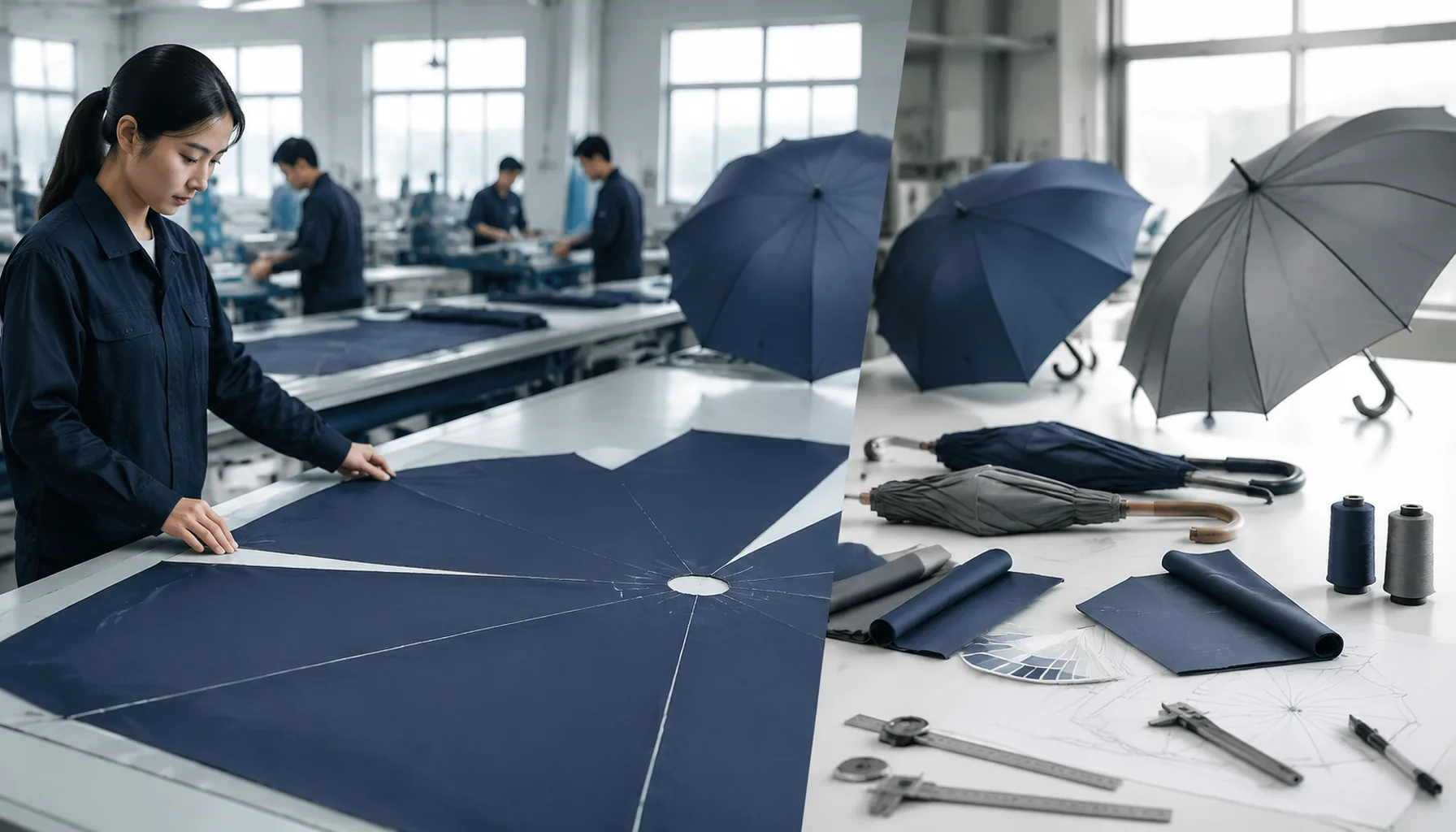
In bulk OEM umbrella production, a canopy that is 2 mm off at the cutting table can become a wrinkled, twisted, or short-cover frame after sewing and final assembly. Umbrella canopy cutting tolerances are not just a CAD number; they depend on fabric grain, lay height, blade sharpness, nesting direction, and how panels behave under stitching tension. On our Songxia factory floor, these controls decide whether an order runs smoothly or turns into rework, waste, and delayed inspection.
Why Cutting Accuracy Drives Canopy Fit
Cutting accuracy decides whether the canopy sits like a clean engineered surface or fights the frame after assembly. On an 8K umbrella, each panel carries more arc length, so a 2 mm error at the outer edge can show up as loose fabric between ribs or over-tension near the tips. On a 16K umbrella, the panels are narrower, but the error repeats more often; if half the pieces run long and half run short, the peak starts to twist and the seam lines no longer land evenly over the ribs. For bulk OEM umbrella production, our normal target for umbrella canopy cutting tolerances is ±1 mm on critical edges and ±2 mm on less visible hem allowance, checked before sewing. That sounds strict, but after seam allowance, top cap compression, rib-end binding, and final stretching, small panel variances multiply fast.
The main control point is not the cutting knife alone; it is the full canopy panel cutting setup. CAD fabric nesting must account for fabric direction, roll tension, coating drag, and shrinkage after printing or heat pressing. A 190T pongee panel behaves differently from 210T polyester with a silver UV coating, and POE or EVA clear panels need slower cutting because stacked material can creep under pressure. In umbrella factory QC, we measure panel width, arc, notch position, and peak angle using templates or digital calipers before bundles go to sewing. If the notches are off by even 1.5 mm, operators may still sew the canopy closed, but assembly workers will see uneven rib tension immediately when the 8K or 16K frame is opened. Accurate cutting keeps seam balance predictable, peak alignment centered, and the finished umbrella stable enough to pass AQL 2.5 inspection without rework.
Fabric Selection and Cutting Behavior
Fabric choice sets the real limit before the cutting table operator touches the marker. In bulk OEM umbrella production, 190T pongee is easier to spread than nylon because the yarns have a slightly drier hand and less spring-back after relaxation, but it can still creep if the stack is too high or the clamp pressure is uneven. 210T pongee has tighter construction, better water resistance after coating, and a cleaner premium feel, yet the denser weave increases drag on a straight knife and can pull small gores off-size if the blade is dull. Basic polyester oxford or low-cost polyester taffeta usually frays more aggressively on bias edges, while nylon slides more in the stack and shows shrinkage variance after heat-transfer printing or high-temperature sublimation. For umbrella canopy cutting tolerances, I do not treat “polyester” as one category; yarn count, finish, and coating weight change the behavior more than many buyers expect.
Canopy panel cutting is most stable when fabric is relaxed 12 to 24 hours after dyeing, coating, or printing, especially for 190T/210T pongee rolls packed under high tension. In our umbrella factory QC checks, we measure panel length, arc, notch position, and tip allowance before sewing because a 2 mm error at the panel edge becomes a visible twist after eight panels are joined on an 8K frame. CAD fabric nesting helps reduce waste, but the marker must respect grain direction; rotating panels only to save 1% fabric can create uneven stretch around the canopy, especially on 23 inch and 27 inch umbrellas. For pongee, I usually allow lower stack height than plain polyester when the order has logo registration near panel seams. For nylon, we reduce stack height again because layer slippage is the bigger risk than cutting speed.
UPF 50+ acrylic, black-out, silver, or PU coatings make the fabric stiffer and thicker, while DWR and Teflon finishes can make the surface slick enough that the top and bottom layers do not cut identically. This is where umbrella canopy cutting tolerances become a production discipline, not a drawing note. A 210T pongee with UV coating may need 20% to 30% lower stack height than uncoated 190T to keep the gore shape within ±1.5 mm, and coated nylon can require more frequent blade changes because the finish heats and gums the edge. Rotary cutting works well for sample panels, but bulk cutting usually depends on a straight knife, sharp dies, or automated CNC cutting depending on MOQ and design complexity. Our standard practice at ZheBrella is to record fabric shrinkage, coating side, blade-change interval, and first-piece dimensions before releasing the lay to sewing, then verify against AQL 2.5 inspection at final assembly.
CAD Nesting, Grain Direction, and Waste Control
CAD fabric nesting is where good cutting discipline starts, because a triangular umbrella panel looks simple but wastes fabric fast if the marker is lazy. For 190T or 210T pongee, we normally nest 8K, 10K, or 16K panels tip-to-base across a fabric width of 150–160 cm, leaving enough allowance for seam fold, hem, and rib-end reinforcement. The fabric grain must stay consistent around the umbrella; if one panel is rotated off-grain to save 2% material, the canopy can twist after sewing or show uneven tension when opened on a 23" or 27" frame. In OEM umbrella production, I tell buyers to treat umbrella canopy cutting tolerances as a functional issue, not just a costing issue. A typical tolerance of ±1.5 mm on panel edge length is workable for straight-color pongee, but printed panels and double-canopy windproof umbrellas usually need tighter marker control and first-piece confirmation before bulk cutting.
For all-over prints, nesting cannot be decided by yield alone. Sublimation patterns, heat-transfer graphics, and yarn-dyed stripes all behave differently when panels meet at the top notch and at the closing seam. If the buyer expects a continuous pattern around the umbrella, the CAD marker must lock panel orientation and sequence, even if fabric waste rises from 8% to 12–15%. Logo placement is even less forgiving: a centered 120 mm logo on one panel may pass AQL 2.5 visually, but if the panel apex is cut 2 mm short or the grain pulls diagonally, the logo will lean after sewing. Our standard practice at ZheBrella is to print a positioning grid on the first bulk sheet, cut one full canopy set, assemble it on the target frame, then approve the print-to-seam location before releasing the cutting table.
Double-canopy vented windproof layouts need separate nesting logic for the upper and lower layers. The top vent layer is shorter, often with overlap allowance of 25–40 mm depending on a 21", 23", 27", or 30" frame, and the lower canopy must keep clean airflow gaps without exposing ribs. Fiberglass ribs tolerate flex better than steel ribs, but poor canopy panel cutting can still overload one rib channel and reduce wind performance, even on umbrellas rated to survive 50+ mph in a wind tunnel. Buyers should ask the umbrella factory QC team for the CAD marker file, fabric utilization percentage, cutting tolerance standard, and a pre-production canopy photo showing logo position, vent overlap, and seam alignment. These checks matter more than saving a few cents on fabric, because cutting errors multiply across every sewing station and are expensive to correct after panels are bundled.
In-Process QC Before Sewing
The cheapest place to control umbrella canopy cutting tolerances is still the cutting table, not the sewing line and definitely not final inspection. For a 23" 8K umbrella, our usual in-process check is panel length, panel width at the crown and hem, bias direction, and arc consistency against the approved CAD pattern. A small panel error of 2-3 mm may look harmless on a single wedge, but multiplied across 8 or 10 panels it pulls the canopy off-center, creates puckering at the tip, or leaves one rib pocket sitting short. In OEM umbrella production, we normally check the first 30-50 panels after blade setup, then sample each fabric lay after cutting. If a die, CNC knife, or band-knife operator drifts, the whole bundle is quarantined before sewing tickets are released.
Notch marks need the same discipline as outer dimensions because sewing operators use them as their road map. Each panel should have clean crown notches, hem alignment marks, logo-center reference points, and rib seam matching points where the spec requires them. On printed 190T or 210T pongee, we also verify that canopy panel cutting has not shifted the logo into the seam allowance or rotated directional artwork panel by panel. CAD fabric nesting helps reduce waste, but nesting efficiency should never override grain direction, plaid alignment, reflective stripe position, or UPF-coated face orientation. For promotional umbrellas, I would rather lose 2% fabric yield than ship a canopy where every second panel makes the logo look twisted once stretched over the frame.
Color lot separation is a hard rule before panels reach stitching lines. Navy 190T pongee from two dye lots can pass under warehouse light and fail badly under daylight after the canopy is assembled, so bundles should carry roll number, dye lot, cutting date, and purchase order labels. Umbrella factory QC should compare panels under a light box or consistent D65 daylight lamp, especially for black, red, royal blue, and beige where shade variation is common. Our standard practice at ZheBrella is to keep suspect lots out of mixed-panel assembly unless the buyer signs a tolerance sample. AQL 2.5 final inspection will catch visible shade bands, wrong dimensions, and distorted canopies, but by then you have already paid for sewing, tips, straps, top caps, packing, and rework labor. Cutting defects are upstream defects; catching them early protects both lead time and margin.
How Cutting Specs Affect MOQ, Cost, and Lead Time
MOQ is not just a sales number; it is the point where cutting-room setup stops eating the order. In OEM umbrella production, a standard 23 inch, 8K umbrella in stocked 190T pongee can move quickly because the marker, die settings, and sewing allowance are already proven. Change that to a custom-dyed 210T pongee, a non-standard 27 inch golf pattern, or a 16K frame with narrower panels, and the cutting team must recheck panel arc, bias stretch, notch position, and seam allowance before bulk cutting. Good umbrella canopy cutting tolerances are usually controlled within about ±1.5 mm on panel edges and tighter at the tip and runner alignment points, because small errors multiply across 8, 10, or 16 panels. Low MOQ runs feel expensive because the same CAD fabric nesting, trial cutting, shade matching, and first-article inspection are spread over 300 pieces instead of 3,000 or 10,000 pieces.
Fabric yield is where many cheap quotes hide trouble. 210T pongee costs more than 190T, but the bigger issue is how artwork, grain direction, and panel shape affect usable meters per umbrella. Solid-color canopies allow tighter CAD fabric nesting, while sublimation artwork often requires directional placement, panel matching, and extra allowance for heat shrinkage after printing. If the design has edge-to-edge logos, gradient backgrounds, or repeated panel graphics, we may add 3% to 8% fabric waste compared with a plain canopy. POE, PVC, and EVA transparent canopies have different behavior again: they cannot be stacked and cut as aggressively as woven pongee because slipping, pressure marks, and cold cracking can show up later in umbrella factory QC. For this reason, a serious factory should quote cutting loss separately or at least build it into the BOM instead of pretending every roll converts at the same yield.
FOB and DDP prices should reflect the real calendar, not just the sewing time. A normal stocked-fabric order may sample in 5 to 7 days and produce in 25 to 35 days after approval, but custom color lab dips can add 7 to 12 days, bulk dyeing another 10 to 15 days, and sublimation strike-off approval often adds one full sample loop. At ZheBrella, we treat canopy panel cutting approval as part of pre-production control, especially when the order has UPF 50+ coating, Teflon treatment, or vented double-canopy construction that changes fabric handling. DDP quotes also need room for carton volume, destination duty, and inspection timing; an AQL 2.5 final inspection failure caused by poor cutting alignment can delay shipment more than the original cutting setup. Buyers comparing quotes should ask whether umbrella canopy cutting tolerances, fabric yield, sampling cost, and lead time assumptions are written into the offer, not discussed after the deposit is paid.
Frequently Asked Questions
What cutting tolerance should buyers specify for umbrella canopy panels?
For most OEM orders, ±1-2 mm per panel is a practical target before sewing. Tighter tolerances may be needed for full-panel artwork, 16K frames, or premium retail umbrellas.
Does 210T pongee require different cutting control than 190T pongee?
Yes. 210T pongee is denser and may cut cleaner, but coated fabrics can increase stack stiffness and blade wear. Factories should confirm panel size after cutting, not only after sewing.
What cutting tolerance should buyers specify for bulk umbrella canopy panels?
For most OEM polyester or pongee canopies, buyers commonly specify panel cutting tolerance within ±1.5 mm to ±2.0 mm after fabric relaxation. Tighter tolerances may be possible with automatic cutting, but they should be confirmed during pre-production sampling because fabric stretch and coating thickness affect final fit.
How can CAD fabric nesting reduce cost in an OEM umbrella order?
CAD nesting improves marker efficiency by arranging canopy panels to reduce offcut waste, especially for 6-panel, 8-panel, and double-canopy designs. A 2% to 5% fabric saving can be significant on large orders, but the nesting plan must still respect fabric grain direction and print alignment.
When should canopy cutting tolerances be checked during production?
Tolerances should be checked at fabric spreading, first-piece cutting approval, in-line panel inspection, and before sewing starts. For large orders, factories usually measure random panels from each cutting lot to catch blade drift, fabric shifting, or incorrect marker placement before thousands of canopies are assembled.
Looking to Launch Your Custom Umbrella Line?
ZheBrella is a Zhejiang-based OEM/ODM umbrella manufacturer with 17 years of export experience. Free design, low MOQ from 100 pieces, windproof construction, full-color print.
Get Free Quote Now »People Also Search For
Related Articles
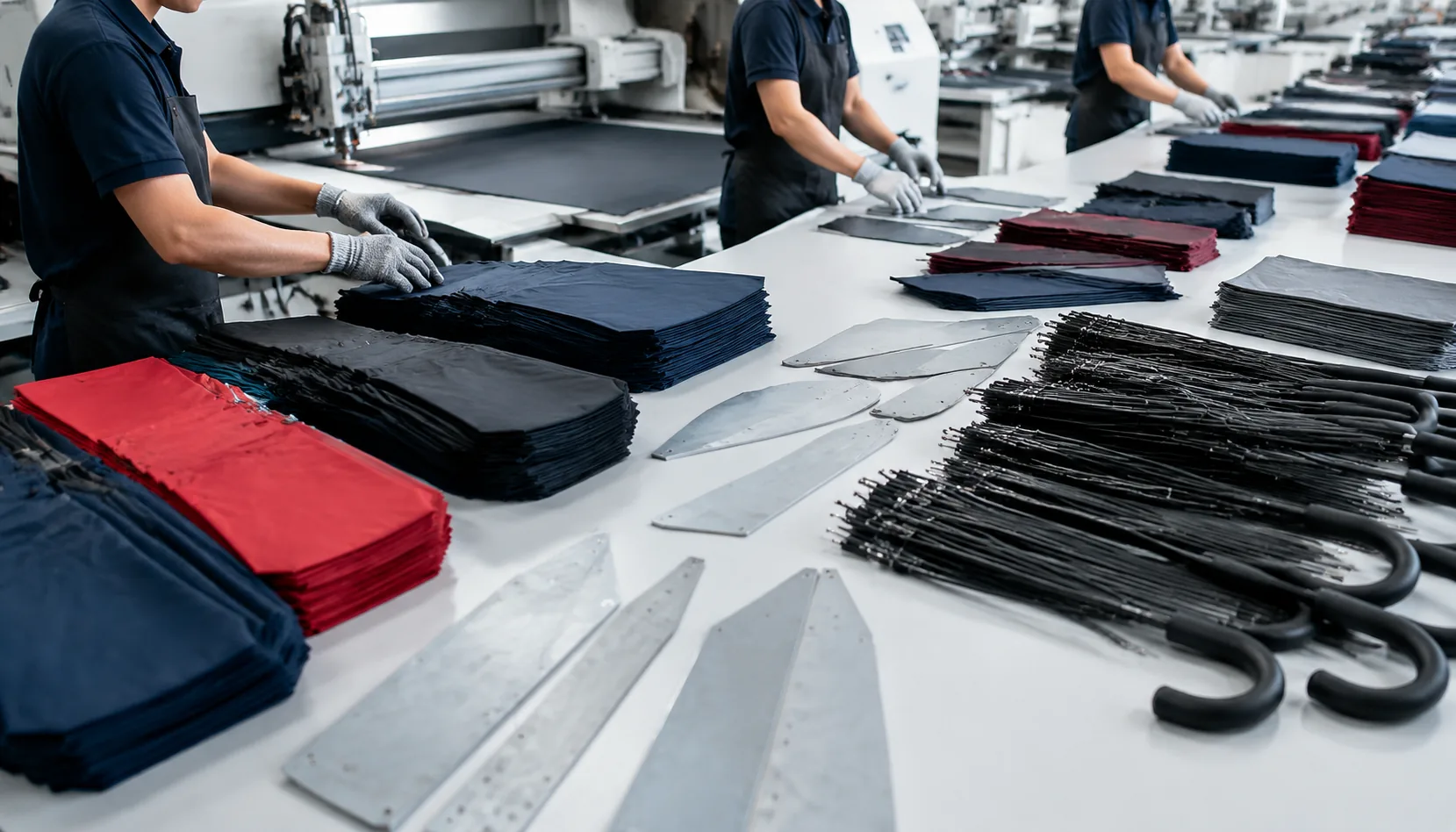
Umbrella Canopy Cutting: Panel Accuracy for Bulk Orders
Understand canopy cutting controls for 190T and 210T pongee, panel matching, shrinkage allowance, and print alignment in...
Read More »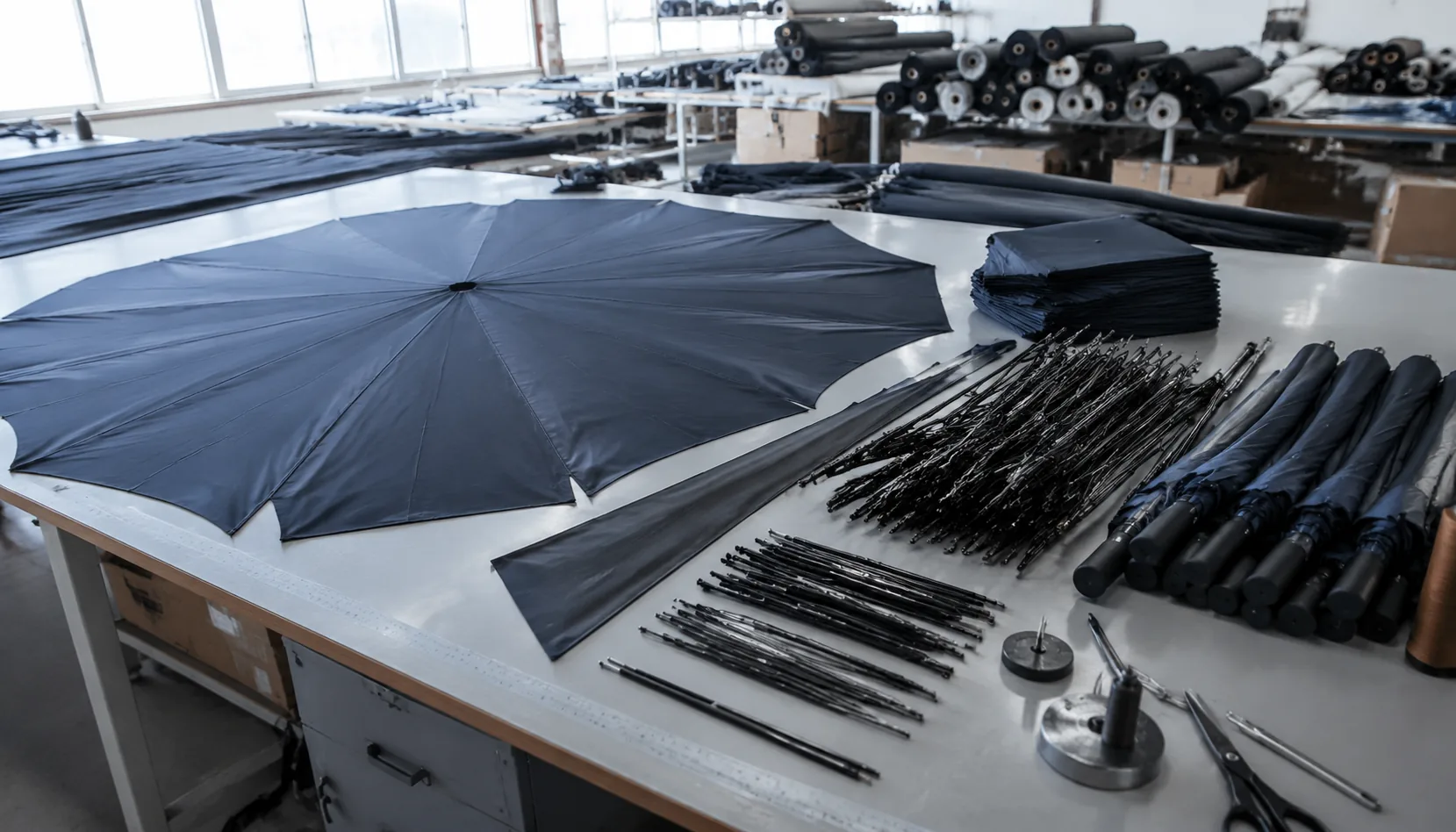
Umbrella Canopy Cutting Tolerances for Consistent Fit
Control panel cutting, fabric relaxation, and marker layout so 190T or 210T pongee canopies fit frames cleanly with fewe...
Read More »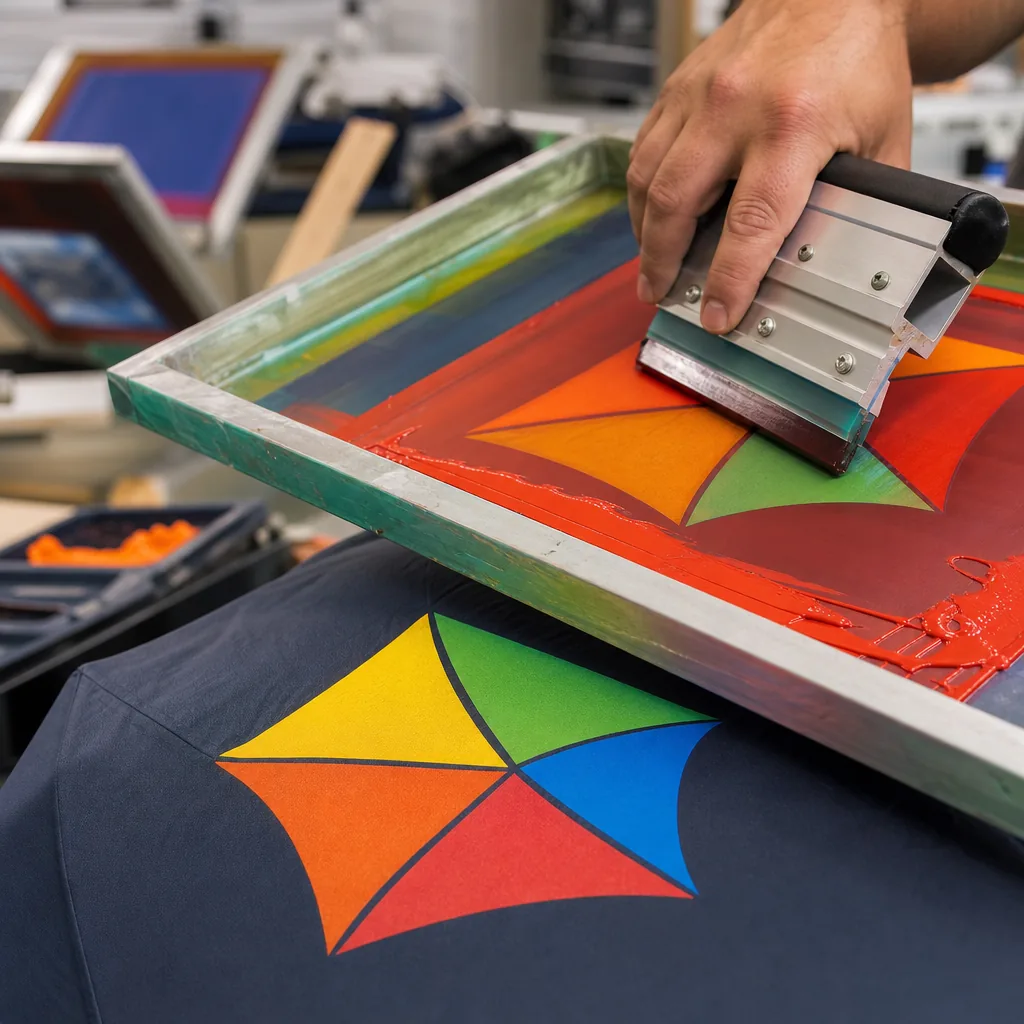
Panel Cutting Tolerances for Umbrella Production Lines
See how CNC patterns, fabric relaxation, +/-2 mm panel control, and shade-lot batching improve 190T/210T pongee canopy f...
Read More »