Umbrella Canopy Cutting Tolerances for Cleaner Logo Placement
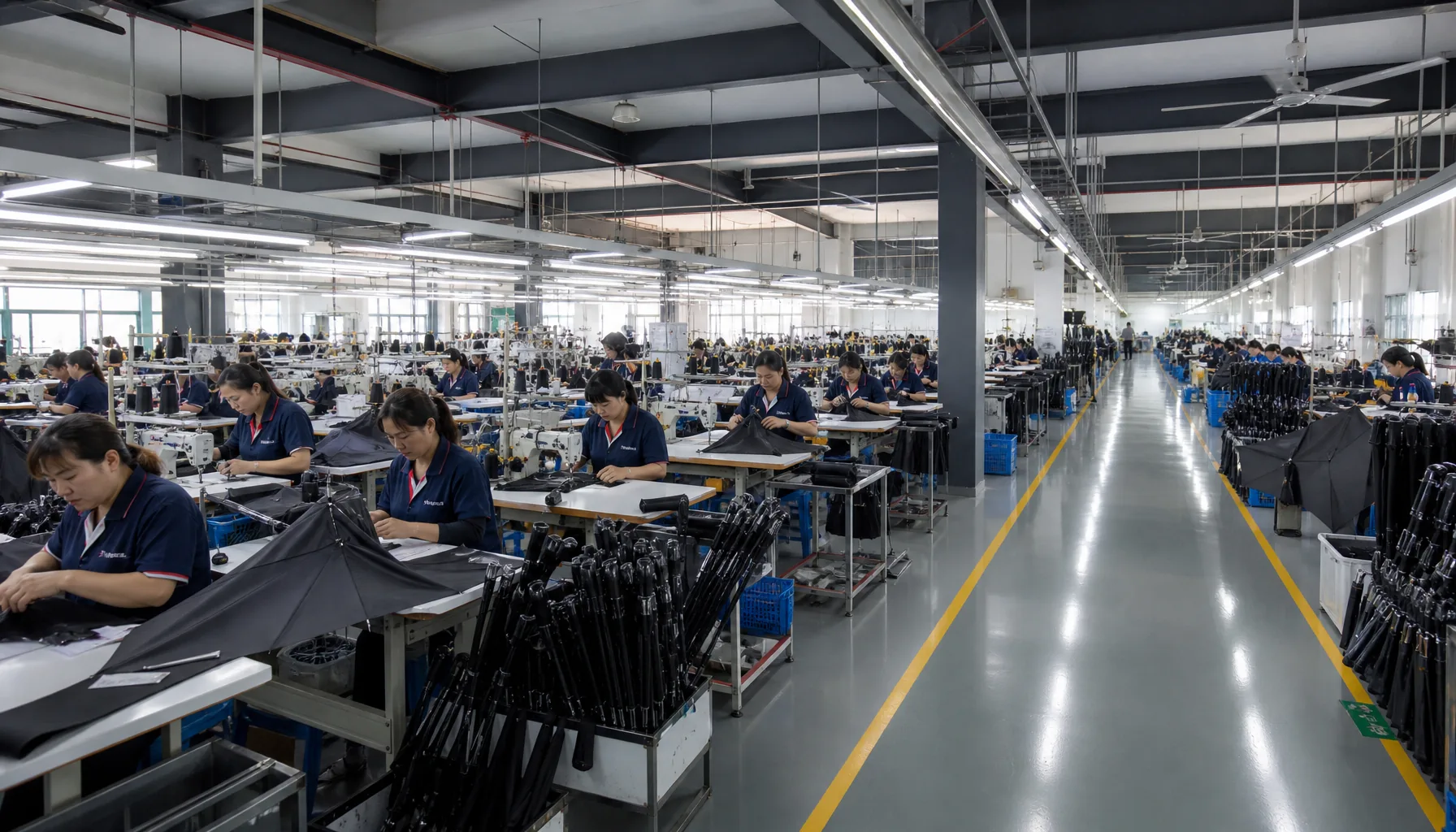
When a logo lands even a few millimeters off center on an umbrella, the whole piece can look unbalanced to the buyer and the end customer. That is why umbrella canopy cutting tolerances matter: in factory production, die cutting accuracy, fabric grain control, and consistent panel matching are what keep logos aligned, reduce canopy twist, and support AQL 2.5 inspection results.
Why Panel Cutting Accuracy Matters in OEM Umbrellas
In OEM work, umbrella canopy cutting tolerances are not a theory problem; they show up immediately once 8 panels are stitched around a frame. A 2 mm error at the panel edge can become a crooked top cap, an uneven hem, or a canopy that sits twisted on the shaft after assembly. That is why umbrella panel cutting has to be controlled by template, blade condition, lay direction, and fabric stretch, especially on 190T or 210T pongee where the weave can shift if the marker is sloppy. On a finished sample, the eye catches these mistakes faster than a caliper does: the tip points no longer land in the same circle, the seams wander, and the logo looks like it was printed on a moving target.
The logo problem is usually the loudest complaint. If the cut line is off, custom umbrella logo alignment drifts panel by panel, so a centered mark on the artwork file ends up one seam too far left or right once the canopy is sewn and tensioned. That is tolerable on cheap promotional umbrellas where the buyer only wants a rough brand hit, but retail-grade orders get inspected much harder because the visual center, panel symmetry, and seam-to-print relationship all have to look intentional. In pongee canopy production, we usually treat cutting and printing as one system: if the panel geometry is unstable, the print placement spec is meaningless, no matter how clean the screen or transfer looks.
For OEM umbrella quality, the practical rule is simple: control cutting before you blame sewing. Stable umbrella canopy cutting tolerances reduce rework in top cap riveting, hem folding, and final inspection because the canopy closes evenly and the panels share the load instead of fighting each other. ZheBrella’s standard practice is to check sample cut accuracy against the artwork repeat, then verify the first sewn canopy for symmetry before mass production starts. Buyers who need retail-level presentation should ask for tighter approval on panel patterns, seam allowance, and print location, because once the order moves into bulk cutting, fixing a bad layout costs more than rejecting a weak sample.
Fabric Preparation: Pongee Roll Control and Grain Direction
Clean logo placement starts before the die or CNC knife touches the cloth. In pongee canopy production, we first inspect incoming 190T and 210T polyester rolls for shade bands, oil marks, pinholes, coating streaks, and width variation; a 58-inch roll that drifts 8–10 mm across its width will create panel mismatch even if the cutting table is perfect. For OEM umbrella quality, our standard practice at ZheBrella is to unroll and relax fabric for 12–24 hours in the cutting room, especially after vacuum-packed export storage or winter trucking. Tensioned pongee shrinks back after cutting, and that movement can pull a printed logo 3–5 mm off center by the time the canopy is sewn onto an 8K or 10K frame.
Coating-side orientation is not a small detail. PU, PA, silver UV, black-out, and Teflon-treated pongee all behave differently under screen print, heat transfer, and sublimation; print on the wrong face and you may get poor ink bite, haloing, or uneven gloss after curing. We mark the face side at roll inspection and keep it consistent through spreading, panel cutting, printing, and sewing. Grain direction is controlled the same way: the warp direction should run consistently from crown to tip so each triangular panel stretches evenly when the canopy is pulled over ribs. If one panel is cut off-grain, the logo may look straight on the table but twist after final tensioning.
Good umbrella canopy cutting tolerances are impossible if shade, skew, and stretch are ignored. Before umbrella panel cutting, we check skew by aligning the selvage and cross-grain; more than about 1.5–2% distortion is risky for large one-panel or multi-panel logos. Color shading is separated by roll and batch, because a navy 190T panel from roll A and roll B may pass individually but look striped after sewing under daylight. Stretch is also tested by hand and with simple tension marks, since softer 210T pongee can grow during spreading if operators pull too hard. These checks protect custom umbrella logo alignment later, whether the job is spot-color screen print, heat-transfer film, or panel sewing before final AQL 2.5 inspection.
Cutting Methods, Dies, and Practical Tolerance Targets
Hand cutting is still common in low-volume umbrella canopy work, but it is the least repeatable method when you care about logo registration. A skilled cutter can stay close on a small run, yet the real-world spread on long curves and tip points usually widens once the order volume climbs or operators change stations. For bulk umbrella panel cutting, I would treat ±1.5 to ±2 mm on the panel edge as a practical target, with seam allowance held consistent from panel to panel; otherwise the sewing line drifts, the canopy twists slightly, and custom umbrella logo alignment starts looking off even before printing enters the picture. In pongee canopy production, that tolerance is tight enough for most 21" to 23" promotional umbrellas if the frame is stable and the sewing team is disciplined.
Die cutting improves repeatability because the blade path is fixed, so the panel shape stays consistent across cartons and shifts. For OEM umbrella quality, that matters more than people admit: if the die is sharp and the nesting is controlled, you get cleaner edge geometry, fewer notches at the tie points, and less variation in the seam line that throws off print placement. The downside is tooling cost and maintenance; once the die dulls or the fabric slips, the tolerance advantage disappears fast. On larger golf umbrellas, double-canopy builds, and especially 16K frames, panel matching needs to be tighter because any mismatch is multiplied across more ribs and longer seams, and the vent opening or overlap can expose a printing error immediately.
Automated cutting is the best option for high-volume programs because it holds pattern repeat more consistently, especially when the canopy artwork must land in the same visual zone across multiple SKUs. The machine itself does not solve everything, though: you still need accurate CAD compensation for fabric stretch, blade drag, and material shrink after heat sealing or coating. For umbrella canopy cutting tolerances, I push buyers to specify the target on the panel edge, the allowable seam variance, and the inspection method together; otherwise procurement compares only price and ignores fit. If the order includes full-panel graphics, reflective ink, or tight stripe-to-panel registration, the cutter spec should be written before sampling, not after the first production lot, because fixing misaligned artwork on sewn canopies is slow and expensive.
In-Process Checks Before Sewing and Frame Assembly
The fastest way to keep logo placement clean is to stop bad parts before they reach stitching. For umbrella canopy cutting tolerances, I want a hard stack height limit on every cut bundle, because once the pile gets too thick the knife drifts, the top and bottom panels no longer match, and the print center moves off by a few millimeters. In pongee canopy production, that small error shows up later as skewed seams, twisted panels, and extra labor during canopy stitching. Our standard practice is to lock the stack height, count every panel set immediately after cutting, and reject any bundle that does not match the order card before it is moved to sewing.
First-piece approval matters more than people think. The first set from each cutting lot should be checked for notch alignment, panel count, and key dimensions against the pattern, then signed off before the rest of the batch is released. If the notches are off, the umbrella panel cutting line is already losing registration, and custom umbrella logo alignment will suffer even if the print file is correct. Random measurement per bundle catches the slow drift that happens when blade wear, operator fatigue, or fabric slip starts to build; that is where OEM umbrella quality gets protected in a practical way, because you are comparing real cut pieces, not trusting the machine setting alone.
These checks pay off downstream because every bad panel creates work in three places: stitching, rib tying, and frame assembly. When a canopy panel is oversized or short, the sewer has to force the seam, the rib tip lands off-center, and the auto-open mechanism assembly picks up extra stress from a canopy that no longer sits square on the frame. I prefer a simple rule: if one bundle shows repeat error, stop and remeasure the next three bundles before continuing. That is usually enough to cut rework rates sharply and keep the canopy moving into sewing with dimensions that actually match the frame geometry.
How Buyers Should Specify Cutting Quality in the Tech Pack
Start with the finished arc size and do not hide behind “about 60 inches” language. For umbrella canopy cutting tolerances, the tech pack should state the finished arc, open diameter, panel count, panel width at the hem and top, and whether the measurement is taken on the sewn canopy or the cutting pattern. That matters because a 1–2 mm drift per panel becomes obvious after 8K or 10K assembly, especially on pongee canopy production where fabric stretch, bias direction, and heat-setting all affect the final shape. Buyers should also lock the color direction, face side, and any panel rotation before cutting starts, because a logo printed on the wrong grain looks off even when the artwork itself is correct.
For custom umbrella logo alignment, approve a panel template before bulk cutting and define the allowable placement window in millimeters from the panel centerline, hem, and seam. Good umbrella panel cutting is not just “cut to size”; it is matching every panel so the logo lands consistently across the canopy and does not wander after stitching and tensioning. I usually tell buyers to require a sealed pre-production sample with the exact fabric lot, print method, seam allowance, and rib count, then sign off on the actual physical sample instead of a PDF mockup. That sample should become the reference for any OEM umbrella quality dispute, because once the panel is cut and stitched, arguing over artwork intent is a waste of time.
The acceptance criteria should include AQL 2.5 visual standards for print registration, seam symmetry, edge fray, puckering, and panel-to-panel color shift, with clear photos of pass/fail examples in the tech pack. Under FOB or DDP terms, vague cutting specs usually turn into chargebacks, rework claims, or arguments about who owns the error after goods ship. Clear umbrella canopy cutting tolerances protect both sides: the factory knows the exact target, and the buyer has a measurable basis for inspection at pre-shipment or destination. If the order involves multiple canopy colors or mixed logo positions, put each SKU on its own cut sheet; that is the cleanest way to avoid confusion in production and in later quality claims.
Frequently Asked Questions
What panel cutting tolerance is realistic for bulk umbrella production?
For most OEM orders, ±1.5 to ±2 mm per panel is a practical target when using stable 190T or 210T pongee. Very large golf umbrellas, full-panel prints, and 16K frames may need tighter control and extra pre-production approval.
Can cutting tolerance affect windproof umbrella performance?
Yes. Uneven panels can create unbalanced canopy tension, which stresses fiberglass ribs, steel stretchers, and double-canopy vents during wind testing. Good cutting accuracy helps the frame open evenly and reduces premature rib deformation.
What panel cutting tolerance is typically used for custom umbrella canopies?
For branded umbrellas, many factories target about ±2 mm per panel to keep logo placement consistent. Tighter control is especially important on 8-panel and 10-panel canopies where small errors can shift the print position across panels.
Why does fabric grain direction matter for umbrella logo alignment?
If the pongee grain is off, the canopy can stretch unevenly during sewing and tensioning, which can rotate the logo off center. Keeping grain and cut direction consistent helps reduce twist and improves repeatability in bulk production.
Can tighter cutting tolerances help with AQL 2.5 inspection results?
Yes. Better panel consistency reduces defects like misaligned logos, uneven seams, and canopy distortion, which are common quality issues in AQL 2.5 checks. It does not guarantee a pass, but it lowers the risk of inspection failures in mass production.
Looking to Launch Your Custom Umbrella Line?
ZheBrella is a Zhejiang-based OEM/ODM umbrella manufacturer with 17 years of export experience. Free design, low MOQ from 100 pieces, windproof construction, full-color print.
Get Free Quote Now »People Also Search For
Related Articles
Umbrella Canopy Panel Cutting Tolerances for OEM Production
Learn how panel cutting tolerances, fabric relaxation, and die control affect canopy fit, print alignment, leak risk, an...
Read More »
Umbrella Canopy Cutting Tolerances for Accurate Panel Fit
Set canopy cutting tolerances for 190T/210T pongee panels, print alignment, seam allowance, and frame fit to reduce wrin...
Read More »
Umbrella Canopy Cutting Tolerances for Consistent Fit
Control panel cutting, fabric relaxation, and marker layout so 190T or 210T pongee canopies fit frames cleanly with fewe...
Read More »