Umbrella Fabric Cutting and Marker Planning for OEM Lots
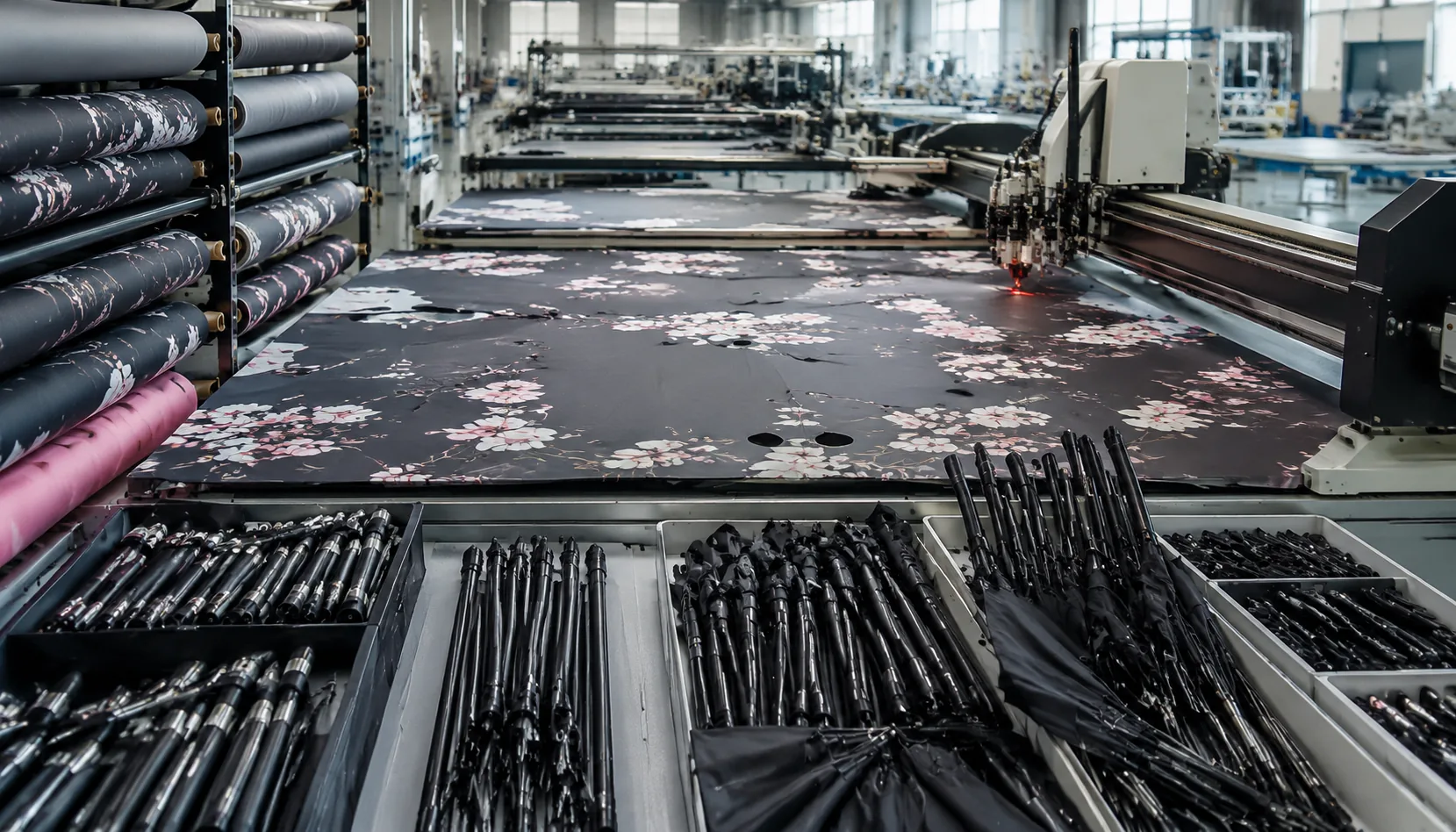
In OEM umbrella lots, canopy problems usually start before sewing: a loose marker, uneven fabric spread, or ignored grain direction can turn 190T/210T pongee panels into wavy ribs and mismatched seams. On our Songxia cutting floor, we control umbrella fabric cutting tolerances by checking ply tension, die sharpness, panel orientation, and first-piece measurements before the bulk stack moves forward. That discipline keeps color runs, seam alignment, and finished canopy shape consistent across thousands of pieces.
Fabric Selection Before Cutting
Lab dips and strike-offs should be locked before umbrella marker planning, not after the factory has already nested panels for yield. Our standard practice at ZheBrella is to freeze the approved lab dip, coating spec, fabric weight, print method, and Pantone tolerance before PP sample sign-off, then assign roll lots against that approval sheet. If a buyer changes from 190T to 210T pongee, or from virgin polyester to RPET, the marker has to be checked again because panel elongation, print registration, and cutting stack height all change. For retail OEM lots, I prefer one color lot per PO line, one approved roll report per shade, and a documented shrinkage result attached to the cutting ticket. That discipline protects canopy panel consistency and keeps AQL 2.5 final inspection focused on real workmanship issues instead of avoidable shade, size, or seam alignment problems created at the cutting table.
Marker Planning and Panel Yield
Good marker planning starts with the panel geometry, not with the fabric roll. A standard 23" straight umbrella uses 8 triangular canopy panels, while a golf umbrella or premium fashion frame may use 16 narrower panels to get a smoother dome and better print registration. In pongee canopy cutting, we usually nest left and right panel shapes head-to-tail across 190T or 210T rolls, keeping the warp direction consistent from tip to skirt so the canopy does not twist after sewing. If the buyer allows random grain, yield looks better on paper, but the finished umbrella often shows uneven tension between ribs, especially on fiberglass 8K and 16K frames where the canopy is pulled harder in wind testing. For OEM umbrella production, I like to see grain direction marked in the tech pack with arrows, not buried in a note, because cutting-room operators follow visual instructions faster and with fewer disputes.
For logo umbrellas, yield is secondary to repeat control. Screen-printed panels can tolerate a little more nesting freedom because each panel is printed after cutting, but sublimation and full-panel heat transfer require repeat alignment before the knife touches the fabric. With all-over artwork, umbrella marker planning must lock the crown point, rib seam lines, and skirt edge to the print repeat; otherwise, one panel may show the logo 8 mm higher than the next after assembly. On 16-panel designs, the problem gets worse because small artwork drift repeats sixteen times around the canopy. Our standard practice at ZheBrella is to cut a pilot set first, sew one complete canopy, then measure canopy panel consistency at the crown, middle arc, and hem before releasing bulk cutting. AQL 2.5 inspection will catch obvious mismatches, but it is cheaper to control the marker than to reject sewn canopies.
Buyers should confirm umbrella fabric cutting tolerances in the tech pack before sampling, because “standard tolerance” means different things in different factories. For regular solid-color pongee, a practical allowance is usually ±2 mm on panel edges, ±3 mm on hem length, and ±5 mm on non-critical logo position after sewing. For repeat sublimation, I would tighten visual alignment to ±2–3 mm at seam joins and define whether the tolerance is measured on cut panels or on the finished canopy. PVC, POE, and EVA clear canopies need different allowances because the material stretches less than pongee but marks more easily under clamp pressure. If the order uses UPF 50+ coating, Teflon finish, or heavy 210T fabric, buyers should also confirm shrinkage testing after printing and steaming. Clear umbrella fabric cutting tolerances prevent arguments later, especially when MOQ is 1,000–3,000 pcs and recutting fabric can push lead time by 5–7 days.
Cutting Methods and Tolerance Control
Cutting method should follow MOQ, fabric behavior, and print registration risk, not factory habit. For sampling and small OEM umbrella production runs under 300–500 pcs, hand cutting with paper patterns is still practical because setup is fast and revisions are cheap; we normally allow tighter operator supervision instead of expensive tooling. For 1,000–5,000 pcs, die cutting is the workhorse for pongee canopy cutting, especially 190T and 210T polyester, because one strike controls the arc, seam allowance, and tip angle across stacked layers. Above 5,000 pcs, CNC knife cutting makes sense when there are mixed sizes such as 21", 23", 27", and 30" in one PO, or when the buyer needs frequent panel shape changes. Laser cutting is clean on some coated polyester and promotional shapes, but I do not like it for PVC, POE, or EVA canopies because heat can harden edges, distort transparent film, or leave odor that fails incoming retail checks.
Real umbrella fabric cutting tolerances must be checked at the panel edge, notch, center point, and tip end before sewing starts. For standard 8K and 10K umbrellas, we target panel edge variation within ±1.5 mm on 190T pongee and keep notch alignment within ±1.0 mm so the sewer can hit the rib pocket consistently. On large golf umbrellas, especially 30" double-canopy vented windproof models with fiberglass ribs, ±2.0 mm may be realistic because the panel arc is longer and fabric relaxation is more visible after cutting. The bad factories only measure the top panel in a stack; the bottom layers tell the truth about knife drag, fabric creep, and clamp pressure. For printed orders, umbrella marker planning must also consider logo position after hemming, because a 3 mm cutting drift can become a very visible crooked panel once the canopy is tensioned on the frame.
Batch control starts with first-piece approval, not final inspection. At ZheBrella, our standard practice is to cut one full canopy set from the approved marker, sew it onto the correct 8K/10K/16K frame, and check canopy panel consistency before releasing bulk cutting. The inspector compares panel-to-panel symmetry, notch-to-rib alignment, tip cup position, and finished canopy tension; if the first umbrella pulls off-center, the marker or stack height is corrected before another bundle is cut. For solid-color pongee, stack height can usually be 60–120 layers depending on fabric slipperiness and blade sharpness; for sublimation panels or all-over matched graphics, I prefer lower stacks and bundle numbering to protect print sequence. Under AQL 2.5, cutting defects are expensive because sewing hides them until assembly, so every batch should record marker version, fabric roll number, cutting table, operator, and first-piece signoff time.
In-Process Checks Before Sewing
The most important check before sewing is not stitch quality; it is whether the cutting room has handed sewing a complete, matched, correctly oriented bundle. For 8K, 10K, or 16K umbrellas, operators count panels by rib set and size before any overlock work starts: a 23" 8K stick umbrella needs eight equal canopy panels, while a 30" golf umbrella may use a different panel geometry and wider seam allowance. In OEM umbrella production, we normally bundle panels by PO, style, size, color, print position, and cutting layer number, then attach a barcode or bundle ticket so the sewing line can trace defects back to the marker table. If one panel is missing, duplicated, or mixed from another shade lot, the defect often appears only after final canopy mounting, when rework is slow and expensive.
Shade matching and coating-side orientation are checked panel by panel because pongee canopy cutting can hide mistakes inside a neat bundle. 190T and 210T pongee often show a face-side color difference under fluorescent light versus daylight, especially on navy, black, burgundy, and coated promotional colors. For Teflon, PU, silver UV, or black UV UPF 50+ coatings, the wrong side facing out changes water repellency, print adhesion, and customer appearance. Inline QC usually pulls samples from the head, middle, and tail of each cut stack, then compares them against the approved fabric swatch and production sample. On printed panels, the check includes logo direction, heat-transfer placement marks, sublimation registration, and whether vented double-canopy top and bottom panels are separated correctly for sewing.
Seam allowance is where small cutting errors become frame problems. Our standard practice at ZheBrella is to verify umbrella fabric cutting tolerances with a steel template or acrylic gauge before panels enter stitching, usually checking the crown point, bottom hem curve, rib seam edge, and notch position. A 2 mm shortage on each panel can make the finished canopy too tight on fiberglass ribs, reducing the intended flex during a 50+ mph wind test; the same error on steel ribs can pull tips inward and create visible puckering between rib pockets. Excess fabric is not harmless either, because loose canopy panels flap, collect water, and fail appearance checks under AQL 2.5 inspection. Good umbrella marker planning reduces these failures by controlling fabric grain direction, bowing, layer slippage, and panel nesting so canopy panel consistency is built in before sewing starts.
Buyer Specs That Prevent Rework
The fastest way to prevent rework is to lock the cutting spec before fabric booking, not after the first canopy comes off the sewing line. Procurement teams should state the exact fabric and construction: 190T or 210T polyester pongee, recycled pongee, nylon, POE, PVC, EVA, or coated fabric such as Teflon water-repellent or UPF 50+ UV. For pongee canopy cutting, shrinkage and coating behavior are different from clear POE or heavy PVC, so the marker cannot be copied blindly from another model. The spec should also define finished canopy diameter, not just umbrella size: for example, a 23-inch 8K straight umbrella may need a finished arc and open diameter target, while a 30-inch golf umbrella with 8K or 10K fiberglass ribs needs larger seam allowance and more careful bias control. Good umbrella fabric cutting tolerances normally state panel edge tolerance, notch location, grain direction, and acceptable variation after sewing, because the cutting table is where canopy panel consistency is either protected or lost.
Logo position tolerance must be written in millimeters from a fixed reference point, usually panel centerline, bottom hem, or rib seam, not described as “visually centered.” For screen printing and heat transfer, I prefer buyers to specify ±3 mm for normal promotional umbrellas and tighter only when the artwork crosses seams or repeats across multiple panels. Sublimation on white 190T pongee needs a different approval mindset because print distortion can come from heat pressing as well as cutting. In OEM umbrella production, the sample approval stage should include one printed pre-production sample made from bulk fabric, cut with the approved marker, then assembled on the correct frame: manual, auto-open, or auto-open-close. Approving artwork on a flat fabric swatch is not enough. Once the canopy is tensioned over steel or fiberglass ribs, a small panel mismatch becomes obvious at the peak, tips, and logo line.
AQL 2.5 inspection points should include cut panel size, panel symmetry, seam allowance, notch alignment, logo position, color shading between panels, and finished open diameter. For umbrella marker planning, the factory also needs to know whether the buyer prioritizes fabric yield or visual alignment; stripe, plaid, border-print, and all-over logo designs often require lower marker efficiency to keep panels consistent. Our standard practice at ZheBrella is to freeze the marker after sample approval and record the CAD layout, fabric roll width, layer height, blade type, and bundle numbering method before mass cutting. That control protects lead time because rejected panels are replaced before sewing, not discovered after 5,000 finished umbrellas are packed. Clear umbrella fabric cutting tolerances also reduce arguments at final inspection: if the PO says panel tolerance is ±2 mm and logo tolerance is ±3 mm, the QC team can judge defects against the same standard the cutting room used, instead of stopping shipment over subjective appearance complaints.
Frequently Asked Questions
What cutting tolerance should buyers specify for umbrella canopy panels?
For most OEM umbrellas, buyers should define both panel edge tolerance and logo placement tolerance in the tech pack. The exact value depends on canopy size, 8K or 16K construction, fabric stretch, and whether the design uses all-over printing.
Does 210T pongee require different cutting control than 190T pongee?
Yes. 210T pongee is denser and can feel more stable, but coatings, rolling tension, and print process still affect cutting accuracy. Factories should verify shrinkage and panel fit during PP sample approval before bulk cutting.
What cutting tolerance is acceptable for OEM umbrella canopy panels?
For 190T and 210T pongee canopies, many OEM factories control panel cutting within about ±1–2 mm, depending on umbrella size and seam allowance. Tighter tolerance is important for automatic sewing, symmetric rib tension, and consistent canopy shape across bulk lots.
Why does marker planning matter for custom umbrella orders?
Marker planning controls fabric yield, grain direction, logo placement, and panel consistency before cutting starts. For printed or coated pongee, poor marker layout can cause mismatched panels, skewed artwork, higher fabric waste, and slower production approval.
Can mixed umbrella sizes be cut in the same production lot?
Yes, but factories usually separate markers by canopy size, panel shape, and fabric specification to avoid tolerance issues. If one PO includes several sizes, cutting plans are normally grouped by model and color, with bulk lead time adjusted for extra spreading and inspection steps.
Looking to Launch Your Custom Umbrella Line?
ZheBrella is a Zhejiang-based OEM/ODM umbrella manufacturer with 17 years of export experience. Free design, low MOQ from 100 pieces, windproof construction, full-color print.
Get Free Quote Now »People Also Search For
Related Articles
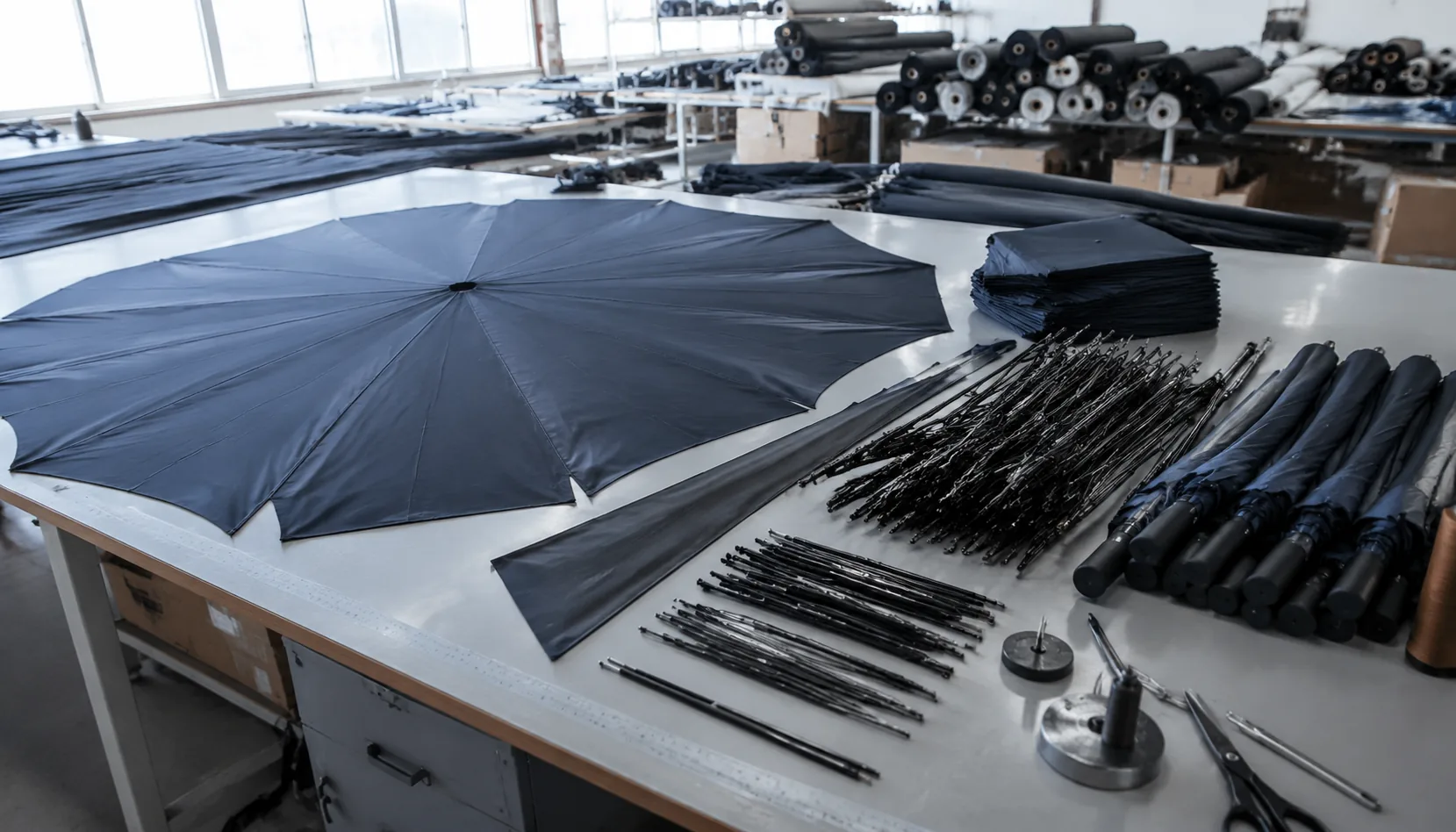
Umbrella Canopy Cutting Tolerances for Consistent Fit
Control panel cutting, fabric relaxation, and marker layout so 190T or 210T pongee canopies fit frames cleanly with fewe...
Read More »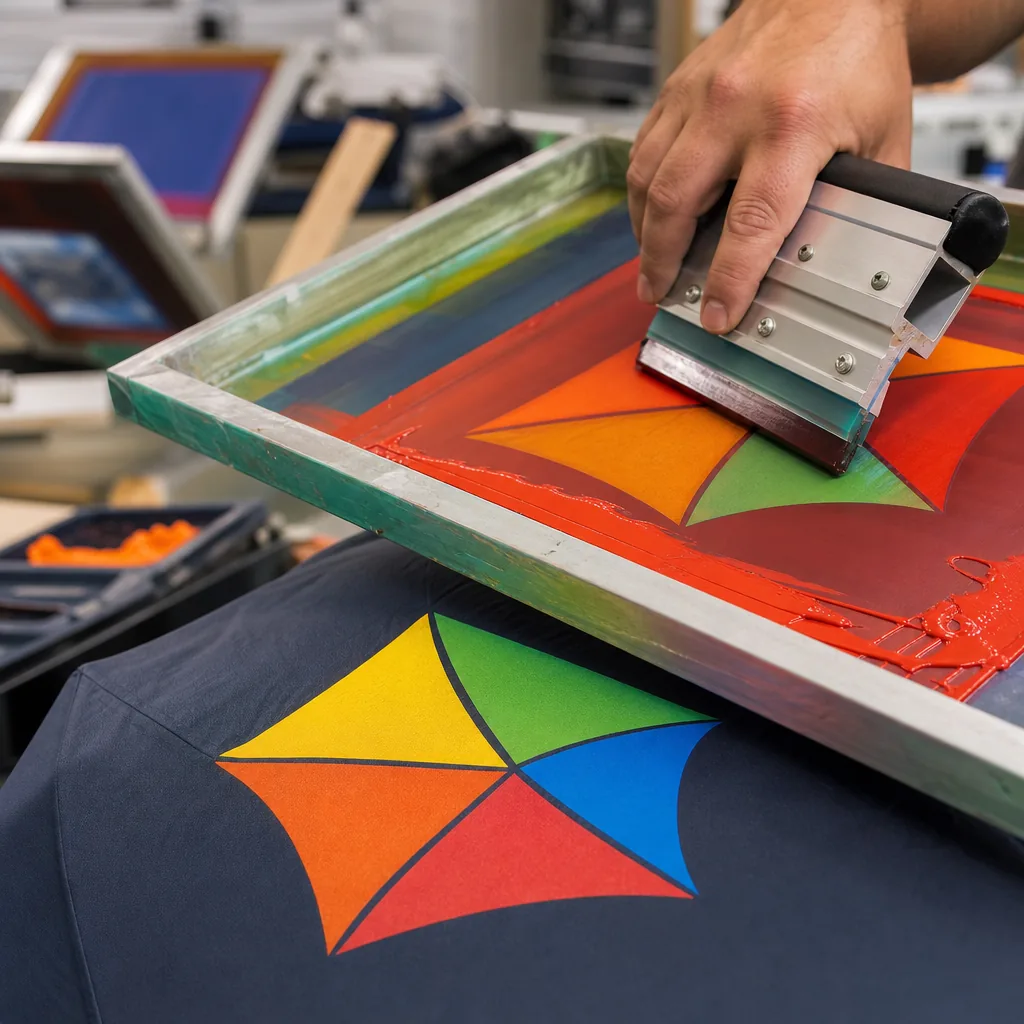
Panel Cutting Tolerances for Umbrella Production Lines
See how CNC patterns, fabric relaxation, +/-2 mm panel control, and shade-lot batching improve 190T/210T pongee canopy f...
Read More »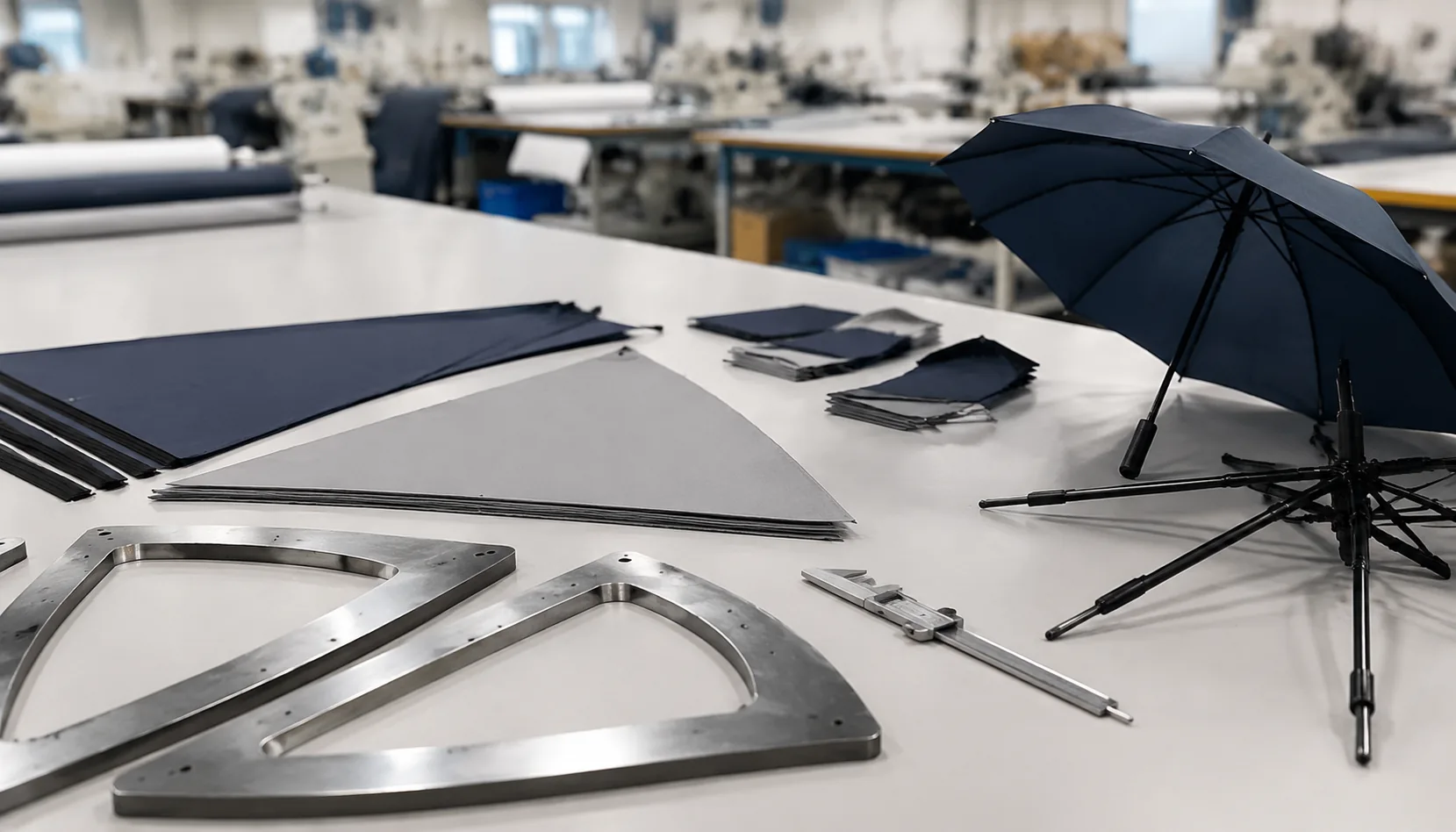
Umbrella Panel Cutting Tolerances for Consistent Canopy Fit
Learn how panel cutting tolerances, fabric lot control, and sewing allowances keep OEM umbrella canopies tight, aligned,...
Read More »