Umbrella Final Assembly Line Setup for Bulk OEM Orders
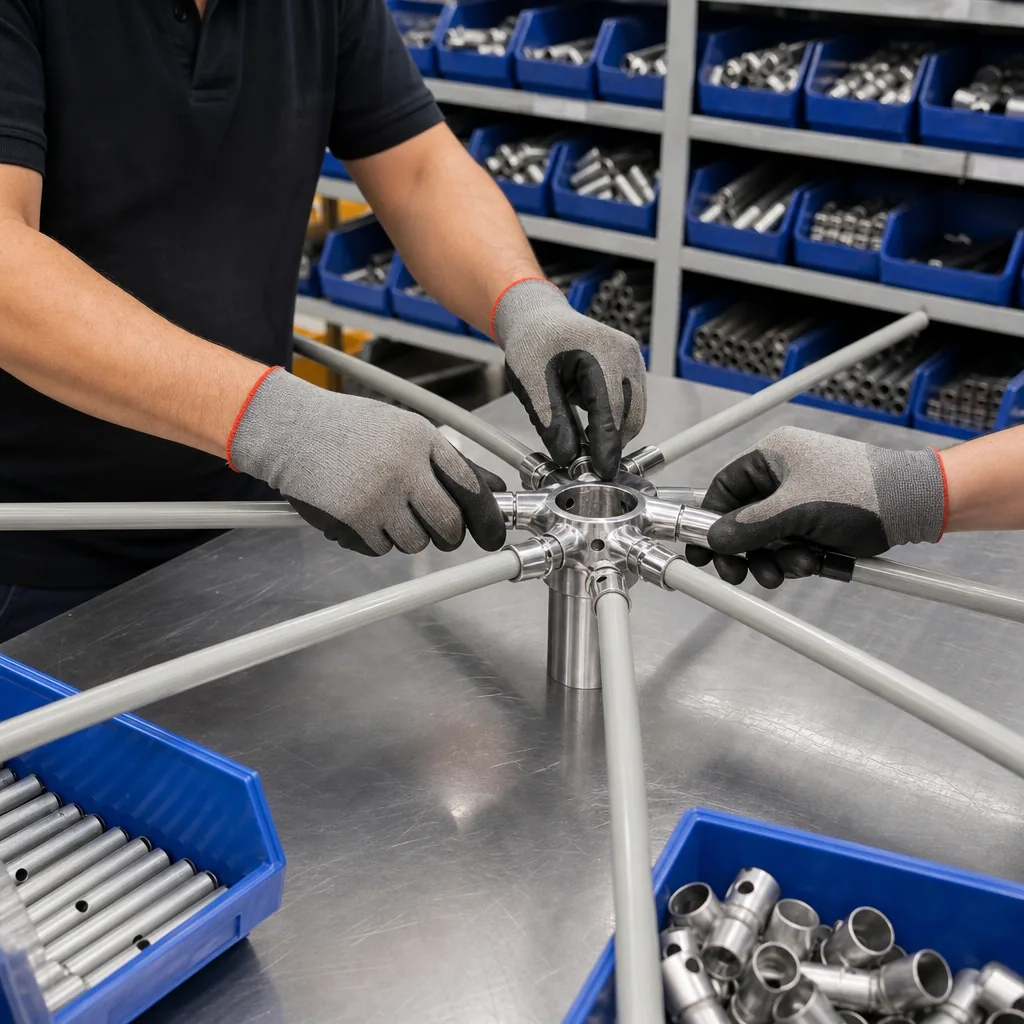
For bulk OEM orders, the risk is rarely one bad operator; it is an umbrella assembly line setup that lets small misses move too far before anyone catches them. On our floor in Songxia, we balance rib fitting, runner locking, canopy fixing, tip work, and final packing around clear station targets and in-line QC gates, so output stays steady without hiding defects until carton inspection.
Mapping the Main Assembly Stations
A good umbrella assembly line setup starts with separating noisy metal work from clean fabric handling. For bulk umbrella production, I normally map the flow as frame preparation, canopy loading, sewing or hand-tacking, tip fixing, handle installation, functional testing, labeling, and final packing. Frame preparation includes checking shaft straightness, runner movement, spring position, rib symmetry, and stretcher rivets before the canopy ever touches the frame. On common 23" and 27" straight umbrellas, 8K steel frames move fastest, while 10K or 16K fiberglass rib sets need a slower prep station because rib tension varies more and poor alignment will show at the canopy edge. Canopies are usually pre-cut and sewn from 190T or 210T pongee, POE, PVC, or EVA, then bundled by color, logo version, and size. In OEM umbrella manufacturing, mixing canopy lots is one of the easiest ways to create shade variation, especially on navy, black, and sublimation-printed panels.
Canopy attachment is the real bottleneck, not packing. Workers first align the top notch, then fix the canopy to rib tips using plastic tips, metal tips, or sewn pockets depending on the design. For promotional 21" folding umbrellas, tip fixing is often faster than for 30" golf umbrellas because the fabric span is smaller, but tolerances are tighter on folding ribs and mistakes wrinkle the edge immediately. After tip fixing, the cap, ferrule, or top cover is installed, followed by handle installation using press-fit, screw, adhesive, or riveted construction. Wood crook handles and EVA foam golf handles need different fixtures than straight plastic J handles. Our standard practice at ZheBrella is to place in-line umbrella QC immediately after handle installation, not only at final inspection, because loose handles, misaligned caps, and skipped tip stitches are cheaper to correct before labels, sleeves, and cartons are already matched to the order.
Line layout changes sharply by mechanism. Manual umbrellas can run in a straight conveyor-style sequence because workers only need to confirm smooth open-close movement, canopy tension, and no rib crossing. Auto-open umbrella assembly needs an extra mechanism-setting station for spring preload, button travel, shaft lock engagement, and runner release; if the button is too stiff, customers blame the whole product even when the canopy and frame are fine. Auto-open-close umbrellas require the slowest line, with added checks for reverse spring reset, telescopic shaft locking, and safe closing force, especially on 21" and 23" compact models. For windproof double-canopy umbrellas, I add a vent alignment station before final function testing so the upper canopy does not twist under 50+ mph wind-tunnel simulation. Final QC should sample to AQL 2.5, but critical defects such as sharp rib ends, failed opening, broken buttons, and wrong logo placement should be treated as zero-tolerance before FOB or DDP shipment.
Balancing Labor, Output, and MOQ
Daily output is not a fixed number on a whiteboard; it is calculated from the slowest operation in the umbrella assembly line setup. A basic 23" 8K straight umbrella with steel shaft, steel ribs, manual runner, and 190T pongee canopy can move fast because the frame is simple, the canopy has fewer sewing stress points, and final closing is easy. In our Songxia workshops, one balanced line of 18 to 24 workers can often finish 2,500 to 3,500 pieces per day for this type, assuming cartons and hangtags are standard. Change that to a 27" golf umbrella with 8K fiberglass ribs and EVA handle, and the line slows because rib tips, runner travel, and canopy tension need more checking before packing. A 16K double-canopy vented windproof model is slower again; more ribs mean more tie-down points, more cap alignment issues, and more chances for twisted panels after opening.
Mechanism type changes the labor math more than many buyers expect. Manual umbrellas are forgiving because the assembler can feel frame resistance during runner movement, but auto-open umbrella assembly requires spring preload consistency, button testing, and safer handling at each station. Auto-open-close compact umbrellas are slower still: the center shaft, spring cassette, runner lock, and reset force all have to match, or the unit fails after a few cycles. For bulk umbrella production, I usually estimate 20% to 35% less daily output when moving from manual to auto-open, and another 15% to 25% loss for auto-open-close compact designs. If the buyer specifies 10K or 16K fiberglass ribs, double-canopy construction, Teflon water-repellent coating, or UPF 50+ blackout fabric, the sewing and final inspection stations must be staffed heavier than the handle-fitting station, otherwise WIP piles up before in-line umbrella QC.
MOQ is tied to this balancing work, not just fabric purchasing. For OEM umbrella manufacturing, a 1,000-piece order with four canopy colors, individual polybags, retail sleeves, barcode labels, and drop-test cartons may consume almost the same setup time as a 5,000-piece run, so the unit cost looks worse. Packaging complexity can reduce output by 10% to 30% if every umbrella needs a color box, warning insert, silica gel, inner carton count, and Amazon-style FNSKU label. Our standard practice at ZheBrella is to confirm output after a pre-production sample and a 50-piece pilot run, then lock the daily target and AQL 2.5 inspection plan before mass production. A realistic umbrella assembly line setup protects delivery dates: 8K straight umbrellas may ship in 25 to 35 days, while 16K vented windproof OEM styles with custom printing often need 40 to 55 days before FOB Ningbo or Shanghai handoff.
Tooling, Fixtures, and Operator Training
The fastest way to lose consistency in bulk umbrella production is to let each operator “feel” the assembly by hand with no fixture reference. For a proper umbrella assembly line setup, we use canopy alignment jigs that lock the shaft center, rib tips, and fabric notch positions before sewing or final tying. On a 23" straight umbrella, even a 3 mm canopy offset can create uneven panel tension, visible twisting at the top notch, or one rib that sits proud after closing. For 8K and 10K models, the fixture is usually a round indexing plate with rib-location marks; for 16K golf umbrellas, we add wider support arms so the pongee 190T or 210T canopy does not sag during tip fixing. Transparent POE and PVC canopies need softer clamping pads because pressure marks show immediately, while EVA tolerates more handling but stretches if pulled too hard.
Handle fixing deserves more control than many buyers realize, especially in OEM umbrella manufacturing where the same frame may carry wood, EVA foam, rubber-coated plastic, or straight PP handles across different orders. For manual and auto-open umbrella assembly, we set either torque-controlled screwdrivers or pneumatic press depth stops depending on handle design. A J-handle with a self-tapping screw may need 8–12 kgf.cm torque, while a straight golf handle pressed onto a 14 mm shaft needs a controlled insertion depth so the release button stays aligned. If the handle sits 1.5 mm too high, the runner can bind; if it sits low, the top spring travel changes and the umbrella opens harshly. Our standard practice at ZheBrella is to confirm the first 20 pieces after any handle, shaft, or spring-lot change before releasing the station for full output.
Operator training should be written into station checklists, not left as a supervisor’s memory. For in-line umbrella QC, each station needs three kinds of checks: visual defects, fit defects, and functional resistance. Fabric operators should reject oil stains, yarn pulls, color shading, pinholes in coated UPF 50+ or Teflon-treated fabric, and misprinted logos before the canopy reaches frame tying. Frame operators should check loose tips, cracked plastic end caps, bent steel ribs, splintered fiberglass ribs, missing safety caps, and uneven stitch pull at the rib pockets. Auto-open operators must be trained to feel abnormal spring resistance: a healthy 21" or 23" auto-open should load smoothly, while grinding, delayed release, or excessive thumb force usually means runner burrs, weak button alignment, or a wrong spring batch. These checks keep AQL 2.5 inspection from becoming a repair department at the end of the line.
In-Line QC Gates Before Final Inspection
The cheapest defect to fix is the one caught before the umbrella becomes a finished umbrella. In a serious umbrella assembly line setup, the first QC gate sits right after frame assembly, before any sewn canopy is mounted. Inspectors should check rib count and symmetry on 8K, 10K, or 16K frames, rivet tightness, runner travel, spring force, shaft straightness, and tip alignment. For steel ribs, we look for bent stretchers, burrs around rivets, and weak plating at hinge points. For fiberglass ribs, we flex-test samples because cracked glass fiber can pass visual inspection but fail during the first windy use. On auto-open umbrella assembly, the release button, spring compression, and safety catch must be tested before the canopy hides half the mechanism. A 2% to 3% in-line sample at this stage prevents a full batch of 23" or 27" umbrellas from reaching final inspection with structural defects that cannot be repaired cleanly.
The second QC gate belongs after canopy sewing, not after the canopy is already fixed to the frame. This is where bulk umbrella production often loses money: crooked panels, uneven seam allowance, missed backstitching, wrong logo direction, or heat-transfer marks that only become obvious when the umbrella is opened. For 190T and 210T pongee, inspectors should check panel tension, stitch density, binding tape, vent construction on double-canopy windproof styles, and whether UV UPF 50+ or Teflon-coated fabric has been scratched during handling. POE, PVC, and EVA canopies need separate checks for crease whitening, cold-crack risk, and ink adhesion after printing. Our standard practice at ZheBrella is to keep approved pre-production samples at the sewing line, not in the office, so operators compare color, logo position, panel sequence, and trim details in real time. This kind of in-line umbrella QC reduces subjective arguments later when a buyer’s inspector measures defects against the signed sample.
The final two gates should happen after the complete opening test and again before carton sealing. Every umbrella should be opened and closed at least once; for premium OEM umbrella manufacturing, we prefer two cycles on manual, auto-open, and auto-open-close mechanisms because weak springs, loose caps, tight runners, and canopy twist show up immediately. Windproof models should include batch sampling for inversion recovery, especially double-canopy vented umbrellas claimed to survive 50+ mph wind-tunnel conditions. Before carton sealing, QC must verify hangtags, polybags, barcode labels, inner carton counts, master carton marks, desiccants, and mixed-color ratios against the packing list. This last gate is not cosmetic bureaucracy; it directly lowers AQL 2.5 rejection risk during pre-shipment inspection. If inspectors find wrong cartons, missing labels, oil stains, or opening failures at PSI, the shipment may need 100% rework, delaying FOB loading or DDP delivery by 3 to 7 days. Good in-line control keeps final inspection boring, which is exactly what buyers should want.
Production Data Buyers Can Request
Carton packing photos are not decoration; they protect delivery planning. Buyers should ask for images of inner polybags, hangtags, master carton marks, carton dimensions, gross weight, net weight, packing quantity, barcode labels, and pallet loading if applicable. For FOB shipments, this lets the forwarder confirm CBM, container loading plan, and cut-off timing before the goods reach Ningbo or Shanghai port. For DDP delivery, the same data supports customs declaration, carton handling, last-mile warehouse receiving, and chargeable weight control. Daily production and packing updates also make lead-time control more honest: if final assembly is 80% complete but packing is only 30%, the shipment is not ready. A disciplined umbrella assembly line setup should give buyers enough data to make decisions before the ex-factory date, such as splitting a shipment, approving overtime, holding a defective lot, or changing carton marks before export documents are issued. That is how production reporting becomes a logistics tool, not just a status update.
Frequently Asked Questions
How does auto-open assembly affect production speed?
Auto-open umbrellas usually require more function testing than manual umbrellas because the spring, runner, and latch must work consistently. This can reduce line output and add QC time.
When should in-line QC start during bulk production?
In-line QC should start with first-piece approval at line setup, not after the first cartons are packed. Early checks help catch canopy alignment, rib tension, and mechanism issues before they spread across the order.
What output target is realistic for a bulk OEM umbrella assembly line?
For a trained manual line, a realistic target is often 800 to 1,500 finished umbrellas per 8-hour shift, depending on the model complexity, frame type, printing method, and packaging requirements. Auto-open and windproof models usually require more station checks than basic straight umbrellas.
Where should in-line QC gates be placed during umbrella assembly?
Common QC gates are after frame fitting, canopy attachment, auto-open function testing, handle installation, and final packing. For OEM shipments, factories typically check opening/closing function, fabric alignment, rib tension, logo position, and carton labeling before final AQL inspection.
How much time should be planned before mass assembly starts?
Buyers should allow time for pre-production samples, material inspection, and line trial production before bulk assembly. For most OEM umbrella orders, mass production usually starts after sample approval and material readiness, with total lead times commonly around 30 to 45 days depending on order size and customization.
Looking to Launch Your Custom Umbrella Line?
ZheBrella is a Zhejiang-based OEM/ODM umbrella manufacturer with 17 years of export experience. Free design, low MOQ from 100 pieces, windproof construction, full-color print.
Get Free Quote Now »People Also Search For
Related Articles
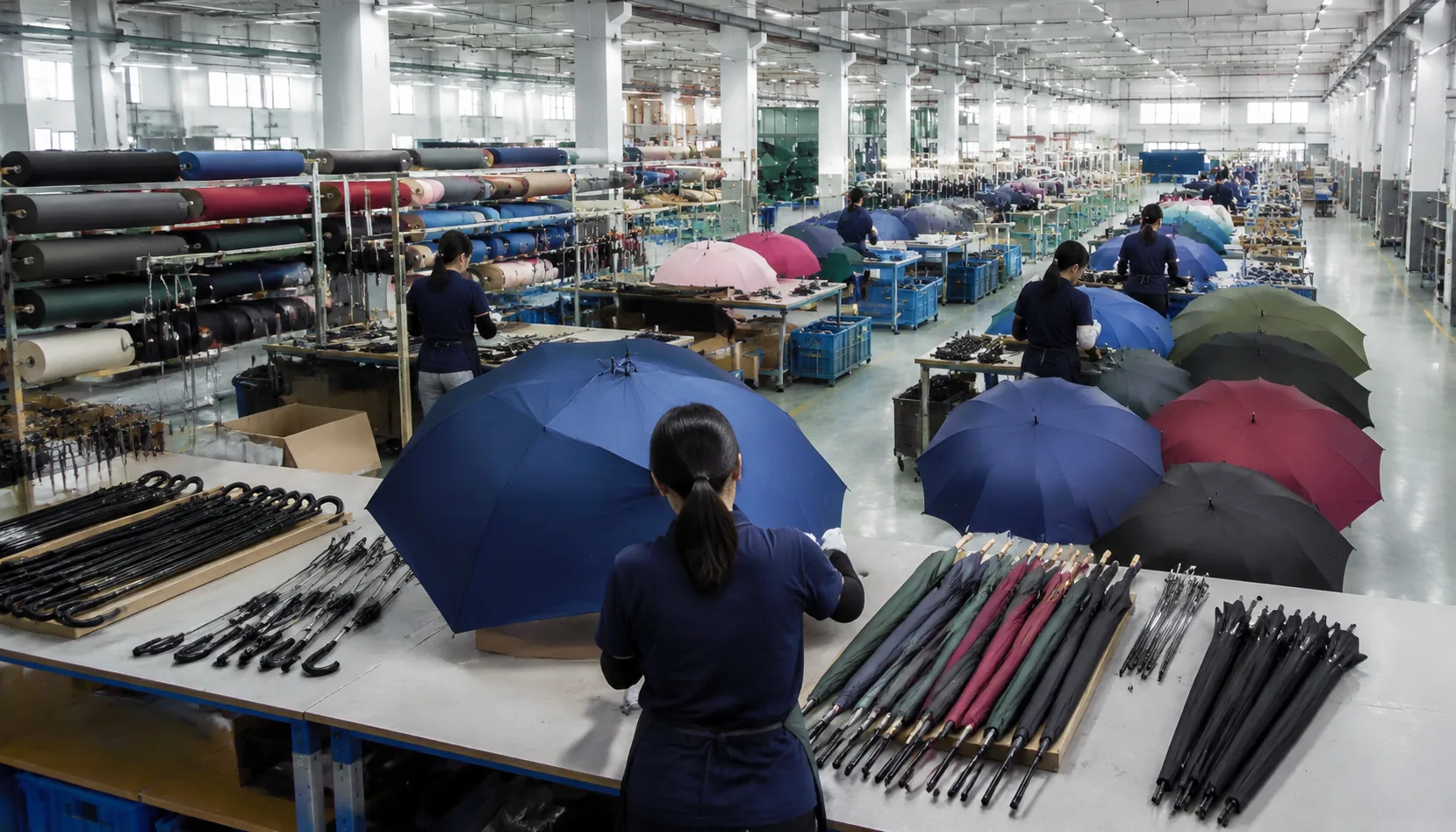
Umbrella Factory Line Setup for Mixed-SKU OEM Orders
See how factories plan mixed-SKU umbrella lines, balance frame assembly, canopy sewing, printing, QC, and packing to red...
Read More »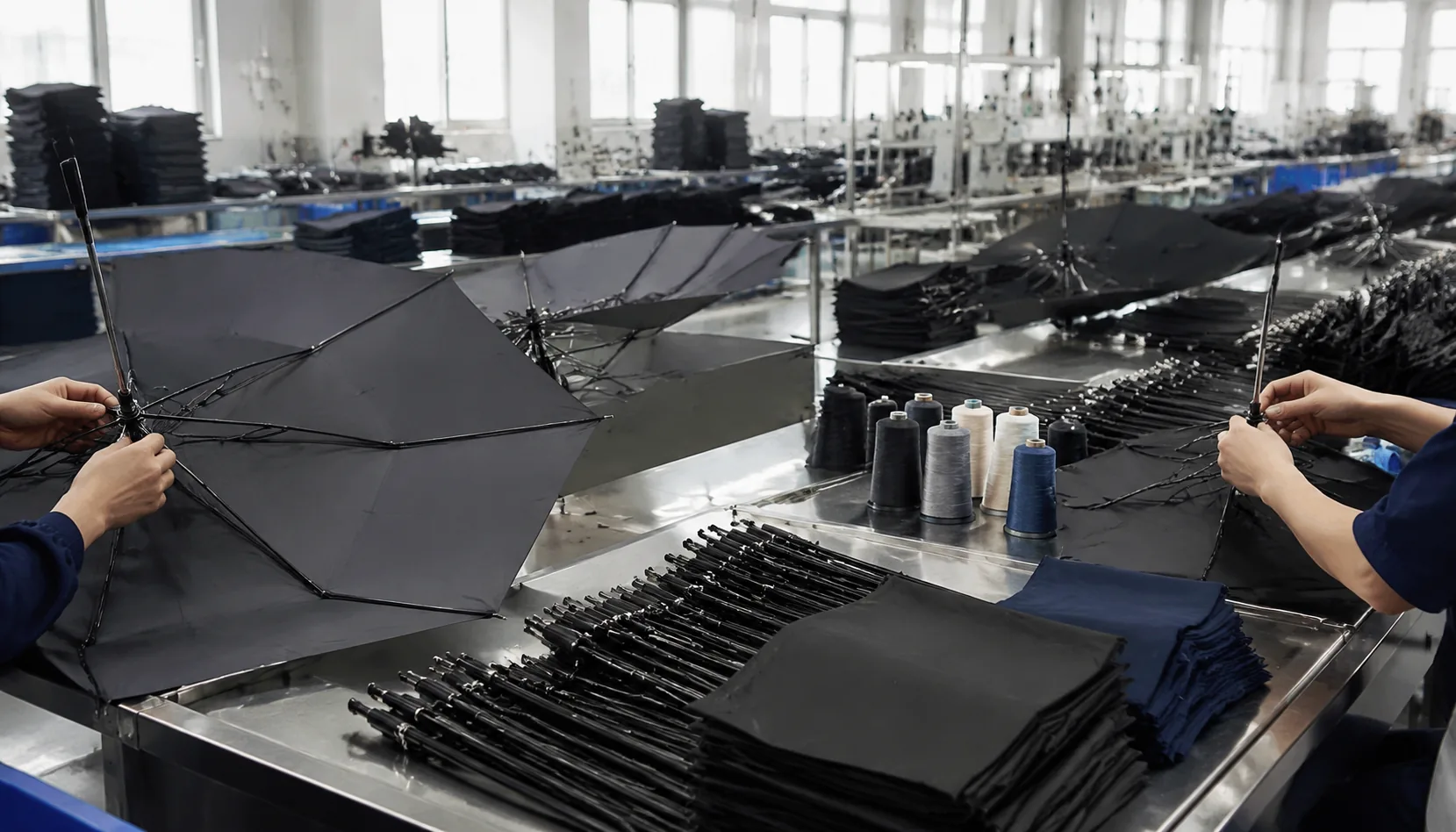
Umbrella Assembly Line Balancing for OEM Production
Plan umbrella assembly stations, labor allocation, and QC gates to keep bulk OEM orders on schedule without sacrificing ...
Read More »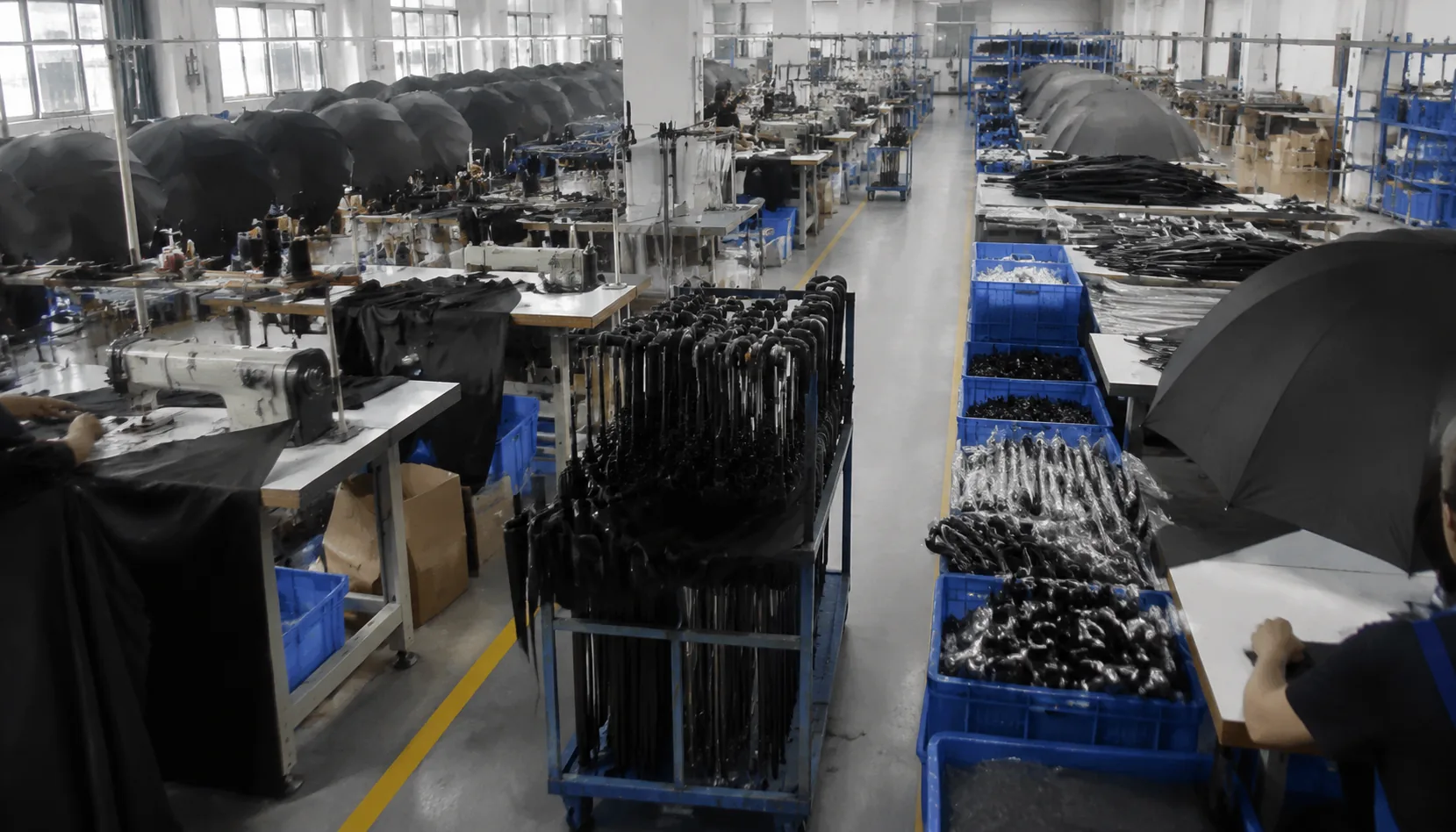
Umbrella Production Line Balancing for Bulk OEM Orders
Understand how balanced cutting, sewing, frame assembly, QC, and packing lines improve umbrella lead times and reduce bo...
Read More »