Umbrella Pack-In Cards That Build Brand Recall
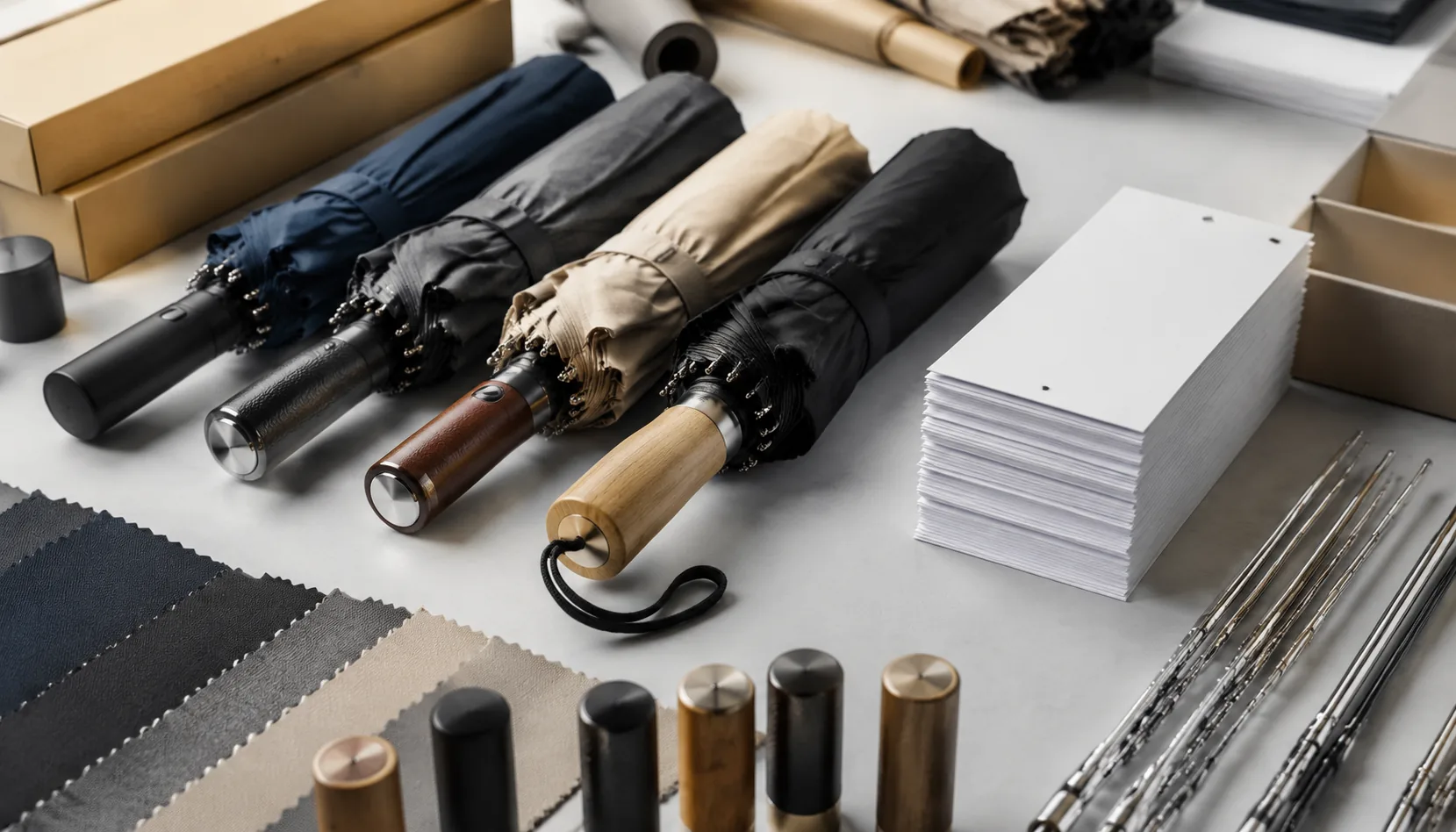
Buyers often treat umbrella pack-in cards as a small print item, but on the factory floor they affect packing speed, carton accuracy, gift presentation, and even claim handling after delivery. When a card carries care instructions, warranty steps, QR brand stories, or a next-order offer, it must fit the folded umbrella, stay clean through polybagging, and pass retailer compliance checks without slowing the line.
Why Inserts Matter After Unboxing
The card inside the sleeve is often the last branded touchpoint a buyer sees before the umbrella goes into a car, office drawer, golf bag, or hotel closet. That makes umbrella pack-in cards more useful than most hangtags, which are usually torn off and thrown away at the counter. For retailers and private-label brands, I prefer a compact 90 x 55 mm or 100 x 70 mm insert printed on 300–350 gsm coated paper, because it survives the wet-hands reality of umbrella use better than thin flyer stock. The front should confirm the product promise in plain terms: 23" auto-open, 190T pongee, fiberglass ribs, vented windproof canopy, UPF 50+ coating, or whatever was actually built. The back should give the buyer one clear next action, not five. A QR code for registration, a reorder link, or a care guide works better than a crowded block of brand copy that nobody reads after unboxing.
Warranty and care information are the two inserts that reduce avoidable after-sales friction. Umbrella warranty cards should define coverage tightly: frame failure, handle defects, spring mechanism issues, seam separation, and coating problems are legitimate; storm abuse, crushed shafts, and canopy tears from sharp objects are not. For corporate gifting, this matters because the recipient rarely knows the procurement contact or purchase channel. A QR-based claim form tied to batch number, PO number, or carton mark helps the distributor trace issues back to production without asking the end user for invoice details. Umbrella care cards also prevent complaints that are really usage problems: dry the canopy open before storage, rinse salt spray after coastal events, do not force an auto-open-close mechanism by hand, and avoid leaving PVC or POE umbrellas folded wet in a hot trunk. These instructions sound basic, but they cut mildew, coating transfer, and bent-rib returns.
For retention, branded umbrella inserts should connect the physical product to a landing page built for the buyer type. A retail umbrella branding program can send consumers to care videos, review prompts, matching rain accessories, or loyalty signup. A promotional distributor can use the same QR code to route HR teams or event planners toward reorder forms for 500, 1,000, or 3,000 units before the next campaign season. Our standard practice at ZheBrella is to keep the insert language separate from factory QC data, but we often print a small batch code so AQL 2.5 inspection records, fabric lots, and frame assembly dates remain traceable if a claim comes in. For DDP projects, especially Amazon FBA or chain retail, the insert also needs to match country language and compliance expectations. A clean card can do warranty, care, registration, and reorder work without making the umbrella package feel like a paperwork bundle.
Card Content Buyers Should Specify
The most useful umbrella pack-in cards are not mini brochures; they are operating instructions with enough brand context to stay in the customer’s drawer. Buyers should specify a tight content map before artwork starts: one short brand story, one “how to open and close” block, one safety block for auto-open or auto-open-close mechanisms, one care block, one warranty block, and one customer-service block. For a 21" folding umbrella, the opening instructions should mention shaking the 190T or 210T pongee canopy loose before pressing the button, because a compressed wet canopy can overload the runner and spring. For 23" and 27" stick umbrellas, note whether the frame is fiberglass, steel, or mixed construction, since care expectations differ. I prefer diagrams over long copy: a three-step sequence for manual, auto-open, or auto-open-close models prevents returns better than a paragraph of legal wording. Branded umbrella inserts should also include QR codes, but the printed card must still stand alone if the buyer never scans it.
Safety and performance claims need exact language, not decoration. If the umbrella has a double-canopy vented windproof structure, explain that the upper canopy lets gusts escape while the lower canopy keeps rain coverage; do not simply write “storm proof.” If the frame uses 8K fiberglass ribs and has passed an internal 50+ mph wind-tunnel or fan-gust test, state the test condition and avoid implying the umbrella cannot invert. For UPF 50+ models, specify whether the rating comes from black coating, silver coating, or tested fabric construction, and keep the claim tied to the canopy only. Umbrella care cards should tell users to dry the canopy fully open, wipe POE/PVC/EVA panels with a soft cloth, and avoid storing a wet umbrella inside a sleeve for days. Our standard practice at ZheBrella is to ask buyers to approve technical wording at the same time as canopy artwork, because a nice insert with loose claims can create warranty problems later.
Warranty wording should be written like a service policy, not a slogan. Umbrella warranty cards need the coverage period, covered defects, exclusions, proof-of-purchase requirement, claim channel, and response time; for example, “12 months against manufacturing defects in ribs, shaft, runner, handle, and stitching; excludes storm damage, misuse, loss, and normal wear.” Add batch code, PO number, or production date if the buyer wants traceability through AQL 2.5 inspection records. Customer service contacts should include email, website, QR code, and market-specific distributor details for retail umbrella branding, especially for FOB orders where the importer handles after-sales service. For promotional programs, keep the card smaller and more direct: campaign message on one side, instructions and support on the other. Well-specified umbrella pack-in cards reduce preventable complaints, support compliant claims, and make the product feel intentional after the customer has thrown away the outer polybag or retail hangtag.
Paper, Finish, and Size Options
The safest sizes for umbrella pack-in cards are the ones that survive packing without curling, hiding, or slowing the line. For stick umbrellas, we usually see 90 x 54 mm business-card size, 100 x 70 mm care-card size, and 105 x 148 mm A6 for richer storytelling. For 21" and 23" folding umbrellas packed in sleeve bags, 90 x 54 mm or 85 x 55 mm slides cleanly into the sleeve without creating a bulge. For retail umbrella branding in a PET box or color carton, A6 gives enough space for a QR code, warranty terms, UPF 50+ coating explanation, windproof frame note, and care instructions in 6- to 8-point legal text. I avoid odd shapes unless the order is above 10,000 pieces, because die-cut waste and slower insertion add cost. If the card must hang from the handle, use a drilled hole plus cotton string or elastic loop, not thin plastic tag pins that can scratch plated J-handles or soft-touch straight handles.
Stock weight changes the way a buyer reads the product before opening the umbrella. 250 gsm art card is fine for basic promotional 190T pongee umbrellas where the insert is only a thank-you note or QR registration card. 300 gsm feels more stable and is our standard practice at ZheBrella for branded umbrella inserts, especially when the umbrella has fiberglass ribs, auto-open-close mechanism, or Teflon coating and the card needs to match that perceived value. 350–400 gsm is better for retail cartons, gift campaigns, and umbrella warranty cards, but it adds weight and can increase freight slightly on 20,000–50,000 piece programs. Recycled paper works well for eco-positioned RPET pongee or POE clear umbrellas, but uncoated recycled stock absorbs ink more aggressively, so black text stays readable while fine gradients look duller. For AQL 2.5 inspection, we check card count, placement, scuffing, registration, and barcode readability along with canopy print and frame function.
Finish should be chosen for the selling channel, not because it looks good on a sample table. Matte lamination is practical and hides fingerprints, while soft-touch lamination gives a premium handfeel but can scuff if umbrella care cards rub against metal tips or zipper pulls during sea shipment. Spot UV is useful for a logo, rain-drop graphic, or QR callout, but heavy UV coverage can warp lighter 250 gsm cards. Foil stamping in gold, silver, or black works best on 300–400 gsm stock and makes premium gift umbrellas feel more expensive, especially with double-canopy vented windproof models rated around 50+ mph. The tradeoff is tooling and setup: foil dies, spot UV screens, and lamination each add cost and usually 2–4 production days after artwork approval. For FOB Ningbo or Shanghai orders, plain CMYK cards are the cost leader; for DDP retail launches, I recommend one controlled finish, not three, because consistency matters more than decoration.
Matching Cards to Umbrella Specifications
Handle and mechanism language should match how the umbrella is used day to day. A wooden crook or straight wooden handle supports a classic, giftable message, but the card should remind users not to leave it soaking in a car trunk or damp entryway because varnish and grain can swell. EVA handles are better for golf, outdoor staff, and wet-grip use; the card can honestly position them as lightweight, comfortable, and less slippery. Manual-open umbrellas need a simple instruction line about pushing the runner until it locks, while auto-open and auto-open-close models need clearer safety wording: point away from the face, press once to deploy, and fully reset the shaft before closing again. Umbrella warranty cards should separate defects from misuse, such as bent steel ribs from forced closing or broken auto shafts from partial reset. Our standard practice at ZheBrella is to review insert copy against the final BOM before mass packing, because one wrong line can turn a useful insert into a claim trigger.
Approval Workflow and Packing Control
Approval has to lock the card before the umbrella goes into final packing, not after cartons are sealed. For multilingual umbrella pack-in cards, I prefer a two-step proof: first a PDF layout proof showing trim size, bleed, QR code position, warranty language, recycling marks, and translations; then a physical pre-production sample placed inside the actual polybag, sleeve, or retail box. Spanish, French, German, Arabic, and Japanese text can look correct on screen but fail in print because of line breaks, font substitution, or right-to-left layout mistakes. For branded umbrella inserts tied to a promotion, every language version should carry a revision code such as US-EN-V03 or EU-MULTI-V02, printed in 5–6 pt text on the back corner so QC can identify it without opening a dispute over artwork files.
Carton-level version control is where factories often lose discipline. If a 23-inch auto-open umbrella ships to three retailers with different umbrella warranty cards, the master carton needs a matching version mark on the carton label, packing list, and internal work order. Mixed inserts inside one PO are possible, but they slow the line because operators must separate by SKU, canopy logo, handle tag, and destination market. For small runs, MOQ matters: digital printing can work for 300–500 cards, but offset printing usually becomes economical around 1,000–3,000 pieces per version. If the buyer wants 8 languages across a 1,200-piece umbrella order, the card MOQ may become more complicated than the umbrella MOQ itself.
AQL 2.5 inspection should treat missing or wrong umbrella care cards as a functional packing defect, not a cosmetic issue. During final inspection, we pull samples by carton, open the retail packaging, and verify card presence, correct language, barcode/QR scan, warranty date format, and whether the insert stains the 190T or 210T pongee canopy after compression. Our standard practice at ZheBrella is to add an insert checkpoint before carton sealing and another during random finished-goods inspection. If cards are printed separately by the buyer’s nominated printer, FOB timing needs at least 3–5 extra days for inbound receiving and line allocation; DDP projects need more buffer because customs, trucking, and warehouse relabeling can delay retail umbrella branding materials even when the umbrellas themselves are ready.
Frequently Asked Questions
What should a branded umbrella care card include?
Include drying instructions, safe auto-open use, storage tips, warranty contact details, and any claims such as UPF 50+ or windproof double-canopy construction.
Can different markets receive different insert cards in one production run?
Yes, but each language or retailer version should have a separate SKU or packing code. The factory should verify insert placement during AQL 2.5 inspection to prevent mixed-market cartons.
What information should a pack-in card include for a retail umbrella order?
For retail umbrellas, the card usually includes care instructions, warranty terms, return or claim steps, a QR code for registration, and brand contact details. If the umbrella is sold in the EU or U.S., avoid unsupported claims such as “stormproof” unless the product has test data to back it up.
What card size works best inside umbrella packaging?
Common sizes are 90 x 54 mm for wallet-style warranty cards and 100 x 150 mm for care or story cards. For compact folding umbrellas, smaller cards help prevent bulging in sleeves or gift boxes.
Can pack-in cards be customized for different retailers in the same umbrella production run?
Yes, factories can usually split insert artwork by retailer, region, or language if quantities are confirmed before packing starts. A practical MOQ is often 500–1,000 cards per version, with 3–7 extra days needed for proofing and printing.
Looking to Launch Your Custom Umbrella Line?
ZheBrella is a Zhejiang-based OEM/ODM umbrella manufacturer with 17 years of export experience. Free design, low MOQ from 100 pieces, windproof construction, full-color print.
Get Free Quote Now »People Also Search For
Related Articles
Printed Umbrella Care Cards That Reinforce Brand Value
Use care cards, warranty inserts, and QR codes to protect product quality, reduce returns, and strengthen brand storytel...
Read More »
Umbrella Insert Cards for Private-Label Brand Storytelling
Use insert cards to explain fabric, frame, care, warranty, and brand values while improving perceived value in private-l...
Read More »
Umbrella Care Cards That Reinforce Premium Brand Value
Plan umbrella care cards and warranty inserts that improve perceived value, reduce misuse, and support retail or gifting...
Read More »