Branded UV Umbrellas: Print Choices for UPF 50+ Canopies
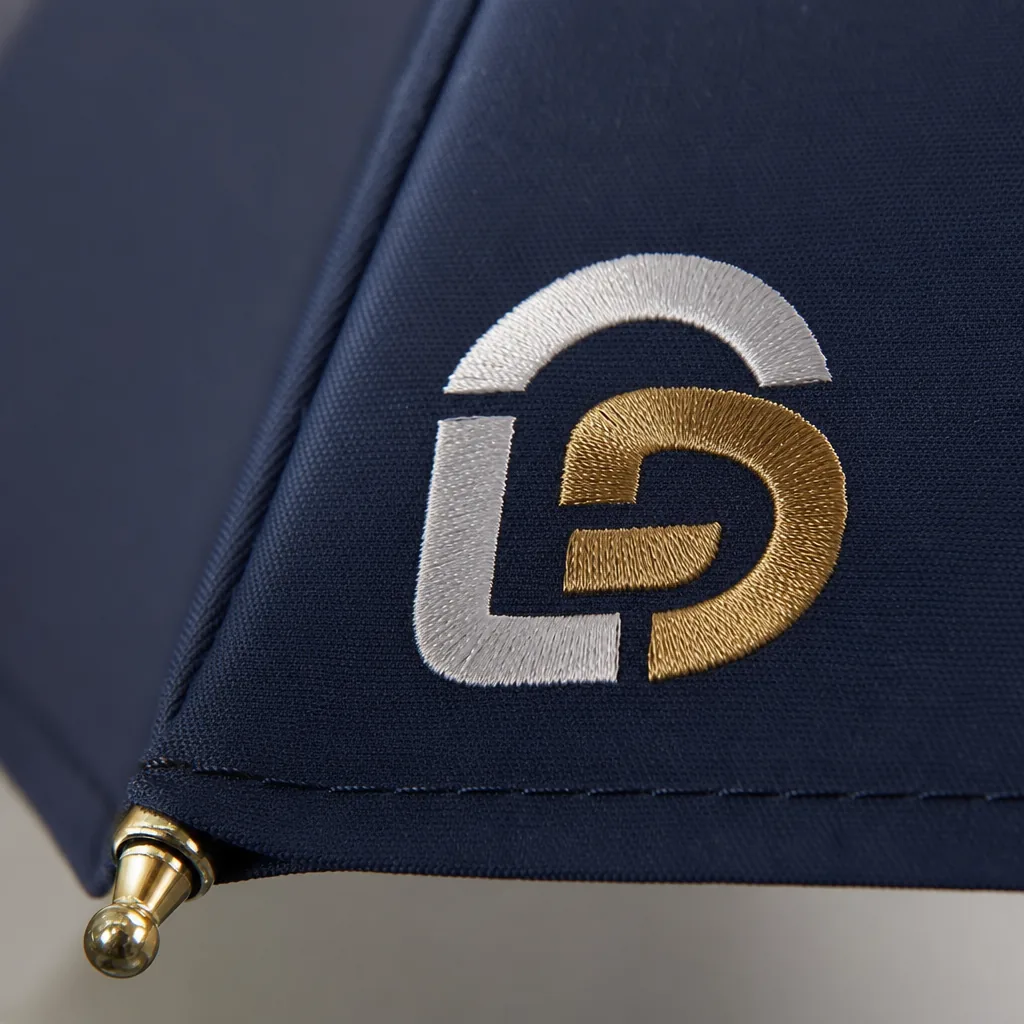
When buyers source branded UV umbrellas, the hard part is not choosing a logo color but balancing UPF 50+ canopy performance against print clarity, MOQ, and lead time. On our Songxia production floor, we see the same issue repeatedly: a print method that looks fine on standard pongee can shift color, hand feel, or approval risk once UV coatings and dark canopy shades enter the process.
Why UV Canopy Construction Changes Branding Decisions
UPF 50+ performance starts with the canopy build, not the print, and that is exactly why branding decisions need to be made earlier on branded UV umbrellas than on a standard rain umbrella. Most UV programs use either tightly woven pongee 190T 210T with a dark inner coating, or a silver/black UV block layer added on the underside to stop light transmission. That construction changes how ink sits, how crisp edges look, and how the fabric feels in hand. A 210T pongee face usually gives cleaner screen print definition than cheaper polyester because the weave is denser and flatter, but once you add a UV or silver coating underneath, the panel gets slightly stiffer and the drape is less soft than a fashion umbrella. In practice, that makes these umbrellas better for summer promotions, resort retail, golf sidelines, school commuting, and outdoor event queues where sun protection matters as much as rain cover.
Logo appearance shifts depending on whether the canopy is print-facing color on the outside or a reflective lining underneath. A silver coating umbrella logo often looks strongest on the exterior panel rather than over the coated interior, because metallic or UV-block backings can affect opacity, strike-through risk, and the visual balance of lighter brand colors. For UPF 50+ umbrella printing, we usually steer buyers toward simple solid logos, heavier line weights, and Pantone-matched spot colors instead of fine halftones unless the job is sublimation on uncoated white fabric. That is also where hand feel and use case connect: compact 21 inch or 23 inch auto-open styles sell well for commuter and gift channels, while 27 inch or 30 inch straight-stick formats give more coverage and larger print panels for hospitality, beach, and corporate campus use. Our standard practice is to confirm print method only after the canopy coating, color, and fold test are locked.
Frame format also changes the branding math. An 8K umbrella gives eight wider panels, so each logo can be larger and easier to read from distance; that works well for bold retail branding and promotional runs. A 16K style looks more premium and elegant, especially in UV parasol-inspired programs, but each panel is narrower, so artwork often has to be reduced, simplified, or repeated more strategically. On the sourcing side, buyers should match decoration complexity to volume because OEM umbrella MOQ rises quickly when you combine custom-coated canopies, special ribs, and multi-position printing. For FOB DDP umbrella orders, that usually means balancing price, carton efficiency, and lead time: a routine UV umbrella can run about 35 to 45 days in production, while custom frames or difficult logo placements can push it to 50 days or more, with inspection typically held to AQL 2.5 before shipment.
Best Fabric and Frame Specs for Clean Logo Execution
For clean logo edges on branded UV umbrellas, canopy fabric matters more than most buyers expect. 190T pongee is the common baseline because it prints crisply enough for solid logos, holds color well under screen printing or heat transfer, and keeps unit cost under control at medium OEM umbrella MOQ levels. 210T pongee has a tighter weave and slightly heavier hand, so fine text, thin linework, and large dark fills usually look cleaner and more opaque, especially on white or pastel canopies where show-through can ruin contrast. In factory terms, pongee 190T 210T is not just a texture choice; 210T generally resists pinholing and abrasion better during folding cycles, which helps preserve logo integrity after repeated use. If the canopy also needs UV treatment, the coating recipe has to be matched to the print method, because a rough backside UV layer can telegraph through lighter face prints.
When buyers try to cost down, plain polyester is the first substitute, but it is usually a compromise in both print appearance and service life. Budget polyester can accept a simple one-color logo, yet it tends to have a flatter, harsher surface and less consistent yarn density, so gradients, small registration marks, and premium retail branding are harder to hold. For a silver coating umbrella logo project, that matters even more: the silver UV backing improves blocking performance, but it can slightly stiffen the cloth and make the canopy less forgiving during printing and sewing. Our standard practice is to test coated swatches before mass production, because silver-backed fabric can shift the perceived face color and affect whether screen ink, transfer film, or sublimation gives the cleanest result for UPF 50+ umbrella printing.
Frame choice affects logo presentation almost as much as fabric. Fiberglass ribs are the better match for premium branded UV umbrellas because they flex and recover under wind loads more cleanly than standard steel ribs, reducing canopy distortion that can wrinkle a centered print panel; for commuter styles, an 8K 21-inch or 23-inch frame with fiberglass ribs and a steel shaft is a practical balance. Full steel frames are cheaper and acceptable for giveaway umbrellas, but they add weight and are more likely to take a set after inversion, which can permanently skew panel alignment. Double-canopy vented windproof construction is excellent for 50+ mph wind resistance, but it complicates both exterior and interior branding because the top and under-canopy panels must be registered separately around vents and stitch lines. That adds setup time, raises rejection risk under AQL 2.5 inspection, and should be priced and approved early on FOB DDP umbrella orders rather than discovered after artwork is locked.
Which Print Methods Work on UPF 50+ Umbrella Canopies
On UPF 50+ canopies, the coating matters more than the artwork. A branded UV umbrellas program printed on standard 190T pongee behaves very differently from one printed on black-back or silver-back UV fabric, because the print is bonding to a finished surface rather than raw polyester. Screen print is still the safest option for bold spot-color logos on pongee 190T 210T, especially when the logo sits on the outer face and the UV layer is on the back side. In production, I treat 0.8 mm positive lines and 6 pt text as the practical floor for clean screen results on umbrella panels; below that, edge spread and stitch-area distortion start to show. If the canopy uses a silver coating umbrella logo placement on the coated side itself, adhesion and color holdout become the first risk, not appearance on press day. Silver and black-back coatings can make whites look dirty, reds go brownish, and fine reversals fill in after fold testing.
Heat transfer works when artwork is photographic or has gradients, but it is less forgiving on UV-treated canopies that run hot during pressing. On a UPF 50+ umbrella printing job, transfer temperature and dwell time have to be tuned against coating stability, otherwise you get gloss marks, slight panel shrink, or a visible press box on dark fabric. Digital sublimation gives the best image detail, but only when the canopy is built from printable white or light polyester before cutting and sewing; it is not a good rescue method for finished silver-back stock. For small copy, I usually warn buyers that anything under 2 mm cap height or thin serif text may pass a lab proof and still fail readability once the 8K or 10K canopy is tensioned over ribs. ZheBrella's standard practice is to test fold-open cycles after printing, because some inks look fine flat and then crack or telegraph when the canopy is repeatedly wrapped.
Pre-production samples are where approval risk gets taken out of the job, especially for OEM umbrella MOQ projects with coated canopies and strict brand colors. A digital mockup cannot show how a Pantone white sits over silver, how a navy logo shifts on black-back fabric, or whether a one-panel print stays centered after sewing. I prefer a physical strike-off or full PPS on the actual frame size—21 inch folding and 27 inch golf umbrellas do not tension panels the same way—so the buyer can judge line weight, small text, and color holdout before mass production. That matters even more on FOB DDP umbrella orders, because once 3,000 to 5,000 pieces are packed out, correcting a bad print decision is expensive and slow. For export production, the clean method is simple: confirm artwork limits early, sample on the exact coated fabric, then lock color and placement before the AQL 2.5 final inspection stage.
Sampling, QC, and Tolerance Standards for Brand Buyers
For branded UV umbrellas, the approval flow should lock down risk before fabric ever hits the cutting table. We start with an artwork file check on vector layers, Pantone references, repeat size, logo position by panel, and whether the canopy is plain 190T pongee, 210T pongee, or a silver-coated UV fabric that can shift color slightly after heat setting. If the job involves UPF 50+ umbrella printing, I want the buyer to approve a strike-off on the actual canopy material, not on substitute cloth, because silver coating umbrella logo work often looks sharper on screen than it does on reflective fabric. After the strike-off, the next gate is a pre-production sample with the real frame spec—usually 21 inch or 23 inch folding, or 27 inch straight stick—so you confirm not just print appearance, but also panel tension, seam shape, and how the artwork reads when the umbrella is fully opened.
The pre-production sample is where most preventable mistakes show up. We check panel-to-panel alignment at seam joins, logo centering from tip to crown, color consistency across all 8 panels, and whether dark inks crack or lighten on fold lines after repeated open-close cycling. Function testing covers manual, auto-open, or auto-open-close mechanisms, plus runner travel, spring response, rib symmetry, and whether fiberglass ribs or steel ribs distort the printed canopy when loaded in wind. For UV styles, print adhesion matters more than buyers expect, especially on coated fabrics; we run tape and rub checks after curing to make sure the print does not lift, powder, or ghost. At ZheBrella, our standard practice is to freeze the signed sample against bulk production, because changing artwork size or handle spec after that point usually affects carton count, lead time, and sometimes OEM umbrella MOQ assumptions.
Before shipment, bulk goods should be inspected to AQL 2.5 with clear checkpoints instead of a vague visual review. Critical points are canopy fabric shade lot consistency, clean sewing with no skipped stitches, matched panel orientation, correct handle and ferrule spec, smooth opening and closing, and no broken ribs, loose caps, or scratched shafts. On printed goods, inspectors should compare bulk units against the approved sample for delta in color, logo placement tolerance, and edge sharpness; on silver UV canopies, slight visual variance can happen under different light angles, so the acceptable standard needs to be agreed in advance. For FOB DDP umbrella orders, I also recommend confirming packing before final release: inner bag type, carton drop resistance, shipping marks, and moisture protection, because a perfect umbrella can still arrive unsellable if cartons collapse or canopies pick up transit odor during a 25 to 35 day production-and-export cycle.
MOQ, Lead Times, and Shipping Terms to Plan Early
MOQ is usually driven more by frame and print setup than by canopy color. For branded UV umbrellas, a plain stock-color 21" or 23" straight umbrella with one-color screen print often starts around 300 to 500 pcs per design, while a custom Pantone canopy in pongee 190T 210T with matching handle or sleeve is more realistically 1,000 pcs. Folding auto-open-close styles, reverse umbrellas, and 16K fashion frames tend to push MOQ upward because the components are less interchangeable; 500 pcs is possible on some shared molds, but 1,000 to 3,000 pcs is the safer planning number. If you want all-over heat transfer or true UPF 50+ umbrella printing on coated fabric, expect MOQ to rise again because fabric yield, panel registration, and reject risk all tighten. A silver coating umbrella logo job sounds simple, but printing on the coated underside needs adhesion testing before anyone promises volume.
Sampling time depends on whether you are proving artwork or proving construction. A digital mockup is same day to 2 days, but a physical pre-production sample normally takes 5 to 7 days for a basic screen-printed manual umbrella and 7 to 12 days for an auto-open-close frame, custom color matching, or underside print. If new molds, custom tips, or branded handles are involved, sampling can stretch to 15 to 20 days. Mass production after sample approval is typically 25 to 35 days for 500 to 3,000 pcs, and 35 to 45 days for larger retail programs with multiple SKUs, swing tags, color cartons, and carton drop-test requirements. Our standard practice is to quote lead time from signed sample approval, not from first inquiry, because canopy coating availability, rib stock, and print line loading are what actually move the ship date.
FOB and DDP change the buying decision more than many first-time importers expect. FOB Ningbo or Shanghai usually gives experienced importers the best freight control: they can consolidate umbrella orders with other goods, choose their own forwarder, and see the factory price separately from ocean, duty, and last-mile charges. DDP works better for promotional distributors and smaller retail programs that need a clean landed number, especially when the order is split across several delivery addresses or the buyer does not want to manage customs entry. For FOB DDP umbrella orders, the right choice depends on order size and timing: on a 5,000 to 10,000 pc OEM umbrella MOQ program, FOB is often cheaper overall, but on smaller, deadline-driven campaigns, DDP can reduce admin risk even if unit landed cost is a little higher. Always compare by total delivered cost per usable unit, including duty rate, customs fees, palletization, and damage allowance under AQL 2.5.
Frequently Asked Questions
Can you print logos on both the outside and inside of a UPF 50+ umbrella?
Yes, but it depends on the canopy construction. Double-canopy and black-coating UV umbrellas often limit interior print options, so buyers should confirm artwork areas during sampling.
Does a UV coating reduce logo durability on the canopy?
It can affect ink adhesion if the print method is not matched to the coating. A pre-production sample and adhesion check should be part of approval before bulk production.
Which print method works best on a silver-coated UPF 50+ canopy without hurting logo clarity?
For silver-coated interiors, the logo is usually printed on the outer canopy panel, where screen printing or heat transfer gives cleaner results. If the exterior fabric is dark or textured, a test panel is recommended because fine lines under 0.3 mm and light pastel colors can lose definition.
Does 190T or 210T pongee change the approved artwork outcome for branded UV umbrellas?
Yes. 210T pongee usually gives a tighter surface and slightly sharper small text or thin strokes than 190T, especially for 1-color screen prints. For distributor programs with strict brand guidelines, buyers often approve a pre-production sample before mass production to reduce color and edge-risk.
What MOQ and lead time should buyers expect for OEM UPF 50+ umbrellas with custom printing and FOB or DDP terms?
A common OEM MOQ is 500-1,000 pieces per style and colorway, depending on frame, fabric, and packaging requirements. Typical production lead time is about 25-35 days after sample approval, while DDP orders may add 7-15 days beyond FOB timing depending on destination and customs handling.
Looking to Launch Your Custom Umbrella Line?
ZheBrella is a Zhejiang-based OEM/ODM umbrella manufacturer with 17 years of export experience. Free design, low MOQ from 100 pieces, windproof construction, full-color print.
Get Free Quote Now »People Also Search For
Related Articles
Colorfast Logo Printing for Branded Umbrella Canopies
Reduce logo fading, bleeding, and transfer issues by matching ink, fabric, coating, and QC tests before branded umbrella...
Read More »Repeat Pattern Printing for Branded Umbrella Canopies
Plan repeat-pattern umbrellas with correct scale, panel sequencing, 190T/210T fabric choices, sampling steps, and QC che...
Read More »
White Ink Underbase for Logos on Dark Umbrella Canopies
Learn when white ink underbase improves logo opacity on dark pongee canopies, how it affects cost, sampling, AQL checks,...
Read More »