Canopy Panel Cutting Tolerances for Custom Umbrellas
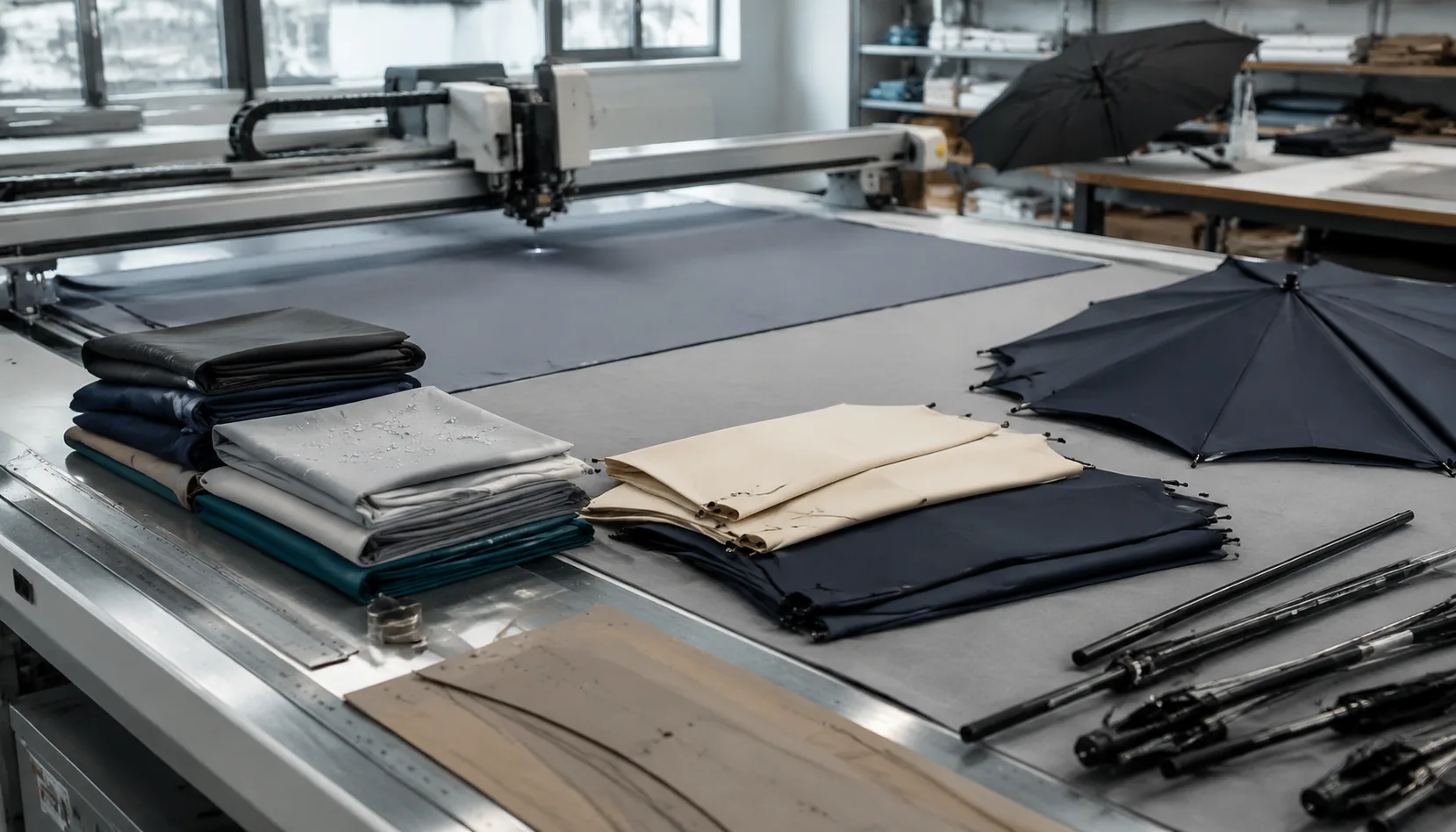
When a buyer approves a custom umbrella sample, the real risk starts at bulk cutting: small panel errors multiply into twisted seams, uneven tips, and print artwork that misses the rib line. On our Songxia cutting tables, umbrella canopy cutting tolerances are controlled by fabric direction, marker layout, blade heat, ply height, and batch numbering—not by measurement alone. If those details drift, a good frame cannot save the canopy fit.
How Panel Cutting Affects Finished Umbrellas
Panel cutting is where umbrella quality starts to become visible, because a 2-3 mm error on each gore does not stay small after sewing eight or sixteen pieces together. On an 8K 23" frame, one oversized panel can create loose canopy tension between two ribs while the opposite side pulls tight; on a 16K walking umbrella, the same error repeats more often and makes the crown look wavy instead of round. In pongee canopy production, 190T and 210T fabric also relax differently after spreading, especially if the roll has been stored under pressure or cut immediately after sublimation heat. That is why umbrella canopy cutting tolerances must be controlled against both the paper pattern and the actual frame arc, not just the finished diameter printed on the spec sheet.
Bad umbrella panel cutting usually shows up first at the tips. If panels are short, the tail pockets fight the rib ends and the umbrella canopy fit becomes too tight, causing twisted tips, bent fiberglass ribs, or steel ribs that do not sit evenly in the seam line. If panels are long, the canopy sags between ribs and water collects near the edge instead of shedding cleanly. We normally allow tighter tolerance on the straight seam edge than on the hem edge, because seam mismatch affects stitch strength and visual balance immediately. For OEM umbrella manufacturing, this matters more when the buyer specifies 10K or 16K frames, vented double canopies, or auto-open-close folding models where the canopy must fold into a narrow bundle without forcing the runner.
Logo placement is another reason umbrella canopy cutting tolerances cannot be treated as a sewing-room detail. A screen-printed or heat-transfer logo may be centered on the flat panel, but after sewing, a 3 mm skew at the cut edge can rotate the artwork toward one rib and make the finished umbrella look defective even when the print itself passed inspection. Weak seams also come from inconsistent panel width: operators stretch one panel to match the next, the stitch density changes, and the seam can pucker or leak after Teflon coating or a UPF 50+ treatment. Our standard practice at ZheBrella is to check first-cut panels against the approved pattern, then measure sewn canopy circumference before bulk assembly, because fixing bad panels after tips, caps, and frames are attached costs far more than controlling the cutting table.
Fabric Behavior During Cutting
The first cutting risk is not the blade; it is the cloth movement before the marker is even pinned. In umbrella panel cutting, 190T pongee usually behaves more forgivingly than 210T because the yarn density is lower and the hand feel is softer, so a stacked lay can settle faster after spreading. 210T pongee gives a smoother canopy and better print surface, but it also shows cutting error more clearly at the seam line, especially on 8K and 10K frames where every panel must land evenly at the rib tip. Polyester pongee, RPET pongee, and recycled polyester blends should be relaxed on the cutting table before cutting; for bulk OEM umbrella manufacturing we normally allow 4–12 hours depending on roll tension, coating, humidity, and whether the fabric was tightly wound after dyeing or digital printing.
Stretch direction matters because an umbrella canopy is a tensioned cone, not a flat tote bag. Most pongee canopy production has slightly different behavior in warp and weft, and bias movement becomes visible when panels are pulled over 23", 27", or 30" frames. If one panel is cut with the high-stretch direction toward the leading edge and the next is rotated to save fabric, the finished umbrella canopy fit will show scalloped edges, twisted seams, or uneven rib pockets. This is why serious factories control marker direction instead of only chasing fabric yield. For solid-color 190T promotional umbrellas, a small directional compromise may pass AQL 2.5 inspection, but for logo-printed 210T, sublimation panels, or retail-grade double-canopy vented models, we keep panel orientation consistent even if consumption increases by 2–4%.
Coated UPF 50+ fabric needs tighter handling because coating changes friction, memory, and heat response. Silver-coated, black-coated, PU-coated, and Teflon-treated pongee do not slide through the cutter like uncoated polyester; the coating side can drag against the lower ply, causing lower panels to grow or shift by 1–2 mm in a high stack. That sounds small, but umbrella canopy cutting tolerances often need to stay within about ±1.5 mm on panel edges and tighter at the notch, otherwise the canopy will pull off-center during final assembly. Coated cloth also should not be over-compressed under heavy weights because pressure marks can telegraph through light colors. Our standard practice at ZheBrella is to reduce lay height, use sharper straight-knife or CNC cutting settings, and separate coated UPF 50+ orders from regular pongee so the operator does not apply the wrong stack height or clamp pressure.
Cutting Methods and Tolerance Control
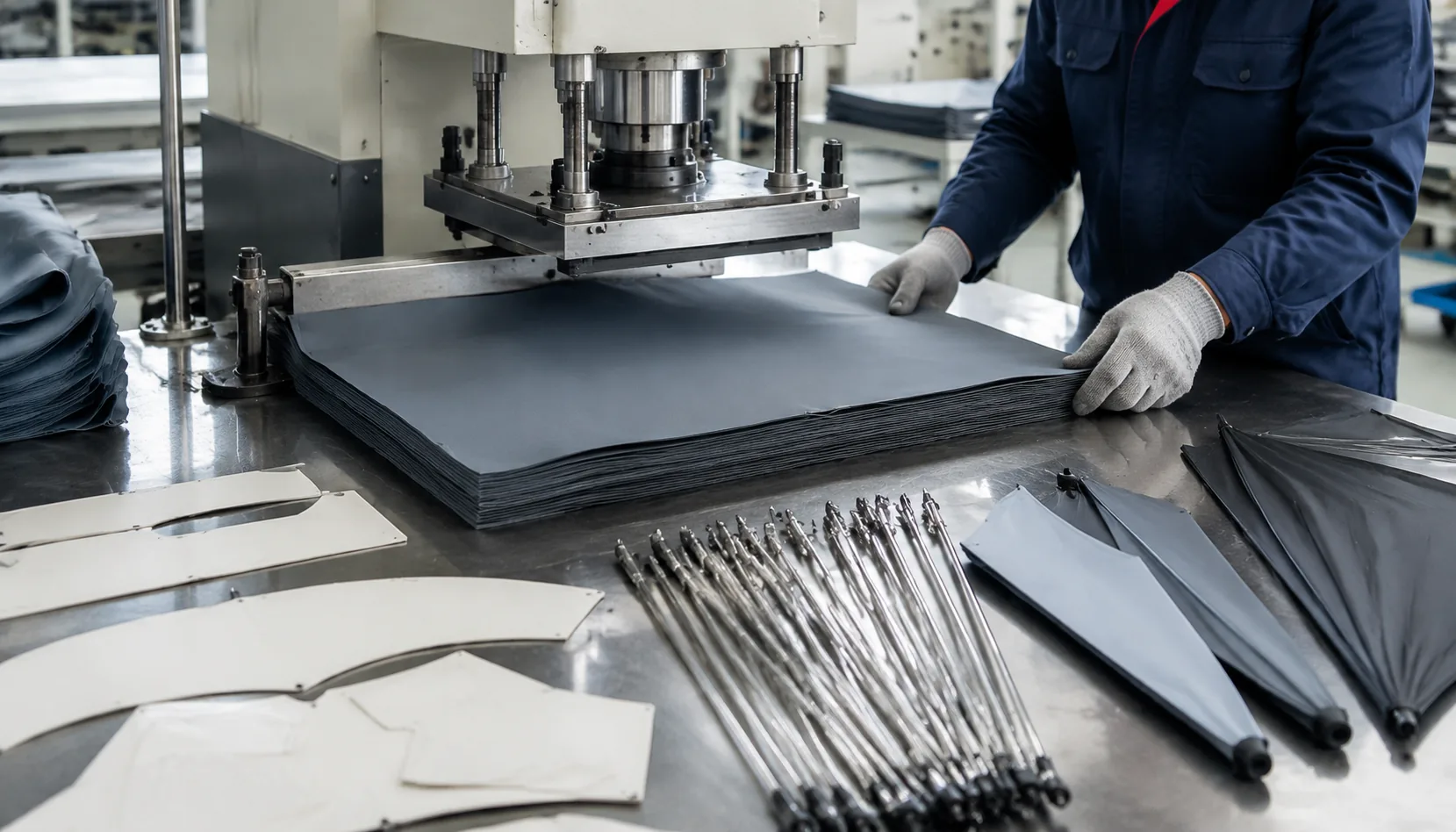
Die cutting is still the fastest method for high-volume umbrella panel cutting when the design is stable and the panel shape is a standard 8K, 10K, or 16K wedge. For 190T or 210T pongee canopy production, we normally keep the fabric stack at 40 to 80 plies depending on coating thickness; PU, black-out UV, and Teflon-treated cloth need lower stacks because coated layers slide less evenly and can compress at the die edge. A good steel-rule die can hold about ±1.0 mm on the straight grain and ±1.5 mm near the curved hem if the marker layout is tight and the cloth is relaxed before cutting. The weak point is not the die itself; it is stack distortion. If the operator pulls the fabric too hard during spreading, the finished umbrella canopy fit will look short on one side after sewing, especially on 23 inch and 27 inch frames where rib length exposes small errors.
Laser cutting gives the cleanest edge on polyester pongee and works well for short OEM umbrella manufacturing runs with many logo placements or unusual panel profiles, but I do not use it blindly for every bulk order. The heat seals the edge, which reduces fraying before sewing, yet it can slightly harden coated fabric and leave a faint brown edge on light colors if power and speed are not tuned. Stack height is usually limited to 1 to 5 plies, so output is slower than die cutting, but tolerance can be tighter, typically ±0.5 mm to ±1.0 mm on single-ply cutting. Laser is useful when the marker layout includes asymmetric panels, photo-print matching, or vents for double-canopy windproof umbrellas. Shrinkage allowance must be built into the CAD file before cutting: sublimation-printed pongee can shrink 1% to 3%, while heat-transfer panels may change less but can distort locally around heavy ink coverage.
CNC knife cutting is the most balanced option for mid-size custom orders because it avoids die-tooling cost while cutting more consistently than hand-guided methods. Our standard practice at ZheBrella is to spread 8 to 20 plies for CNC knife cutting, add vacuum hold-down, and cut a pilot run before releasing bulk fabric. For umbrella canopy cutting tolerances, we target ±0.8 mm to ±1.2 mm on 210T pongee and ±1.5 mm on softer PVC, POE, or EVA materials because flexible films can creep under the knife. The marker should follow fabric grain, keep enough gap at the bias edges, and include sewing allowance for the hem, tip pockets, and center cap hole. Good tolerance control is confirmed after sewing, not just after cutting: we mount sample canopies on manual, auto-open, and auto-open-close frames, then check rib-tip alignment, seam tension, and whether the canopy pulls evenly across 50+ mph wind-rated fiberglass ribs. That final fitting test is where umbrella canopy cutting tolerances become a real product quality issue, not just a CAD number.
Print Registration and Panel Matching
Print registration starts before ink ever touches fabric: the cutting room must treat artwork position as a dimensional control point, not a decoration issue. For screen print logos that cross a seam, heat-transfer badges near a rib line, or full-panel artwork that must continue across 8 panels, the marker needs registration ticks outside the stitch allowance, centerline marks at the crown and hem, and a clear face direction for every panel. In umbrella panel cutting, a 2 mm drift at the cutter can become a visible 5-6 mm mismatch after hemming, seam folding, and canopy tensioning on the frame. I prefer putting notch marks on the seam side rather than relying only on chalk dots, because chalk disappears during handling and steam pressing. For pongee canopy production, especially 190T and 210T polyester, the fabric can creep slightly under stacked cutting; keep printed-panel stacks lower than plain-color stacks and check the top, middle, and bottom ply against the paper pattern before release.
Panel numbering is the simplest way to protect umbrella canopy fit when artwork has sequence or direction. A vented double-canopy 23 inch umbrella may have 8 lower panels and 8 upper vent panels, and those cannot be mixed casually even if the fabric color is identical. Number panels clockwise from the handle logo position, mark the crown side, and bundle them by frame size, rib count, and order line: 21 inch compact 8K, 23 inch straight 8K, 27 inch golf 8K or 10K, and 30 inch golf are not interchangeable. For full-panel sublimation or engineered all-over artwork, the sewing operator should receive a diagram showing panel 1 through panel 8, seam direction, and which edges must meet. This is where umbrella canopy cutting tolerances become visible to the buyer; the frame may pass function testing, but a skyline, stripe, or mascot face that jumps at every seam looks like poor OEM umbrella manufacturing.
Batch segregation matters because print alignment problems often look like sewing mistakes after assembly. Keep screen-printed, heat-transfer, and sublimated panels in separate WIP bins with job cards showing PO number, Pantone reference, print method, panel count, cutting die or template code, and inspection status. Never mix panels from two print runs unless the QC record confirms color, shrinkage, and placement are within the approved sample tolerance; heat-transfer films and sublimated pongee can react differently to temperature, and even a 1% dimensional change can disturb seam-to-seam matching. Our standard practice at ZheBrella is to inspect registered artwork after cutting and again after trial sewing on one frame before bulk canopy assembly, using AQL 2.5 for final visual inspection but tighter in-line checks for logo position. Good umbrella canopy cutting tolerances are not just plus/minus numbers on a spec sheet; they are controlled by marks, numbering, and disciplined batch handling from cutting table to sewing line.
QC Checks Buyers Should Require
The first QC check buyers should require is panel dimension sampling before sewing, not after the umbrella is already built. In umbrella panel cutting, a 2 mm error on one gore can become a 16 mm circumference problem on an 8K frame, and it gets worse on 10K or 16K promotional styles where every panel is narrower. For 190T or 210T pongee canopy production, I prefer sampling the first 30 cut panels from each fabric roll and each cutting stack, then checking top width, bottom arc, center height, and bias stretch against the approved CAD pattern. Practical umbrella canopy cutting tolerances are usually plus or minus 1.5 mm for straight edges and plus or minus 2.0 mm on curved hems for standard orders; retail private-label work may ask for plus or minus 1.0 mm, but that requires slower spreading, sharper dies, and more frequent blade changes.
Seam allowance must be checked separately because a good-looking cut panel can still produce a poor umbrella canopy fit if the operator eats too much fabric during sewing. Buyers should specify seam allowance on the tech pack, normally 7 mm to 10 mm depending on the model, stitch type, and whether the canopy is single-layer pongee, double-canopy vented, POE, PVC, or EVA. QC should pull semi-finished canopies after panel joining and measure seam bite, rib-tip alignment marks, and crown hole position before attaching to 21 inch, 23 inch, 27 inch, or 30 inch frames. After assembly, verify open canopy diameter at four cross points, panel tension near rib ends, and symmetry around the top notch. A canopy that is 8 mm undersized may still pass casual viewing, but it will overload fiberglass ribs in wind testing and wrinkle badly after auto-open cycling.
Final inspection should connect these checks to an AQL 2.5 plan, with panel cutting records, in-line sewing reports, and finished canopy measurements available for buyer review. Our standard practice at ZheBrella is to treat diameter shortage, twisted panels, exposed raw edges, and off-center logos as major defects, especially in OEM umbrella manufacturing where the artwork must sit square across seams. Buyers can ask the supplier to include photos of the measuring jig, caliper readings, and final open-diameter readings in the inspection file, whether shipment terms are FOB Ningbo/Shanghai or DDP to the warehouse. Tighter umbrella canopy cutting tolerances are possible, but they affect cost structure: cutting stacks may drop from 80 layers to 40 or 50 layers, MOQ may rise from 500 pieces to 1,000 or 2,000 pieces per color, and lead time can extend by 3 to 7 days because cutting, sewing setup, and re-inspection all slow down.
Frequently Asked Questions
Does 210T pongee need different cutting control than 190T pongee?
Usually yes. 210T pongee is denser and may behave differently under stacked cutting, especially with DWR or UV coatings, so sample approval should confirm final canopy tension.
What tolerance should buyers specify for umbrella canopy panels?
The exact tolerance depends on model size and fabric, but buyers should specify panel dimension limits, seam allowance, and finished canopy diameter rather than only approving a visual sample.
What cutting tolerance is usually acceptable for OEM umbrella canopy panels?
For most straight and folding umbrellas, factories typically control panel cutting within about ±1–2 mm, depending on fabric type, panel size, and print requirements. Tighter tolerances may be needed for logo placement, full-panel printing, or complex multi-color designs.
Why does fabric direction matter when cutting pongee umbrella panels?
Pongee can stretch differently along warp and weft directions, so inconsistent fabric orientation may cause uneven canopy tension or twisted seams after sewing. OEM production should keep all panels in the same direction within one batch to improve canopy fit.
How can buyers reduce print misalignment during umbrella canopy production?
Buyers should confirm artwork position with a pre-production sample and allow cutting registration marks for printed panels. For bulk orders, batch inspection should check panel size, print center position, and seam alignment before full assembly.
Looking to Launch Your Custom Umbrella Line?
ZheBrella is a Zhejiang-based OEM/ODM umbrella manufacturer with 17 years of export experience. Free design, low MOQ from 100 pieces, windproof construction, full-color print.
Get Free Quote Now »People Also Search For
Related Articles
Umbrella Panel Cutting Tolerances for OEM Canopy Fit
Learn how CAD markers, die cutting, and 190T/210T pongee tolerances control canopy tension, seam alignment, and rework i...
Read More »
Umbrella Canopy Cutting Tolerances for Accurate Panel Fit
Set canopy cutting tolerances for 190T/210T pongee panels, print alignment, seam allowance, and frame fit to reduce wrin...
Read More »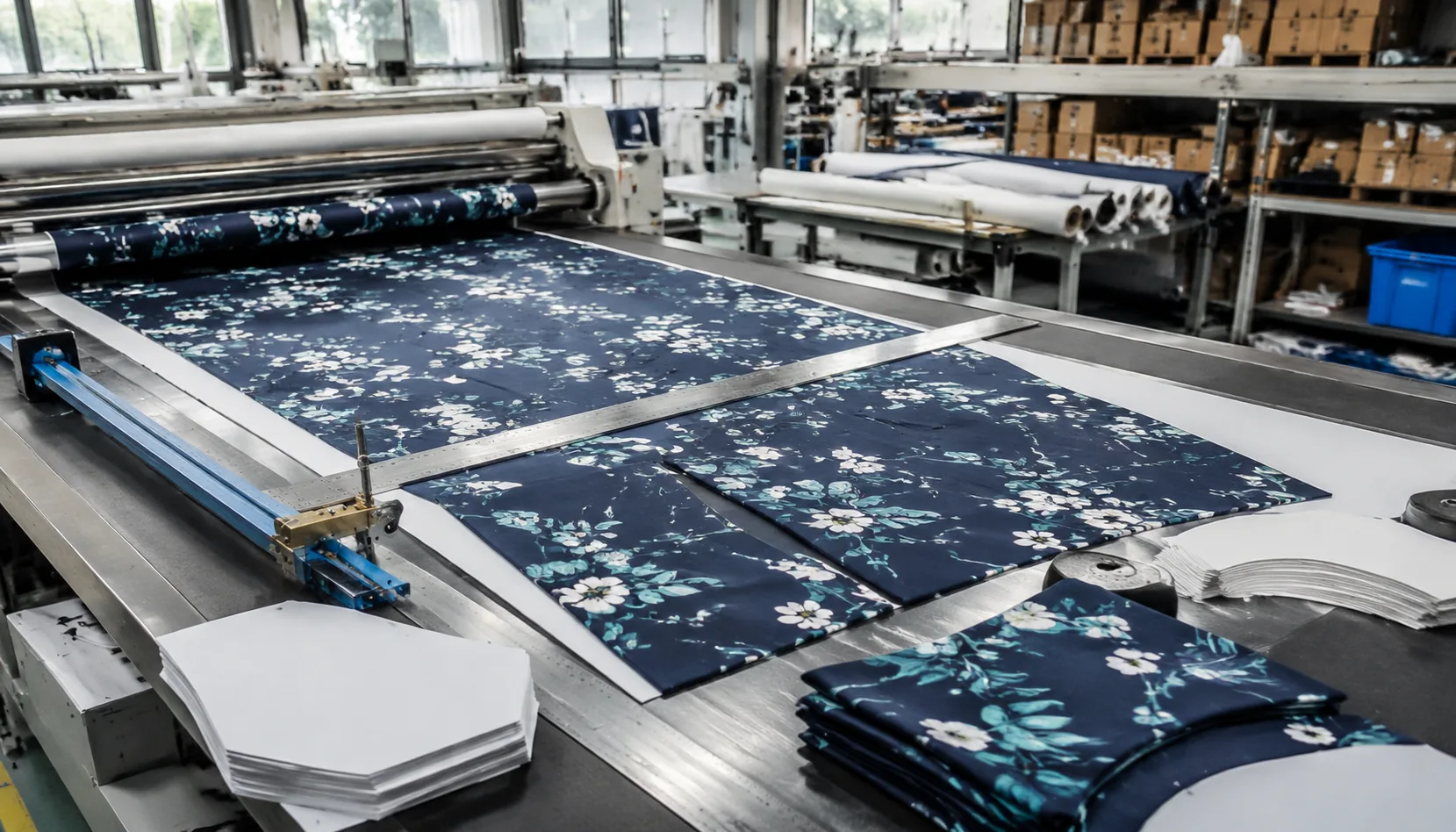
Umbrella Canopy Cutting Tolerances for OEM Production
Learn canopy cutting tolerances, panel grain control, and sewing allowances that keep 190T/210T pongee umbrellas fitting...
Read More »