Cutting Umbrella Canopy Panels: Grain, Tolerance, and Yield
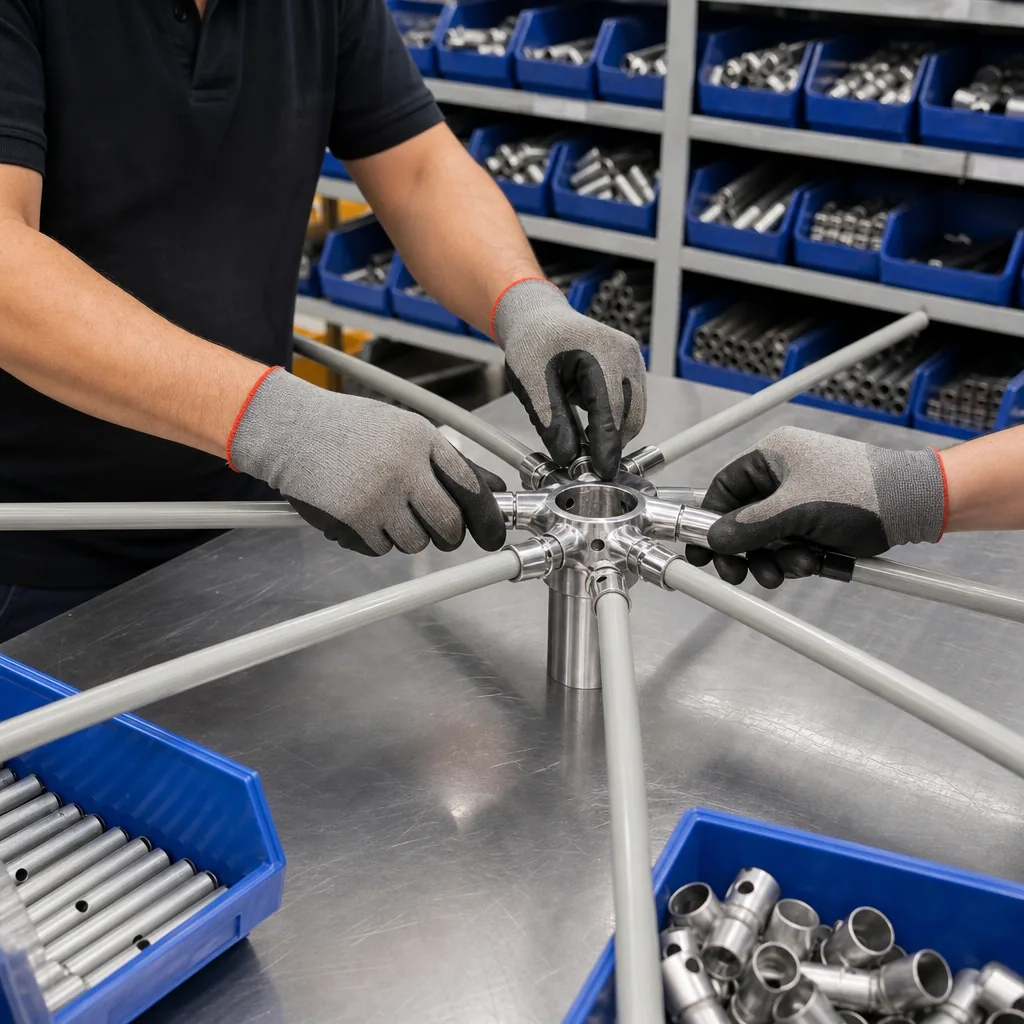
For buyers, canopy problems usually show up late: a finished umbrella twists, adjacent panels shade differently, or the cover pulls off-center even though the fabric spec looked correct. On our Songxia cutting tables, umbrella canopy panel cutting starts with grain direction, panel tolerance, and 190T/210T pongee behavior before any marker is approved. If those controls are loose, yield may look good on paper while rework, claims, and inconsistent lots quietly erase the savings.
Why Panel Cutting Matters Before Sewing Starts
Umbrella canopy panel cutting decides whether the umbrella will sit cleanly on the frame before a sewing operator touches the fabric. On a standard 23" 8K stick umbrella, eight triangular panels must share load evenly across the ribs; if one panel is 3 mm short on the bias edge and the next is 4 mm wide at the skirt, the seam can still look straight but the finished canopy pulls off-center. That is when buyers see twisted tips, one rib sitting higher than the next, or a peak that leans after opening. In OEM umbrella production, I treat canopy panel tolerance as a structural issue, not a cosmetic one. For 190T or 210T pongee, our practical cutting tolerance is usually within ±2 mm on panel length and ±1.5 mm on key seam edges, tighter for 16K golf umbrellas because small errors multiply around the full circle.
Pongee umbrella fabric cutting is tricky because the woven grain, coating, and lay tension all change how the panel behaves after sewing. If the fabric roll is pulled too hard on the cutting table, the panels shrink back after bundling; if the grain direction is inconsistent, one seam stretches while the opposite seam stays firm. That creates uneven canopy tension even when lockstitch density, seam allowance, and thread quality are correct. I have seen good sewing blamed for water pooling near the tips, but the real cause was panels cut with a shallow crown curve or mismatched bias stretch. For rain umbrellas using Teflon-coated pongee, PVC, POE, or EVA, incorrect panel geometry can also interrupt runoff, leaving pockets of water between ribs instead of shedding cleanly toward the edge.
Good umbrella canopy panel cutting also controls umbrella fabric yield, which directly affects FOB cost and delivery stability. A careless marker may save 1% fabric on paper but create shade mismatch, wrong grain direction, or panels that cannot pass AQL 2.5 visual inspection after assembly. For custom printed canopies, especially screen print logos crossing seams or sublimation artwork on full panels, cutting accuracy must match the print registration; otherwise seam matching looks poor even if the artwork file was correct. In our standard practice at ZheBrella, cutting teams check first-piece panels against acrylic templates, confirm roll face direction, and separate lots before sewing starts. That extra 10 minutes prevents hours of rework later, because once panels are stitched into an 8K, 10K, or 16K canopy, the frame will expose every cutting mistake under tension.
Fabric Grain, Roll Width, and Pongee Handling
Fabric grain is the first place a canopy starts going right or wrong. In umbrella canopy panel cutting, 190T pongee is more forgiving because the yarn is slightly looser and settles faster after spreading, while 210T pongee has a tighter hand and will show skew or tension marks if the cutter pulls it across the table. We spread along the roll direction, keep the selvedge square, and check bowing every 10 to 15 meters instead of trusting the roll label. For 23" and 27" straight umbrellas, a small grain drift can turn into twisted seams after sewing, especially on 8K or 10K frames where each panel has to land cleanly on the rib tip. Our standard resting time is 4 to 8 hours for coated pongee before cutting, longer in humid weather, because fresh-unrolled fabric can shrink back 2 to 4 mm across a panel after the tension releases.
Roll width decides yield before anyone talks about labor cost. Common pongee rolls arrive around 57/58" usable width, but the real cutting width may drop by 1 to 1.5" after removing crushed selvedge, coating streaks, or shade-edge variation. For pongee umbrella fabric cutting, we separate shade lots before spreading, even when the supplier claims one dye batch, because a half-tone difference becomes obvious once eight triangular panels meet at the top notch. In OEM umbrella production, we mark shade lot numbers on the cut bundle ticket and never mix them inside one canopy unless the buyer approves panel contrast as a design. Coating-side orientation matters just as much: Teflon, PU, black UV, or silver UPF 50+ layers must face consistently, or the umbrella will show uneven water beading, patchy sheen, and different heat-transfer adhesion after printing.
Canopy panel tolerance should be controlled at the cutting table, not corrected by the sewing operator. For promotional and retail orders, I normally hold panel length within +/-1.5 mm and seam edge within +/-1.0 mm on 190T/210T pongee; looser cutting creates puckering at the vent seam or a canopy that cannot close neatly around a manual or auto-open shaft. Too much vacuum pressure on a CNC cutter can stretch lighter 190T, while a dull straight knife can drag 210T and leave one side longer than the ply underneath. Good umbrella fabric yield comes from nesting panels tightly without rotating them off grain just to save fabric. On a 30" golf umbrella, that discipline matters because 8 or 16 large panels magnify every shortcut. For printed orders, we add extra margin for logo registration and keep coated sides protected with interleaf paper when the fabric has heavy sublimation, metallic ink, or fresh water-repellent finishing.
Tolerance Targets for 8K and 16K Canopies
For 8K umbrellas, a practical buyer specification is usually ±2.0 mm on panel edge length, ±1.5 mm on the top notch and rib-tip notch position, and no more than 2 mm difference in diagonal measurement after the panel is laid flat without tension. On a standard 23" or 27" 8K rain umbrella using 190T or 210T pongee, that range is tight enough to keep the canopy smooth after sewing but still realistic for mass OEM umbrella production. If the spec is pushed to ±0.5 mm on every edge, the factory will slow cutting, reject more bundles, and raise cost without much visible gain on a normal promotional umbrella. For umbrella canopy panel cutting, I prefer buyers to define both dimensional tolerance and matching tolerance inside one umbrella, because eight panels that are all slightly large can still sew better than a mixed set with four large and four small panels.
16K canopies need tighter consistency because each panel is narrower, so a small cutting error becomes a larger percentage of the panel width. On a 16K golf umbrella or fashion umbrella, I would specify ±1.0 mm on side edges, ±1.0 mm on notch position, and less than 1.5 mm diagonal variation within the same canopy set. A 2 mm error that hides inside an 8K panel can create puckering, twisted seam lines, or an uneven scallop on a 16K frame, especially when the ribs are fiberglass and the frame flexes under wind load. Canopy panel tolerance also matters more when the design uses stripes, borders, or sublimation artwork crossing multiple seams. If the cutting table stacks too many layers of slippery pongee, the lower plies can creep, and the last few panels in the stack will not match the top marker even when the cutting operator follows the printed line.
Pongee umbrella fabric cutting should be controlled by grain direction as much as by ruler measurement. We normally align the warp direction from crown to tip so the canopy stretches evenly under rib tension; if panels are rotated to chase umbrella fabric yield, the umbrella may pass open-close inspection but show waves after rain or after a 50+ mph wind-tunnel flex test. For 8K solid-color orders, a marker efficiency of 78% to 84% is common depending on size and selvage width, while 16K layouts often lose a few more points because narrow panels create more unusable gaps. Our standard practice at ZheBrella is to approve one sealed cutting template per size, then check the first 20 panels from each cutting batch before bundling for sewing. Buyers should put the tolerance on the tech pack, not just the PO, and tie it to AQL 2.5 final inspection for visible seam twisting, uneven rib-tip alignment, and canopy edge waviness.
Marker Planning for Yield and Print Alignment
Marker planning decides whether a canopy order makes money before the cutting table starts moving. For solid 190T or 210T pongee, a clean CAD marker for 8K panels can usually hold waste around 8–12% if the fabric roll width is stable and the grain is not skewed. With 10K or 16K layouts, the panel geometry changes enough that nesting efficiency often drops 2–4 points unless we adjust panel pitch and rotate only where the fabric face permits it. In pongee umbrella fabric cutting, we do not treat warp and weft casually: panels cut off-grain twist during sewing and show uneven tension after the umbrella is opened. Our standard practice at ZheBrella is to lock the marker direction first, then optimize yield inside that rule, not the other way around. For OEM umbrella production, that discipline matters because one poorly planned 5,000-piece run can consume several hundred extra meters of fabric.
Print alignment is where many buyers underestimate yield loss. A plain navy canopy can be nested tightly, but a directional logo, repeating border print, or alternating brand panel forces every triangle to face the same way. That can push umbrella fabric yield loss from 10% to 18–25%, especially on 23-inch and 27-inch golf umbrellas where each panel occupies a larger footprint. Border prints are stricter than center logos because the cut edge must land within a narrow visual band after hemming; if the artwork sits 5 mm too close to the seam allowance, the finished umbrella looks crooked even when the sewing is correct. For canopy panel tolerance, we normally hold cutting variation within ±1.5 mm on straight edges and tighter around the top notch, but printed panels add a second tolerance: artwork position. The CAD marker must reference both panel shape and print repeat, not just fabric area.
Sublimation panels need even more conservative planning because the printable sheet or roll is created before cutting. Heat transfer can stretch polyester slightly, and color blocks make misalignment obvious, so we build registration marks into the print file and cut from the printed image, not from theoretical panel dimensions alone. With full-panel sublimation, usable yield may fall below 75% if the artwork has gradients crossing seam lines or if left and right panels must mirror perfectly. In umbrella canopy panel cutting, I would rather quote the real yield up front than pretend a full-bleed design behaves like stock dyed pongee. The practical fix is early engineering: send vector art, identify which panels carry logos, confirm whether the print is directional, and approve a digital marker before bulk fabric booking. That one step prevents the common argument where the buyer expects standard MOQ fabric consumption, but the factory has to reject panels because the logo lands 8 mm off-center after cutting.
Inspection Points Before Canopy Assembly
The most expensive canopy defects are usually locked in before a sewing operator touches the panel, so pre-assembly inspection has to start at the cutting table. After umbrella canopy panel cutting, every bundle should carry a job card with PO number, model size, fabric lot, color code, panel position, cutter ID, and quantity; for OEM umbrella production, I also want the print direction and logo version written clearly because promotional orders often mix similar artwork. A 23" straight umbrella normally needs 8 panels, a 27" golf umbrella may use 8K or 10K layout, and 16K styles double the counting risk. We count panels by bundle and again by production line before issue, not after sewing, because one missing or extra panel can stop a whole batch. For pongee umbrella fabric cutting, 190T and 210T pieces can cling from static, so separators and hand counting still matter even when an automatic cutter gives a digital count.
Shade matching is not cosmetic housekeeping; it is a real rejection point when panels from two dye lots are sewn into one canopy. Before assembly, inspectors should open each bundle under D65 light or a calibrated light box and compare against the approved swatch, especially for navy, black, red, and dark green where slight batch drift becomes obvious on an 8-panel dome. Coated fabrics need extra care: Teflon-treated pongee, UPF 50+ silver-coated polyester, PVC, POE, and EVA can reflect light differently depending on face side, so panel orientation must be confirmed before sewing. Our standard practice at ZheBrella is to keep shade bands separated by cutting lot and line-feed them in sequence, which protects umbrella fabric yield because borderline panels are sorted early into inner-use, sample, or re-cut categories instead of becoming finished goods scrap.
Notch alignment is the fastest way to catch bad geometry from cutting, spreading, or marker slippage. Inspectors should stack panels tip-to-tip and check top notch, rib-seam notch, hem allowance, and print registration against the approved pattern; for most folding and straight umbrellas, practical canopy panel tolerance is usually kept within ±1.5 mm on seam-critical edges and ±2.0 mm on outer hems, tighter if the logo crosses a seam. If notches drift, the sewer will compensate by stretching one side, and that creates puckering, twisted tips, uneven valleys, and poor rib attachment after assembly. Good pre-sewing inspection directly reduces AQL 2.5 failures at final QC because it removes root causes before they become finished defects: shade panels mixed in one canopy, wrong panel count, misaligned logos, distorted vent openings, or canopy tension that fails a 50+ mph windproof test on double-canopy models.
Frequently Asked Questions
Does 210T pongee require different cutting control than 190T?
Yes. 210T pongee is denser and often feels smoother, but coating, roll tension, and fabric relaxation still affect panel size after cutting.
How much fabric waste is normal for printed umbrella panels?
Plain solid panels are usually more efficient. Directional logos, edge borders, or matched graphics can increase waste because each panel must follow a fixed layout.
What cutting tolerance should buyers specify for umbrella canopy panels?
For standard 8-panel rain umbrellas, many OEM factories control canopy panel cutting within about ±1–2 mm depending on panel size, fabric stretch, and cutting method. Tighter tolerances should be confirmed during pre-production sampling because they can reduce cutting speed and fabric yield.
Why does fabric grain direction matter when cutting pongee umbrella panels?
If panels are cut off-grain or mixed in different directions, the finished canopy can twist, wrinkle, or show uneven tension after assembly. For 190T and 210T pongee, factories usually align all panels consistently with the warp/weft direction and avoid rotating panels only to save fabric.
How can importers reduce shade variation in umbrella canopy production?
Buyers should require roll-by-roll color inspection, shade grouping, and one-canopy-one-lot cutting where possible. For bulk orders, the factory should mark roll numbers on cutting bundles and avoid mixing panels from different dye lots unless approved.
Looking to Launch Your Custom Umbrella Line?
ZheBrella is a Zhejiang-based OEM/ODM umbrella manufacturer with 17 years of export experience. Free design, low MOQ from 100 pieces, windproof construction, full-color print.
Get Free Quote Now »People Also Search For
Related Articles
Panel Cutting Tolerances for Umbrella Production Lines
See how CNC patterns, fabric relaxation, +/-2 mm panel control, and shade-lot batching improve 190T/210T pongee canopy f...
Read More »
Fabric Spreading and Die Cutting for Umbrella Canopies
Learn how spreading, die cutting, and panel tolerance control improve canopy symmetry, print placement, and fit on bulk ...
Read More »
Umbrella Canopy Cutting Tolerances for OEM Production
Learn canopy cutting tolerances, panel grain control, and sewing allowances that keep 190T/210T pongee umbrellas fitting...
Read More »