Fabric Spreading and Die Cutting for Umbrella Canopies
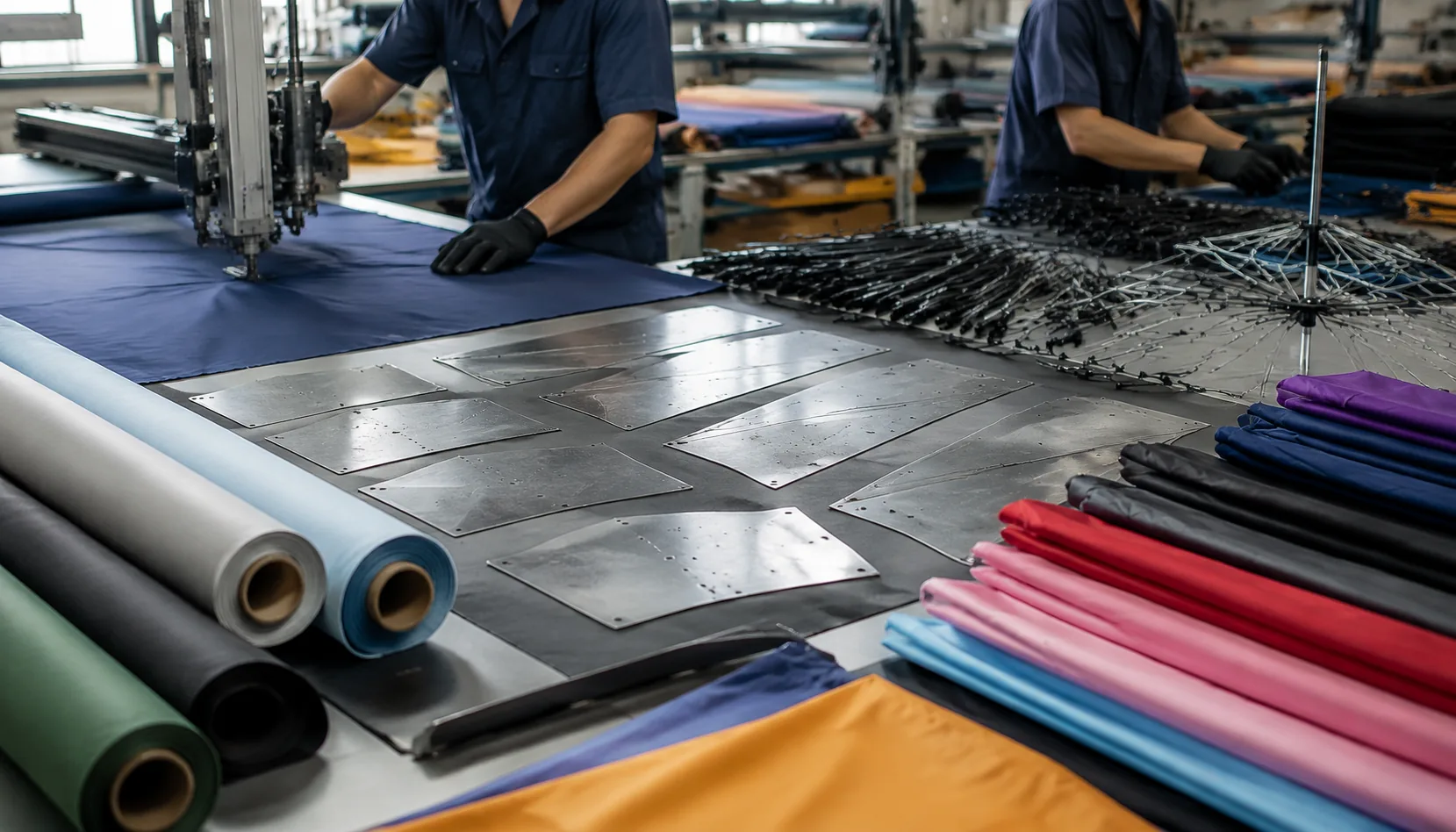
When a bulk umbrella order reaches the cutting table, small fabric handling errors can show up later as twisted canopies, mismatched prints, or panels that fight the frame during assembly. In our Songxia factory, the umbrella canopy cutting process starts with controlled spreading, relaxed fabric layers, and die alignment checks before any steel rule touches cloth. That discipline keeps panel tolerance tight enough for clean symmetry, accurate logo placement, and faster sewing on repeat production runs.
Why Cutting Accuracy Drives Finished Umbrella Fit
Cutting accuracy decides whether an umbrella looks round and calm on the frame or fights the ribs from the first opening. In the umbrella canopy cutting process, each gore is only one piece of the circle, but the error multiplies fast: an 8K canopy has 8 seams trying to share load evenly, while a 16K canopy has 16 narrower panels with twice as many chances for mismatch. If each panel is only 1.5 mm wide at the outer arc, the total circumference can drift 12 mm on an 8K umbrella and 24 mm on a 16K umbrella. That is enough to pull one rib off center, make the canopy twist clockwise, or leave a sagging bay between two ribs. We normally hold umbrella panel tolerance tighter on high-rib-count models because a 16K golf umbrella shows small errors more clearly than a basic 8K 23-inch stick umbrella.
190T and 210T pongee behave differently during umbrella fabric cutting, especially after spreading. 190T pongee is lighter and more forgiving, so minor tension from the sewing line or rib tips can sometimes be absorbed without obvious distortion. 210T pongee has a denser hand and better water repellency after coating, but it also shows tight stress lines more easily when the panel is short on the bias or too narrow at the peak. If the fabric is spread with uneven tension, the top layers relax after cutting while the bottom layers stay closer to the marker dimensions; that creates pongee canopy panels that look identical in bundles but sew into different curves. Coated pongee, especially with Teflon or UV UPF 50+ treatment, should be rested before cutting because fresh rolls can shrink or curl at the selvage.
The practical problem is not just shape; it is assembly speed and field durability. A panel that is long at the hem may force operators to ease fabric into the seam, creating puckers that pass a quick visual check but fail after repeated auto-open impacts. A panel that is short from peak to hem pulls against the rib end cap, making the canopy tight in dry weather and overly stressed when wet fabric gains weight. In OEM umbrella manufacturing, I prefer die cutting for repeat programs because a sharp steel-rule die gives cleaner repeatability than hand knife cutting on curved gore shapes, especially for 27-inch, 30-inch, and double-canopy vented windproof umbrellas. The umbrella canopy cutting process should be checked before sewing with a hard template, not only after final AQL 2.5 inspection, because once 8 or 16 wrong panels are locked into seams, the frame can only hide so much.
Fabric Spreading Rules Before Cutting
Fabric relaxation is the first control point in the umbrella canopy cutting process, because rolled fabric carries memory from winding, dyeing, coating, and transit compression. For 190T or 210T pongee, we normally unroll and relax the fabric 12 to 24 hours before spreading; heavier coated polyester, black-out UV fabric, or laminated UPF 50+ material may need 24 to 48 hours. If you cut immediately from a tight roll, the pongee canopy panels shrink back after sewing and the finished canopy pulls unevenly on the 8K or 10K frame. In OEM umbrella manufacturing, that shows up as twisted tips, loose valleys between ribs, and inconsistent logo position. Shade lots must stay separated from the spreading table onward. Even a small dye-lot shift is obvious when alternating panels are sewn into one canopy, especially on navy, red, black, and fluorescent event colors.
Layer count should be set by fabric behavior, not by how fast the cutting room wants to finish the order. For standard 190T pongee, 40 to 80 layers can be stable if the cloth is relaxed and the knife is sharp; for slippery polyester with Teflon or DWR treatment, I prefer fewer layers because the stack creeps under pressure. POE, PVC, and EVA transparent canopies need much lower stacks, often 10 to 25 layers, because heat buildup and compression marks become visible. Grain direction also matters: the warp and weft must follow the marker plan so every triangular panel stretches the same way when pulled over 21", 23", 27", or 30" ribs. A common umbrella panel tolerance is about +/-1.5 mm on straight edges and +/-2 mm near curved hems; loose spreading can exceed that before the blade even starts.
Tension control is where experienced umbrella fabric cutting teams beat low-cost workshops. The fabric should be laid flat with no pulling at the selvage, no bowing across the width, and no forced smoothing by hand that stores stress into the layer. We check marker alignment every few meters, clamp only after the stack settles, and avoid mixing face-up and face-down direction unless the print layout requires it. Coated UPF 50+ and DWR fabrics need extra handling: no aggressive vacuum pressure that leaves coating impressions, no dirty weights that scratch the surface, and no prolonged folding that creates white stress lines on dark colors. Our standard practice at ZheBrella is to record fabric lot, layer count, relaxation time, and cutting table operator on the cutting ticket, because these upstream records help explain any AQL 2.5 inspection issue later, from panel mismatch to canopy leakage after rain testing.
Die Cutting, Knife Cutting, and Pattern Templates
Die cutting is the right choice when the order has locked artwork, fixed panel geometry, and enough volume to justify a steel rule die. In OEM umbrella manufacturing, I prefer die cutting for 23-inch and 27-inch straight umbrellas, 21-inch folding models, and any repeat program using 190T or 210T pongee canopy panels because the edge repeatability is much better than hand-guided cutting. A good die board keeps the crown point consistent, controls the outer arc, and reduces panel-to-panel drift before sewing. That matters because an 8K canopy only needs eight small errors to become a twisted umbrella; a 16K canopy doubles the chance for cumulative mismatch. For production runs, the umbrella canopy cutting process should be checked after spreading, after cutting, and again after sewing, not only at final inspection under AQL 2.5.
Knife cutting still has a place, but buyers should understand what it is best for. For small MOQ samples, ODM shape trials, unusual POE/PVC/EVA transparent panels, or a one-off promotional umbrella with changing logos, CNC knife cutting or skilled manual knife cutting avoids the cost and waiting time of a dedicated die. It is slower and depends more on operator discipline, fabric tension, and pattern marking quality. With slippery pongee or coated fabric, we limit stack height because too many layers will creep during umbrella fabric cutting, especially near the narrow crown point. Our standard practice at ZheBrella is to use knife cutting for sample confirmation, then move to die cutting once the client approves size, seam construction, and logo placement.
Tolerances must be measured where they affect assembly, not just across the widest part of the panel. Check panel edges against the pattern template, especially the outer arc and rib-side edges that will be joined by lockstitch or overlock sewing. Check the crown point because a 2-3 mm error there can create bunching under the top notch and make the cap sit off-center. Check seam allowance, normally 6-8 mm depending on fabric and seam type, because narrow allowance opens under wind load and wide allowance shortens the finished canopy. For printed work, logo position should be measured from the panel centerline, bottom hem, and rib seam, not by eye. A practical umbrella panel tolerance is usually within ±1.5 mm for die-cut production panels and ±2.5 mm for sample-stage knife cutting, with tighter control required for repeat logos across adjacent panels.
Process Checks for Printed and Solid Canopies
Printed canopies need inspection before sewing because a perfect seam cannot hide a bad layout. In the umbrella canopy cutting process, we separate screen print, heat transfer, sublimation, and solid-color lots at the spreading table so inspectors can check panel direction and artwork position against the approved sample. For 8K and 10K umbrellas, one reversed panel is obvious once the canopy is tensioned on the ribs; for 16K styles, the mistake is harder to catch until final assembly, so we mark the fabric face side and panel top edge before bundling. Screen-printed logos are checked from the panel centerline to the future rib seam, not only from the raw die edge, because sewing allowance can shift the visual position by 3–5 mm. Heat-transfer panels are also checked for film edge, scorch marks, and mirror-image errors before they enter the sewing line.
All-over printed panels require stricter shade and registration control than solid 190T or 210T pongee canopy panels because the customer sees the pattern as one continuous surface after the umbrella opens. We fan out one full canopy set on a light table or clean inspection board, alternating adjacent panels in sewing order, then check whether stripes, borders, gradients, or mascot graphics run consistently from panel 1 through panel 8 or 10. For OEM umbrella manufacturing, our standard practice at ZheBrella is to keep panel shade variation within the approved color tolerance under D65 lighting, especially for navy, red, black, and fluorescent tones that shift between fabric rolls. If sublimated panels come from different print batches, we do not mix them in one canopy bundle unless the buyer has approved the shade band, because a 2% color drift becomes very visible on a 23 inch or 27 inch umbrella.
Solid canopies still need process checks, even without artwork. During umbrella fabric cutting, inspectors confirm grain direction, coating side, panel count, and fabric defects such as oil spots, slubs, pinholes, coating scratches, and water-repellent streaks before sewing starts. The practical umbrella panel tolerance is usually controlled within ±1.5 mm on the long edges and ±2 mm at the arc, depending on whether the model uses steel ribs, fiberglass ribs, or a double-canopy vented construction. For printed work, we add a registration checkpoint after bundling: one operator lays a complete canopy set in order, another compares it with the signed sample, and the supervisor signs the traveler sheet before stitching. This prevents upside-down layouts, mixed left/right panels, and logo drift from moving into assembly, where correction means unpicking seams, replacing panels, and losing at least one production day on a rushed FOB order.
What Buyers Should Approve Before Mass Cutting
PP sample approval must come before the umbrella canopy cutting process, not after fabric is already spread on the table. Buyers should approve the exact 190T or 210T pongee, color under D65 light, coating hand-feel, print position, seam allowance, panel shape, and finished canopy diameter on a real umbrella, not only on a flat swatch. For promotional jobs, I also want the logo checked after sewing because a 2 mm screen-print shift on one pongee canopy panel can look like 6 mm once eight panels are joined around the cap. The signed PP sample should state rib count and size clearly, such as 8K 23 inch auto-open or 16K 27 inch golf umbrella, because the panel arc and notch position change with frame geometry. If the buyer changes fabric weight, UV coating, Teflon finish, or print method after PP approval, mass cutting should stop and the lead time clock should reset.
Cutting marker confirmation is the control point most buyers underestimate in OEM umbrella manufacturing. Before mass umbrella fabric cutting, the factory should submit the marker layout showing panel direction, grain alignment, usable fabric width, shrinkage allowance, and waste percentage. This matters more on striped, gradient, sublimation, or all-over printed canopies where every panel must match at the seam; a marker that saves 2% fabric can still create a crooked visual line on the finished umbrella. Fabric lot records should also be locked before spreading: roll number, dye lot, coating batch, received quantity, defect notes, and whether rolls are mixed in one order. Our standard practice at ZheBrella is to keep roll tags with the cutting bundle ticket, so if AQL 2.5 inspection finds shade variation or coating pinholes later, we can trace the problem back to a specific lot instead of arguing over the whole shipment.
Acceptable umbrella panel tolerance should be written in millimeters, not described as “normal factory tolerance.” For most 21 inch to 23 inch rain umbrellas, I recommend controlling panel edge length within ±1.5 mm and notch position within ±1 mm; for 27 inch to 30 inch golf umbrellas, ±2 mm is usually workable if the sewing team keeps even tension. Inspection frequency should be defined before cutting starts, such as first-piece check after die setup, then one bundle check every 500 to 1,000 panels, plus random re-measurement before sewing. Delayed approvals have real logistics consequences: one missed marker confirmation can hold cutting for one or two days, but if fabric spreading tables are already booked for another MOQ order, the delay may become four or five days. That pushes sewing, final AQL inspection, carton packing, and vessel or courier booking, so FOB Ningbo and DDP delivery dates must be updated immediately rather than hidden until shipment week.
Frequently Asked Questions
What canopy cutting tolerance is realistic for bulk umbrella orders?
Many OEM orders use millimeter-level panel tolerances, but the exact target depends on umbrella size, rib count, fabric stretch, and sewing method. Buyers should approve the tolerance on the PP sample.
Why does 210T pongee need careful spreading before cutting?
210T pongee is denser and can hold tension from rolling or coating. Relaxing and spreading it evenly helps prevent panels from shrinking or skewing after cutting and sewing.
What panel tolerance is acceptable for bulk umbrella canopy production?
For standard pongee or polyester canopies, many factories control cut panel tolerance within about ±1–2 mm, depending on fabric stretch and umbrella size. Tighter tolerance is especially important for 8-panel printed designs because small errors can shift logo placement at the seams.
How many fabric layers can be spread before die cutting umbrella panels?
Layer count depends on fabric weight and slipperiness, but a typical bulk run may spread 50–100 layers for plain pongee and fewer layers for coated, printed, or high-slippage fabrics. Lower stack heights improve cutting accuracy for custom print placement.
Does die cutting improve repeatability for OEM umbrella orders?
Yes. Steel rule dies keep panel shape consistent across thousands of pieces, reducing canopy imbalance, seam mismatch, and fitting issues during frame assembly. Buyers should confirm that the cutting die matches the approved sample size before mass production.
Looking to Launch Your Custom Umbrella Line?
ZheBrella is a Zhejiang-based OEM/ODM umbrella manufacturer with 17 years of export experience. Free design, low MOQ from 100 pieces, windproof construction, full-color print.
Get Free Quote Now »People Also Search For
Related Articles
Umbrella Canopy Panel Cutting for Accurate OEM Fit
Learn how canopy panel cutting tolerances, fabric layup, and inspection controls prevent wrinkles, leaks, and fit issues...
Read More »
Cutting Umbrella Canopy Panels: Grain, Tolerance, and Yield
Plan canopy cutting with panel tolerance, fabric grain, 190T/210T pongee handling, and marker yield controls to prevent ...
Read More »
Umbrella Canopy Cutting Tolerances for OEM Production
Learn canopy cutting tolerances, panel grain control, and sewing allowances that keep 190T/210T pongee umbrellas fitting...
Read More »