Gradient and Photo Printing for Branded Umbrella Campaigns
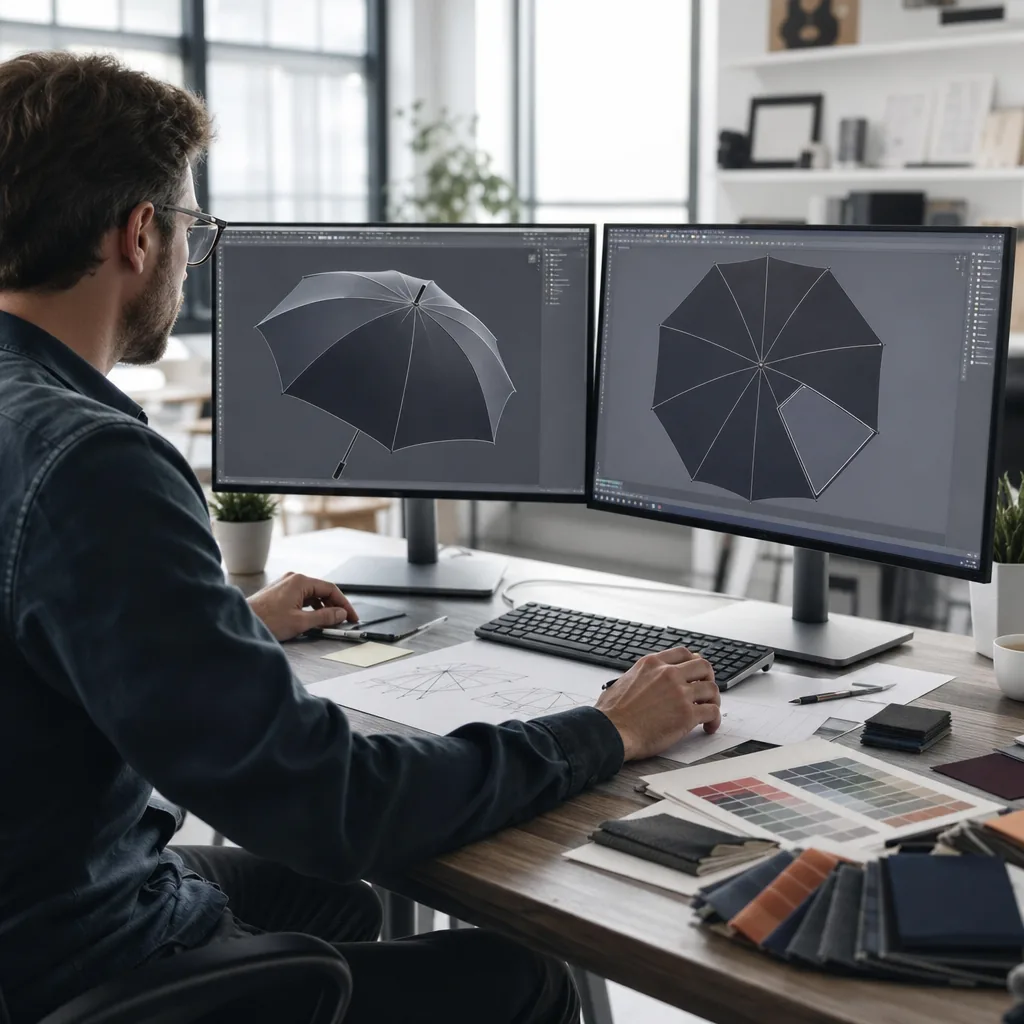
Full-color canopy work looks simple on a mockup, but gradients, skin tones, and brand colors can shift quickly once they meet polyester, coating, panel seams, and heat. On our Songxia production floor, photo print umbrellas are treated less like standard logo jobs and more like controlled print projects, with artwork checks, fabric selection, strike-off proofing, and realistic lead-time planning built in before bulk cutting starts.
Best Campaigns for Photo and Gradient Umbrellas
Photo print umbrellas work best when the umbrella is treated as a moving billboard, not just a logo carrier. Tourism boards can print skylines, mountain silhouettes, beach sunsets, or heritage streets across a 23" or 27" pongee canopy, giving visitors a souvenir that also functions in real rain. University campaigns often use campus photography, mascot scenes, or graduation imagery for alumni gifts and admissions events. Museum shops can turn collection details, architectural ceilings, or exhibition graphics into digital printed umbrellas, usually on 190T or 210T pongee with black electroplated steel or fiberglass frames depending on the retail price point.
Gradient umbrella printing is especially strong for festivals, beverage promotions, and seasonal retail capsules because color blocking is visible from a long distance. A beer brand can run amber-to-black panels, a bottled water sponsor can use blue-to-clear effects, and a music festival can match the sunset palette used on wristbands, stage banners, and staff ponchos. For these programs, I usually recommend full color umbrella printing by sublimation for polyester pongee, because it keeps the canopy soft and avoids the heavy hand feel of large-area screen ink. On POE or EVA clear umbrellas, UV or digital printing can work, but artwork must be adjusted for transparency and panel seams.
Full-color artwork creates stronger visual recall than a single chest-size logo because people remember scenes, colors, and emotional context before they remember brand marks. A plain umbrella with a 4" logo may satisfy procurement, but it often disappears in a crowd of black and navy canopies. Branded campaign umbrellas with panoramic photos, gradients, or repeating visual systems create recognition from 20 to 50 meters away, especially on 8K or 16K layouts where the artwork wraps smoothly around the dome. Our standard practice at ZheBrella is to check photo resolution, seam alignment, panel orientation, and color tolerance before bulk cutting, because a beautiful rendering can still fail if faces land on rib seams or the gradient shifts between panels.
Artwork Resolution and File Preparation
For photo print umbrellas, the first mistake is treating a flat screen file like it will survive the curved panel. I want source images at the actual finished size, not a stretched mockup: 300 dpi is ideal, and I would not go below 200 dpi on the printed panel if the artwork has faces, fine lettering, or product shots. Convert everything to CMYK before proofing, because a bright RGB blue or neon red often dies on polyester pongee 190T or 210T once it hits the press profile. For gradient umbrella printing, smooth tonal transitions are only clean when the file is built with enough bit depth and no banding from low-quality JPEGs. If the campaign includes logos, keep them as vector overlays so the brand mark stays sharp even when the background is photographic. That is the difference between decent digital printed umbrellas and something that looks blurry at arm’s length.
Panel templates matter more than most designers admit. Each segment has seams, stitch take-up, and a small amount of distortion toward the tip and center point, so use the factory panel pattern instead of a flat rectangle and keep critical faces, slogans, QR codes, and product names away from seam lines. I usually allow bleed around each panel edge so no white sliver shows after cutting and sewing, and I check that repeated elements match across adjacent panels before approval. For full color umbrella printing on branded campaign umbrellas, the design should also respect the center hub, runner area, and vent openings on double-canopy styles, because those zones can hide or break important content. If the umbrella uses an 8K, 10K, or 16K frame, the panel geometry changes, so do not reuse one template for every size.
Approve the artwork at actual print size, not only on a polished flat mockup, because a mockup can hide the problems that appear on the finished canopy. We ask buyers to review a panel-by-panel proof with seam marks, bleed marks, and crop lines visible, then compare it against the real decoration method: sublimation on white pongee, heat transfer, screen print, or mixed digital printed umbrellas with vector logo overlays. If the piece is meant for photo print umbrellas, inspect skin tones, dark shadows, and small text under the same viewing distance the end user will have, usually 1 to 2 meters for a walking umbrella. ZheBrella’s standard practice is to sign off on the final production file only after the proof matches the true panel size and the print direction, because once the canopy is cut, a bad layout is expensive to fix.
Fabric and Coating Effects on Image Results
Fabric structure changes the print before ink ever touches it. On 190T pongee, the yarn gaps are slightly more visible, so gradient umbrella printing can show a softer edge and a little more light scatter, especially in pale blue, beige, and skin-tone artwork. 210T pongee gives a tighter face and normally holds full color umbrella printing with better detail, but it also absorbs dye or pigment differently depending on whether the mill used cationic, polyester, or recycled yarn. For photo print umbrellas, I prefer 210T when the campaign image has faces, product shots, or fine typography under 8 mm high. A 190T canopy is still acceptable for bold event graphics, skyline silhouettes, and large gradient bands, but buyers should not judge it from a paper proof. The umbrella’s curved 8K or 16K panel geometry and seam allowances already break the image; a looser fabric exaggerates that effect.
Black coating is the biggest color killer on digital printed umbrellas because the backing layer absorbs transmitted light and makes the front side look heavier. Red can move toward burgundy, navy can look almost black, and yellow loses the clean brightness buyers expect from a screen display. Silver coating behaves differently: it reflects more light and improves sun protection, but it can create a cooler cast, making warm gradients look slightly gray or metallic. UPF 50+ layers, whether chemical UV treatment or laminated backing, add another variable because they change both fabric hand feel and optical density. A canopy that measures well for ultraviolet blocking may print one to two tones darker than an uncoated sample. This is why coated UV umbrellas should go through extra proofing before bulk approval, not just a JPG signoff. Our standard practice at ZheBrella is to compare the approved print under daylight D65 and indoor LED, because retail buyers and outdoor event teams see different results.
For branded campaign umbrellas, the safest approval route is a physical strike-off on the exact bulk fabric, coating, rib count, and panel size. A 23-inch auto-open umbrella with 8 panels will not display a panoramic photo the same way as a 30-inch golf umbrella with a double-canopy vented windproof structure, even when both use 210T pongee. Sublimation usually gives cleaner gradients on white or light pongee, while UV-coated black-back fabric may require adjusted ICC curves, higher ink limits, or a deliberately brighter file. Heat transfer can boost sharpness for logos, but large photo areas may feel stiffer if the film coverage is heavy. For digital printed umbrellas with coated UV fabric, I advise approving one opened sample, one closed roll-up view, and one wet-rub check before mass production. It adds 3 to 5 days, but it avoids an AQL 2.5 inspection argument after 3,000 pieces are already sewn and packed for FOB or DDP shipment.
Choosing the Right Umbrella Construction
The construction decision should start with viewing distance, not handle style. A 21" or 23" compact auto-open umbrella is convenient for commuting and giveaway programs, but its smaller canopy means each of the 8 panels is narrow and more curved. That works for repeated logos, simple gradient umbrella printing, and cropped product textures, but it is unforgiving for faces, skyline photos, or campaign artwork with text near the seams. With 8K steel ribs, the panel edge tension is usually stable enough for standard 190T pongee, yet the image is still broken into eight visible wedges. For photo print umbrellas, I normally tell buyers to keep the focal subject centered inside one or two panels and avoid running eyes, buildings, or QR codes across rib seams.
Golf umbrellas give branded campaign umbrellas the best visual impact because the canopy is physically large and easier to read from 10 to 30 feet away. A 27" or 30" 8K golf frame creates wide panels, so full color umbrella printing can carry a landscape, athlete image, event visual, or sponsor layout with less distortion. Fiberglass ribs are preferred over steel here because the larger span needs flex, especially when the canopy is 210T pongee with a Teflon or UV UPF 50+ coating that adds finishing tension. Manual-open golf umbrellas are more durable for field use, while auto-open models improve user experience at events. The tradeoff is shipping cube: a golf umbrella can cost noticeably more under DDP freight than a compact model, even before printing cost is considered.
Double-canopy windproof umbrellas are the right choice when the campaign must look premium and survive real weather, but buyers need to understand how the vent layer affects artwork. On an 8K vented frame, the upper canopy interrupts the image area, so digital printed umbrellas should use patterns, gradients, or logos positioned below the vent rather than one continuous photograph. A 16K frame looks more luxurious and rounder, but it divides the artwork into 16 slimmer panels; that improves canopy shape and wind stability, often surviving 50+ mph tunnel tests with fiberglass ribs, but it increases image segmentation. Our standard practice at ZheBrella is to request panel-by-panel artwork for 16K photo designs, then check seam alignment during pre-production sampling before moving to AQL 2.5 inspection.
Proofing, QC, and Bulk Order Planning
For gradient umbrella printing and photographic artwork, I do not approve bulk fabric cutting from a PDF mockup alone. The correct sequence is a digital strike-off first, then one full pre-production sample on the actual umbrella construction: same 190T or 210T pongee, same panel count, same coating, same ribs, same handle, and same sewing method. A strike-off shows whether skin tones, skyline details, logo edges, and gradient bands hold up after sublimation or digital transfer, but only a finished sample confirms panel-to-panel alignment across 8K or 16K canopies. For photo print umbrellas, pay special attention to the top cap area and panel seams, because a face, product shot, or building façade can look distorted once the canopy is tensioned over the frame. Our standard practice at ZheBrella is to mark approved Pantone references, CMYK artwork files, and acceptable visual limits before the production sample is signed, not after fabric has already been printed.
Bulk QC should combine appearance checks with mechanical and print durability checks, not just count cartons. For branded campaign umbrellas, I recommend AQL 2.5 for major defects and tighter internal checks for logo position, color drift, and canopy stains, especially when the order is for retail or a national promotion. Rub tests should be done on printed panels using dry and damp white cloth to catch ink transfer, and color tolerance should be checked under D65 lighting against the approved strike-off, usually within a practical Delta E range agreed before production. Full color umbrella printing also needs seam inspection because dark photographic panels can show skipped stitches, puckering, or needle marks more clearly than solid navy or black. On auto-open and auto-open-close models, QC must still include runner function, rib attachment, spring force, and open-close cycling; beautiful digital printed umbrellas are useless if the shaft jams after ten opens.
Order planning is where many campaign buyers lose time. MOQ for custom full-color canopies is usually higher than for stock-color screen printing because fabric printing, drying, panel cutting, and print matching must be batched; 300 to 500 pieces per design is a realistic starting point, while better unit costs usually begin around 1,000 pieces. Standard lead time for approved artwork plus strike-off is often 5 to 7 days, a full pre-production sample adds another 7 to 10 days, and bulk production for large photo or gradient runs commonly needs 25 to 40 days after sample approval, depending on quantity and season. FOB Ningbo or Shanghai is cleaner for experienced importers, while DDP works better for event planners who need landed cost control and delivery to one warehouse. For time-sensitive campaigns, carton dimensions, HS codes, shipping marks, and spare umbrellas for replacement should be planned before production starts, not after final inspection.
Frequently Asked Questions
Can a photograph be printed clearly on an umbrella canopy?
Yes, if the image is high resolution and adjusted for the panel shape and fabric. A full umbrella sample is important because seams and canopy curvature change how the photo appears.
Will gradient colors match Pantone references exactly?
Gradients are harder to match than solid Pantone colors because they shift across the image. Buyers should approve a printed strike-off and define acceptable color tolerance before bulk production.
Which umbrella fabric works best for photo-quality and gradient artwork?
190T or 210T polyester pongee is the most common choice for clean full-color output because the surface is smoother and holds detail better than basic nylon. For large photo areas or soft gradients, buyers usually approve pongee with digital heat transfer or sublimation-style panel printing.
What artwork setup reduces visible breaks across umbrella panels?
Build the file on a panel template with 3-5 mm bleed and keep faces, logos, and text away from panel seams, tips, and the center cap. For continuous images, factories normally separate art by panel first and then send a seam-adjusted proof before sampling.
How much extra time should a buyer allow for color proofing on full-color umbrellas?
Compared with standard logo printing, full-color canopy orders usually need an extra 3-7 days for file checking, panel mapping, and color proof approval. A pre-production sample often adds about 5-10 more days, especially when gradient balance or skin tones are critical.
Looking to Launch Your Custom Umbrella Line?
ZheBrella is a Zhejiang-based OEM/ODM umbrella manufacturer with 17 years of export experience. Free design, low MOQ from 100 pieces, windproof construction, full-color print.
Get Free Quote Now »People Also Search For
Related Articles
Gradient and Photographic Umbrella Prints for Brand Campaigns
Plan photo, gradient, and all-over digital umbrella prints with file specs, 190T/210T fabric choices, panel seams, lead ...
Read More »Gradient and Photo-Print Umbrellas for Brand Campaigns
Specify gradient and photo-print umbrellas with realistic color control, fabric choices, sample approvals, and productio...
Read More »
Gradient Umbrella Printing for Branded Color Campaigns
Learn how to specify gradient umbrella prints with realistic color transitions, fabric choices, sampling steps, and prod...
Read More »