Logo Placement on Umbrellas: Panels, Straps, and Handles
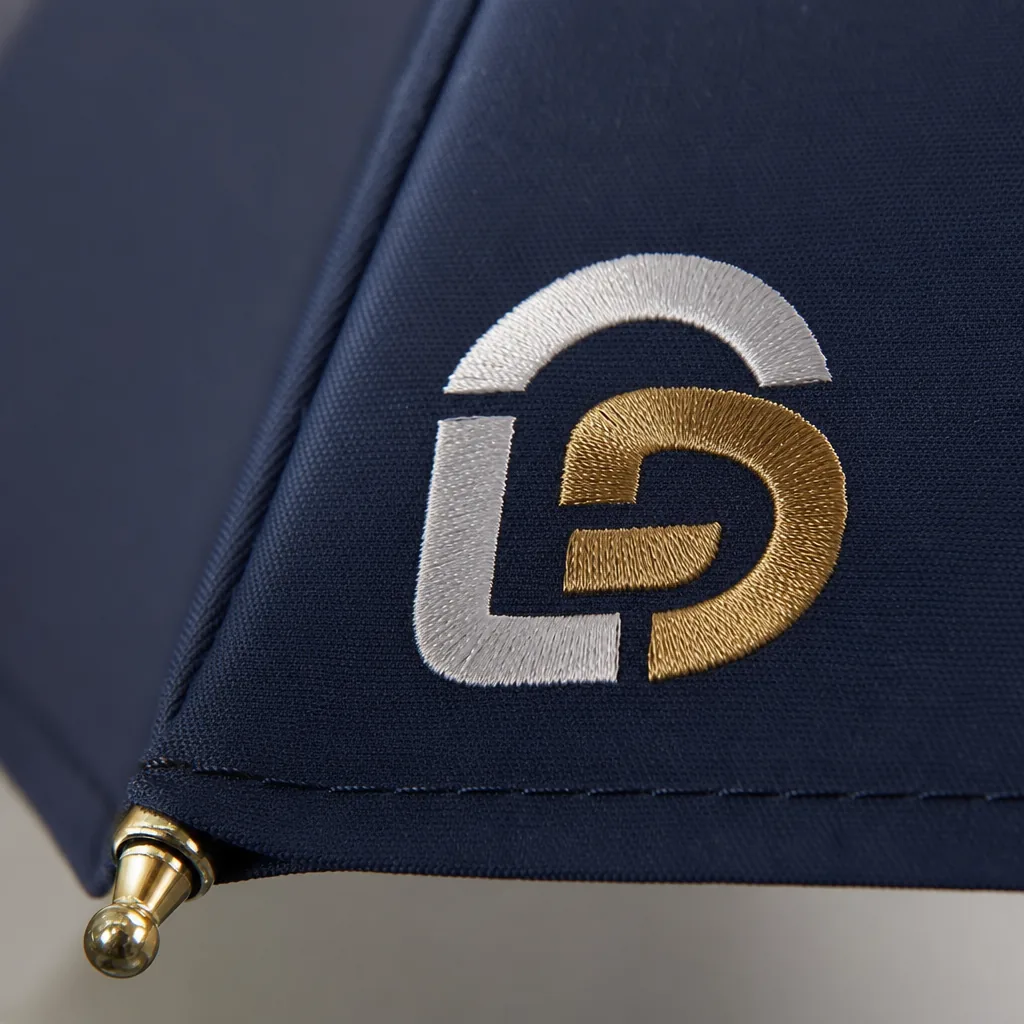
Choosing where a logo goes on an umbrella sounds simple until panel curvature, strap stitching, handle material, and opening behavior start affecting print quality and brand visibility. Buyers need a practical umbrella logo placement guide that balances appearance, durability, and production limits before samples go into mass order. From a factory floor perspective, the right position is the one that stays readable, aligns with the canopy structure, and survives real use.
Match Logo Placement to How the Umbrella Is Used
Logo position should follow the viewing distance, not the buyer’s internal preference sheet. A walking umbrella is seen at chest-to-head height, usually from 6 to 20 feet away, so umbrella panel printing on one or two outer panels gives the strongest moving visibility. On a 21" or 23" folding umbrella, I normally keep the main mark under 180–220 mm wide because panel curvature and seam pull will distort oversized artwork. Golf umbrellas are different: a 27", 30", or 32" canopy sits higher and is viewed across a fairway, parking lot, or event lawn. Here, alternating-panel logos or a large single-panel print on 190T/210T pongee can work, especially on 8K or 10K fiberglass frames where the canopy stays flatter in wind. For a practical umbrella logo placement guide, I would not treat a compact giveaway and a vented double-canopy golf umbrella as the same advertising surface.
Retail display and event giveaway orders need different branding logic. In retail, the umbrella is often closed in a rack, polybag, or sleeve, so panel artwork may be invisible until after purchase. That is where sleeve printing, hangtag color coding, and custom umbrella straps matter: the strap is the first branded touchpoint when the product is folded, and a 60–90 mm woven label or heat-transfer mark can carry a clean logo without making the canopy look cheap. For event giveaways, speed and recognition matter more than fine detail. A one-color screen print on a white, navy, or black panel is safer than a four-color logo with tiny registration points, especially when production is 3,000–10,000 pcs under a 25–35 day lead time. Our standard practice at ZheBrella is to review branded umbrella artwork at actual size before sampling, because a logo that looks balanced on PDF often crowds the rib line after sewing.
Hotel concierge umbrellas are the case where subtle branding usually beats loud panel coverage. Guests carry the umbrella through a lobby, into a taxi queue, and sometimes back to the room, so the handle, strap, and sleeve are touched more often than the open canopy is seen. Logo umbrella handles can be effective on straight EVA, wood-look, or rubberized J handles, but the artwork has to match the process: debossing, pad printing, metal badge, or laser marking each has different durability. A strap logo reinforces ownership when staff count returns, while a sleeve logo keeps the hotel name visible in storage baskets. The canopy can still carry a small crest on one panel, but I avoid placing it too close to the tip or lower hem where water runoff, Teflon coating, and repeated folding create abrasion. Good placement is not decoration; it controls who sees the brand, when they see it, and how long it survives in real use.
Panel Printing Rules for Clean Artwork
Clean panel artwork starts with respecting the umbrella’s geometry, not the PDF artboard. On a standard 23" straight umbrella, one panel is usually a curved wedge about 15-17" wide at the bottom edge and 10-12" high from seam to valance, but the safe print zone is smaller. I normally keep logos at least 20-25 mm away from both side seams, 30-40 mm above the lower hem, and clear of the top notch where fabric gathers around the cap. For compact 21" umbrellas, shrink those margins rather than pushing artwork into the stitch line; a logo caught under binding looks cheap and will fail AQL 2.5 visual checks. This is the first rule in any practical umbrella logo placement guide: the printable area is not the full panel. For umbrella panel printing, ask for a dieline based on the actual frame size, rib count, and canopy pattern, especially if the order uses 8K versus 10K construction.
Curved canopy distortion is the part buyers underestimate. A round logo placed flat on a panel can look slightly stretched once the pongee 190T or 210T canopy is tensioned over steel or fiberglass ribs. Tall vertical marks usually survive better near the center of the panel, while long horizontal text should be kept closer to the lower third where the panel is wider and flatter. Avoid splitting critical branded umbrella artwork across seams unless the design is intentionally repeated; panel-to-panel registration can shift 3-5 mm during sewing, even in a disciplined line. For minimum artwork rules, keep positive lines at 0.3 mm or thicker for heat transfer, 0.5 mm for screen print, and avoid tiny reversed text below 6-7 pt. Our standard practice at ZheBrella is to flag hairlines, trademark symbols, and QR codes before sampling because they are the first details to fill in, crack, or distort after opening cycles.
Printing method changes placement discipline. Screen print is economical for one- or two-color logos, but it needs flatter zones and enough clearance for the screen frame, so oversized logos near the crown are risky. Heat transfer handles gradients and small color runs better, yet the transfer film must sit fully inside one panel with smooth pressure; if it crosses a seam allowance, the edge will lift after folding and packing. Sublimation works best on white polyester panels and can cover full-panel artwork, but the design still needs bleed past the cut line and must account for sewing loss at every seam. A good umbrella logo placement guide should also separate canopy art from custom umbrella straps and logo umbrella handles, because those parts use different dielines, tolerances, and materials. Final approval should always happen on an opened sample, not only on a flat mockup, since the customer sees the logo on a curved, ribbed surface.
Strap, Sleeve, and Handle Branding Options
Strap branding is the most overlooked real estate on a custom umbrella because buyers focus on umbrella panel printing first, but the closure strap is what the user touches every time. For low MOQ runs, I prefer printed closures: a one-color or two-color logo screen printed or heat-transferred onto the same 190T or 210T pongee used for the canopy. It keeps tooling simple, works from roughly 300–500 pcs depending on color, and does not change sewing flow. Woven strap labels look more retail, especially on 23" auto-open or 27" golf umbrellas, but they need label weaving, cutting, and extra attachment labor; that usually makes sense from 1,000 pcs upward. If the strap has Velcro, keep the logo at least 5 mm away from the stitch line and hook tape, or the edge will fray after repeated closing. In any umbrella logo placement guide, strap artwork should be checked at actual folded diameter, not only on the flat pattern.
Sleeves give more printable area than straps and are useful when branded umbrella artwork has a tagline, QR code, event date, or distributor contact details. A sleeve logo can be screen printed, heat transferred, sublimated on white polyester, or sewn with a woven side label. For standard black or navy sleeves, heat transfer is cleaner for small text than screen printing, but a thick transfer film can crack if the sleeve is folded tightly around a compact 21" umbrella. Sublimation works only on light polyester and is best for full-surface retail graphics, not a simple white logo on dark fabric. Our standard practice at ZheBrella is to align sleeve logos with the closure opening, because sleeves rotate in cartons and a centered logo on the wrong face looks accidental in retail photos. Sleeve branding is low-tooling and low-risk, so it suits seasonal campaigns, corporate gifts, and orders where MOQ is under 1,000 pcs.
Handle branding depends heavily on handle material and whether the buyer can justify tooling. Rubberized handle badges look premium on storm umbrellas with fiberglass ribs and double-canopy construction, but molded badges require a logo mold and usually need 1,000–3,000 pcs to amortize the cost. Wood engraving is excellent for executive 23" stick umbrellas or 30" golf umbrellas; laser engraving has no color matching issue, handles moisture better than cheap pad ink, and can run at lower MOQ if the wood handle is already in stock. Plastic handle pad printing is the economical choice for promotional orders: it works on J handles, straight EVA grips, and ABS handles, but curved surfaces limit logo size and fine lines. For logo umbrella handles, avoid placing artwork where fingers rub constantly; pad ink on high-contact zones will fail earlier in AQL wear checks. A practical umbrella logo placement guide should treat handle branding as either stock-handle decoration for low MOQ or custom tooling for long-term retail programs.
Placement Decisions by Umbrella Type
Folding umbrellas are the tightest layout problem because the printable panels are broken by short rib geometry, crease memory, and the sleeve or strap position when packed. On a 21" or 23" 3-fold with 8K steel or fiberglass ribs, I usually keep the main logo inside a 160–190 mm wide safe zone per panel and avoid artwork that crosses rib seams; the panel looks wide on the cutting table but narrows visually once the canopy is tensioned. Auto-open-close models need extra caution around the runner path and push-button side of the shaft, because thick heat-transfer patches or heavy embroidery near the closure line can cause poor folding or strap misalignment. For promotional use, folding umbrellas work best with one or two outer-panel logos plus a woven label or heat-transfer mark on custom umbrella straps, where the brand remains visible when the umbrella is carried closed.
Straight umbrellas and classic stick umbrellas give cleaner umbrella panel printing because the 23" or 27" canopy holds a smoother arc and the ribs are longer, so distortion is easier to control. With 8K spacing, one panel can carry a bold logo, while 16K frames create narrower triangular panels that suit repeated small marks or alternating-color layouts rather than one oversized graphic. Golf umbrellas, especially 30" and 32" models, offer the best walking billboard effect: a 16K fiberglass frame spreads the canopy wide, and a double-canopy vented windproof build still allows large branding if the upper vent layer and lower panel are registered correctly. The catch is visibility angle. A logo placed too high near the crown may look good in a flat proof but disappear from eye level; for retail and event orders, branded umbrella artwork should sit in the lower two-thirds of the panel unless the buyer specifically wants aerial visibility.
Reverse and UV umbrellas need a different umbrella logo placement guide because the user sees different surfaces at different moments. Reverse umbrellas expose the inside canopy when closed, so inner-panel printing can be more valuable than outer-panel decoration for commuters entering a car or lobby. However, the double-layer structure means POE, 190T pongee, or black-coated UV fabric must be tested for ink migration, especially with white logos over dark UPF 50+ coatings. UV umbrellas also need spacing from seam tape and coating-heavy crown areas, since aggressive curing heat can mark silver or black glue layers. Handles are another branding point: logo umbrella handles can be pad-printed, laser-marked on wood, or molded with a badge, but the mark must clear the auto-open button by at least 8–12 mm so fingers do not rub it off during use. Our standard practice at ZheBrella is to confirm panel, strap, and handle artwork together before sampling, not as three separate decisions.
Artwork Approval and Pre-Production Checks
Artwork approval should lock the file, color, size, and location before any fabric is cut. For branded umbrella artwork, I ask buyers for editable AI or vector PDF files with fonts outlined, embedded images at 300 dpi, and separate layers for each print position: panel, strap, sleeve, or handle insert. JPEG logos pulled from a website are not production files; they create fuzzy edges on screen printing and poor registration on heat transfer. Pantone references should be written clearly, for example Pantone 186 C or Pantone Black 6 C, because “red” changes under factory LED light, daylight, and wet 190T pongee. For umbrella panel printing, specify whether the logo sits centered on one panel, repeats on alternating panels, or crosses a seam, which I usually discourage unless the design accepts a 3–5 mm sewing shift. A practical umbrella logo placement guide should also show print dimensions in millimeters, not only visual mockups.
Strike-off samples are where mistakes get caught cheaply. Before bulk printing, our standard practice at ZheBrella is to print one or two strike-offs on the actual canopy material, such as 190T pongee with Teflon coating, 210T polyester with UPF 50+ treatment, or transparent POE/PVC if the logo uses white ink. Coatings change ink absorption, especially on dark navy, bottle green, and black panels. Approval photos should include a full open umbrella, close-up logo detail, ruler measurement, and color comparison against a Pantone book when available. For custom umbrella straps, the check is different: confirm the logo reads correctly when the strap is wrapped around a 21 inch, 23 inch, or 27 inch canopy, and allow space for the snap button. Logo umbrella handles need extra confirmation because laser engraving, pad printing, epoxy doming, and molded badges each have different edge sharpness and minimum line width.
Set a written logo position tolerance before production starts, or inspection becomes an argument. For panel logos, I normally allow ±5 mm from the approved center point on standard 8K umbrellas and ±7 mm on large 30 inch golf umbrellas, because fabric stretch, seam allowance, and rib tension all move the visual center after assembly. Strap logos can usually hold ±3 mm if the strap is cut by jig, while handle logos depend on the curvature and fixture accuracy. AQL 2.5 visual checks should include wrong Pantone, ink bleeding, pinholes, ghosting, crooked placement, cracked heat-transfer film, sublimation color shift, and logos hidden by ribs when the umbrella is open. The final pre-production package should include signed artwork, approved strike-off photos, print method, logo size, panel number, tolerance, and inspection standard. That is the part of an umbrella logo placement guide that prevents 10,000 pieces from becoming a discount problem.
Frequently Asked Questions
Can a logo cross umbrella panel seams?
It is possible with full-canopy sublimation, but seam alignment can vary during sewing. For precise corporate logos, keeping artwork inside one panel is usually safer.
Which umbrella logo position is most visible at events?
Outer canopy panels offer the strongest distance visibility when umbrellas are open. Straps and sleeves are better for handout moments, retail display, and storage visibility.
How much print space is usually available on an umbrella panel?
Most standard canopy panels allow a logo area of about 8 to 14 inches wide, depending on the umbrella size and panel shape. For curved panel printing, artwork is usually adjusted to fit the seam allowance and avoid distortion near the edges.
Can logos be printed on both the umbrella strap and handle in one order?
Yes, many OEM orders allow branding on multiple parts, but each location may require a different method such as screen print, pad print, or laser engraving. The final MOQ and unit cost usually increase slightly if you add both strap and handle branding.
What should importers confirm before approving umbrella logo placement samples?
Buyers should confirm logo size, exact position relative to seams, print color match, and whether the design is visible when the umbrella is open and closed. It is also important to check the handle material, because wood, EVA, and plastic handles each limit the available decoration methods.
Looking to Launch Your Custom Umbrella Line?
ZheBrella is a Zhejiang-based OEM/ODM umbrella manufacturer with 17 years of export experience. Free design, low MOQ from 100 pieces, windproof construction, full-color print.
Get Free Quote Now »People Also Search For
Related Articles
Top 5 Logo Size Decisions for Branded Umbrella Panels
Plan logo size by umbrella type, panel count, print method, and buyer approval needs before sampling branded umbrella or...
Read More »Refined Logo Placement Specs for Branded Umbrella Canopies
Plan logo placement on umbrellas with clear specs for panel size, safe zones, seam breaks, and repeat-order consistency ...
Read More »
Umbrella Logo Placement Guide for Better Brand Visibility
Plan canopy, sleeve, handle, and strap branding with print-size limits, panel layouts, and model selection to improve lo...
Read More »