Top 5 Logo Size Decisions for Branded Umbrella Panels
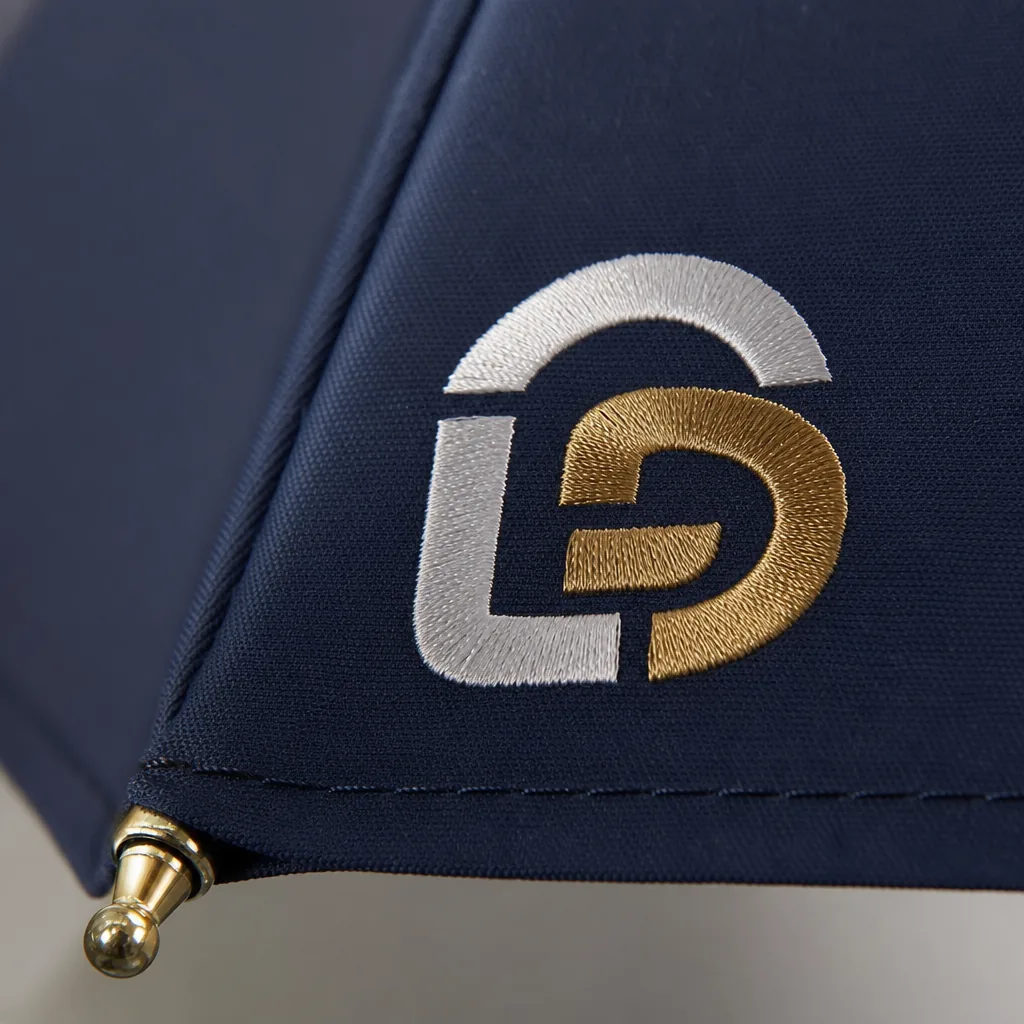
An umbrella logo size guide must account for canopy curvature, panel taper, seam allowance, and print registration, all of which can turn a clean flat proof into a crowded production mark. Example assumptions to verify in the supplier quote are a 60 mm logo width, 8 panels per canopy, and 145 mm of usable width per panel. Compare the buyer's vector proof with the supplier's panel template, then confirm the measured print area, ink spread, and production tolerances because umbrella type and print method can change the result.
Start With Umbrella Type and Usable Print Area
The first decision in an umbrella logo size guide is frame-and-canopy geometry, not nominal arc size. For preliminary planning as of the date on the supplier’s quote, use these CAD-based example assumptions from the quoted SKU template, then verify every dimension in that quote and the production dieline: a compact umbrella with a 21-inch nominal arc and artwork measuring 120 millimeters wide by 80 millimeters high; a straight umbrella with a 23-inch nominal arc and artwork measuring 180 millimeters wide by 110 millimeters high; and a golf umbrella with a 30-inch nominal arc and artwork measuring 260 millimeters wide by 160 millimeters high. These measurements describe finished artwork, not the printer’s fixture. Compact branded umbrella panels lose usable height at folding creases and narrow tips; straight panels usually retain a cleaner center; golf panels offer more visible area, but seams, curvature, and vent overlaps can interrupt a large mark. These are example calculations, not guaranteed capacities. Confirm the umbrella print area before releasing screens, transfers, or sewn panels because artwork scale, printed-panel count, and process choice directly affect setup cost, remake exposure, and lead time.
Set canopy logo placement by reconciling both production records for the actual quoted SKU. Source context A is the supplier’s current CAD cutting template for the selected frame-and-canopy combination; exclude stitched hems, seam allowances, rib pockets, tapered edges, vent overlaps, and the high-curvature ferrule zone. Source context B is the printer’s current screen-frame drawing, heat-transfer platen specification, or sublimation registration sheet for the quoted print process. Overlay the promotional umbrella artwork at final scale and define the usable rectangle as the largest contiguous area left after applying both sets of exclusions. Approve a physical strike-off before bulk printing and sewing. This method derives a defensible layout but does not guarantee production output: fabric stretch, manual panel alignment, ink bleed, logo aspect ratio, vent construction, and print route can reduce usable space. Require the dated quote to state finished artwork width and height, print method, printed-panel count, placement reference, registration or placement tolerance, strike-off approval time, and remake-cost responsibility. Also confirm whether each quoted dimension refers to finished artwork or the printing fixture; confusing those measurements changes price, visual scale, and dispute risk.
Byline: Vincent Xi, Editorial Author. Author profile: https://www.zhebrella.com/authors/vincent-xi/. That profile is the approved source for the author’s name, role, and URL only; it does not substantiate factory tests, certifications, or measured print capacity. Article JSON-LD author: {"@type":"Person","name":"Vincent Xi","jobTitle":"Editorial Author","url":"https://www.zhebrella.com/authors/vincent-xi/"}. Evidence and limitations: the dimensions above are example calculations based on the production-source types described, not measurements for a released SKU. Verify them against the dated supplier quote, current CAD template, printer setup, and approved physical strike-off. Visual brief/imagePrompt: Create a realistic overhead factory-layout photograph of unbranded compact, straight, and vented golf canopy panels beside proportionate steel or fiberglass rib frames. Use removable masking shapes to indicate provisional print rectangles. Show woven pongee texture, stitched hems, rib pockets, compact-panel folding creases, a golf-panel vent overlap, matte ink-test swatches, a screen-print registration jig, and a metric measuring rule under neutral factory lighting. Include no people, text, logos, watermarks, certificates, branded equipment, or impossible machinery.
Match Logo Scale to 8K and 16K Panel Geometry
Panel geometry sets usable logo width; nominal arc diameter does not. For this umbrella logo size guide, treat 8K as eight ribs forming eight sewn panels and 16K as sixteen ribs forming sixteen sewn panels only when the supplier’s revision-coded production dieline and purchase quote, current as of artwork approval, confirm that construction. At a comparable canopy arc, a sixteen-panel wedge has a shorter horizontal chord than an eight-panel wedge, especially near the ferrule. That geometry can force a long wordmark into a stacked lockup, narrower scale, or lower canopy logo placement; a compact emblem usually needs less reduction. Define the umbrella print area from the approved dieline, never a generic template. At the proposed logo height, draw a centerline, measure the chord, and deduct the clearance marked at each seam. Exclude seam allowance, vent overlap, tip pockets, and high-curvature zones that will not lie flat on the specified screen-print pallet or heat-transfer press. Panel cut, seam construction, vent geometry, and print method can change every limit, so a mismatched dieline revision creates sampling cost and production rework.
Treat every dimension as a quote-specific input, not a transferable specification. Example calculation, based on a hypothetical approved dieline and to be verified in the supplier quote current as of artwork approval: assume a 280 mm horizontal chord for one eight-panel wedge, a 150 mm chord for one sixteen-panel wedge, and 30 mm total seam clearance for each panel. Deducting that clearance yields a 250 mm umbrella print area in the hypothetical eight-panel layout and 120 mm in the hypothetical sixteen-panel layout. These five dimensions are example assumptions and derived values, not ZheBrella product specifications. Review promotional umbrella artwork at full physical scale, retain vector paths and minimum printable strokes, apply trapping suited to the selected process, and approve a position proof carrying the dieline revision code. Repetition can offset the narrower single-panel mark: under an example every-other-panel pattern to verify on the approved dieline, sixteen equal panels provide eight printed faces, while eight equal panels provide four. Those counts describe placement, not guaranteed viewing performance; repeated compact marks improve the number of viewing angles without crossing seam clearances or distorting a wordmark.
Evidence and method: derive each width from the supplier’s revision-coded production dieline current as of artwork approval, cross-check rib and panel construction plus print process against the purchase quote from the same approval date, bind the signed position proof to that exact revision, and inspect placement on a physical preproduction sample. This method separates calculated clearance from sample verification. Limitations: no project-specific dieline, quote, signed proof, or sample measurement was supplied. Before release, buyers must verify nominal canopy size, rib and panel count, fabric, seam allowance, print process, repeat pattern, registration tolerance, and packing requirements. Byline: Vincent Xi, Editorial Author. Author identity and role source: https://www.zhebrella.com/authors/vincent-xi/. Image prompt: top-down QC-table photograph of side-by-side open, unbranded umbrellas whose eight-rib/eight-panel and sixteen-rib/sixteen-panel geometry matches supplier documents current as of artwork approval. Use a 23-inch nominal canopy and 190T polyester pongee only as visual assumptions to verify in the supplier quote at artwork approval. Show realistic ribs, seams, ferrules, tips, paper dielines, rulers crossing proposed logo centerlines, and blank contrasting placement masks revealing the narrower sixteen-panel chord. Use neutral factory lighting; exclude people, readable text, logos, watermarks, implausible machinery, and certification marks.
Choose Size by Print Method and Fabric Behavior
Set the usable logo boundary from the print process, not the nominal panel outline. Treat 190T and 210T as supplier-reported total thread-count classes, nominally threads per square inch, for the quoted pongee lot as of the quotation date; source those classifications from the mill specification and confirm yarn construction, finished weight, and coating there. Neither class alone predicts ink holdout or heat response. Screen printing fits bold spot colors, but a solid area spanning a natural fold can bridge the weave, accumulate ink, and crack. For this umbrella logo size guide, use 15 mm live-art clearance from stitched seams, a 10 mm sewing allowance, and +/- 2 mm color-registration tolerance only as example assumptions for a single printed panel; verify each assumption against the supplier's quotation-date dieline and print quote. Keep fine lines, small reversals, and tight color traps near the center of branded umbrella panels, away from seam ridges and sewing distortion. Approve the resulting umbrella print area before screens or fixtures are made to control rework, cost, and lead-time risk.
Digital printing supports gradients, photographs, and multicolor promotional umbrella artwork without screen-ink buildup, but production sequence controls edge clearance. Printing before cutting can extend color into the cutting allowance; printing a cut or sewn panel requires additional clearance for platen access, fabric stretch, and fixture variation. Heat transfer can reproduce sharp detail on compatible polyester pongee, but excessive temperature, pressure, or dwell can flatten the weave, disrupt a water-repellent finish, leave a platen outline, or reduce adhesion after repeated folding. Use settings from the transfer-film manufacturer's technical data sheet current on the quotation date, then approve a strike-off on the actual production fabric and coating; results from another fabric lot do not establish compatibility. Test canopy logo placement and print stress on the assembled approval sample. Fiberglass ribs may distribute flex over a broader area, while steel ribs can create sharper contact creases during closing and strap compression; neither guarantees print durability. Open, close, fold, and strap the sample, inspecting rib tracks and natural folds for cracking, edge lift, color shift, or permanent creasing before production release.
Methodology and limitations: derive the usable boundary by overlaying the supplier's quotation-date cut-panel dieline with its sewing allowance, stitched seams, rib tracks, fold lines, and the print shop's documented process limits. Compare that geometry with the ink, coating, or transfer-film manufacturer's technical data sheet current on the same quotation date, then validate the interaction through a production-equivalent strike-off and assembled sample. These sources establish geometry and material limits, but nominal 190T or 210T classifications for the quoted lot, sourced from that date's mill specification and expressed nominally per square inch, do not disclose yarn denier, calendaring, Teflon-type treatment, polyurethane backing, or shade variation. Verify final dimensions, tolerances, color standard, coating compatibility, required compliance documents, sample performance, cost, and lead time in the dated quote and approval record. Visible byline: Vincent Xi, Editorial Author, https://www.zhebrella.com/authors/vincent-xi/. Article or BlogPosting JSON-LD must identify Vincent Xi as a Person with jobTitle "Editorial Author" and the same profile URL. Visual brief/imagePrompt: documentary overhead view of a dark navy pongee umbrella panel on a cutting table with screen-print mesh, digital color swatches, transfer film, seam guides, natural fold creases, visible ink buildup, and adjacent fiberglass and steel rib assemblies; accurate textile texture, realistic tools, neutral factory lighting, no text, logos, watermarks, impossible machinery, or identifiable people.
Build an Approval Checklist Before Bulk Production
Freeze the checklist before film output, ink mixing, or canopy sewing capacity is booked. For this umbrella logo size guide, the PO should lock these fields: artwork file format, finished print size in millimeters, canopy logo placement by panel, Pantone Solid Coated or CMYK reference, pre-production sample approval date, AQL 2.5 final-random-inspection scope, MOQ, and lead-time basis. Use two source contexts: Vincent Xi’s approved Editorial Author profile at https://www.zhebrella.com/authors/vincent-xi/ for attribution, and the order-specific supplier quote plus spec-sheet review for production limits. Example assumptions to verify in that quote: a 23 inch, 8K stick umbrella may allow a 180 mm wide logo on one outer panel, while a 21 inch folding umbrella may need a 120 mm to 150 mm wide logo to clear rib seams and panel curvature. Confirm 190T or 210T pongee, POE/PVC/EVA canopy material, rib count, print method, and usable umbrella print area before deposit.
Treat artwork scale and color as production controls, not design preferences. Promotional umbrella artwork for spot-color printing should be vector AI, EPS, or PDF; accept PNG or TIFF only when the supplier confirms the resolution and the quoted process, such as sublimation or heat transfer, fits the canopy material. Record print size as width by height in millimeters for each panel, not as a mockup percentage. Example calculation to verify against the supplier template: a 200 mm wide logo printed on 8 branded umbrella panels creates 1,600 mm of total visible logo width per umbrella, but every panel still needs seam allowance, rib-tip clearance, and, on vented double-canopy styles, overlap allowance. Use a dated approval line, such as “approved on 2026-02-10 for this PO only,” because any later change to canopy logo placement, Pantone/CMYK reference, or file format can restart sampling and bulk timing. Methodology: compare buyer artwork, supplier panel template, pre-production sample photos, and the written spec sheet before release.
Write AQL 2.5 into the PO with the exact finished-carton inspection scope instead of relying on a generic quality note. As an example assumption to verify in the supplier quote, AQL 2.5 may cover logo-position tolerance in millimeters, Pantone or CMYK color match, print adhesion after tape testing, canopy stains, frame opening and closing, handle defects, carton labels, and packing marks. MOQ and lead time belong on the same approval checklist: 500 pieces per logo/color and 25 to 35 calendar days after approved sample are quote assumptions to verify, not universal ZheBrella terms. State whether the price basis is FOB or DDP, and confirm whether sampling, export cartons, duties, and destination delivery are included. Limitations to check before deposit include coating shrinkage, ink density on transparent POE/PVC/EVA canopies, UV or Teflon coating compatibility, and panel-size changes when switching among 21 inch, 23 inch, 27 inch, or 30 inch frames.
Visual Brief, Evidence Method, and Buyer Limitations
Visual brief: show a real overhead QC table for an umbrella logo size guide, not a showroom setup. Place one open 8K rib-count umbrella and one open 16K rib-count umbrella as RFQ-date comparison samples, both laid flat enough to show branded umbrella panels, rib intersections, stitch lines, seam allowance, and canopy logo placement zones. Use plain geometric placeholder marks on printed panels; include no readable text, logos, watermarks, fake people, or impossible machinery. Set a steel ruler and transparent millimeter grid beside the promotional umbrella artwork proof so 90 mm, 120 mm, and 150 mm single-panel artwork-width assumptions are visible as example measurements to verify against the current supplier dieline for the actual quote date. Add 190T pongee and 210T pongee swatches named in the RFQ, a POE/PVC/EVA sample strip, a color-block-only artwork proof sheet, and a blank QC checklist under neutral factory inspection lighting.
Evidence method: use two source contexts and keep their roles separate. Public attribution comes only from the approved author profile: Vincent Xi, Editorial Author, https://www.zhebrella.com/authors/vincent-xi/. Product guidance should come from current supplier dielines and quotation sheets for the actual RFQ date, including panel geometry, umbrella print area, MOQ, FOB or DDP terms, and lead time. Treat exact numbers as project assumptions unless the signed quote confirms them: a 23 in canopy diameter, a 120 mm single-panel logo width, and a 30 calendar-day production lead time are example values to verify in the supplier quote. The working method is to place the artwork on the supplier dieline, subtract seam allowance and rib-interference zones, confirm the frame count such as 8K, 10K, or 16K, then approve printed size on the specified 190T or 210T fabric before mass production.
Buyer limitations: this guidance narrows the logo-size decision, but the purchase order and pre-production proof control final approval. Verify final logo size in millimeters, canopy logo placement, print method, fabric type, rib count, MOQ, FOB/DDP terms, and lead time on the actual PO because each item can change cost, durability, compliance risk, and delivery schedule. At the same canopy diameter, a 16K frame typically leaves narrower individual panels than an 8K frame, so artwork that clears one dieline may crowd seams on another. AQL 2.5, if named in the actual inspection plan, is a sampling and acceptance standard, not proof that every umbrella will have identical print registration. If UPF 50+ coating, Teflon water repellency, or windproof double-canopy construction is required, request current test documents and sample confirmation rather than relying on catalog wording.
Frequently Asked Questions
What logo size is usually safe for a single umbrella panel?
Use the supplier dieline as the controlling document. As an example assumption to verify in the quote, many buyers start around 180-220 mm wide for one panel on a full-size umbrella, then adjust for seam clearance and panel shape.
Does a 16K umbrella allow a larger logo than an 8K umbrella?
Not usually on one panel because each 16K panel is narrower. A 16K layout can work well for smaller repeated marks, border graphics, or alternating brand elements across panels.
What logo size should we use for a standard umbrella panel before sampling?
As an example planning assumption to verify in the supplier quote, many buyers start with a logo width of 180-220 mm on one panel of a 23-inch straight umbrella. The final size should be checked against the factory artwork template, seam allowance, and the curved canopy shape before the pre-production sample is approved.
Does the logo size change between screen printing and digital printing?
Yes. As a supplier-quote assumption to verify, screen printing is usually better for solid logos and fewer colors, while digital printing can handle larger full-panel artwork and gradients. Buyers should confirm the printable panel area in millimeters, color count, Pantone references, and whether setup charges apply per color or per panel.
Should importers approve logo placement on paper artwork or a physical sample?
For OEM orders, approve both: a dieline or artwork proof first, then a physical pre-production sample before mass production. As an example approval process to verify with the supplier, sampling often takes about 7-10 calendar days after confirmed artwork, depending on fabric, print method, and order complexity.
Looking to Launch Your Custom Umbrella Line?
ZheBrella is a Zhejiang-based OEM/ODM umbrella manufacturer with 17 years of export experience. Free design, low MOQ from 100 pieces, windproof construction, full-color print.
Get Free Quote Now »People Also Search For
Related Articles

How to Specify Logo Size and Placement on Umbrellas
Learn how to specify logo size, placement, and panel count so branded umbrellas stay readable, balanced, and production-...
Read More »
Logo Placement on Umbrella Panels: A Buyer’s Spec Guide
Avoid artwork delays by specifying logo size, panel position, seam clearance, fabric, proofing, and inspection requireme...
Read More »
Umbrella Logo Placement Strategies for Different Brand Goals
Learn how logo placement changes visibility, resale value, and repeat use on branded umbrellas, with print-area and pane...
Read More »